Why Traditional Planning Fails IT Teams and What Integrated Planning Fixes
TL;DR: Most integrated planning guides define the concept without showing where traditional planning structurally breaks. This one maps the exact failure points, missed handoffs, stale data, disconnected goals, then shows what changes mechanically when you integrate, using IT operations as the concrete context throughout.
What Integrated Planning Actually Means
Abstract 3D illustration of interconnected gears and workflow systems representing integrated planning solutions
Integrated planning is a business planning system where strategy, resource allocation, task execution, and performance feedback operate inside one connected loop rather than across disconnected spreadsheets, meetings, and tools. The defining trait: when a strategic goal shifts, the downstream tasks, budgets, and timelines update in the same system, visible to every team that touches the work.
This differs from simply "planning better." Connected planning means three things are true simultaneously:
Every active project traces back to a stated company objective, not just a department request
Resource changes (budget cuts, new hires, scope shifts) propagate to affected workstreams without manual re-entry
Feedback from execution (missed deadlines, blocked tasks, budget overruns) surfaces at the strategic layer fast enough to adjust direction mid-quarter
For a 30-to-150-person IT company, the practical test is simple: if your CEO changes a Q3 priority, how many hours pass before delivery teams see the impact on their task boards? In a traditional setup, the answer is often weeks. In an integrated system, it is same-day.
If you are already running adaptive planning software or PI planning cycles, integrated planning is the structural layer that keeps those practices from drifting apart as your team grows.
Where Traditional Planning Breaks Down
Traditional planning fails in predictable ways. If your IT company runs quarterly strategy sessions that produce spreadsheets nobody updates past week two, you already know the pattern.
Siloed planning is the root failure. Sales builds a revenue forecast in one sheet. Delivery tracks capacity in another. Finance owns a budget model that references neither. Each plan is internally logical but disconnected from the others, so when one assumption shifts (a client churns, a senior dev leaves), the downstream plans stay frozen until someone manually notices.
The second failure is plan-to-execution lag. Most mid-size IT firms experience a gap of four to six weeks between a strategic decision and the first task appearing in someone's sprint. By then, the context has changed. Teams execute against stale priorities because the planning artifact lives in a slide deck, not in the system where work actually happens. If you have tried building a project planning process and found it decays within a month, this lag is usually why.
Third: goal drift between departments. Without a shared, live view of company objectives, each team optimizes locally. Engineering ships features that sales never asked for. Marketing generates leads that delivery cannot service this quarter. Nobody is wrong individually, but the company moves sideways.
Finally, stale data. Traditional plans rely on snapshots (last month's utilization, last quarter's pipeline). Decisions made on month-old numbers compound errors fast, especially in IT services where project margins are thin and scope changes weekly.
These failures aren't discipline problems. They're structural. Siloed planning is a system design issue, and fixing it requires a different architecture, not more meetings. Teams exploring adaptive planning software for IT teams are responding to exactly this realization.
The Structural Differences Between the Two Approaches
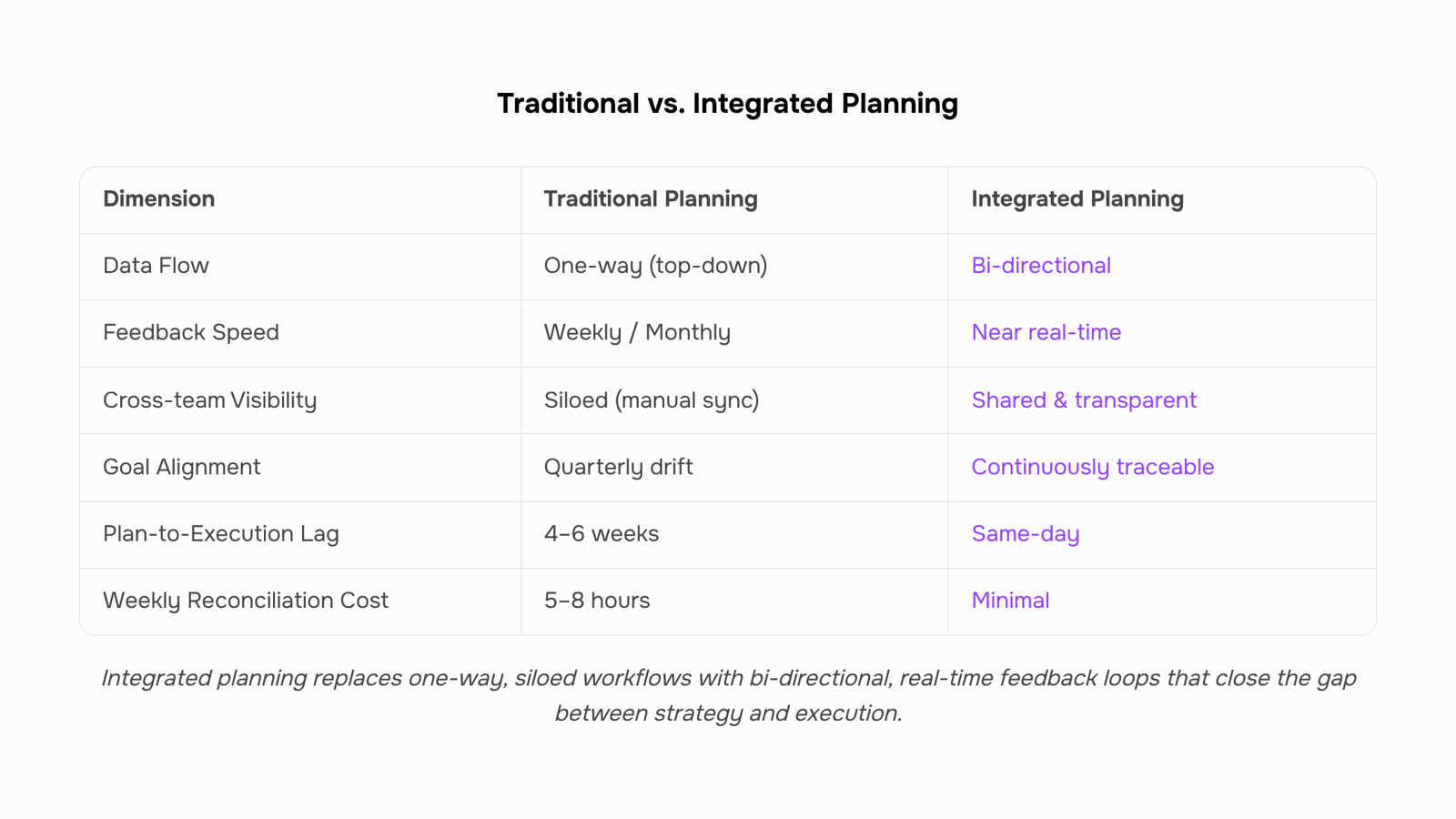
The gap between integrated planning and traditional planning shows up across four structural dimensions. Here's how they differ in practice, especially for project planning for IT teams running multiple client engagements at once.
Dimension | Traditional Planning | Integrated Planning |
|---|
Data flow | One-directional. Strategy doc flows down; execution data rarely flows back up. Plans live in separate spreadsheets per team. | Bi-directional. Task-level data feeds back into strategic dashboards continuously, so capacity and progress are always current. |
Feedback speed | Weekly or monthly review cycles. By the time a blocker surfaces in a status meeting, it's already cost days. | Near real-time. Changes in one workstream trigger visibility updates across dependent teams within hours, not weeks. |
Cross-team visibility | Each department sees its own lane. Shared context requires manual syncs, Slack threads, or forwarded spreadsheets. | All teams operate from a shared planning layer. Dependency mapping is built in, not bolted on. |
Strategic goal alignment | Goals are set quarterly, then forgotten until the next review. Execution drifts from intent without anyone noticing until it's too late. | Goals cascade into tasks with traceable links. When a task slips, the affected objective is flagged automatically. |
The practical consequence: in a traditional setup, strategic goal alignment degrades every week between planning sessions. A 20-person IT services firm running four concurrent projects can easily lose 5 to 8 hours per week just reconciling status across tools and teams. That's not a productivity problem. It's a structural one.
Integrated planning doesn't just add visibility. It changes the feedback architecture so that execution data informs planning continuously, not periodically. If you're evaluating adaptive planning software for IT teams, this is the distinction that matters most: does the tool close the loop between plan and execution, or does it just digitize the old one-way flow?
The next section breaks down the specific building blocks that make this loop work in practice.
Key Components of an Integrated Planning System
An integrated planning system isn't a single tool. It's a set of connected capabilities that feed each other continuously. Four building blocks matter most for IT teams:
Sprint and project planning tied to strategic goals: Every sprint backlog or project milestone maps upward to a quarterly objective. Without this link, teams ship work that feels productive but doesn't move the business forward. If you're building a project planning process from scratch, start here.
Real-time task tracking with status propagation: When a task slips, dependent teams see it immediately, not at Friday's standup. This eliminates the plan-to-execution lag that traditional planning hides until it's too late to recover.
Cross-functional visibility: Connected planning means your dev team's capacity constraints are visible to sales ops, and vice versa. A 30-person IT company running separate boards per department will lose 3 to 5 hours per week just reconciling status across Slack threads and spreadsheets.
AI-assisted prioritization: When the system holds task dependencies, team capacity, and goal weights in one place, an AI layer can surface what actually deserves attention today, not just what's loudest. This is where project planning for IT teams shifts from reactive to deliberate.
Taro, WorksBuddy's project planning agent, operates across these four layers. It connects task ownership to strategic objectives, flags misalignment before sprint reviews, and adjusts priority recommendations as dependencies shift. The result is fewer "why are we building this?" conversations mid-cycle.
These components don't work in isolation. The value comes from their interaction, which is what separates adaptive planning software for IT teams from a stack of disconnected project boards.
How Integrated Planning Improves Business Decision-Making
Decisions made from stale data get reversed. That's the core failure of traditional planning: by the time a weekly status report reaches the decision-maker, the ground has shifted. Teams commit resources based on last Tuesday's snapshot, then scramble when reality catches up on Thursday.
An integrated business planning system changes the input layer. Instead of periodic summaries, decisions draw from live task progress, budget burn, and dependency status across every team touching the work. When you can see that a dev sprint is 40% behind before the client deadline moves, you reroute capacity the same day, not after a missed delivery.
The mechanism works like this:
Real-time data surfaces a constraint (blocked task, resource conflict, scope creep)
Cross-functional visibility shows who else is affected
The decision-maker acts with full context, not a partial narrative filtered through two layers of management
Fewer reversals means faster execution. Teams stop hedging because they trust the plan reflects current reality, not a two-week-old guess.
This is also where strategic goal alignment becomes operational rather than aspirational. When daily decisions connect to quarterly targets through visible dependencies, you stop choosing between "urgent" and "important" blindly. The system shows you which fires actually threaten the goal.
For a deeper look at how adaptive tools support this kind of connected decision-making, see the benefits of adaptive planning software.
How Integrated Planning Supports Strategic Goal Achievement
Most teams treat strategic goals as quarterly artifacts. They get set, shared in a deck, then buried under daily execution. The gap between "goal approved" and "task completed" is where strategic goal alignment breaks down.
Integrated planning closes that gap by creating a live feedback loop: tasks roll up into milestones, milestones map to strategic objectives, and progress on any single item updates the picture at every level. When a developer closes a sprint ticket, the system reflects that completion against the quarterly target it supports. No manual status report required.
For project planning for IT teams, this means you can answer "are we on track for Q3?" by looking at actual task data, not by asking three managers to compile updates next Friday.
This is where Taro fits. Taro's AI-assisted execution layer connects individual task ownership to the strategic milestones those tasks serve. When work stalls or ownership gets confused, Taro flags the misalignment before it compounds into a missed objective. Your team stays oriented toward outcomes, not just output.
The structural difference matters: traditional planning reviews goals monthly or quarterly. Integrated planning surfaces drift daily. If you're building a project planning process from scratch, wire this feedback loop in from the start. Retrofitting it later costs more time than getting it right upfront.
Does Integrated Planning Work for Smaller IT Operations
Yes. A 5-to-15-person IT operation doesn't need enterprise-grade scenario modeling or cross-divisional governance layers. What it does need: a single business planning system that connects client commitments, team capacity, and cash flow in one view. That's integrated planning at its simplest.
Skip the formal planning office. Skip quarterly review ceremonies. Instead, wire your project boards to your invoicing and resource data so a change in one updates the others. If you're unsure where to start, building a project planning process from scratch covers the minimum viable structure for small teams.
Closing
Integrated planning isn't about having better meetings or shinier spreadsheets—it's about closing the structural gap between what you decide and what your team actually executes. When strategy, resources, tasks, and feedback operate in the same connected system, strategic shifts propagate in hours instead of weeks, dependencies surface before they derail, and every team sees the same current reality instead of reconciling stale data across tools.
For IT teams juggling multiple client engagements, this shift eliminates the 5-to-8 hours per week spent manually syncing status across departments. Taro's project planning and AI-assisted task management is built to do exactly this—connecting strategy to daily execution so you're not manually bridging the gap between what was planned and what's actually happening. Ready to see how it works for your team?
FAQ
What is the difference between integrated planning and traditional planning?
Traditional planning flows one direction through disconnected spreadsheets. Integrated planning operates as a closed loop where task-level data feeds back into strategic dashboards continuously, triggering visibility updates across dependent teams within hours.
How can integrated planning improve business decision-making?
It surfaces execution data in real time, so decisions reflect current facts. When blockers appear, leaders see the impact immediately and adjust mid-quarter instead of discovering misalignment at the next review cycle.
What are the key components of an integrated planning system?
Sprint and project planning tied to strategic goals, real-time status propagation, cross-functional visibility from shared data, and AI-assisted prioritization based on dependencies and capacity.
Can integrated planning be applied to small businesses?
Yes. Even a 20-person IT firm loses 5 to 8 hours per week reconciling status across tools. The structural benefits apply at any team size because siloed data exists at any team size.
How does integrated planning support strategic goal achievement?
Goals cascade into tasks with traceable links. When a task slips, the affected objective is flagged automatically, preventing goal drift and keeping execution aligned to company direction.


 Elena Petrova15 September 2026


