TL;DR: Most content on lead generation and management treats them as separate problems with separate fixes. This one maps the full process as a single system, identifies the exact points where the handoff between generation and management breaks down, and gives IT company owners specific repairs for each failure point — not a tool list.
What Lead Generation and Management Actually Cover
Lead generation is the work of attracting and capturing interest from potential buyers. Lead management is everything that happens after: tracking, qualifying, routing, and moving those leads toward a conversation with the right person.
Most teams treat them as separate workstreams, one owned by marketing, the other by sales. That split is where pipelines quietly break.
The two functions are a single continuous process. A lead captured through a web form, a LinkedIn campaign, or an inbound referral email enters a system. What that system does in the next few minutes determines whether the lead converts or goes cold. There is no clean handoff point where "generation ends" and "management begins." There is only a pipeline that either keeps moving or stalls.
For IT company owners managing lead generation and management across multiple sources simultaneously, the risk compounds. Each additional channel adds a new entry point where leads can sit unrouted, unscored, and uncontacted.
Structuring your lead capture process tightly is what keeps that from happening. So is building the routing logic that connects capture to contact without a manual step in between.
The next section covers exactly where that connection breaks, and why it almost always happens at the same moment.
Where Lead Generation Ends and Management Begins
The handoff happens the moment a lead is captured — a form submission, a LinkedIn inquiry, an inbound email. That's where lead generation ends and management begins. It's also where most IT company pipelines quietly break.
The problem has a name: lead decay. Research from InsideSales found that odds of qualifying a lead drop by over 80% if contact isn't made within the first five minutes. Most teams aren't responding in five minutes. They're responding in hours, if at all, because there's no system connecting capture to follow-up.
Multi-source lead capture makes this worse. A mid-size IT company typically pulls leads from web forms, LinkedIn, referrals, and inbound email simultaneously. Each source lands in a different inbox or spreadsheet. No single owner. No consistent response time. The lead sits there while a rep figures out whose job it is.
This is the gap that a deeper look at sales lead management consistently surfaces: the process breaks not during generation, not during closing, but in the 15-minute window after a lead first appears.
Fixing it starts with treating capture as a trigger, not a data entry task. The moment a lead enters your pipeline, something should happen automatically: a timestamp, an owner, a first contact attempt. If that sequence isn't defined, lead follow-up defaults to whoever notices first, which is the same as no system at all.
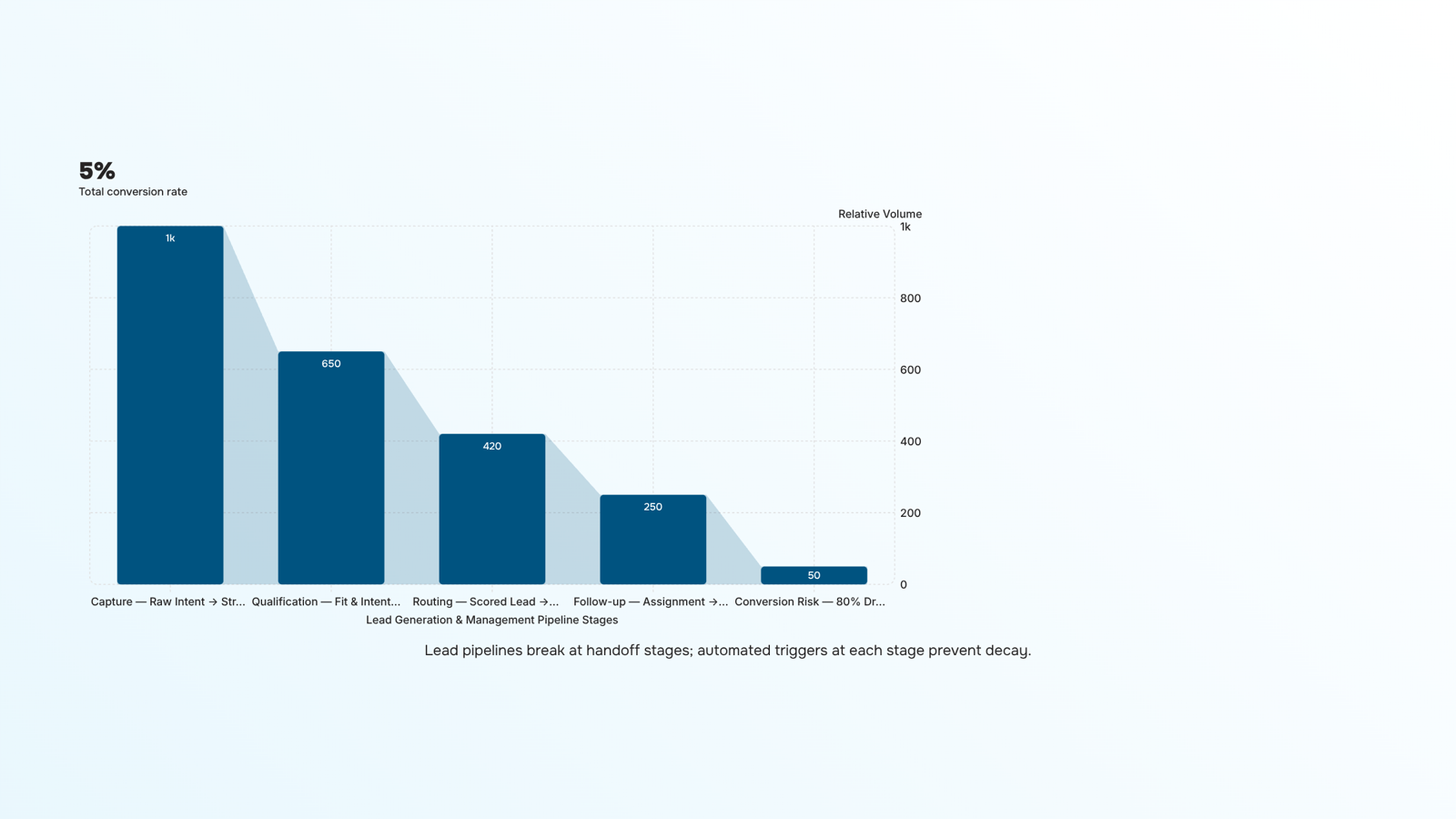
The Four Stages of a Working Lead Management Process
Each stage in lead generation and management has a defined job. When one stage fails, every stage after it degrades — and the failure is usually invisible until a deal goes cold.
Capture is the entry point. Its input is raw intent: a form submission, a LinkedIn message, an inbound email, a referral. Its output should be a structured lead record with source, timestamp, and contact data. The failure mode here is fragmentation — leads arriving across five channels with no unified intake. A mid-size IT company often manages web forms, LinkedIn, referral programs, and inbound email simultaneously, and without a single capture layer, records get duplicated or missed entirely.
Qualification takes that record and answers one question: is this worth a rep's time? The input is the raw lead; the output is a scored, categorized contact. The failure mode is manual scoring — someone eyeballing firmographics and guessing. Automated lead management tools can apply consistent criteria (company size, role, budget signals, behavior data) without the lag. When qualification is manual, high-intent leads sit in a queue while a rep finishes other work.
Routing is where most teams lose the most time. Its input is a qualified lead; its output is an assigned rep with context. The failure mode is manual assignment — a manager forwarding a Slack message or updating a spreadsheet. Effective lead management requires routing logic that accounts for territory, rep capacity, and lead source before a human ever touches the record. This section's next topic covers that logic in detail.
Follow-up closes the loop. Its input is an assigned lead; its output is a first meaningful contact. The failure mode is delay. Given how quickly lead qualification value drops after initial capture, the gap between routing and first outreach is where deals die. Automated sequences — triggered the moment routing fires — remove the dependency on a rep remembering to act.
Each stage feeds the next. Fix one in isolation and the bottleneck shifts downstream.
How Lead Routing Determines Who Responds and When
Manual assignment is the single biggest delay in lead routing, and the math is unforgiving. Research from InsideSales shows that B2B leads contacted within five minutes of capture are dramatically more likely to convert than those reached an hour later. Most teams don't come close to five minutes when a human is deciding who gets the lead.
Routing logic determines which rep sees a lead and when. The four variables that matter most:
Territory: geographic or account-based ownership rules that prevent rep conflicts
Capacity: current workload per rep, so a lead doesn't pile onto someone already at 30 open opportunities
Lead source: a LinkedIn inbound and a web demo request carry different intent signals and may need different rep profiles
Score threshold: only leads above a set score enter the routing queue; below it, they go to nurture
When those rules live in a spreadsheet or a manager's head, every assignment becomes a manual decision. That decision takes minutes at best, hours at worst, and it happens dozens of times a day.
Real-time lead routing removes that gap by applying the same rules automatically the moment a lead is captured. Lio's real-time lead routing evaluates territory, capacity, and source simultaneously, so the right rep gets notified in seconds, not after a morning standup.
For lead tracking to mean anything, the timestamp on first contact has to be short. Routing is what controls that timestamp.
What Good Lead Qualification Looks Like in Practice
Good lead qualification isn't about memorizing BANT. It's about building a consistent signal set your team applies the same way every time, regardless of who picks up the lead.
For IT company leads, the signals that actually predict conversion fall into two categories: fit and intent.
Fit signals tell you whether the prospect belongs in your pipeline at all:
Company size (headcount or seat count, not revenue guesses)
Tech stack compatibility — do they run the infrastructure your service supports?
Decision-maker access — is the contact an IT director, VP of IT, or CTO, or are you talking to someone who can't approve spend?
Budget cycle timing, especially for enterprise accounts with annual procurement windows
Intent signals tell you how warm the lead actually is:
Pages visited (pricing page and case studies outrank a blog post)
Form type (demo request scores higher than a content download)
Response speed to your first outreach
Repeat visits within 72 hours of initial capture
A practical lead scoring model assigns points to each signal, sets a threshold (commonly 40–60 points), and routes leads above it to sales immediately. Leads below threshold go into a nurture track, not a rep's queue.
The disqualified lead is where most processes break. A hard disqualification should trigger an automated sequence, not silence. That contact may re-enter the funnel in 90 days with a different budget or title. If your lead capture process doesn't tag and re-queue disqualified leads, you're losing recoverable pipeline.
Automated lead management handles this without manual triage — every lead gets a next action, regardless of score.
How to Measure Whether Your Process Is Actually Working
Four numbers tell you whether your lead generation and management process is working or quietly bleeding revenue.
Lead response time measures how fast a rep reaches out after capture. Most B2B teams respond in hours; leads that don't hear back within the first hour are significantly more likely to go cold before any conversation starts. Track this per source, not just as a company average.
Conversion rate by source shows which channels produce buyers versus browsers. If your web form converts at 4% and LinkedIn at 0.8%, those leads need different qualification thresholds, not the same nurture sequence. Lead source tracking only works if you're consistent about tagging every entry point.
Routing accuracy tells you what percentage of leads landed with the right rep on the first assignment. If you're re-routing more than 20% of incoming leads, your distribution logic is broken, not your team.
Follow-up completion rate measures whether scheduled touchpoints actually happen. A deeper look at sales lead management consistently shows that missed follow-ups, not bad leads, kill most pipelines.
Run these four numbers weekly. If any one of them is missing from your dashboard, you don't have lead tracking — you have guesswork.
Common Mistakes That Break the Generation-to-Management Link
Three mistakes account for most lead generation and management breakdowns, and each one compounds the next.
Treating all leads the same means a cold LinkedIn click gets the same follow-up cadence as a warm referral. You burn rep time on low-fit contacts while high-intent leads wait. Multi-source lead capture only creates value when source context travels with the lead.
Routing by availability instead of fit sends whoever is free, not whoever is right. A mismatch at first contact is hard to recover from, and most teams never measure routing accuracy closely enough to notice the pattern.
Skipping lead status updates is the quietest killer. When no one owns the next step, leads stall. A deeper look at sales lead management consistently shows that lead status management gaps, not lead volume, are what flatten conversion rates.
Fix the handoff, and the rest of the process gets easier.
Closing
Your lead generation and management process breaks at the handoff—the moment a lead is captured but before the right rep makes contact. The gap isn't a people problem; it's a system problem. When capture, qualification, routing, and follow-up aren't connected, lead decay compounds across every channel you're pulling from. The fix is treating the entire sequence as a single pipeline with automated triggers at each stage, starting with real-time routing that removes manual assignment delays. If you're managing leads across web forms, LinkedIn, email, and referrals simultaneously, the five-minute window to first contact is already closing. The question isn't whether you need better tools—it's whether your current process can route and contact a lead faster than your competition can. Lio is built specifically for this sequence: it captures leads from all your sources, scores them automatically, routes them to the right rep in real time, and tracks status without manual updates. See how it handles the handoff problem your team is facing right now.
FAQ
What is the difference between lead generation and lead management?
Lead generation attracts and captures interest from potential buyers. Lead management tracks, qualifies, routes, and moves those leads toward a conversation. They're one continuous process, not separate workstreams.
How quickly should a sales rep follow up with a new lead?
Within five minutes. Research shows odds of qualifying a lead drop over 80% if contact isn't made in that window. Most teams respond in hours because there's no system connecting capture to follow-up.
What does lead qualification involve and who should do it?
Qualification applies consistent criteria—company size, role, budget signals, tech stack fit—to score and categorize leads. Automated tools do this without lag; manual scoring leaves high-intent leads sitting while reps finish other work.
How do you route leads to the right sales rep automatically?
Build routing logic that accounts for territory, rep capacity, lead source, and score threshold. When those rules are automated, the right rep gets notified in seconds instead of hours.
What metrics show whether your lead management process is working?
Time to first contact, qualification rate, conversion rate by source, and lead decay rate. If your first-contact window exceeds five minutes or qualification is manual, your process is breaking.
Can lead generation and management be handled in one tool?
Yes. A unified system captures leads from multiple sources, qualifies them automatically, routes them in real time, and tracks status without manual updates—eliminating handoff delays.
What happens to leads that don't convert — should they be discarded?
No. Leads below qualification threshold should enter a nurture sequence, not be deleted. They signal future intent and can re-enter the pipeline when conditions change.


 Elena Petrova11 September 2026


