TL;DR: Most rank tracking guides treat accuracy as a crawl-frequency problem. This one argues it's a signal-interpretation problem: raw position numbers miss three other data layers that determine whether a ranking actually holds. You'll see how AI reads all four simultaneously and what that means for the decisions your content team makes every week.
Why Traditional Rank Trackers Produce Inaccurate Data
Most rank trackers report a single position number per keyword. That number comes from one crawl, run from one server location, on one device type, at one point in time. The problem is that no real user searches from those exact conditions.
Google personalizes results based on search history, location, and device. A query run on mobile in Austin returns a different SERP than the same query run on desktop in Chicago. Research on mobile vs. desktop SERP variance shows this gap is wider than most SEO teams assume. Add featured snippets, AI Overviews, and People Also Ask boxes, and the organic position your tracker reports may not even be visible above the fold for a significant share of real searches.
This is the structural problem with rank tracking limitations: legacy tools are built to report consistently, not correctly. They optimize for returning the same number every crawl, which looks like reliability. What it actually produces is a precise but inaccurate picture of where you rank.
SERP features compound the issue. When a featured snippet or AI Overview occupies positions one through three visually, a tool reporting "position 4" is technically right and practically misleading. The click-through implications are completely different.
Daily tracking across ChatGPT, Claude, Perplexity, Gemini, and Google AI Overviews exists partly because these surfaces change faster than weekly crawls can capture. AI rank tracking accuracy requires reading the full SERP context, not just the blue-link position.
Accuracy vs. Precision in Rank Tracking: Why the Difference Matters
Precision means your rank tracker returns the same number every time it checks. Accuracy means that number reflects what a real user actually sees when they search.
Most tools optimize for precision. They crawl from fixed data centers, strip personalization, ignore device type, and return a clean, consistent position. That consistency feels reliable. It isn't.
The gap between the two is where SEO decisions go wrong. A keyword showing position 4 in your tracker might sit behind a featured snippet, an AI Overview, and a People Also Ask block for the majority of real searches. The precise number is 4. The accurate picture is "below the fold for most users."
This distinction is absent from how legacy rank tracking tools compare in practice — those tools report what they can measure consistently, not what searchers actually experience. The rank tracking precision vs accuracy problem isn't a data freshness issue. It's a structural one: a single crawl perspective cannot model device variance, localization, or SERP feature displacement simultaneously.
AI rank tracking accuracy requires measuring all four variables together. The next section introduces a framework for doing exactly that.
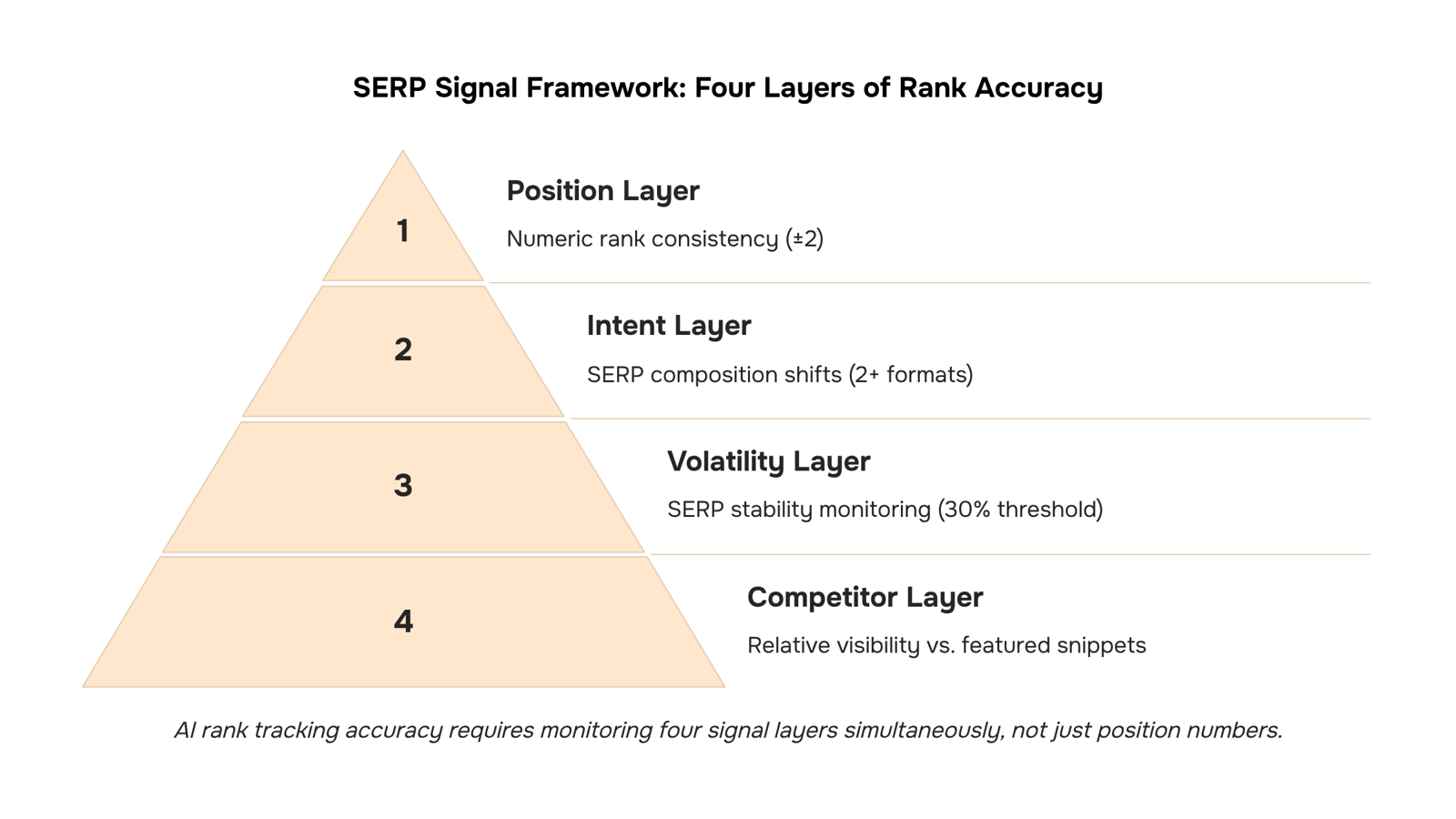
The SERP Signal Framework: Four Layers of Rank Tracking Accuracy
The SERP Signal Framework treats rank tracking accuracy as a four-layer measurement problem, not a single number. Each layer captures a different dimension of what a real user actually sees — and each has a benchmark that separates signal from noise.
Position Layer is the baseline. It tracks the numeric rank your page holds for a given query. The benchmark here is consistency across crawl windows: position variance of more than ±2 spots on the same query, same device, same location within a 24-hour window is a data quality problem, not a ranking shift. Most tools stop here. How legacy rank tracking tools compare in practice shows how much position-layer variance exists between major trackers reporting on identical queries.
Intent Layer sits above position. A page can hold rank #3 while the query's dominant intent has shifted — from informational to transactional, or from a how-to format to a comparison format. Intent shift monitoring flags when the SERP composition changes (fewer blog posts, more product pages, new featured snippet types) even when your numeric position stays flat. The benchmark: any SERP where the top-3 result types change by two or more formats in a rolling 30-day window qualifies as an intent shift that warrants content review.
Volatility Layer measures SERP stability, not just your position within it. SERP volatility detection identifies when the entire ranking environment is in flux — AI Overviews appearing or disappearing, featured snippets turning over, People Also Ask blocks expanding. A position that looks stable inside a volatile SERP is not a reliable signal. The benchmark: track the turnover rate of the top-10 results for your target queries. More than 30% turnover in a week on an informational query is high volatility; act on it differently than a stable SERP.
Competitor Layer closes the model. Your rank only matters relative to who is above and below you. Competitor rank tracking at this layer means monitoring not just position changes but SERP feature captures — when a competitor earns a featured snippet or AI Overview mention you don't hold, your effective visibility drops even if your position number doesn't. How Ranko maps competitor movements across the Competitor Layer covers this in detail.
Together, these four layers define what AI rank tracking accuracy actually measures: not the position you hold, but the visibility you own across a dynamic, intent-driven SERP. The next section explains the mechanism — how AI models detect when any of these layers has shifted before the position number moves.
How AI Detects SERP Volatility and Intent Shifts in Real Time
Position numbers move. What they mean changes faster.
A rank tracker that only logs where you sit in the SERP misses the more important signal: whether the SERP itself has changed around you. AI-based SERP volatility detection works by monitoring the full result structure, not just your URL's position, on every crawl cycle.
Here is what that looks like in practice. An AI model watching a competitive informational query will flag when a featured snippet switches ownership, when an AI Overview appears for the first time, or when the People Also Ask block expands to absorb clicks that used to flow to organic position one. Your position number may not move at all, yet your effective visibility has dropped.
Intent shift monitoring adds a second layer. When query reformulations cluster around a keyword, the dominant search intent is changing. A query that was informational six weeks ago may now return transactional results because Google has re-classified user intent. A position held in the old SERP structure does not carry over cleanly to the new one.
This is the precision-versus-accuracy distinction that most rank tracking tool content ignores. Precision is crawling your position reliably. Accuracy is knowing whether that position still means what it meant last month.
Legacy rank tracking tools treat these as the same problem. They are not. AI models that track SERP feature turnover, snippet ownership, and query-cluster drift give you the Volatility Layer signal that position-only crawls cannot produce. Daily monitoring across ChatGPT, Claude, Perplexity, and Google AI Overviews extends this same logic beyond traditional SERPs entirely.
How AI Rank Tracking Handles Personalization and Localization Bias
A single-location rank crawl gives you one data point dressed up as a verdict. For a business targeting multiple regions, that's not a precision problem — it's an accuracy problem. The crawl might be perfectly consistent and still wrong for 80% of your audience.
Localization bias in rank tracking compounds fast. A query like "managed IT services" returns different position 1 results in Austin versus Chicago versus London, and that's before accounting for device type. Research consistently shows that mobile and desktop SERPs diverge meaningfully for the same query, often enough to flip which page ranks first.
AI-based rank tracking normalizes across these variables by aggregating signal clusters: geographic coordinates, device profiles, and search history patterns. Instead of reporting one position, it reports a representative range with variance flagged by cluster. That's the difference between knowing your average rank and knowing your actual rank for a specific audience segment.
The same normalization logic applies to AI mention tracking. When daily tracking runs across ChatGPT, Claude, Perplexity, Gemini, and Google AI Overviews, each platform carries its own personalization layer. AI rank tracking accuracy depends on accounting for all of them, not treating any single surface as canonical.
What Ranko Does Differently: The Framework Applied
Most rank trackers tell you where a page sits in Google's index. Ranko tells you whether AI assistants are actually citing it — and where the gaps are costing you visibility you can't see in a position report.
The daily AI mention tracking runs across ChatGPT, Claude, Perplexity, Gemini, and Google AI Overviews simultaneously. That breadth matters because citation behavior differs meaningfully across engines: a page Perplexity cites for a definitional query may never appear in a ChatGPT response to the same question. Treating those as interchangeable is the same precision error that makes single-location rank crawls misleading.
Where Ranko's approach sharpens AI rank tracking accuracy is the Opportunity Score — a 0–100 index that measures citation gaps across all five engines against your competitors' footprint. A page ranking at position 3 in Google but scoring 22 on the Opportunity Score is a concrete signal: the page holds a position but isn't being pulled into AI-generated answers. That's a different problem than a ranking problem, and it requires a different fix.
The Page Refresher then scores that page against 18 AI citation criteria and surfaces a side-by-side rewrite, so the gap becomes an action, not just a number.
For teams running competitor rank tracking alongside their own, the same Opportunity Score logic applies to competitor pages — showing exactly where rivals are getting cited and you aren't. How teams use Ranko to drive results shows this workflow end to end.
What Accurate AI Rank Tracking Changes About Content Decisions
Signal-layer accuracy changes three decisions your content team makes every week.
When to update a page: if a page holds position but loses AI Overview citations, that's a precision signal, not a ranking one. Update the page's structure and sourcing, not its keyword density.
When to target a new intent variant: when daily tracking across ChatGPT, Claude, Perplexity, and Gemini shows a competitor gaining citations on a query you rank for, a new intent variant has opened, not just a gap.
When competitor movement requires a response: how Ranko maps competitor movements across the Competitor Layer shows whether a shift is structural or noise, so you respond to real changes, not crawl artifacts.
For teams still relying on position-only data, how legacy rank tracking tools compare in practice shows exactly where that gap costs you.
Closing
The SERP Signal Framework reframes rank tracking accuracy as a four-layer problem: Position, Intent, Volatility, and Competitor signals all matter, and they move at different speeds. A position number without context is precise but misleading. AI models that read all four layers simultaneously give you the visibility picture that actually drives clicks and revenue.
After establishing what all four signal layers look like in practice, the next step is to see how your own keywords perform across these layers. Ranko tracks the Position, Intent, Volatility, and Competitor layers daily across both Google and the major AI answer engines — readers who want to see their own Opportunity Score can start there.
FAQ
How does AI rank tracking work across multiple generative AI platforms?
AI rank trackers crawl your content's presence and position across Google, ChatGPT, Claude, Perplexity, Gemini, and other AI answer engines daily. They detect when your page is cited, summarized, or mentioned, then measure visibility changes across all surfaces simultaneously rather than treating each platform in isolation.
What are the best AI rank tracking tools for monitoring Google AI Overviews?
Tools that monitor SERP feature turnover, intent shifts, and AI Overview appearance daily outperform position-only trackers. Ranko specifically tracks AI Overview mentions and competitive displacement across Google and generative AI platforms with daily crawl cycles.
Can I track daily mention changes across ChatGPT, Claude, and Perplexity with one tool?
Yes. AI rank trackers built for multi-platform monitoring crawl all three daily and flag when your content appears, disappears, or shifts position within AI-generated answers. This requires unified crawling infrastructure, not separate integrations.
Why is AI rank tracking important for SEO strategy in 2025?
AI Overviews and generative AI platforms now capture search traffic that used to flow to organic results. Tracking only Google position misses half your visibility. AI rank tracking accuracy measures all surfaces where users find your content, not just one.
What is the difference between rank tracking accuracy and rank tracking precision?
Precision means your tracker returns the same number consistently. Accuracy means that number reflects what a real user actually sees. Legacy tools optimize for precision; AI models optimize for accuracy by reading device, location, SERP features, and intent simultaneously.
How does AI detect SERP volatility and intent shifts in real time?
AI models monitor the full SERP structure, not just your position: featured snippet ownership, AI Overview presence, People Also Ask expansion, and result-type composition. When these shift, volatility or intent change is flagged before your position number moves.
How does AI rank tracking handle personalization and localization bias?
AI rank trackers crawl from multiple device types, locations, and search contexts simultaneously, then aggregate results to show what a typical user sees rather than one fixed crawl perspective. This surfaces personalization and localization variance that single-crawl tools miss.


 Elena Petrova11 September 2026


