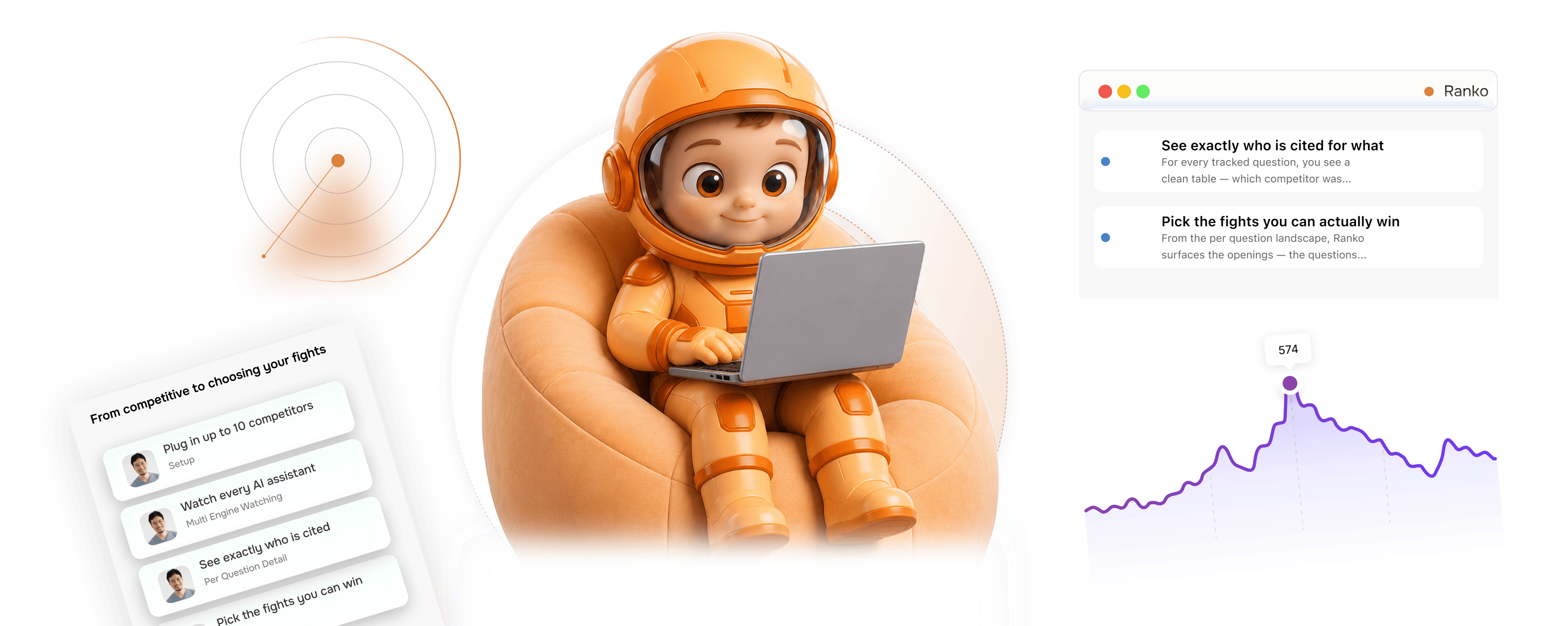
Plug in up to ten competitor websites. For every topic that matters, Ranko shows you which competitor is currently being quoted by which AI assistant, on which exact question, and how often. You stop guessing where the brand stands and start choosing the openings where your work can genuinely beat the incumbent. The competitive intelligence layer your strategy has always wanted, finally pointed at the half of search no traditional tool can see.
Plug in up to ten competitor domains. Ranko watches all four AI assistants for every topic that matters and records which competitor is being cited where. You see exactly who is winning which fights competitor by competitor, engine by engine, question by question, with the frequency that tells you how genuinely they own the answer. Then you pick the openings where your work can win instead of crashing into ground a rival already owns.
Setup
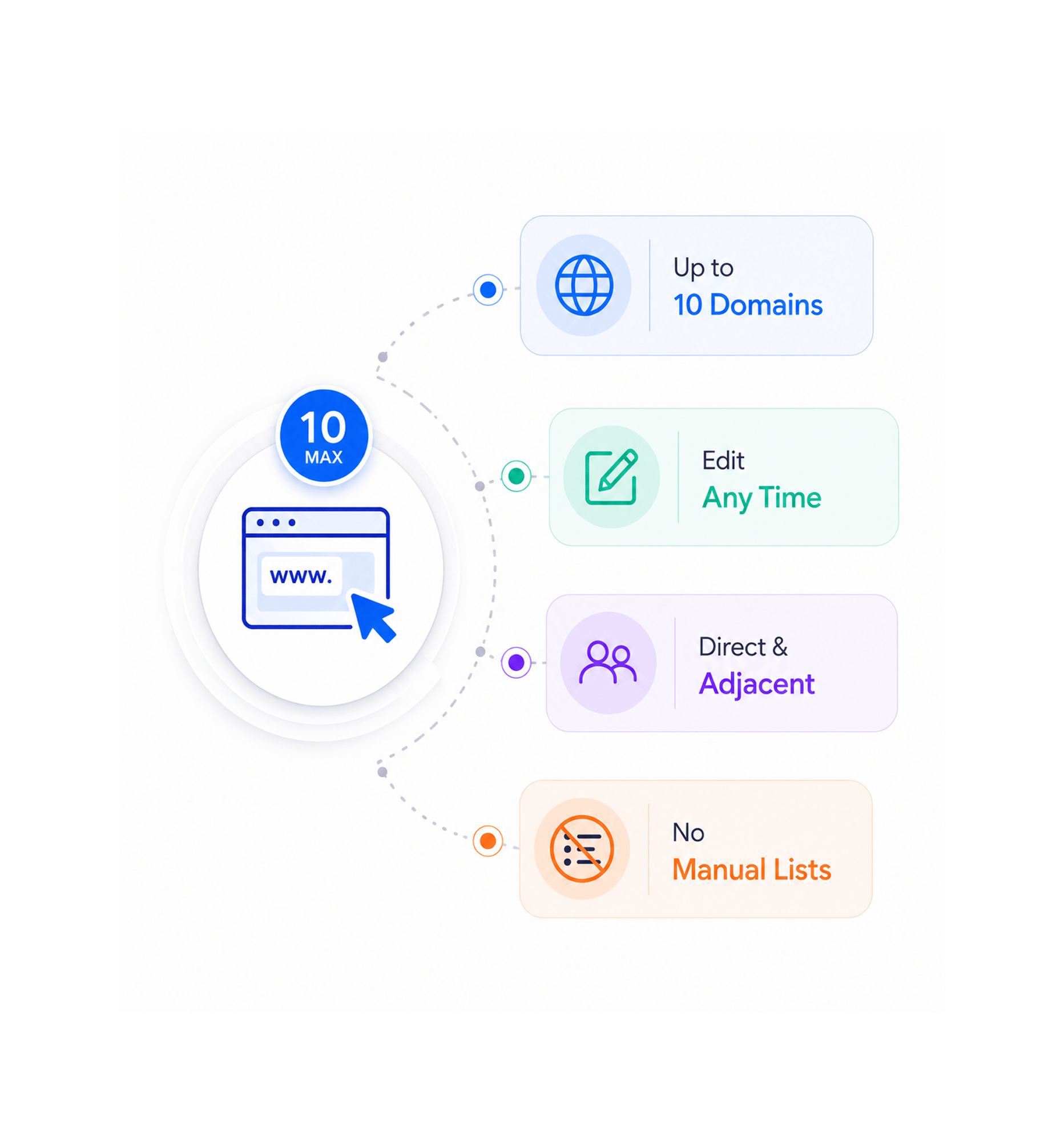
Paste in the competitor domains the brand actually competes with. The direct rival that shows up in every sales conversation. The category leader the team is trying to displace. The scrappy upstart who is starting to win mindshare. The adjacent player whose audience overlaps with yours. The agency content site that keeps stealing the citations. Up to ten domains per workspace, edited at any time, with new competitors picked up the moment you add them. No keyword lists, no manual setup beyond the domains.
Multi Engine Watching
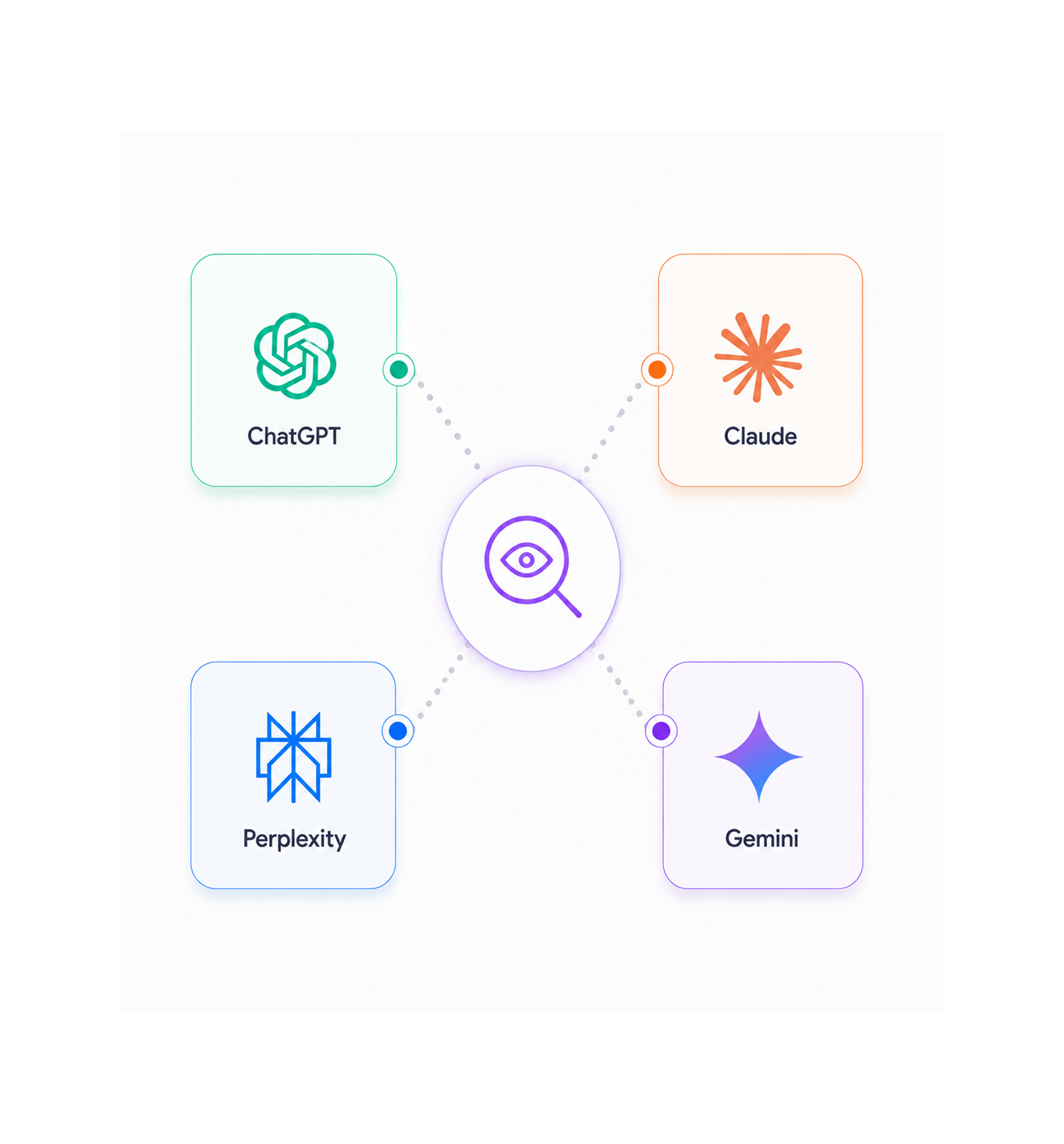
Ranko watches ChatGPT, Claude, Perplexity, and Gemini for every topic in your workspace and records every time one of your competitors gets cited. The four engines have genuinely different audiences and genuinely different citation patterns the competitor winning on Perplexity is often not the one winning on Gemini, and a brand can be strong on Claude while invisible on ChatGPT. All four patterns tracked separately, because pretending they are one channel is how teams end up optimising for the wrong rival.
Per Question Detail
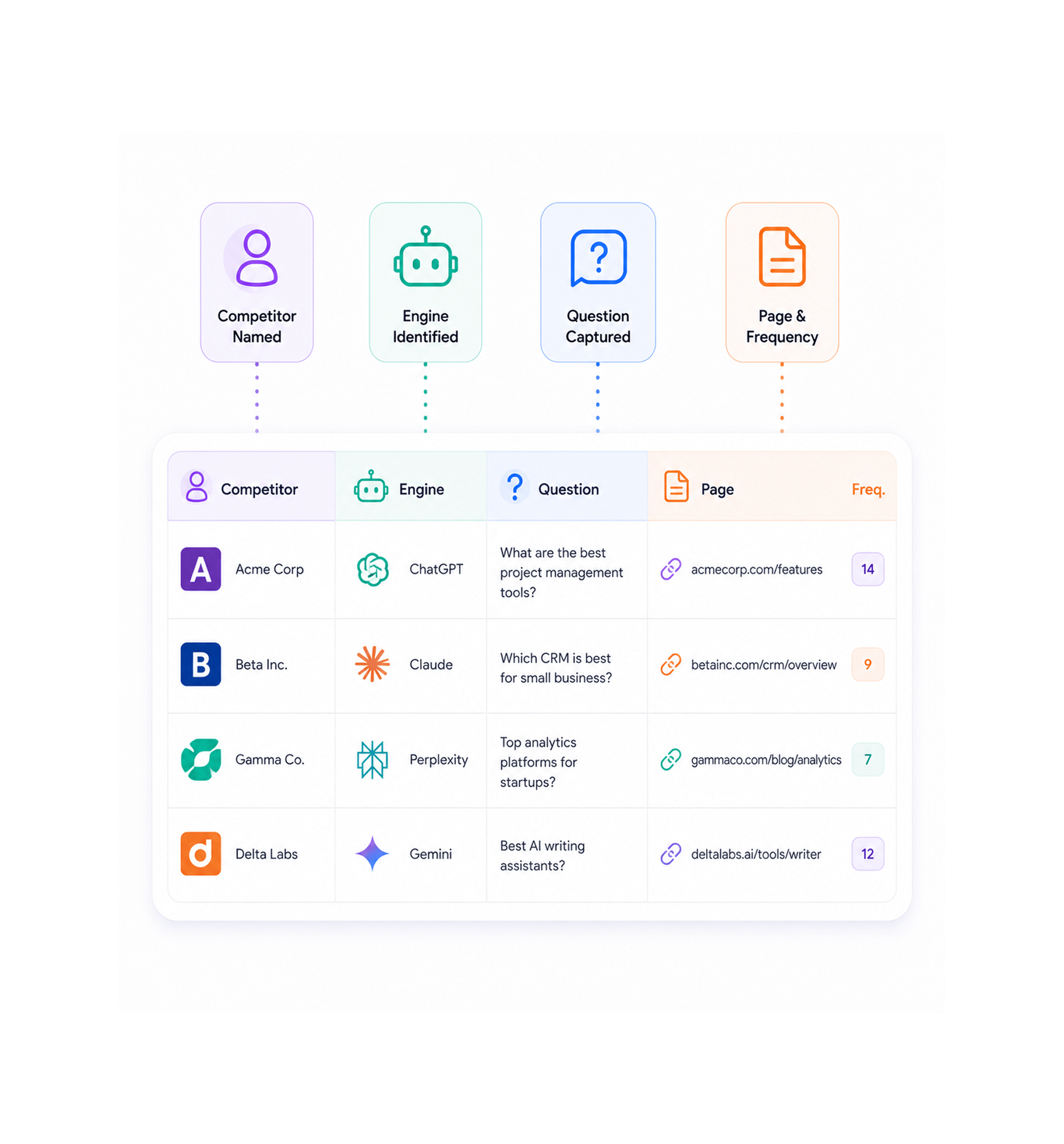
For every tracked question, you see a clean table which competitor was cited, which AI assistant cited them, the exact question that triggered the citation, the page on the competitor's site that got pulled, and how often the citation has come up across the recent window. No aggregated guesses, no monthly summaries that smooth away the detail that matters. The per question, per engine, per competitor view gives the team the granular intelligence that turns we should compete on this category into we should compete on these eleven specific questions where Acme Corp is currently winning twice as often as we are.
Pick Your Fights
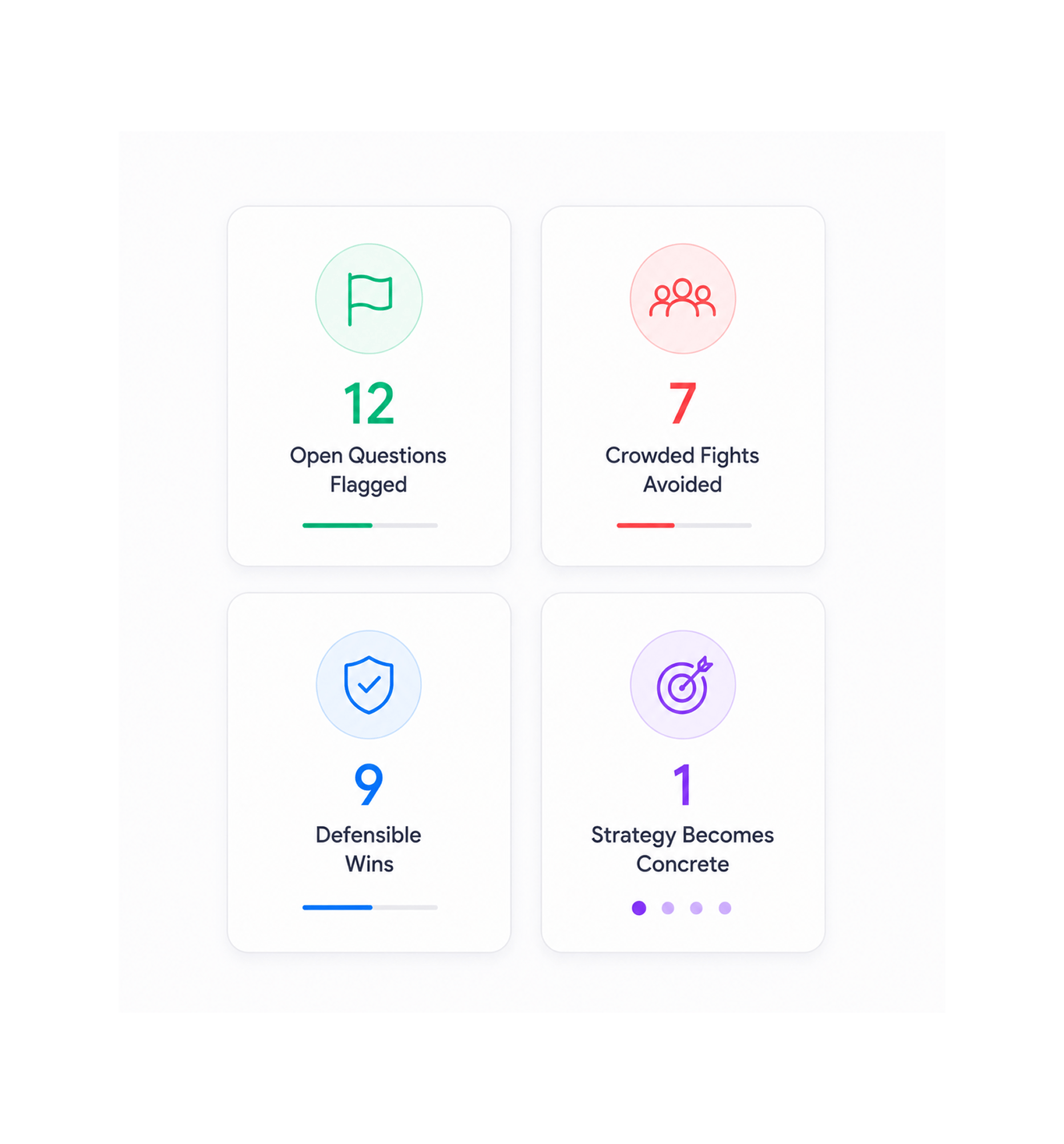
From the per question landscape, Ranko surfaces the openings the questions where no competitor is winning convincingly, where the current incumbent's coverage is thin, where a fresh strong answer would have a genuine chance of taking the citation. Crowded fights where five rivals are already winning together get flagged as defensive ground to avoid. The team finally has a competitive landscape they can read at a glance and a list of fights worth picking instead of a vague feeling that we should write more.
Once a team can see exactly which competitor is being cited by which AI assistant on which question and how often and where the openings genuinely sit the old pattern of writing more content and hoping for the best stops being acceptable. These are the changes that show up first.
Traditional competitive analysis gives you a monthly leaderboard that smooths over the detail that matters. Ranko gives you the per question, per engine, per competitor view the exact granularity strategy actually needs. Acme Corp is winning the comparison questions on Perplexity but is invisible on ChatGPT is a useful sentence. Acme Corp has thirty four percent share of voice is not.
Treating the four AI assistants as one channel is how teams end up chasing the wrong competitor on the wrong engine. ChatGPT, Claude, Perplexity, and Gemini have genuinely different audiences and different citation patterns Ranko watches all four separately, so the team can see which rival is dominant where and decide whether to challenge them on their strongest engine or pick the engine where they are weakest.
A single citation is luck. Forty citations across thirty questions is a position. Ranko's frequency counts separate the noise from the signal, so the team sees which competitors are genuinely owning a question with consistent repeat citations and which competitors are just occasionally lucky. Strategy aimed at displacing a genuine incumbent looks very different from strategy aimed at outpacing a lucky outlier, and the team finally has the data to tell them apart.
Ranko surfaces the questions where no rival is winning convincingly, where the incumbent's coverage is thin, where a fresh strong answer would have a real chance of taking the citation. These are the fights worth picking. The team stops crashing into ground a rival already owns and starts publishing into the openings where the citation is genuinely available, which changes the economics of every piece of content the team ships.
A new competitor's domain starting to show up in citations is a signal worth catching the first week it happens, not the third month. Ranko flags new entrants to the citation landscape the moment they appear, so the team can decide whether to engage early while the rival is still establishing or wait to see whether the threat sticks. The competitive surprise that catches incumbents off guard simply does not catch teams running Ranko off guard.
The conversation in the next strategy meeting shifts from we think we should focus on X to we are picking these eleven specific questions where Acme is currently winning twice as often as we are and where their coverage is shallower than ours could be. Strategy stops being a feeling that a leadership team has to take on faith and starts being a list of moves any reasonable person would make given the same view of the landscape.
Up to ten competitor domains. Every AI engine watched. Per question, per engine, per competitor detail. Citation frequency counts. Openings surfaced where rivals are weak. The competitive intelligence layer your strategy has always wanted.
6900+
Teams making competitive decisions on data instead of instinct
Founders who refuse to make competitive decisions on instinct, content marketers building campaigns aimed at specific rivals instead of generic positions, search specialists shifting their work from blind keyword chasing to deliberate competitive choices, agencies running competitive intelligence across multiple client workspaces from one cockpit, growth teams at SaaS companies watching the rivals their sales team mentions in every demo, ecommerce operators tracking the comparison shopping engines that decide whether a product gets recommended, and PR teams catching when a competitor's launch starts to reshape the citation landscape all use Ranko's competitor tracking as the always on intelligence layer that turns rival watching from a quarterly research project into a continuous strategic input. Every team a small business tracking three direct rivals or a larger organisation watching ten across multiple product lines gets the same per engine, per question, per competitor detail.
Competitors
Engines
View
Frequency
Ranko watches up to ten competitor domains across ChatGPT, Claude, Perplexity, and Gemini for every topic in the workspace, recording every time a rival gets cited. The view shows which competitor, which engine, which exact question, and how often the granular intelligence that turns vague we should compete on this category into a specific list of eleven questions worth picking up.
A complete competitive intelligence toolkit built into the same answer engine optimisation platform your team already uses. Up to ten competitor domains, per engine citation views across all four AI assistants, per question citation detail, citation frequency counts, opening detection for weak competitor coverage, and new competitor mention alerts come together so the team always knows exactly who is winning which fight and where the next opening sits.
Track up to ten competitor domains per workspace the direct rivals, the category leaders, the scrappy upstarts, the adjacent players whose audience overlaps with yours, the agency content sites that keep stealing citations. Add or remove competitors at any time, and Ranko picks up new domains the moment they are added without any manual catch up work.
Watching across ChatGPT, Claude, Perplexity, and Gemini separately, because the four AI assistants have genuinely different audiences and citation patterns. The competitor winning on Perplexity is often not the one winning on Gemini, and the team needs to see each engine on its own terms to choose where to engage and where to leave alone.
For every tracked question, the per question view shows which competitor was cited, which engine cited them, the exact question that triggered the citation, and the page on the competitor's site that got pulled. No aggregated guesses just the clean line item view that lets the team see exactly where the rival's coverage is strong and where it is thin.
A single citation could be luck. Forty citations across thirty questions is a real position. Citation frequency counts separate the noise from the signal so the team can tell which rivals are genuinely owning a topic versus which ones are just occasionally lucky. Strategy aimed at a genuine incumbent looks very different from strategy aimed at a lucky outlier.
Ranko surfaces the questions where no rival is winning convincingly, where the incumbent's coverage is thin, where a fresh strong answer has a real chance of taking the citation. The team finally has a list of fights worth picking instead of a vague feeling that we should write more. Openings become a deliberate strategic input rather than a happy accident.
When a new competitor domain starts appearing in citations for topics in your workspace, Ranko flags it the moment it happens not the third month when the team finally notices. The early signal lets the team decide whether to engage while the rival is still establishing or wait to see if the threat sticks, which is the difference between leading the response and chasing it.
Track up to ten competitor domains per workspace the direct rivals, the category leaders, the scrappy upstarts, the adjacent players whose audience overlaps with yours, the agency content sites that keep stealing citations. Add or remove competitors at any time, and Ranko picks up new domains the moment they are added without any manual catch up work.
Watching across ChatGPT, Claude, Perplexity, and Gemini separately, because the four AI assistants have genuinely different audiences and citation patterns. The competitor winning on Perplexity is often not the one winning on Gemini, and the team needs to see each engine on its own terms to choose where to engage and where to leave alone.
For every tracked question, the per question view shows which competitor was cited, which engine cited them, the exact question that triggered the citation, and the page on the competitor's site that got pulled. No aggregated guesses just the clean line item view that lets the team see exactly where the rival's coverage is strong and where it is thin.
A single citation could be luck. Forty citations across thirty questions is a real position. Citation frequency counts separate the noise from the signal so the team can tell which rivals are genuinely owning a topic versus which ones are just occasionally lucky. Strategy aimed at a genuine incumbent looks very different from strategy aimed at a lucky outlier.
Ranko surfaces the questions where no rival is winning convincingly, where the incumbent's coverage is thin, where a fresh strong answer has a real chance of taking the citation. The team finally has a list of fights worth picking instead of a vague feeling that we should write more. Openings become a deliberate strategic input rather than a happy accident.
When a new competitor domain starts appearing in citations for topics in your workspace, Ranko flags it the moment it happens not the third month when the team finally notices. The early signal lets the team decide whether to engage while the rival is still establishing or wait to see if the threat sticks, which is the difference between leading the response and chasing it.
Common questions about how the competitive tracking actually works, what counts as a competitor citation, how Ranko detects the openings, why the cap is ten competitors, what happens when a competitor leapfrogs you on a key question, and how this works alongside the citation tracking for your own brand.
For every topic in your workspace, Ranko runs ongoing checks across ChatGPT, Claude, Perplexity, and Gemini and records which competitor domains get cited in the answers. The checks run continuously in the background no manual triggering, no daily refresh button, no batch job to remember. As citations land, they flow into the dashboard with the competitor name, the engine that cited them, the exact question that triggered the citation, the page that got pulled, and the frequency of the citation across the recent window. The team always works from a current view of who is genuinely winning which fight.
Up to ten competitor domains. Every AI engine watched. Per question, per engine, per competitor detail. Citation frequency counts. Openings flagged. New rivals caught early. The competitive intelligence layer your content strategy has always deserved.