Who you are. What you know about.

Ranko maintains a single brand tag with your logo, social profiles, contact, and address plus author tags for every contributor with verified links to LinkedIn, X, GitHub, Wikipedia, and scholarly profiles. The tags get applied across every page on the site automatically. AI assistants finally know exactly who is behind your content and what those people actually know about, which is the difference between an anonymous source and a named expert getting quoted.

Who
How it works

From anonymous brand to named experts in 4 steps

Set up the brand tag once with the team's logo, social profiles, contact, and address. Set up an author tag for every contributor with verified links to LinkedIn, X, GitHub, Wikipedia, and scholarly profiles. The tags get applied across every page on the site automatically, so AI assistants and search engines pick up the identity signals consistently. Trust earned, named experts recognised, brand entity tied to every page.

1
2
3
4

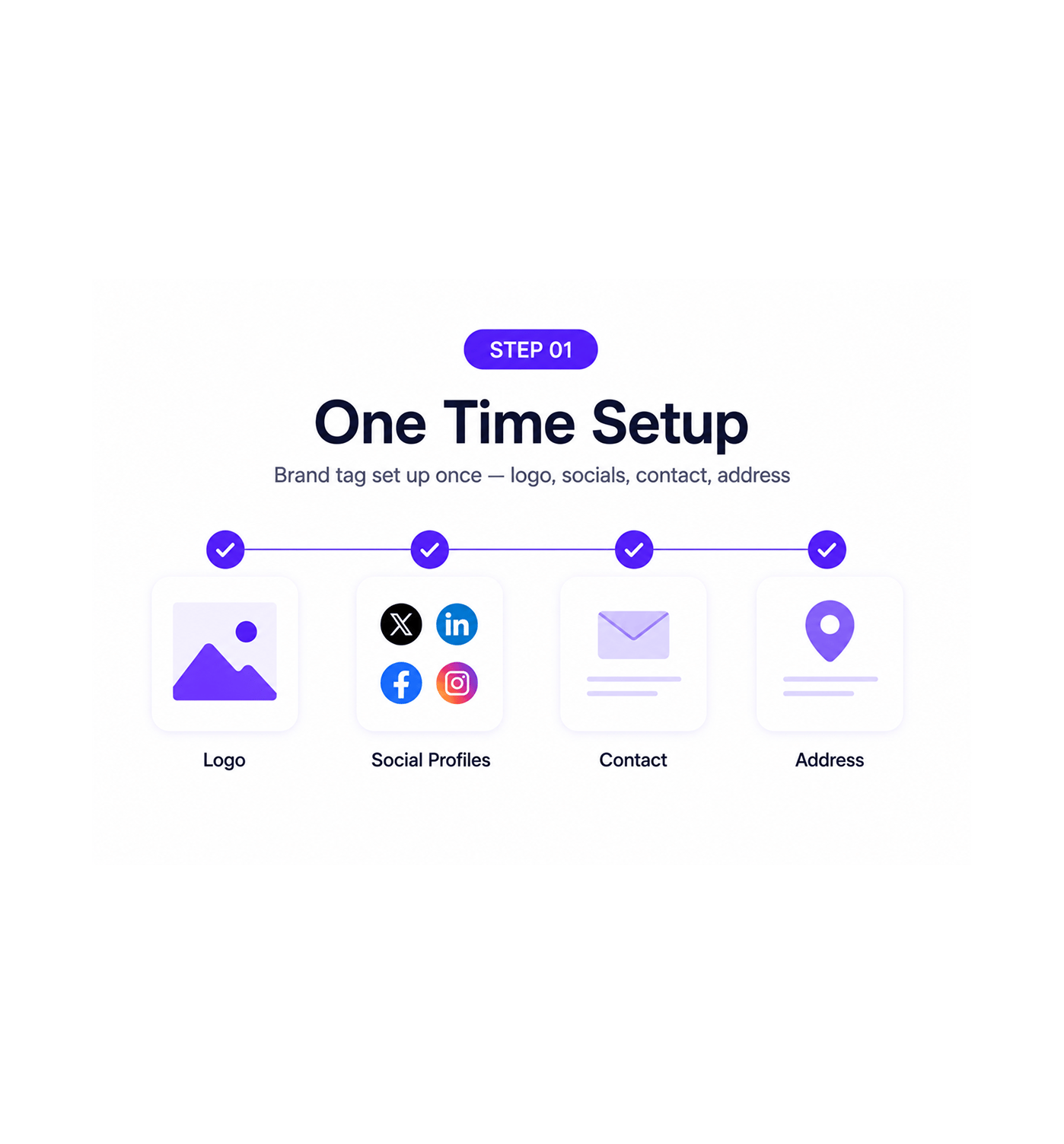
One Time Setup

Brand tag set up once logo, socials, contact, address

The brand tag describes the team as an entity the official name, the logo, the social profiles on every platform the brand actually maintains, the contact email or form, the physical address if one applies, the founding date, the industry, and the parent organisation if part of a larger group. The team fills it in once during onboarding, and from that moment forward every page on the site signals the same consistent brand entity. The "this content was produced by an unidentified site" problem that hurts trust on AI assistants and search engines alike simply does not exist any more.

LogoSocial ProfilesContactAddress

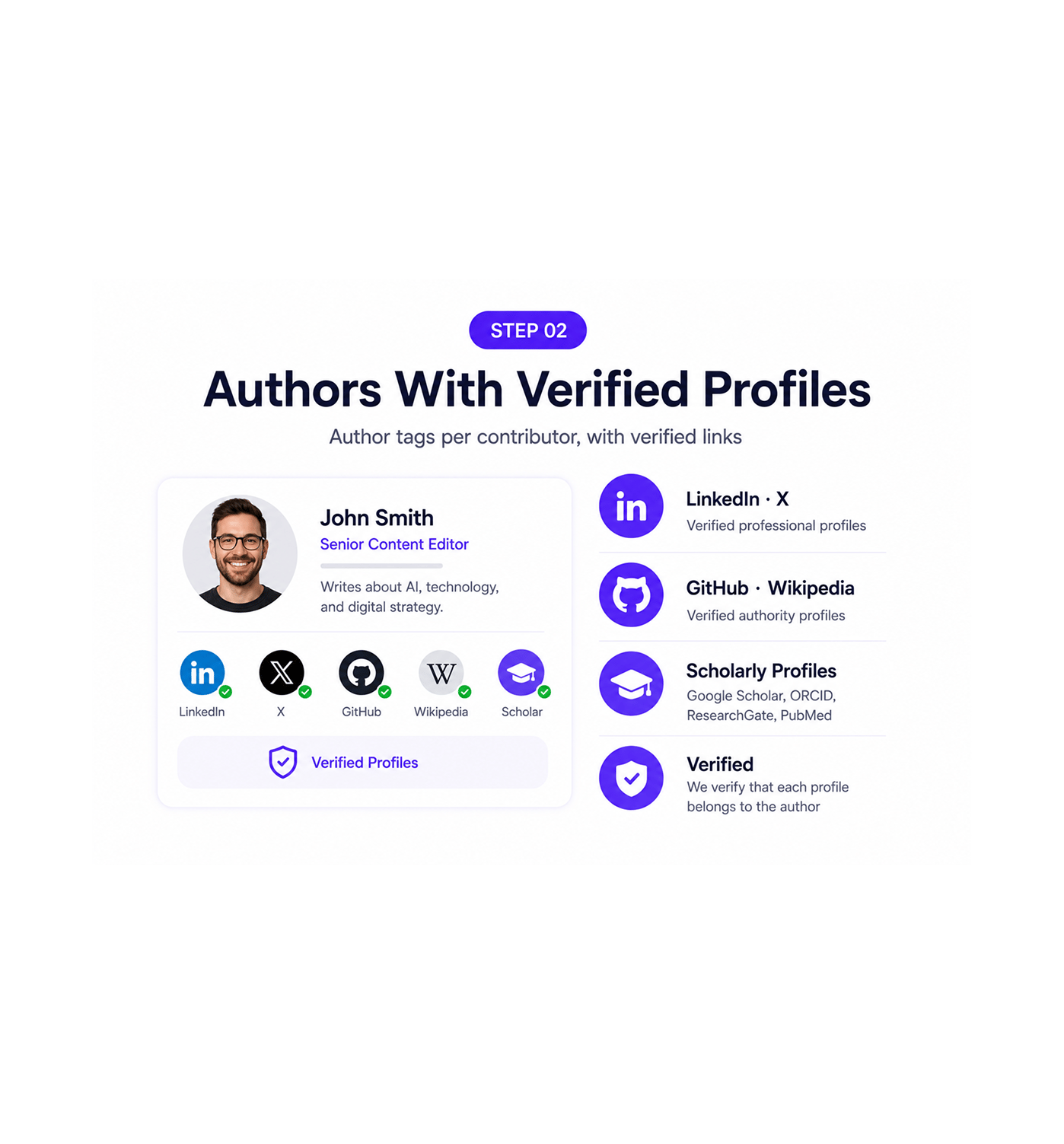
Authors With Verified Profiles

Author tags per contributor, with verified links

Every contributor on the team gets an author tag with the same consistent set of fields name, role at the brand, bio, photo, and verified links to LinkedIn, X, GitHub, Wikipedia, and any scholarly profiles such as Google Scholar, ORCID, ResearchGate, or PubMed. The verification step matters as much as the link itself Ranko confirms each profile actually belongs to the named author rather than just accepting whatever URL the team enters. Authors with verified scholarly profiles in their field carry a different trust weight than authors without, and the verification is what makes that difference real rather than claimed.

LinkedIn · XGitHub · WikipediaScholarly ProfilesVerified

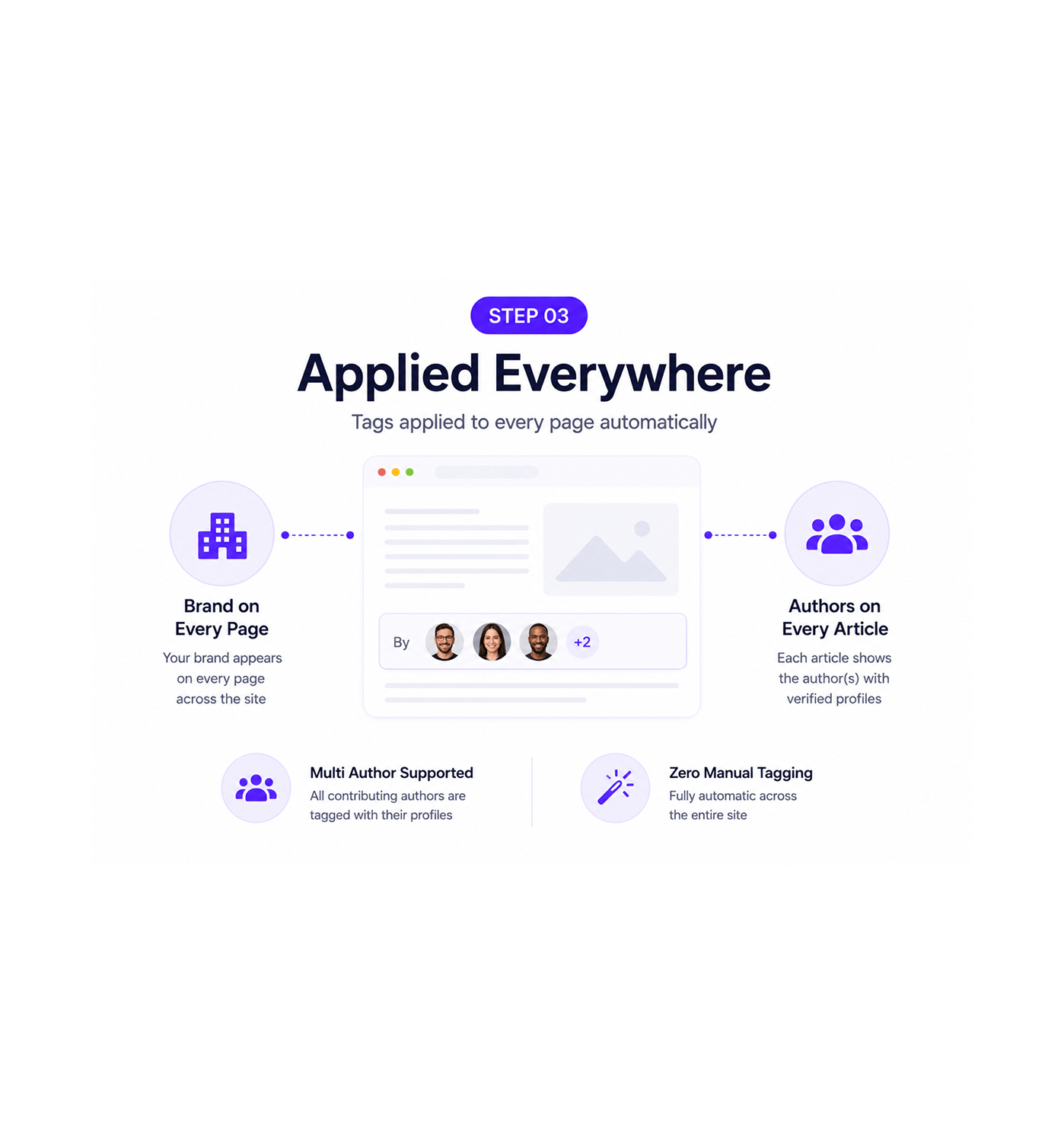
Applied Everywhere

Tags applied to every page automatically

The brand tag appears on every page on the site without anybody having to add it manually. Every article gets the author tag for whoever wrote it, with the author's full profile attached including the verified external links. Multi author articles get all the contributing authors tagged correctly with each one's verified profile set. The full identity layer gets signed across the whole site, every page, every time, without the team maintaining a manual list of who wrote what or which tags to apply where.

Brand on Every PageAuthors on Every ArticleMulti Author SupportedZero Manual Tagging

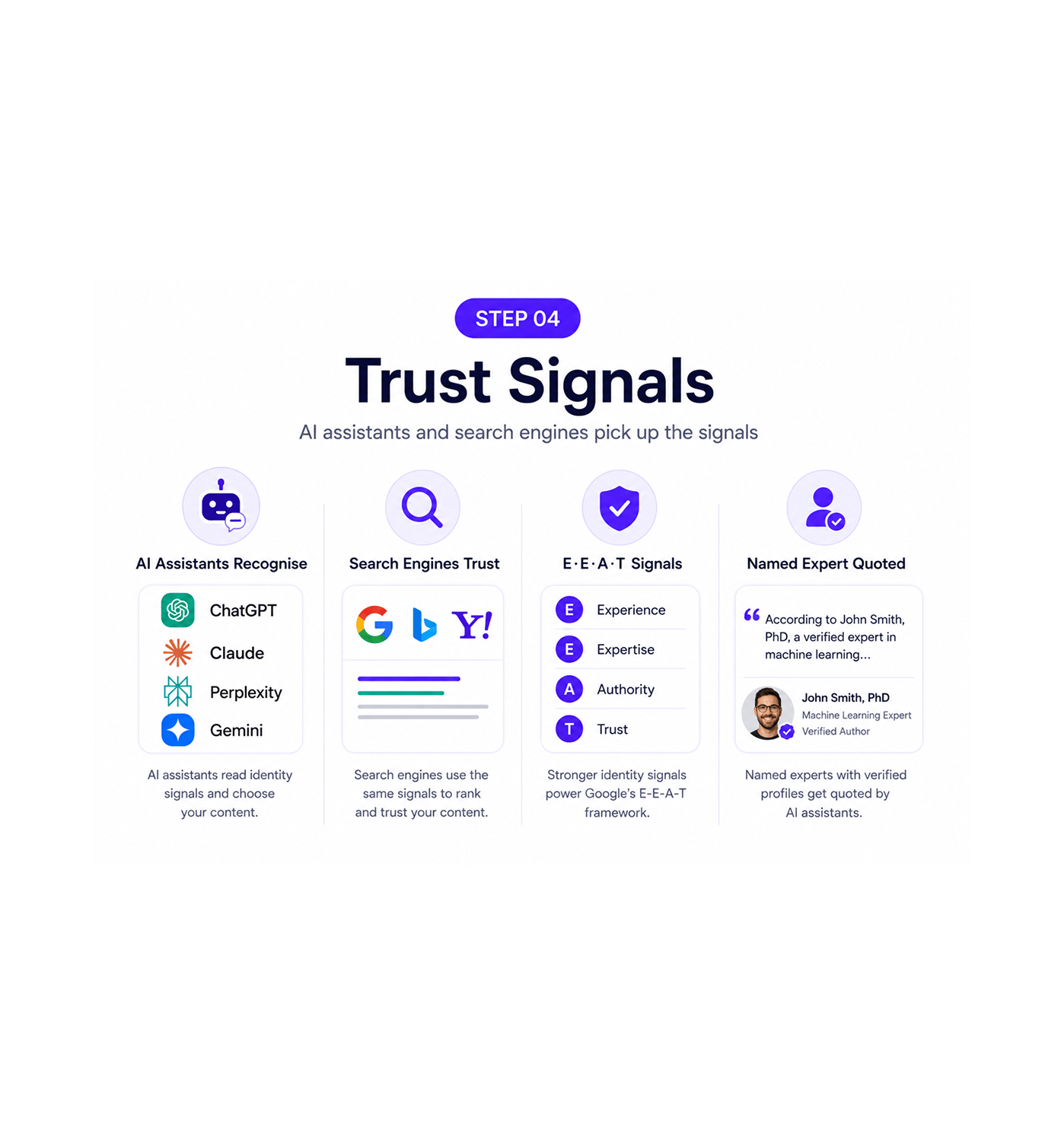
Trust Signals

AI assistants and search engines pick up the signals

ChatGPT, Claude, Perplexity, and Gemini all read the identity signals when deciding which sources to quote. A page written by a named expert with verified scholarly profiles in the relevant field carries different trust weight than an anonymous page with no author attribution. Google's experience, expertise, authority, and trust framework leans heavily on the same signals for traditional search. The same structured identity layer earns recognition on both fronts quoted by AI assistants and ranked by search engines without the team having to maintain two separate systems.

AI Assistants RecogniseSearch Engines TrustE·E·A·T SignalsNamed Expert Quoted
Why Teams Choose RANKO

Six reasons your authors stop being anonymous

Once a team can sign every page with a consistent brand entity, attribute every article to a named author with verified expertise profiles, and have the identity layer apply sitewide automatically, the old pattern of publishing as a faceless brand and hoping AI assistants somehow figured out the team's credibility stops being acceptable. These are the changes that show up first.

AI assistants know who you are now

AI assistants know who you are now

ChatGPT, Claude, Perplexity, and Gemini all weigh source identity when picking what to quote. A page with a complete brand tag and a named author with verified profiles is a different proposition than a page that simply exists at a URL with no signal of who is behind it. The identity signals are exactly the trust signals the AI assistants reach for, and putting them in place is the difference between being a source the engines feel safe quoting and being one they cannot confidently attribute.

Author authority becomes a structural signal

Author authority becomes a structural signal

"The author has expertise" is a claim. "The author has a verified LinkedIn profile showing fifteen years in the field, a verified Wikipedia entry, a verified Google Scholar profile with published papers, and a verified GitHub showing the open source work they contributed" is a structural signal. The first version is rhetoric. The second is something the AI assistants and search engines can actually verify, which is exactly what makes the difference between claimed expertise and recognised authority.

Verified links beat unverified credentials

Verified links beat unverified credentials

An author bio that says "twenty years of experience in the industry" is one anybody can write. A verified link to the author's LinkedIn confirming those twenty years is one the engines can actually check. Verification is the step that turns identity claims into trust signals. Ranko confirms each profile belongs to the named author rather than just accepting whatever URL the team submits, so the credibility represented by each link is real rather than aspirational.

Every page carries the brand entity

Every page carries the brand entity

A brand tag applied on the home page but missing on the article pages is a brand entity that breaks the moment somebody lands on a deep page. Auto Page Data Tags sitewide means every page on the site signals the same brand entity consistently homepage, blog posts, product pages, support docs, the whole site reads as a coherent entity rather than a collection of disconnected URLs. The entity signal stays strong across the whole site rather than dropping off as soon as the reader leaves the home page.

Multi author teams get individual recognition

Multi author teams get individual recognition

Brands publishing articles by ten different team members deserve to have each contributor recognised individually. Each author maintains their own profile with their own expertise signals, their own verified external links, and their own scholarly profiles where applicable. The senior writer with a ten year track record gets their authority signalled clearly. The newer contributor with relevant credentials gets theirs. The brand benefits from the cumulative trust of the whole team, rather than averaging it out into a single faceless byline.

The trust signals work for traditional search too

The trust signals work for traditional search too

The same identity layer that the AI assistants read for source trust is the layer Google uses for its experience, expertise, authority, and trust framework. Setting up brand and author tags well is genuinely the rare optimisation that pays off on both traditional search and answer engines at once. The team is not choosing between SEO investment and AEO investment they are doing both with the same work, which is the only kind of investment that compounds across the whole modern search landscape.

Stop publishing as a faceless brand.
Start being recognised by name.

A single brand tag with logo, socials, contact, and address. Author tags for every contributor with verified LinkedIn, X, GitHub, Wikipedia, and scholarly profiles. The identity layer your content has always needed.

Who uses RANKO author & brand tags
Deepak MehrotraDeepak MehrotraDeepak MehrotraDeepak Mehrotra

18800+

Teams building trusted brand and author visibility

Built for teams that want recognised expertise

Built for founders, content teams, SEO specialists, agencies, and brands that want AI assistants and search engines to recognise their expertise instead of treating their content as anonymous. Ranko turns brand identity and verified author credentials into structured trust signals applied consistently across every page.

1 Brand

Tag

Every

Author Tagged

5 Profile

Types Verified

Auto

Applied

Brand Layer

Logo, socials, contact, address

A single brand tag with the official name, the logo, the social profiles on every platform the brand maintains, the contact details, the address if applicable, the founding date, the industry, and the parent organisation if relevant. Set up once during onboarding, applied to every page on the site from then on, signalling the same coherent brand entity across the whole property.

Logo, socials, contact, address
Features

Everything the identity layer ships with

A complete brand and author identity toolkit built into the same answer engine optimisation platform your team already uses. A single brand tag with all the standard entity fields, author tags per contributor, verified LinkedIn and X profile linking, verified GitHub and Wikipedia and scholarly profile linking, and sitewide automatic application come together so the team finally signals who they are and what they know about consistently across every page.

Brand Tag With Logo, Socials, Contact, Address

Brand Tag With Logo, Socials, Contact, Address

A single brand tag describes the team as an entity official name, logo, social profiles, contact details, physical address if one applies, founding date, industry, parent organisation. Set up once, applied across every page on the site, signalling a coherent brand entity that AI assistants and search engines can both recognise consistently.

Author Tags Per Contributor

Author Tags Per Contributor

Every contributor on the team gets their own author tag with name, role, bio, photo, and the full set of verified profile links. Each author's individual expertise gets signalled clearly rather than being averaged into a generic team byline, so the senior writer with the ten year track record gets the credit their experience deserves.

Verified LinkedIn Links

Verified LinkedIn Links

Every author's LinkedIn profile gets linked to their author tag, and Ranko verifies the profile actually belongs to the named author rather than just accepting whatever URL is submitted. The professional background, the work history, the connections, and the endorsements that LinkedIn carries become structural trust signals attached to every article the author writes.

Verified X Profile Links

Verified X Profile Links

X profile linking gives the author a recognised public identity beyond LinkedIn, especially valuable for authors whose thought leadership lives publicly on X. The verification step confirms the X account belongs to the named author, which is the difference between a real authority signal and a profile claim anybody could make.

GitHub, Wikipedia, Scholarly Profiles

GitHub, Wikipedia, Scholarly Profiles

For technical authors, verified GitHub profiles signal the actual work they have shipped. For authors with public recognition, verified Wikipedia entries signal third party validation. For authors with academic backgrounds, verified Google Scholar, ORCID, ResearchGate, or PubMed profiles signal published research and field expertise. Each one turns claimed authority into recognised authority.

Tags Applied Sitewide Automatically

Tags Applied Sitewide Automatically

The brand tag appears on every page. Every article gets the author tag for whoever wrote it with their full verified profile set attached. Multi author articles get all the contributing authors tagged. The full identity layer gets signed across the whole site without the team maintaining a manual list of which tags to apply where.

Brand Tag With Logo, Socials, Contact, Address

Brand Tag With Logo, Socials, Contact, Address

A single brand tag describes the team as an entity official name, logo, social profiles, contact details, physical address if one applies, founding date, industry, parent organisation. Set up once, applied across every page on the site, signalling a coherent brand entity that AI assistants and search engines can both recognise consistently.

Author Tags Per Contributor

Author Tags Per Contributor

Every contributor on the team gets their own author tag with name, role, bio, photo, and the full set of verified profile links. Each author's individual expertise gets signalled clearly rather than being averaged into a generic team byline, so the senior writer with the ten year track record gets the credit their experience deserves.

Verified LinkedIn Links

Verified LinkedIn Links

Every author's LinkedIn profile gets linked to their author tag, and Ranko verifies the profile actually belongs to the named author rather than just accepting whatever URL is submitted. The professional background, the work history, the connections, and the endorsements that LinkedIn carries become structural trust signals attached to every article the author writes.

Verified X Profile Links

Verified X Profile Links

X profile linking gives the author a recognised public identity beyond LinkedIn, especially valuable for authors whose thought leadership lives publicly on X. The verification step confirms the X account belongs to the named author, which is the difference between a real authority signal and a profile claim anybody could make.

GitHub, Wikipedia, Scholarly Profiles

GitHub, Wikipedia, Scholarly Profiles

For technical authors, verified GitHub profiles signal the actual work they have shipped. For authors with public recognition, verified Wikipedia entries signal third party validation. For authors with academic backgrounds, verified Google Scholar, ORCID, ResearchGate, or PubMed profiles signal published research and field expertise. Each one turns claimed authority into recognised authority.

Tags Applied Sitewide Automatically

Tags Applied Sitewide Automatically

The brand tag appears on every page. Every article gets the author tag for whoever wrote it with their full verified profile set attached. Multi author articles get all the contributing authors tagged. The full identity layer gets signed across the whole site without the team maintaining a manual list of which tags to apply where.

Questions & Answers

Everything you need to know

Common questions about brand tags, author profiles, verification, scholarly links, multi author support, and how identity signals help AI assistants and search engines trust your content.

The brand tag includes all the core identity details AI assistants and search engines look for when recognising a business as a trusted entity. This includes the official brand name, logo, social profiles, contact details, address, founding date, industry category, and parent organisation details where relevant. Once configured, the same consistent brand entity is applied automatically across the full website.

Network background
RANKO · Author & Brand Tags

Stop being anonymous in the AI answers.
Start being the named expert that gets quoted.

A single brand tag with logo, socials, contact, and address. Author tags for every contributor with verified LinkedIn, X, GitHub, Wikipedia, and scholarly profiles. The identity layer your content has always deserved.