Brand Voice Training takes five of your best existing posts and learns the five dimensions that actually define how your brand writes sentence length, vocabulary, opinion strength, tone, and formatting habits. The profile applies to every future article Ranko produces, so the team's voice stays the team's voice no matter how much volume the calendar ships. Five voice profiles on Growth, unlimited on Scale, for the agencies and multi-brand teams who need a different voice for every house they manage.
Pick the five posts that best capture the voice you want preserved. Drop them into Ranko. The platform learns the five dimensions that actually define how the brand writes sentence length, vocabulary, opinion strength, tone, and formatting habits. A visible, editable voice profile gets created and named, and from that moment forward every article Ranko produces applies the profile automatically.
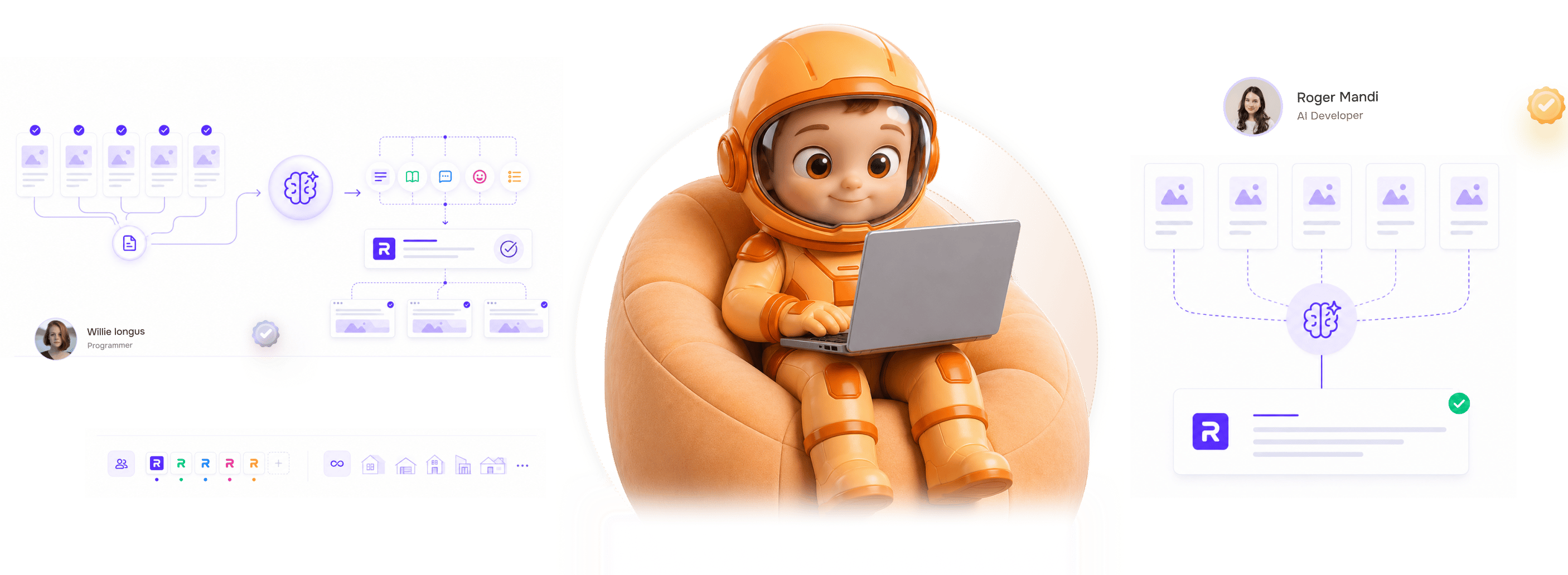
5 Best Posts In
Choose five articles that best capture the voice the brand wants preserved the pieces an editor would point at and say this is exactly how we want to sound. Five is the smallest viable corpus that genuinely teaches the voice rather than a single article, and the largest corpus the team can curate carefully rather than dumping. Paste the posts in, point Ranko at the URLs, or pull them in directly from your existing platform connections. No corpus building, no preprocessing, no annotation the right five articles are enough.
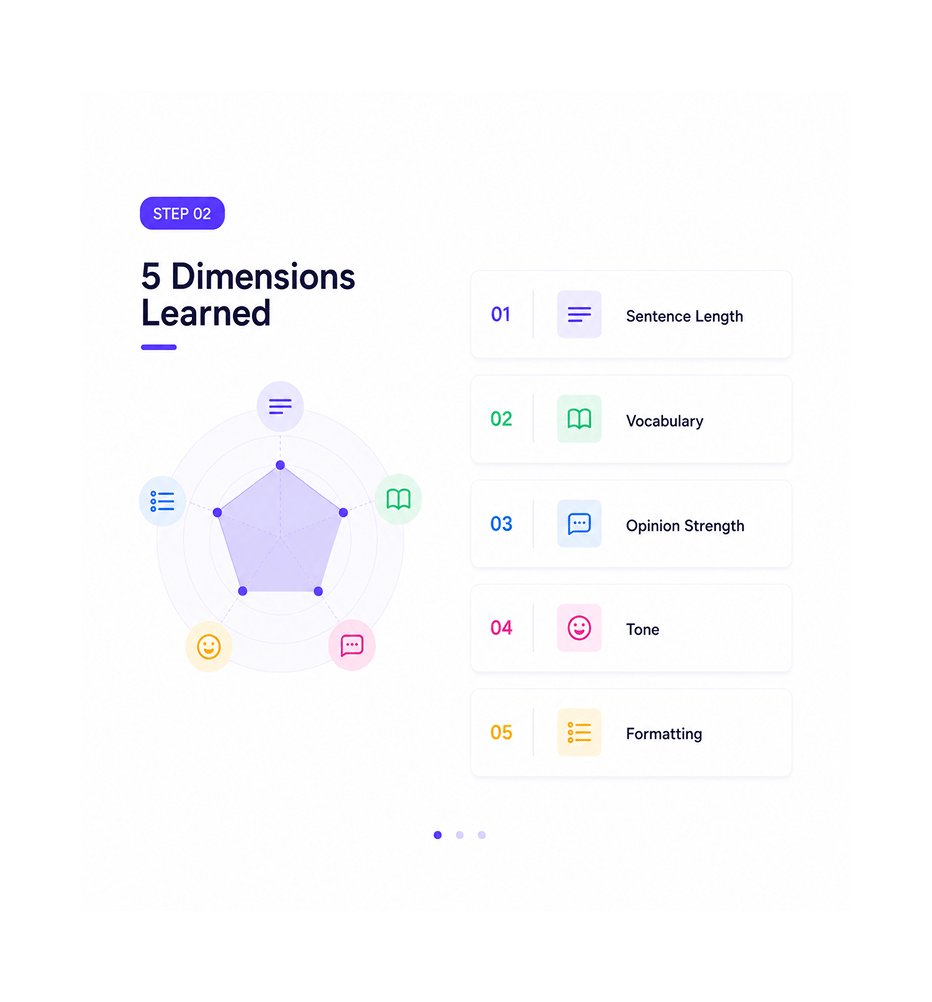
5 Dimensions Learned
Tone is the word every other tool uses when they cannot describe what they actually do. Brand Voice Training learns five concrete dimensions. Sentence length does the brand favour short, punchy sentences or longer, more measured ones, and what is the distribution across an article. Vocabulary which words and phrases the brand consistently uses and which it consistently avoids. Opinion strength does the brand commit to clear positions or hedge with qualifiers. Tone warm, sharp, analytical, conversational, or some specific blend. Formatting habits how the brand uses bullets, headings, examples, asides, and emphasis. Each dimension gets measured precisely so the resulting profile is a specification, not a vibe.
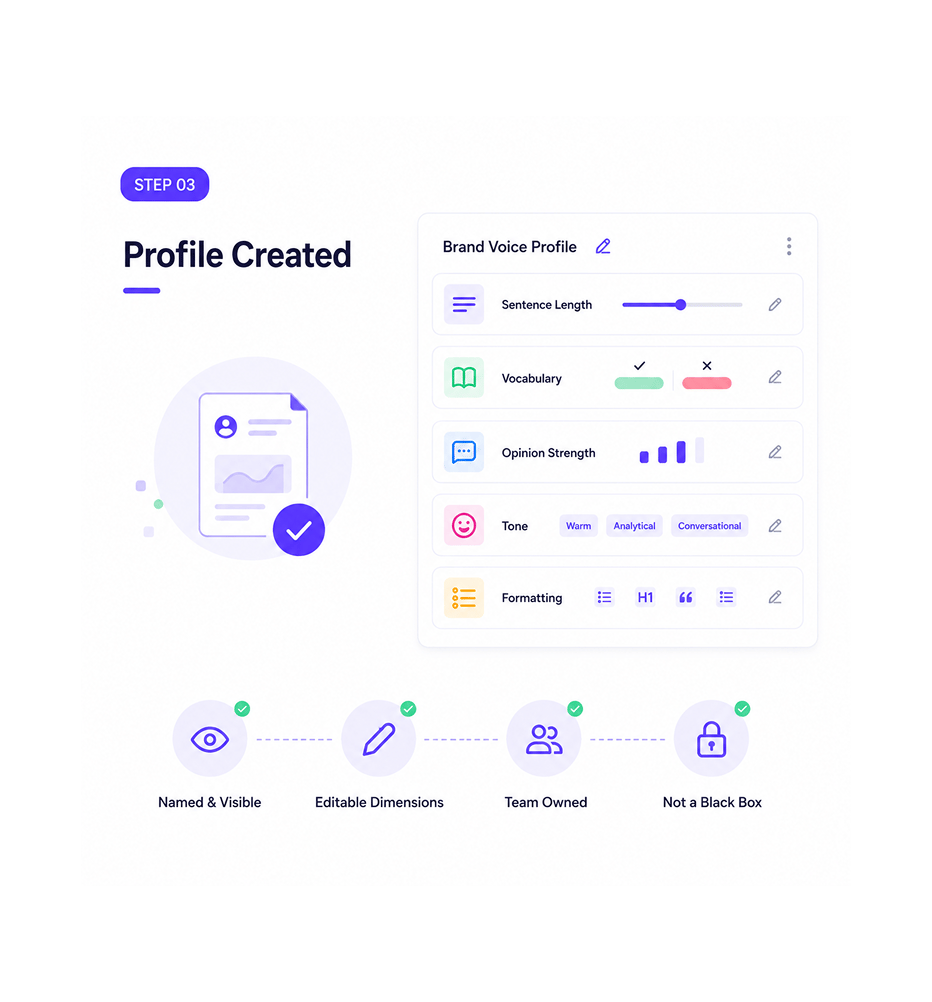
Profile Created
The profile appears in the workspace as a named, editable specification not a black box. The team sees the average sentence length, the words the brand favours and avoids, the opinion strength level, the tone descriptors, and the formatting habits. Each dimension can be adjusted manually if the team wants to push the voice in a slightly different direction than the source articles suggest, and the changes apply immediately. The profile becomes a brand asset the team owns and refines, not a hidden parameter the platform manages for them.
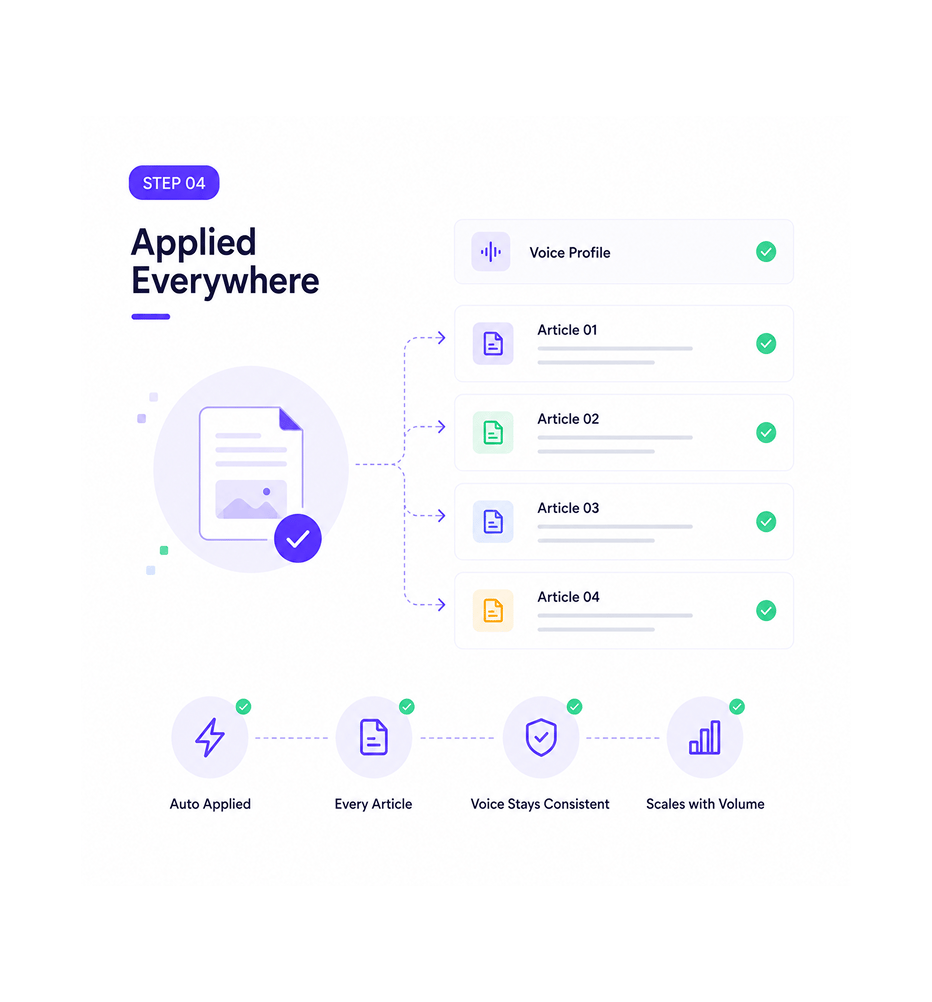
Applied Everywhere
From the moment the profile is created, every article Ranko produces applies it automatically. The Article Writer draft uses the sentence length the profile specifies, the vocabulary the profile prefers, the opinion strength the profile calls for, the tone the profile names, the formatting habits the profile captured. The voice the readers have come to recognise stays the voice the readers see, no matter how many articles ship in a quarter. The team's voice scales with their volume, instead of getting flattened into generic AI cadence the moment production picks up.
Once a team can preserve the voice that took years to develop and apply it to every article that ships without needing a senior editor to police every draft the old pattern of either writing everything by hand or accepting flattened generic AI output stops being acceptable. These are the changes that show up first.
Most tools that promise brand voice training ask for a massive corpus and then produce results that still feel generic. Five carefully chosen articles is the smallest sample that genuinely teaches the voice and the largest sample most teams can curate seriously rather than dumping in. The we need to gather hundreds of examples first excuse that delays voice work for months simply does not apply, which means the team can be writing in voice by the end of the first afternoon.
Generic AI has a sound over qualified sentences, the same handful of transitional phrases, strange formality where there should be confidence, hedging where there should be opinions. A trained profile replaces that default cadence with the brand's actual voice. Readers cannot tell the article was written with AI assistance because the article sounds like the brand they have read before, which is the only outcome that matters when the team's audience expects to hear the team's voice.
The word tone usually means we have not really worked this out. Brand Voice Training captures five concrete dimensions sentence length, vocabulary, opinion strength, tone, formatting habits each measured precisely so the profile is a specification rather than a guess. The team can look at the profile, understand exactly what it captures, and adjust any dimension that does not match the brand's actual direction. Voice work becomes a measurable craft rather than an unmeasurable hope.
A profile the team cannot see is a profile the team cannot trust. Every dimension of the trained voice is visible in the workspace, named clearly, and editable directly. If the brand is moving toward sharper opinions, the team adjusts the opinion strength dimension up and the next article reflects the change. If the formatting habits captured are slightly off, the team refines them. The voice asset is owned by the team and lives in the open, which is the only architecture that earns long term trust.
Agencies running content for ten clients need ten distinct voices. Multi-brand companies need a different voice for the parent brand than for the product line sub-brands. Teams running both a thought leadership track and a product education track need each track to sound like itself. Five voice profiles on Growth and unlimited on Scale support exactly these patterns each profile is independent, each one is visible and editable, and each one applies to the articles that are tagged to its workspace or content track.
The team that used to ship five articles a month with full editorial review can ship fifteen with the trained voice in place and the fifteen sound the same as the five did. The compounding benefit of consistent voice across a growing library readers recognise the brand, search and answer engines learn the brand's signature, the editorial standard scales with output finally becomes accessible without hiring three more senior writers. The voice that took years to develop scales with the volume the strategy actually calls for.
Five posts in. Five dimensions learned. A visible editable voice profile. Auto applied to every future article. Five profiles on Growth, unlimited on Scale. The voice preservation layer your content engine has always needed.
9700+
Teams scaling content without flattening the voice that made the brand
Founders who have spent years developing the voice that distinguishes the brand from the dozen competitors who could otherwise sound the same, content marketing leads whose editorial standards refuse to slip just because volume needs to go up, agencies running content for ten different clients who each need their own voice without three senior editors policing every draft, multi-brand companies running a parent brand voice alongside three product line sub-brand voices, search specialists who have learned that voice consistency is itself a citation signal in the answer engines, and editors who would rather spend their time shaping strategy than rewriting AI drafts to sound like the brand all use Ranko's Brand Voice Training as the dimension capture and application layer that makes voice a scalable asset rather than a bottleneck. Every team a small business with one voice or an agency running ten gets the same five dimensional precision, the same editable profile architecture, and the same automatic application to every article.
Input
Dimensions
Profile
Voices
From just five carefully chosen articles, Ranko learns sentence length, vocabulary, opinion strength, tone, and formatting habits five concrete dimensions that together define how the brand actually writes. The profile is created in minutes, named in the workspace, and stays visible and editable so the team owns and refines the voice asset rather than handing it over to a black box.
A complete brand voice preservation toolkit built into the same answer engine optimisation platform your team already uses. Five post input, sentence length and rhythm learning, vocabulary and phrase pattern capture, opinion strength calibration, tone and formatting habit extraction, and multiple voice profile support come together so the voice that took years to develop stops getting flattened the moment AI production picks up.
The smallest viable corpus that genuinely teaches the voice. Paste five articles in, point Ranko at the URLs, or pull them directly from your existing platform connections. No preprocessing, no annotation, no corpus building project. The right five articles is enough which means the team can be writing in voice by the end of the first afternoon rather than the end of the first month.
Captures whether the brand favours short, punchy sentences or longer, more measured ones, and the distribution across an article. The rhythm that makes the brand recognisable the alternation between short hits and longer build ups gets preserved in every draft rather than being flattened to a generic average.
Learns which words and phrases the brand consistently uses and which it consistently avoids. The signature vocabulary that makes a brand sound like itself the specific word choices, the framings the team has settled on, the phrases that have become brand shorthand gets baked into every future article.
Captures whether the brand commits to clear positions or hedges with qualifiers. A brand that takes strong stances should not suddenly sound like a brand that hedges everything when AI assistance picks up the production, and the opinion strength dimension makes sure the writing matches the editorial stance the team actually wants.
Tone descriptors warm, sharp, analytical, conversational, or some specific blend get captured precisely. Formatting habits how the brand uses bullets, headings, examples, asides, and emphasis get learned from the source articles and applied consistently. The texture of how the brand writes, not just what it says, stays intact across every future piece.
Five voice profiles on Growth, unlimited on Scale. Each profile is independent, each one is visible and editable, and each one applies to articles tagged to its workspace or content track. Agencies running content for ten clients, multi-brand companies with sub-brand voices, and teams running multiple content tracks all get the same architecture without any single profile interfering with the others.
The smallest viable corpus that genuinely teaches the voice. Paste five articles in, point Ranko at the URLs, or pull them directly from your existing platform connections. No preprocessing, no annotation, no corpus building project. The right five articles is enough which means the team can be writing in voice by the end of the first afternoon rather than the end of the first month.
Captures whether the brand favours short, punchy sentences or longer, more measured ones, and the distribution across an article. The rhythm that makes the brand recognisable the alternation between short hits and longer build ups gets preserved in every draft rather than being flattened to a generic average.
Learns which words and phrases the brand consistently uses and which it consistently avoids. The signature vocabulary that makes a brand sound like itself the specific word choices, the framings the team has settled on, the phrases that have become brand shorthand gets baked into every future article.
Captures whether the brand commits to clear positions or hedges with qualifiers. A brand that takes strong stances should not suddenly sound like a brand that hedges everything when AI assistance picks up the production, and the opinion strength dimension makes sure the writing matches the editorial stance the team actually wants.
Tone descriptors warm, sharp, analytical, conversational, or some specific blend get captured precisely. Formatting habits how the brand uses bullets, headings, examples, asides, and emphasis get learned from the source articles and applied consistently. The texture of how the brand writes, not just what it says, stays intact across every future piece.
Five voice profiles on Growth, unlimited on Scale. Each profile is independent, each one is visible and editable, and each one applies to articles tagged to its workspace or content track. Agencies running content for ten clients, multi-brand companies with sub-brand voices, and teams running multiple content tracks all get the same architecture without any single profile interfering with the others.
Common questions about why five posts is enough, exactly what each of the five dimensions captures, how to choose the five posts well, how to handle multiple brand voices, what happens when the voice needs to evolve over time, and how the profile actually applies to a new article.
Because the right five articles teach far more than a hundred mediocre ones. Voice is captured most clearly in articles where the brand is most itself the team's strongest pillar pages, the editorials that defined the brand's stance, the pieces an editor would point at and say this is exactly how we want to sound. Five carefully chosen articles give Ranko enough signal across all five dimensions to build an accurate profile. Adding more often dilutes the profile rather than sharpening it, because a larger corpus inevitably includes weaker pieces that pull the voice toward whatever average a hundred articles approximate. The team's job is to curate, not to gather and five is the number where curation is genuinely possible.
Five posts in. Five dimensions learned. A visible editable voice profile. Auto applied to every future article. Five profiles on Growth, unlimited on Scale. The voice preservation layer your content engine has always deserved.