Before any draft is written, Ranko pulls in the top twenty ranking pages on the topic, the ten most recent Reddit and X conversations about it, and your own live product data then weaves real quotable facts into the article instead of inventing them. The result is content readers can verify, editors can defend, and answer engines can cite with confidence.
Ranko reads the top twenty ranking pages on the topic in full the search consensus and the edges. The ten most recent Reddit threads and X conversations get pulled in for the real opinions and the lived experience. Your own live product data feeds in for the specific features, pricing, and outcomes that only your team can credibly write about. Then the real facts get woven into the draft in the right paragraphs, so every claim is traceable to a source the editor can verify.
Search Consensus
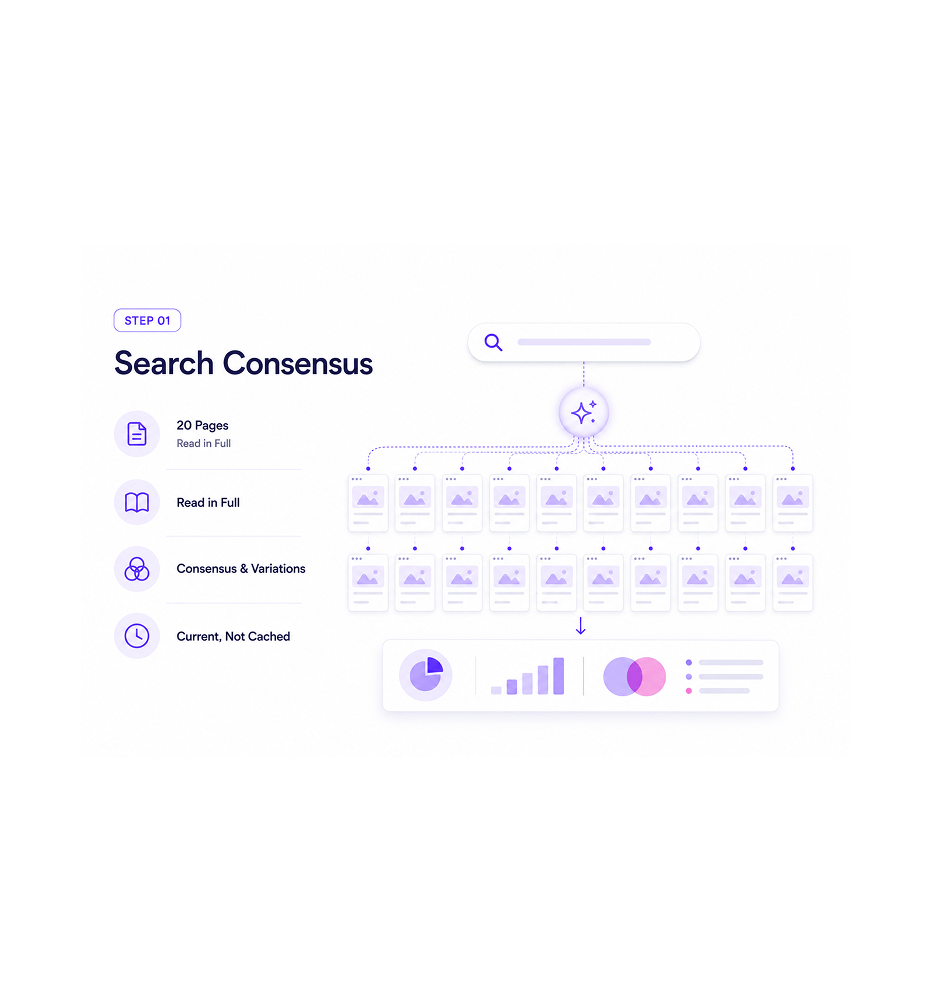
Not the top three. Not snippets. Ranko reads the top twenty ranking pages for the article's primary questions, in full, so the article captures both the consensus that emerges across the leaders and the variations the longer tail introduces. Twenty pages is the number where the consensus becomes credible fewer than that and you risk inheriting whatever a small handful of authoritative sources happen to say, more than that and the long tail starts diluting rather than enriching. The result is a research foundation that reflects what the search world is currently saying, not a guess based on what a language model thinks the search world used to say.
Real Conversations
Search results capture the published consensus. They miss what real people are actually saying right now. The ten most recent Reddit threads and ten most recent X conversations on the topic get pulled in for the lived experience the honest reviews, the genuine frustrations, the practical workarounds, the questions readers are asking each other when they think nobody from the brands is listening. Articles grounded in this layer of conversation sound like they were written by someone who has been paying attention, because in effect they were.
Your Product Data
The feature your competitors cannot credibly write about is the feature only your team knows the specifics of. Your live product data the features and how they actually work, the current pricing, the customer outcomes the team can speak to, the integrations the product supports feeds straight into the research layer so the article can refer to your product accurately rather than vaguely or wrongly. This is the layer that makes an article uniquely yours, because no competitor writing about your category can match the specificity that comes from being the source of the product itself.
Facts Woven In
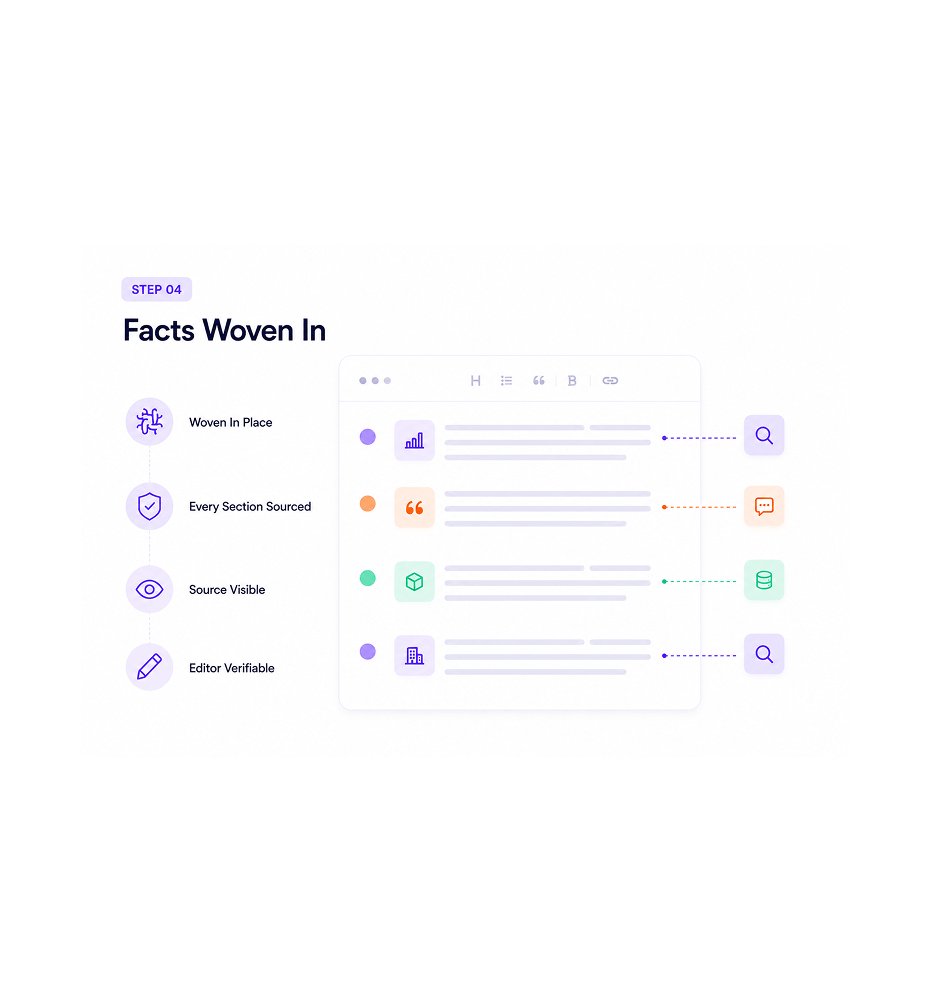
The research does not sit in a research tab nobody opens. The facts get woven into the actual draft in the right paragraphs a verifiable statistic in the intro, a real quote from a recent conversation in the supporting context, a specific product detail in the practical advice section, a concrete example in the depth middle. Every claim in the article is traceable to one of the three research sources, with the source visible in the draft view so the editor can check any specific point. The article reads like a source, not a summary, because the article actually is sourced.
Once a team can ground every article in twenty real ranking pages, ten real recent conversations, and the team's own real product data with every claim traceable to a source the old pattern of shipping generic AI summaries that readers and editors and answer engines all see through stops being acceptable. These are the changes that show up first.
The most common failure mode of generic AI content is the confident assertion of something that turns out to be wrong a misattributed quote, a fabricated statistic, a non existent study, a wrong product specification. Every claim in a Ranko article is traceable to one of three real sources, so the failure mode that has burned every content team that tried to go production with off the shelf AI tools simply does not happen. Editors stop spending afternoons fact checking and start spending them refining substance.
Generic AI content has a tell it reads like somebody distilled the top three search results into a marginally rephrased summary. Articles grounded in twenty pages plus ten real conversations plus the team's own product data read like a primary source instead. The kind of article a researcher would cite, an editor would defend, and an answer engine would quote. The difference shows up in the first paragraph and only widens from there.
Most tools that promise research grounding pull a small handful of sources the top three results, maybe the top five, sometimes just whatever appears in a featured snippet. Twenty is the number where the article reflects the actual consensus across the search landscape rather than the opinion of whoever happened to rank first that week. The article gets the breadth that signals genuine subject understanding rather than narrow source dependence.
Search results capture the published consensus. They miss the real opinions, the lived workarounds, the questions readers are actually asking when nobody from the brands is listening. Reddit and X conversations are where the audience reveals what they genuinely think about a topic, and articles grounded in that layer sound like they were written by someone who has been listening because the platform actually has been.
A competitor writing about your category can copy the search consensus and quote the same Reddit threads. They cannot match the specificity that comes from being the source of the product itself. Live product data the actual features, the current pricing, the customer outcomes the team can speak to feeds into every relevant article so the team's content has a moat that competitors cannot cross even if they adopt the same AI tools.
The source for every claim in the article is visible in the draft view which ranking page contributed the statistic, which Reddit thread contributed the quote, which product data row contributed the specification. The editor can check any specific point in the time it takes to click through. The audit trail that traditional content production lost the moment AI entered the workflow gets restored, which is the trust signal that makes the difference between AI content the team can defend and AI content the team has to hide.
Top twenty ranking pages read in full. Ten most recent Reddit and X conversations captured. Live product data integrated. Real facts woven into every section. Every claim traceable to a source. The grounding layer your content engine has always needed.
11500+
Teams shipping AI content that holds up to professional scrutiny
Founders who refuse to ship anything the team would not stand behind in front of a customer, content marketing leads who have watched generic AI tools embarrass smart teams with fabricated statistics, editors who are tired of fact checking AI drafts and would rather spend their time shaping argument and structure, search specialists who know that the answer engines have learned to filter out the generic AI shape and are looking for content that reads like a primary source, agencies whose clients would notice a single invented quote in a published article, growth teams at SaaS companies whose product specifics are themselves a moat against generic competitor content, and any team whose audience expects to read articles that hold up to professional scrutiny all use Ranko's Real Research Mixed In as the grounding layer that turns AI content from a liability into an asset. Every team a small business worried about an editor reputation on twelve articles a quarter or a larger organisation publishing hundreds gets the same three source research foundation and the same traceable claim architecture.
Read
Conversations
Product data
Claim Sourced
The top twenty ranking pages get read in full for the search consensus and the variations across the leaders. The ten most recent Reddit and X conversations get pulled in for the lived opinions and honest reactions. Your own live product data feeds in for the specifics only your team can write about with credibility. Three sources, real coverage, current signal.
A complete research grounding toolkit built into the same answer engine optimisation platform your team already uses. Top twenty ranking pages read in full, ten most recent Reddit and X conversations captured, live product data integration, real facts woven directly into every section, and source visibility on every claim come together so the team finally publishes articles that read like a source instead of a summary.
Not the top three. Not snippets. The full text of the top twenty ranking pages on the article's primary questions, captured in the moment so the article reflects the current consensus and the variations across the leaders. Twenty is the number where the consensus becomes credible without the long tail diluting it, and reading in full is the depth that catches the substance snippets miss.
The ten most recent relevant Reddit threads on the topic get pulled in for the lived experience, the honest reviews, the practical workarounds, and the questions readers ask each other when they think nobody from the brands is listening. Articles grounded in this layer sound like the team has been paying attention, because the platform has.
The ten most recent X conversations on the topic get captured for the timely takes, the emerging perspectives, and the real time reactions that signal where the conversation is moving next. Conversations that have not yet made it into ranking pages but are shaping how the topic gets understood, captured before they become the next wave of search content.
Your live product data the features and how they actually work, the current pricing, the customer outcomes the team can credibly speak to, the integrations the product supports feeds straight into the research layer. The specificity that makes an article uniquely yours, that no competitor writing about your category can match, becomes a default property of every relevant piece.
The research does not sit in a research tab the writer has to manually reference. The real facts get placed into the actual draft in the right paragraphs verifiable statistics in the intro, real quotes in the supporting context, specific product details in the practical advice, concrete examples in the depth middle. The article reads like a source because the article is sourced from the moment it is written.
Every claim in the article is traceable to a source in the draft view. Click any statistic to see the ranking page that contributed it. Click any quote to see the Reddit thread or X conversation it came from. Click any product detail to see the data row it pulled from. The audit trail that traditional content production lost the moment AI entered the workflow is fully restored.
Not the top three. Not snippets. The full text of the top twenty ranking pages on the article's primary questions, captured in the moment so the article reflects the current consensus and the variations across the leaders. Twenty is the number where the consensus becomes credible without the long tail diluting it, and reading in full is the depth that catches the substance snippets miss.
The ten most recent relevant Reddit threads on the topic get pulled in for the lived experience, the honest reviews, the practical workarounds, and the questions readers ask each other when they think nobody from the brands is listening. Articles grounded in this layer sound like the team has been paying attention, because the platform has.
The ten most recent X conversations on the topic get captured for the timely takes, the emerging perspectives, and the real time reactions that signal where the conversation is moving next. Conversations that have not yet made it into ranking pages but are shaping how the topic gets understood, captured before they become the next wave of search content.
Your live product data the features and how they actually work, the current pricing, the customer outcomes the team can credibly speak to, the integrations the product supports feeds straight into the research layer. The specificity that makes an article uniquely yours, that no competitor writing about your category can match, becomes a default property of every relevant piece.
The research does not sit in a research tab the writer has to manually reference. The real facts get placed into the actual draft in the right paragraphs verifiable statistics in the intro, real quotes in the supporting context, specific product details in the practical advice, concrete examples in the depth middle. The article reads like a source because the article is sourced from the moment it is written.
Every claim in the article is traceable to a source in the draft view. Click any statistic to see the ranking page that contributed it. Click any quote to see the Reddit thread or X conversation it came from. Click any product detail to see the data row it pulled from. The audit trail that traditional content production lost the moment AI entered the workflow is fully restored.
Common questions about why twenty pages and ten conversations specifically, what live product data covers, how facts get verified before being woven in, how the team checks the sources behind any claim, what happens when sources disagree with each other, and how this differs from generic AI search grounding.
Because those are the numbers where the research becomes credible without becoming noisy. Twenty ranking pages is the number where the article captures the genuine consensus across the search leaders plus the meaningful variations the longer tail introduces fewer than that and the article inherits whatever a small handful of top results happen to say, more than that and the long tail starts diluting rather than enriching. Ten most recent conversations on each of Reddit and X is the number where the lived experience layer becomes representative enough threads to spot patterns rather than outliers, recent enough to be current rather than capturing conversations that have already moved on. The numbers are not arbitrary defaults they are the thresholds where each layer crosses from sampling into substance.
Top twenty ranking pages read in full. Ten most recent Reddit and X conversations captured. Live product data integrated. Real facts woven into every section. Every claim traceable to a source. The grounding layer your content engine has always deserved.