Page Refresher scores every existing page on your site from zero to one hundred against eighteen things AI assistants actually look for the short summary at the top, the direct opening answer, the question style headings, the FAQ block, the page data tags, the topic coverage, and twelve more. Where pages fall short, Ranko generates a side by side rewrite. The URLs stay untouched so the search equity stays intact, and every change is one click reversible bravery without risk.
Every page on your site gets scored from zero to one hundred against the eighteen criteria answer engines actually look for. Where pages fall short, Ranko generates a side by side rewrite the old version on the left, the new version on the right, so the team can see exactly what changed before approving. The URLs stay untouched so the search equity the team built over years stays intact. And every change is one click reversible, so the team can be brave without being reckless.
18 Criteria Audit
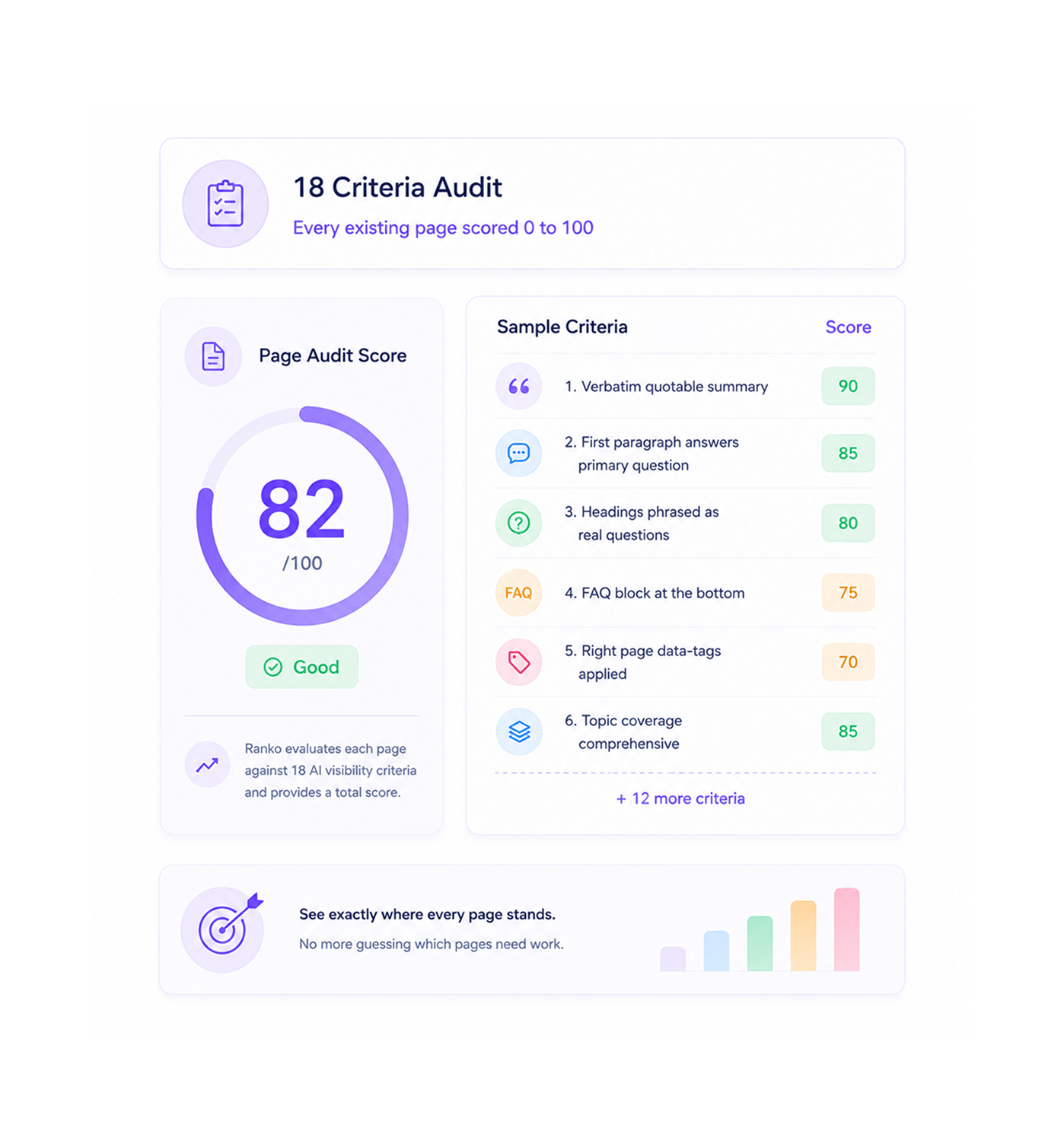
Ranko reads every page on your site and scores it against the eighteen things AI assistants actually look for when choosing what to cite. Does the page open with a short verbatim quotable summary. Does the first paragraph deliver a direct answer to the page's primary question. Are the headings phrased as real questions. Is there a frequently asked questions block at the bottom. Are the right page data tags applied. Is the topic coverage comprehensive. Twelve more criteria follow, each one scored individually, with the totals rolling up into a single zero to one hundred number per page. The team finally sees where every page stands rather than guessing which ones need work.
side by side View
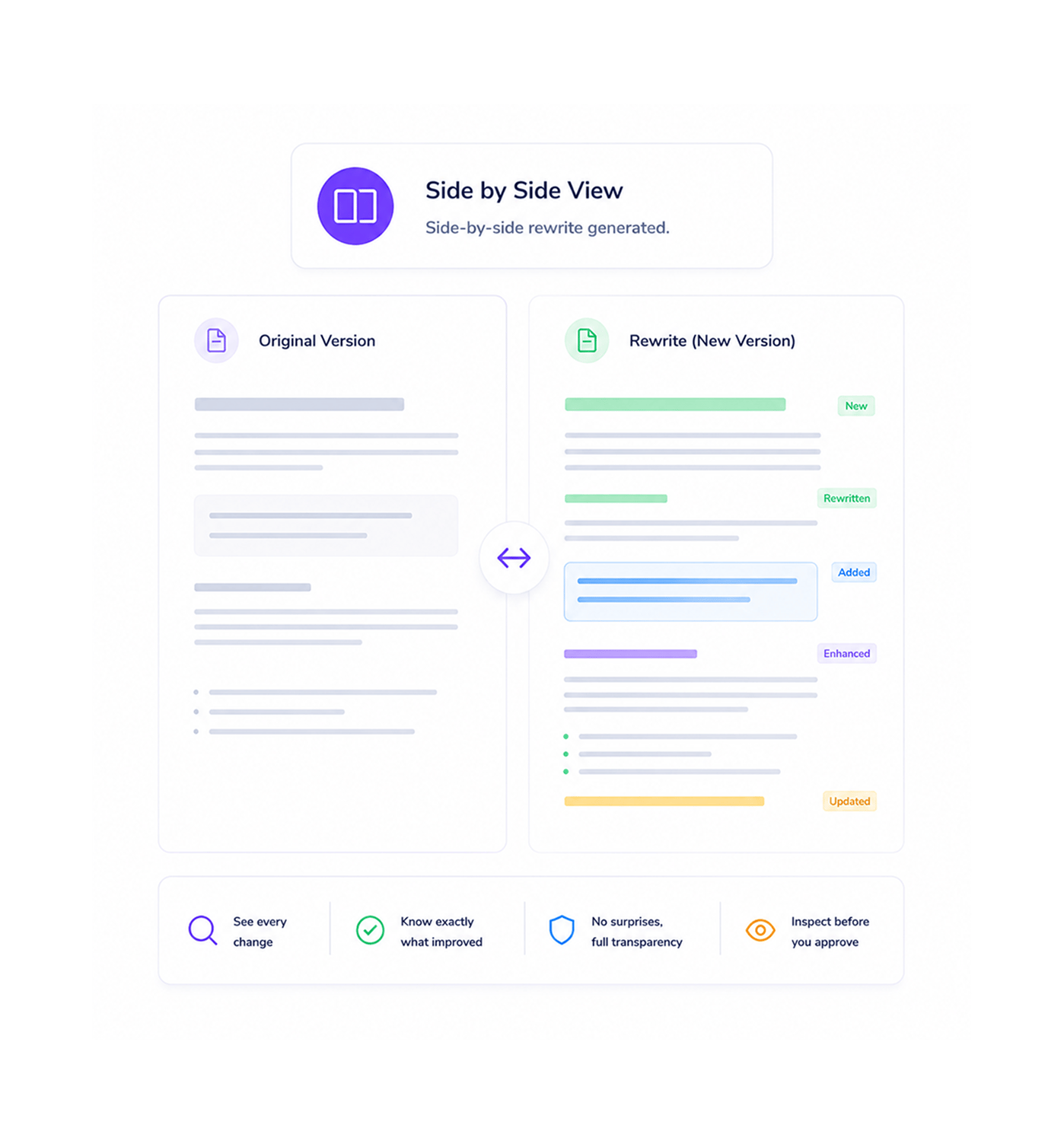
Where a page falls short, Ranko generates a rewrite that addresses the specific criteria the page failed on. The old version sits on the left of the screen. The new version sits on the right. Every change between them is highlighted the new opening summary, the rewritten headings, the added FAQ block, the missing page data tags now applied so the team sees exactly what was changed and why before approving anything. No surprise rewrites, no opaque transformations, no asking the team to trust a refresh they cannot inspect. The full diff is the deliverable.
URL Preservation
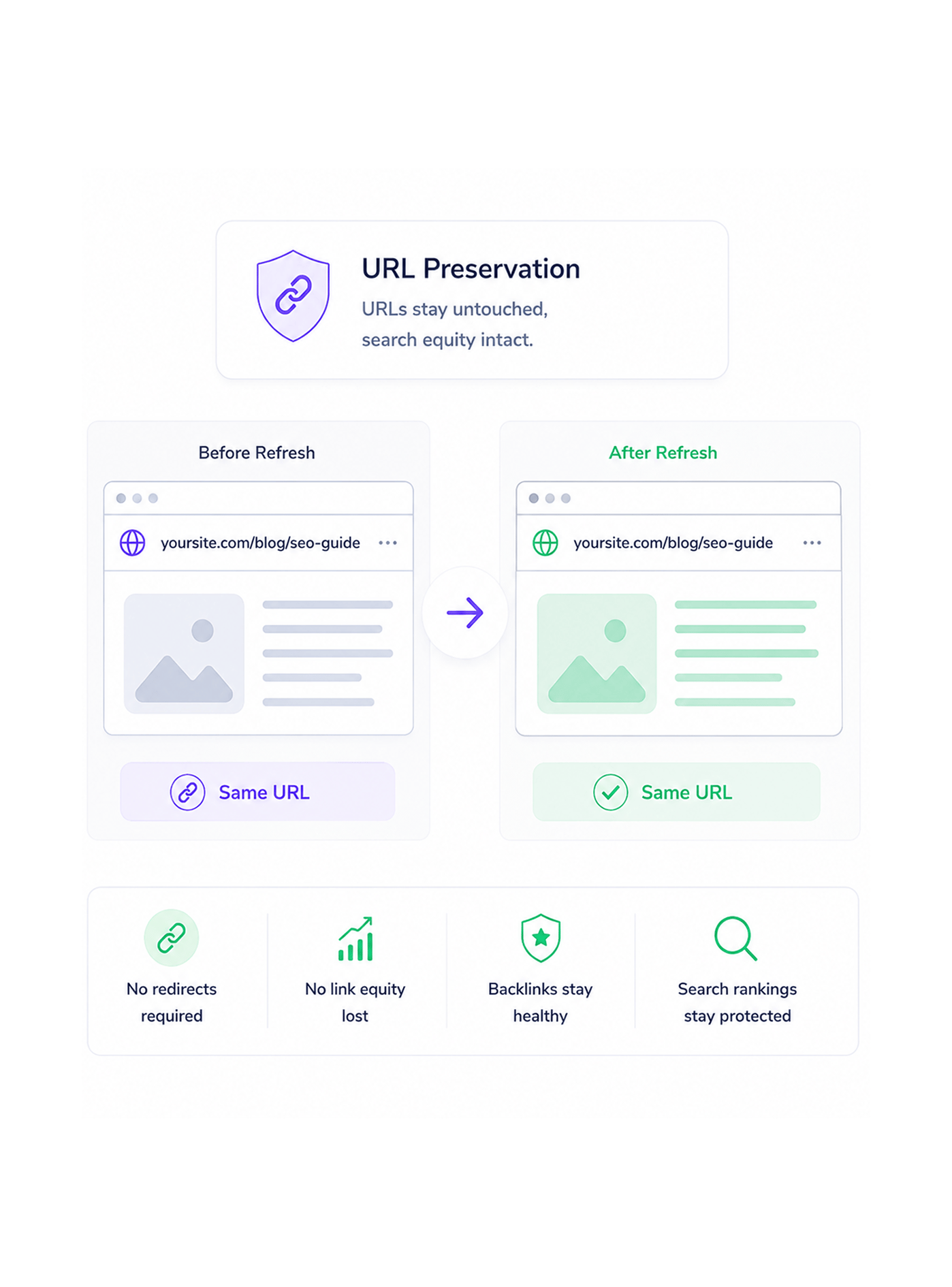
The URL of every refreshed page is preserved exactly as it was. No redirects required, no link equity lost, no backlinks pointing at suddenly broken paths. The search rankings the team built over years stay attached to the same URLs, and the rewrite improves the content sitting at those URLs without disturbing any of the structure search engines have already learned to trust. This is the property that makes Page Refresher genuinely safe to use on a high traffic library the alternative tools that ask the team to migrate URLs or restructure the site are alternatives that put existing rankings at real risk.
One Click Reversibility
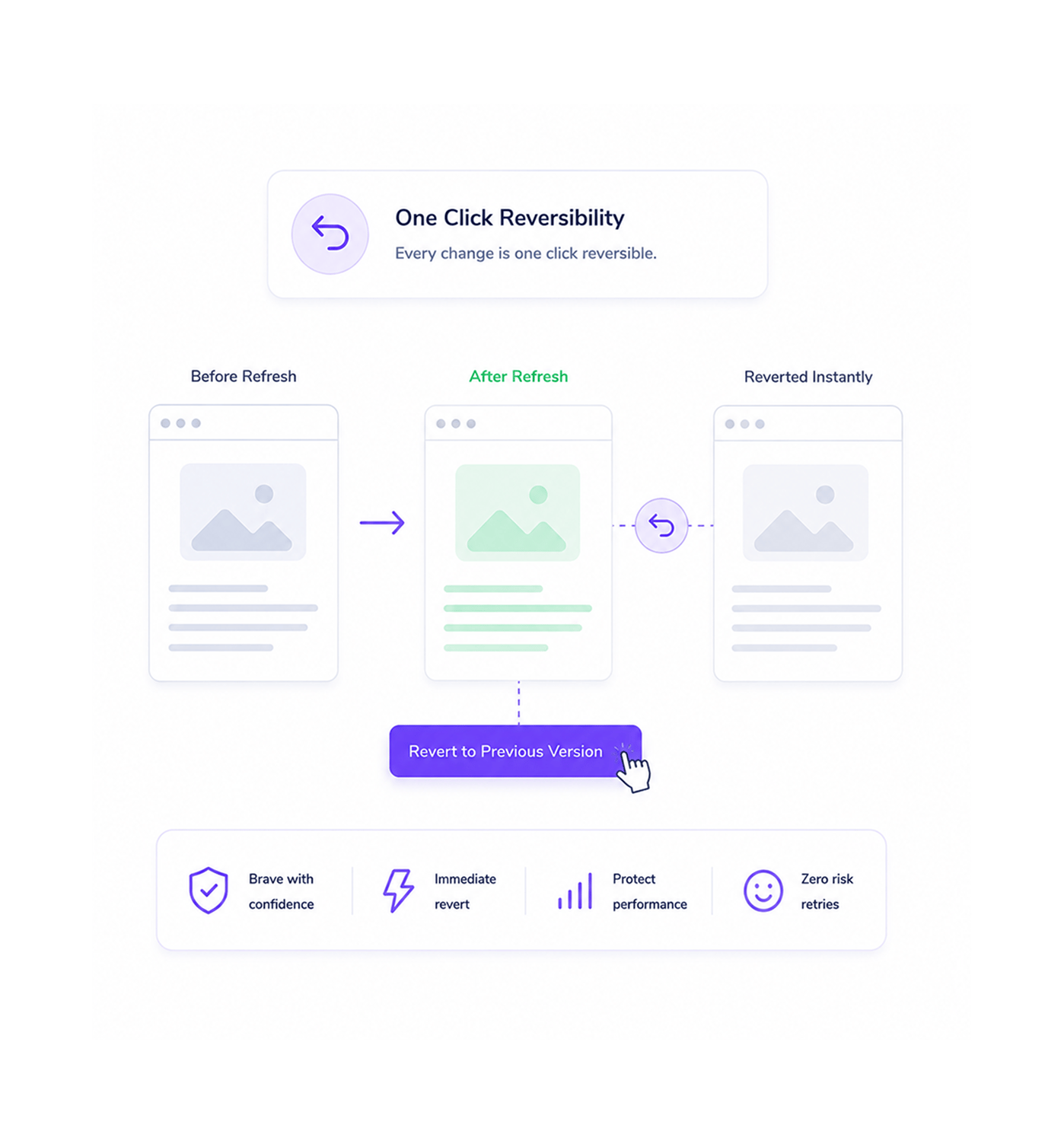
Every refresh is fully reversible. One click on the page, the article reverts to the previous version exactly as it was before the refresh. The team can be brave with the rewrite because they cannot be wrong with it for long if something does not work, if the metrics dip, if a stakeholder objects, the revert is immediate. This single property is what turns refreshing existing pages from a project the team has to schedule for a quiet quarter into a continuous process the team can run without ceremony. Bravery without risk is not just a slogan, it is the architecture.
Once a team can score every existing page against eighteen real AEO criteria, see a side by side rewrite for every page that falls short, refresh without touching the URLs that anchor the search equity, and revert any change with a single click, the old pattern of letting the old library quietly fall behind while the new calendar moves forward stops being acceptable. These are the changes that show up first.
A team with a hundred existing pages that already rank somewhere is sitting on more potential than they realise. Lifting every page one citation tier through targeted refresh produces more total traffic and more total citations than publishing the same number of new pages from scratch because the existing pages already have the trust signals, the backlinks, and the ranking foundations a new page has to build from zero. The biggest leverage in most content libraries is in the pages already published, not the ones not yet written.
The audit that says "this article looks fine to me" is the audit that misses the structural failures answer engines silently penalise. Eighteen concrete criteria summary, opening answer, headings, FAQ, tags, topic coverage, and twelve more produce a measurable score the team can act on rather than a gut feeling that may or may not match reality. The team finally knows which specific pages need which specific work, instead of which pages they have a vague sense of disliking.
The team is not asked to trust a rewrite they cannot see. Every refresh is a side by side view old on the left, new on the right, every change highlighted with the reason for it. The editor reviews the diff in the same way they would review a writer's edit, and approves or rejects each change with the same scrutiny. No surprise transformations, no opaque rewrites, no asking the team to take Ranko's word for what changed. The trust is earned by the transparency, every page, every time.
The single biggest objection to content refresh tools is that they ask the team to restructure URLs, configure redirects, or migrate parts of the site all of which put years of accumulated search equity at risk. Page Refresher does not touch URLs at all. The page sitting at /blog/some-article stays at /blog/some-article. The backlinks pointing at it still point at it. The rankings attached to it stay attached to it. The refresh improves the content without disturbing the structure search engines have learned to trust.
Teams refresh more aggressively when they know they can revert. The fear of breaking something irreversibly is what turns refresh projects into multi quarter consultations that never quite ship. One click reversibility removes the fear, which removes the friction, which means the team actually refreshes the library instead of talking about refreshing it. The architecture is what enables the bravery, and the bravery is what enables the work.
Most content teams ship new articles in the answer engine ready shape while their older library quietly stays in the SEO only shape it was written in. The gap between the new and the old grows every quarter until the older content is openly worse than the new. Page Refresher closes the gap the existing library catches up to the standards the calendar already meets, so every page on the site is working in the same shape rather than half the site competing for citations while the other half quietly cannot.
Every page scored zero to one hundred against eighteen AEO criteria. Side by side rewrite where pages fall short. URLs untouched. One click reversible. The audit and refresh layer your existing library has always needed.
14600+
Teams bringing their existing libraries up to answer engine standards
Founders who have spent years building content libraries that ranked beautifully on Google and now need those same pages to be quoted by ChatGPT, content marketing leads doing post Google update audits and wondering which pages to prioritise for the rewrite work, search specialists who know that the existing library is sitting on more search equity than any new pages could ever build, agencies running content programmes for clients whose archives contain hundreds of legacy pages that need to be brought forward to current standards, editors who have inherited content libraries built before answer engines existed and need to bring them up to the new standard without disturbing what already works, growth teams at SaaS companies whose product education content was written for SEO five years ago and now needs to be cited by the AI engines their buyers actually consult, and ecommerce operators with thousands of category and product pages that all need the same kind of structural lift all use Ranko's Page Refresher as the audit and rewrite layer that turns existing libraries from a liability into the biggest content asset the team has. Every team a small business refreshing twelve pages or a larger organisation working through thousands gets the same eighteen criteria scoring, the same side by side rewrite view, the same URL preservation, and the same one click reversibility.
Score
Criteria
By Side
Reversible
Ranko reads every page on your site and scores it from zero to one hundred against the eighteen things AI assistants actually look for summary, opening answer, question headings, FAQ block, page data tags, topic coverage, and twelve more. The team sees exactly which pages need which specific work rather than guessing which ones to prioritise.
A complete content audit and refresh toolkit built into the same answer engine optimisation platform your team already uses. Per page zero to one hundred AEO scoring, the eighteen criteria audit, side by side rewrite views, URL preservation by default, one click reversibility, and the library wide score dashboard come together so the team finally brings the existing library up to the standards the calendar already meets.
Every page on your site gets a single zero to one hundred score that compresses how the page measures up against the eighteen criteria into one comparable number. The team can sort the library by score, filter to the pages that need work most, and prioritise the refresh without arguing about which pages to do first the score does the prioritisation argument for them.
Every page is checked against the eighteen things AI assistants actually look for summary, direct opening answer, question style headings, FAQ block, page data tags, topic coverage, and twelve more. Each criterion is scored individually so the team sees not just whether the page passes but which specific criteria it fails on and what would need to change to lift the score.
Where a page falls short, Ranko generates the rewrite and shows it side by side with the original. Old version on the left, new version on the right, every change highlighted with the reason for it. The editor reviews the diff in the same way they would review a writer's edit, and approves or rejects each change with the same scrutiny. Transparent by default.
The URL of every refreshed page is preserved exactly as it was. No redirects required, no backlinks broken, no link equity lost. The page sitting at /blog/some-article stays at /blog/some-article. The years of search equity the team built stay attached to the same URLs, and the rewrite improves the content sitting at those URLs without putting any rankings at risk.
Every refresh is fully reversible. One click on the page reverts the article to the previous version exactly as it was before the refresh. The team can be brave with the rewrite because the cost of being wrong is zero if a refresh underperforms, the team reverts and tries something else. Bravery without risk is the architecture.
Every page on the site appears in a single dashboard sorted by score, with the criteria each page failed on and the priority for refresh. The team sees the whole library's current state at a glance which pages are already in good shape, which need targeted refresh, and which are sitting on big citation upside the refresh would unlock. Strategy becomes visible at the library level rather than just per page.
Every page on your site gets a single zero to one hundred score that compresses how the page measures up against the eighteen criteria into one comparable number. The team can sort the library by score, filter to the pages that need work most, and prioritise the refresh without arguing about which pages to do first the score does the prioritisation argument for them.
Every page is checked against the eighteen things AI assistants actually look for summary, direct opening answer, question style headings, FAQ block, page data tags, topic coverage, and twelve more. Each criterion is scored individually so the team sees not just whether the page passes but which specific criteria it fails on and what would need to change to lift the score.
Where a page falls short, Ranko generates the rewrite and shows it side by side with the original. Old version on the left, new version on the right, every change highlighted with the reason for it. The editor reviews the diff in the same way they would review a writer's edit, and approves or rejects each change with the same scrutiny. Transparent by default.
The URL of every refreshed page is preserved exactly as it was. No redirects required, no backlinks broken, no link equity lost. The page sitting at /blog/some-article stays at /blog/some-article. The years of search equity the team built stay attached to the same URLs, and the rewrite improves the content sitting at those URLs without putting any rankings at risk.
Every refresh is fully reversible. One click on the page reverts the article to the previous version exactly as it was before the refresh. The team can be brave with the rewrite because the cost of being wrong is zero if a refresh underperforms, the team reverts and tries something else. Bravery without risk is the architecture.
Every page on the site appears in a single dashboard sorted by score, with the criteria each page failed on and the priority for refresh. The team sees the whole library's current state at a glance which pages are already in good shape, which need targeted refresh, and which are sitting on big citation upside the refresh would unlock. Strategy becomes visible at the library level rather than just per page.
Common questions about exactly what the eighteen criteria cover, how the side by side rewrite view works in practice, what stays untouched and what changes, how the reversibility actually works under the hood, whether the team can refresh the library in bulk, and how Page Refresher works alongside Article Writer.
The eighteen criteria cover every structural and substantive property answer engines look for when choosing what to cite. Six are visible in the page hero short summary at the top, direct opening answer, question style headings, frequently asked questions block, page data tags, topic coverage breadth. The other twelve include answer depth on each heading, internal linking to related pages, originality against the broader web, freshness of the underlying facts, source attribution where claims warrant it, accessibility of the structure, brand voice consistency, real conversational language, presence of comparison tables where the topic calls for them, scannability for the reader, mobile readability, and metadata completeness. Each criterion is scored individually so the team sees exactly which ones a specific page is failing rather than just an overall verdict.
Every page scored zero to one hundred against eighteen AEO criteria. Side by side rewrite where pages fall short. URLs untouched so search equity stays intact. Every change one click reversible. The audit and refresh layer your existing library has always deserved.