Connect what you have. Push to where you work.

Ranko pulls real data from Google Search Console, Google Analytics 4, Ahrefs, Semrush, and Bing Webmaster and pushes briefs, clusters, and calendars to Notion, Asana, ClickUp, Trello, Linear, and Google Sheets. Zero copy paste between tools. Zero drift between sources. Your stack stays your stack, and Ranko slots into the middle of it as the connecting layer that finally makes the whole thing work as one.

Connect what
How it works

From scattered tools to a connected stack in 4 steps

Connect your sources through a secure sign in. Real performance, traffic, and keyword data flows in from Google Search Console, Google Analytics 4, Ahrefs, Semrush, and Bing Webmaster. Ranko does its work building clusters, scoring opportunities, planning quarters, scheduling calendars. The output flows out to Notion, Asana, ClickUp, Trello, Linear, and Google Sheets, landing in the tools your team already uses to ship the work.

1
2
3
4

Connect Sources

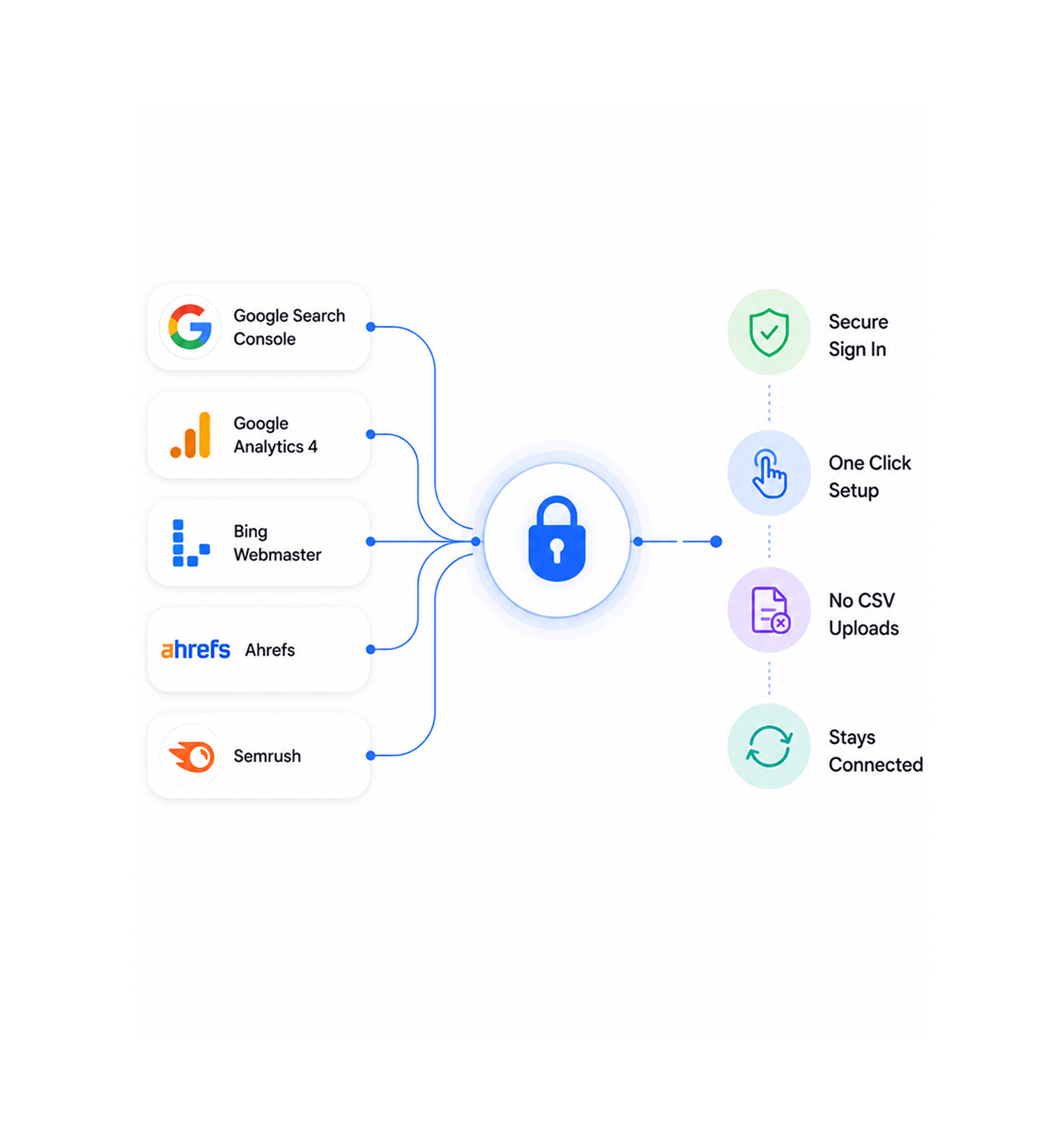
Connect your sources, no copy paste setup

Authorise each source with a single secure sign in. No CSV exports, no manual uploads, no spreadsheet handoffs. Google Search Console connects with a click. Google Analytics 4 connects with a click. Ahrefs, Semrush, and Bing Webmaster connect with their respective sign ins. The team spends a few minutes on setup once and the connections stay live from then on, refreshing automatically as new data lands in the source platforms.

Secure Sign InOne Click SetupNo CSV UploadsStays Connected

Real Data In

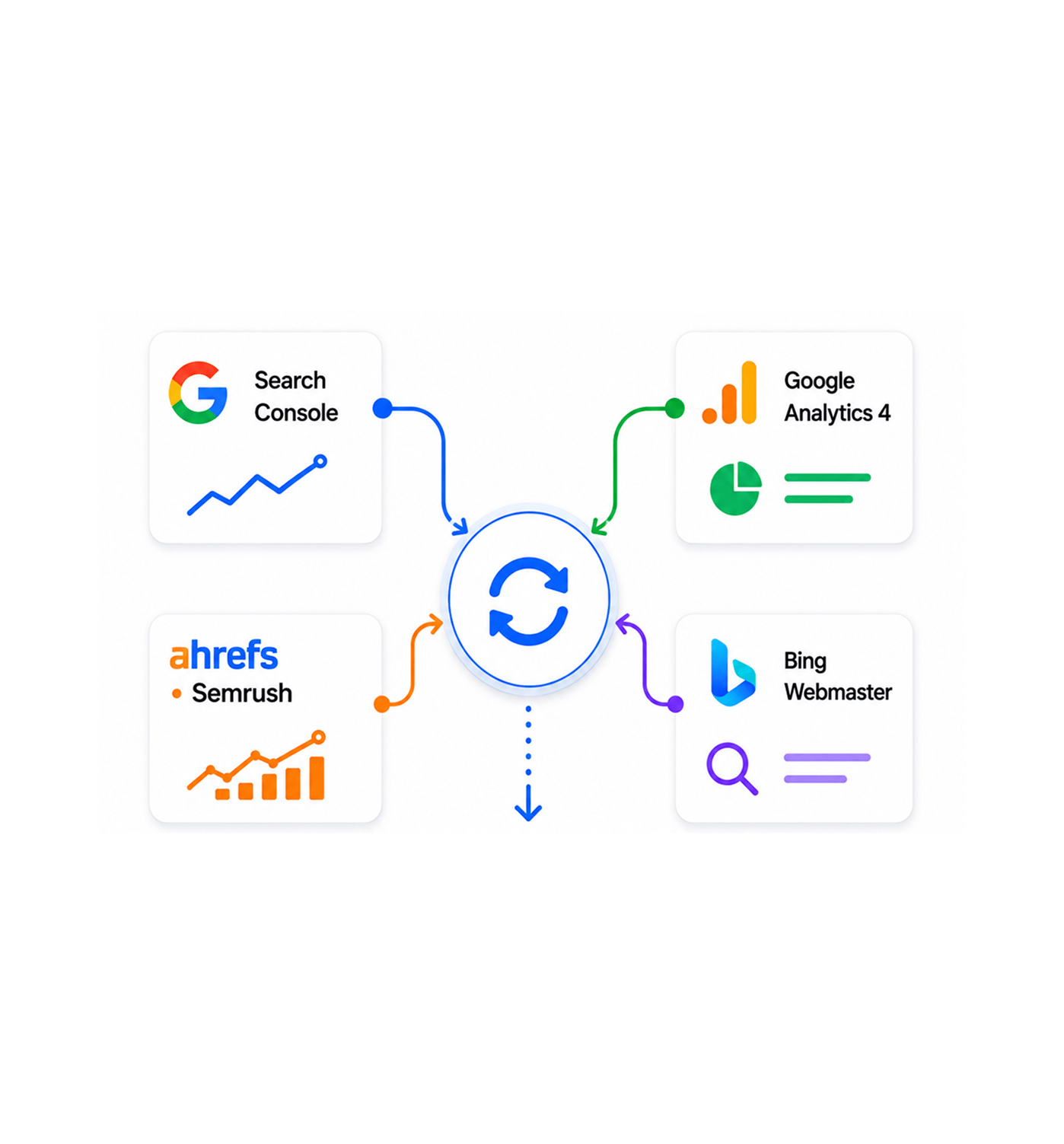
Real data flows in, automatically refreshed

Search Console feeds the queries, clicks, impressions, and average position for every page on your site. Google Analytics 4 feeds the actual traffic, the conversion data, and the engagement signals. Ahrefs and Semrush feed the keyword landscape, the backlink profile, and the competitor view. Bing Webmaster feeds the search side that the team usually forgets about until it surprises them. All of it refreshes automatically so the data Ranko works from is the data your tools are currently reporting, not a snapshot from last Tuesday.

Search ConsoleAnalytics 4Ahrefs · SemrushBing Webmaster

Ranko Does Its Work

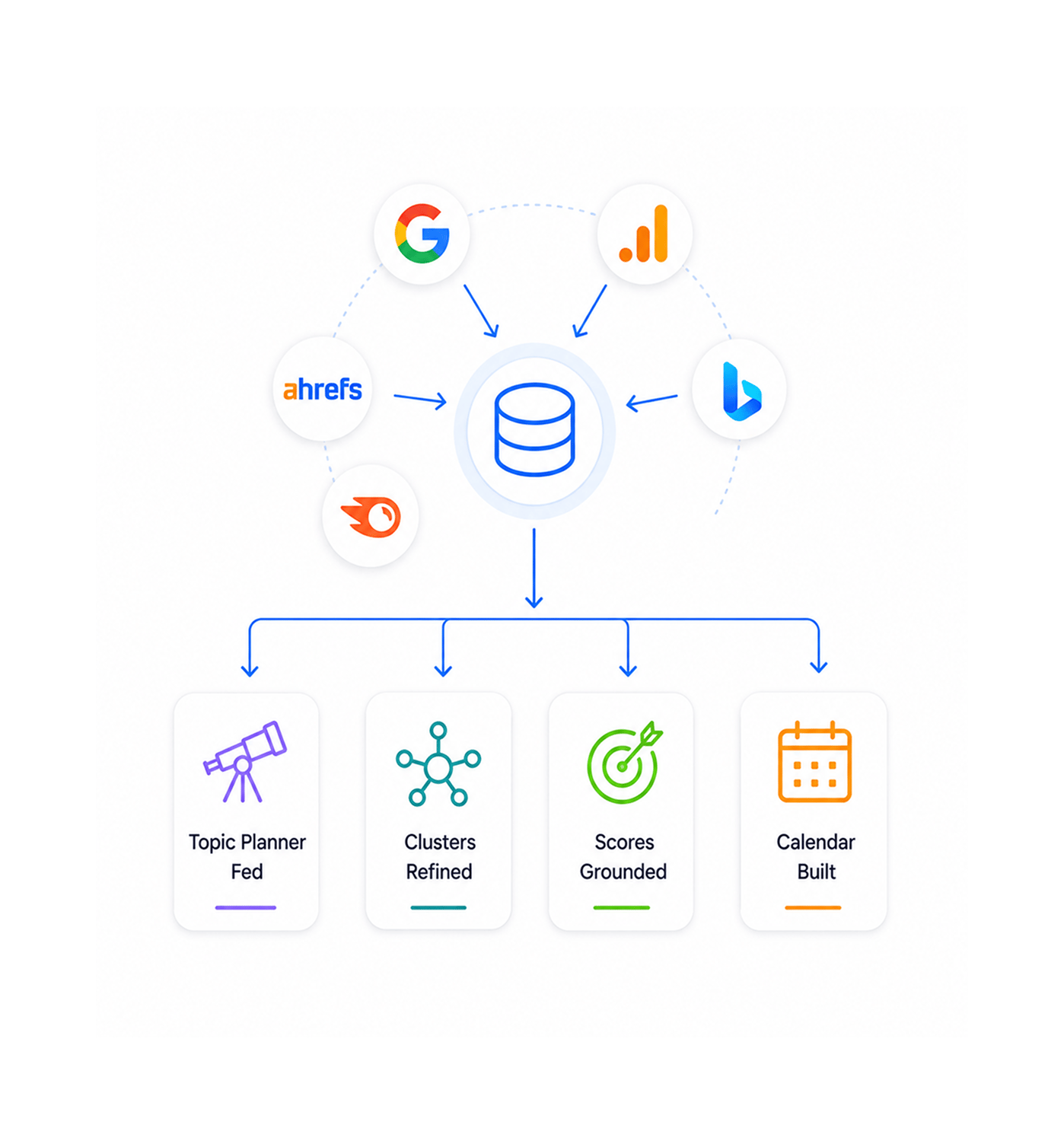
Clusters, plans, scores, calendars

The data flowing in from your sources feeds straight into the rest of the Ranko engine. Topic Planner uses the Search Console performance and the Ahrefs and Semrush landscape to build the ninety day plan. Topic Clusters lean on the actual page performance to suggest which clusters need depth. Opportunity Score reads the live picture from every connected source to keep the prioritisation honest. The 90 Day Calendar inherits all of it and turns it into a schedule. Nothing about the rest of Ranko has to assume every decision is grounded in the team's real data.

Topic Planner FedClusters RefinedScores GroundedCalendar Built

Output Flows Out

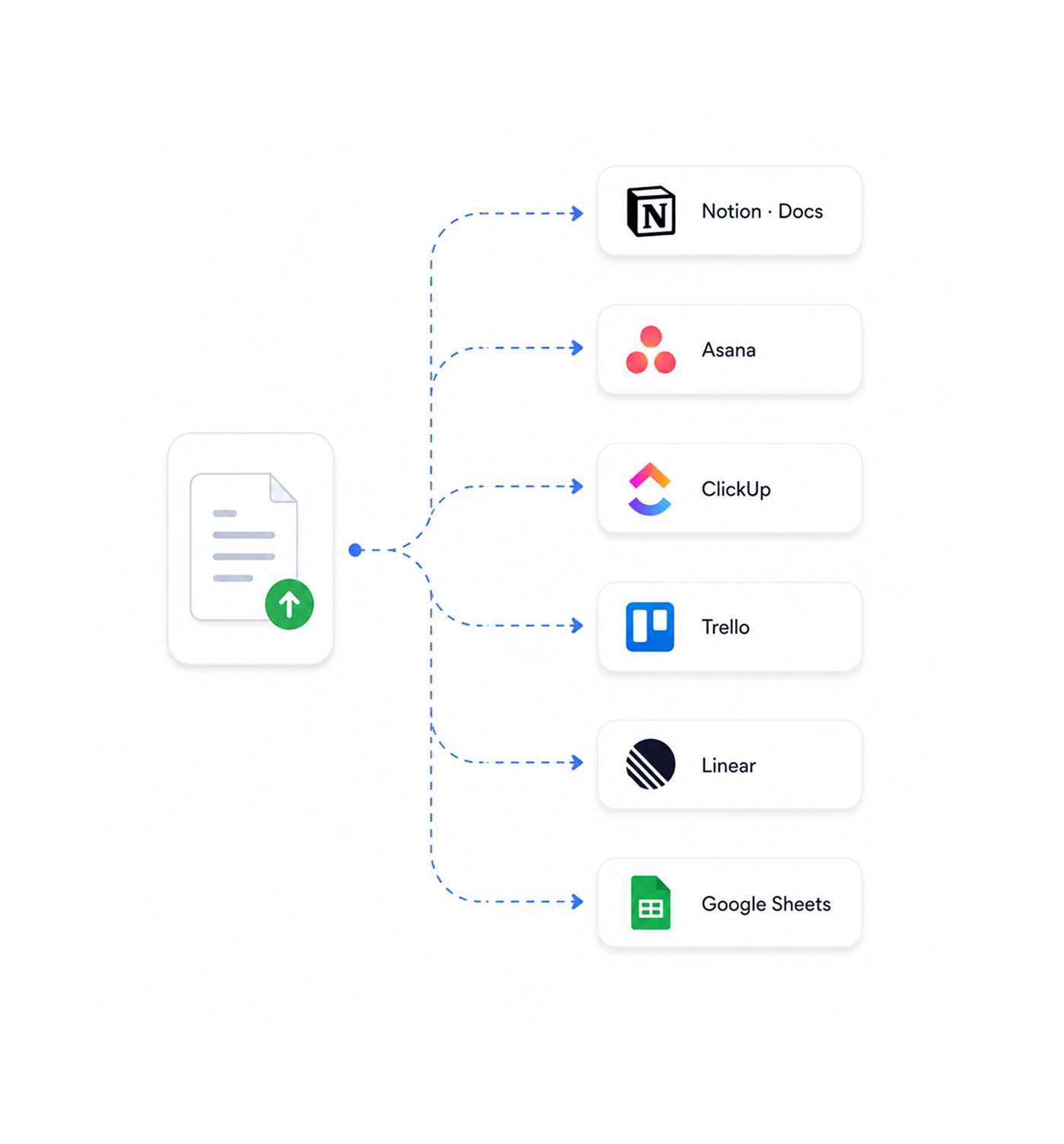
Push to where your team already works

Briefs push to Notion as ready to write documents. Tasks push to Asana, ClickUp, Trello, or Linear with the brief attached and the deadline set. Calendars push to Google Sheets when somebody needs a portable view. The writers open Notion and find the brief waiting. The project tracker shows the task in the right column on the right day. The team that wanted to see a spreadsheet sees a spreadsheet. Nobody has to learn a new tool and nothing has to be copied between systems by hand.

Notion · DocsAsana · ClickUp · TrelloLinearGoogle Sheets
Why Teams Choose RANKO

Six reasons your stack finally works as one

Once a team can pull real data from the SEO and analytics tools they already use and push briefs to the workflow tools where the writing actually happens without any copy paste in between the old pattern of five tabs open and constant manual reconciliation simply stops being acceptable. These are the changes that show up first.

The data is real, not exported from yesterday

The data is real, not exported from yesterday

Every Ranko decision is grounded in what your connected sources are reporting right now. The Search Console performance Ranko sees is the performance Search Console is currently showing. The keyword position from Ahrefs is the position Ahrefs is currently tracking. The conversion data from Analytics 4 is the data the team would see if they opened Analytics 4 themselves. The I exported this on Tuesday so it might be slightly off disclaimer that used to follow every content strategy meeting simply stops being necessary.

Your existing tools stay your existing tools

Your existing tools stay your existing tools

The Search Console, Analytics, Ahrefs, Semrush, and Bing accounts the team has spent years configuring stay exactly where they are. Ranko reads from them, never overwrites them, never makes the team migrate anything. The same applies on the output side Notion is still Notion, Asana is still Asana, the writers still work where they have always worked. Adopting Ranko does not require unwinding any existing setup, which is exactly the property that makes it actually possible to adopt in week one rather than quarter three.

Briefs land where the writers already work

Briefs land where the writers already work

If the team writes in Notion, the brief lands in Notion. If the team writes in Google Docs, the brief lands in Google Docs. The writer does not have to learn a new platform, log into a separate dashboard, or copy a brief from one tool into another. The shortest possible distance between we decided to publish this and the writer started writing gets shorter still, which is exactly where most content operations leak the time they cannot afford to lose.

Calendars sync to your existing project tracker

Calendars sync to your existing project tracker

The publishing calendar in Ranko pushes to Asana, ClickUp, Trello, or Linear with the brief attached, the assignee set, the deadline configured, and the priority weighted. Whichever project tracker the team already runs ops in becomes the surface where the calendar shows up so the team is never asked to maintain two calendars or to open a separate Ranko window to know what is due this week.

Drift between systems quietly stops

Drift between systems quietly stops

Two systems with the same data and no live connection between them are two systems that disagree by Thursday. Every copy paste workflow eventually develops drift the spreadsheet says one thing, the project tracker says another, the dashboard says a third. Live connections in both directions mean the data in Ranko, the brief in Notion, the task in ClickUp, and the source in Analytics 4 always tell the same story, which removes an entire category of wait, which version is right arguments from the team's week.

Adopting Ranko costs zero migrations

Adopting Ranko costs zero migrations

The most expensive part of adopting any new tool is usually not the tool itself it is the cost of moving everything to it. Ranko's import and export coverage means there is nothing to migrate. The data the team already has stays where it is. The work the writers already do stays in the platforms they already use. Ranko slots into the middle as the connecting layer, which means the team can be running on Ranko by the end of the first week rather than by the end of the first quarter.

One platform in the middle. The tools you already have on either side.

Five direct imports from the SEO and analytics stack. Six direct exports to the workflow tools where your team already works. Zero copy paste, zero data drift. The connecting layer your content engine has always needed.

Who uses RANKO imports and exports
Deepak MehrotraDeepak MehrotraDeepak MehrotraDeepak Mehrotra

11200+

Teams running Ranko in the middle of the stack they already had

Built for teams who refuse to rip and replace their stack

Founders who refuse to lose a quarter to tool migration before any content actually ships, content marketing leads who need the data their leadership trusts to be the same data Ranko is acting on, search specialists who have spent years tuning their Search Console, Analytics, Ahrefs and Semrush setups and have no intention of rebuilding any of it, agencies running ten different stack combinations across ten different clients who need Ranko to fit each one without bespoke configuration, growth teams at SaaS companies whose writers are already deeply in Notion and whose project managers are already deeply in Linear, and ecommerce operators whose category page production runs through a fixed Asana workflow they cannot disrupt all use Ranko's imports and exports as the connecting layer that makes adopting a new platform a question of plugging in rather than tearing down. Every team a small business connecting two tools or a larger organisation orchestrating across the full five plus six lineup gets the same secure sign in, the same live refresh, and the same zero drift guarantee.

5

Score

6

Destinations

0

Copy Paste

Live

Sync

Import Layer

GSC, GA4, Ahrefs, Semrush, Bing

Five direct imports cover the SEO and analytics stack most teams already run. Google Search Console for queries, clicks, impressions, and position. Google Analytics 4 for traffic, conversions, and engagement. Ahrefs and Semrush for the keyword landscape and backlink profile. Bing Webmaster for the search side most teams forget. All five refresh automatically so Ranko always works from the data your tools are currently reporting.

GSC, GA4, Ahrefs, Semrush, Bing
Features

Everything the integration layer ships with

A complete connectivity toolkit built into the same answer engine optimisation platform your team already uses. Search Console import, Analytics 4 import, Ahrefs and Semrush import, Bing Webmaster import, Notion and Google Docs export, project tracker export across Asana, ClickUp, Trello and Linear, and the universal Google Sheets escape hatch come together so the team finally works from one connected stack rather than five tabs open at once.

Google Search Console Import

Google Search Console Import

Live performance data flowing in from the property you already have configured the queries that drive your traffic, the clicks and impressions per query, the average position per page, and the changes over time. Ranko reads from Search Console continuously, so the topic prioritisation and the cluster recommendations are always grounded in your actual search performance rather than an estimate from a third party tool.

Google Analytics 4 Import

Google Analytics 4 Import

Real traffic and conversion data feeding straight into Ranko from the Analytics 4 property the team already runs. Page level engagement, conversion data, audience signals, and the change in performance over time all flow in automatically. The team finally has a content tool that knows whether the published work is actually converting not just whether it ranked.

Ahrefs and Semrush Import

Ahrefs and Semrush Import

The keyword landscape, the backlink profile, the competitor positions, the SERP feature visibility the data the team is already paying these tools to maintain flows directly into Ranko through the existing accounts. No re entering keywords, no copying competitor lists from one platform to another, no manually reconciling two slightly different keyword universes. Whichever tool the team prefers connects with the same secure sign in.

Bing Webmaster Import

Bing Webmaster Import

The search side most teams forget about until they remember that Bing powers ChatGPT search and is the engine behind Microsoft's surfacing of cited sources. Bing Webmaster data flows in alongside the Google data, so the Ranko view covers both halves of traditional search rather than letting one of them quietly become a blind spot.

Notion and Google Docs Export

Notion and Google Docs Export

Briefs push directly into the workspace the writers already live in. Notion pages with the full brief, the linking targets, the article type, the pillar and supports, and the Opportunity Score all attached. Google Docs files with the same content laid out for editing. The writer opens the destination tool and finds the brief waiting no separate dashboard to learn, no extra step between strategy and writing.

Project Tracker Export

Project Tracker Export

Tasks push to Asana, ClickUp, Trello, or Linear with the brief attached, the deadline set, the assignee chosen, and the priority weighted. The project tracker the team already runs ops in becomes the surface where the publishing calendar shows up. Plus Google Sheets stays as the universal escape hatch for anyone who needs a portable view they can share with stakeholders who do not live in any of the above.

Google Search Console Import

Google Search Console Import

Live performance data flowing in from the property you already have configured the queries that drive your traffic, the clicks and impressions per query, the average position per page, and the changes over time. Ranko reads from Search Console continuously, so the topic prioritisation and the cluster recommendations are always grounded in your actual search performance rather than an estimate from a third party tool.

Google Analytics 4 Import

Google Analytics 4 Import

Real traffic and conversion data feeding straight into Ranko from the Analytics 4 property the team already runs. Page level engagement, conversion data, audience signals, and the change in performance over time all flow in automatically. The team finally has a content tool that knows whether the published work is actually converting not just whether it ranked.

Ahrefs and Semrush Import

Ahrefs and Semrush Import

The keyword landscape, the backlink profile, the competitor positions, the SERP feature visibility the data the team is already paying these tools to maintain flows directly into Ranko through the existing accounts. No re entering keywords, no copying competitor lists from one platform to another, no manually reconciling two slightly different keyword universes. Whichever tool the team prefers connects with the same secure sign in.

Bing Webmaster Import

Bing Webmaster Import

The search side most teams forget about until they remember that Bing powers ChatGPT search and is the engine behind Microsoft's surfacing of cited sources. Bing Webmaster data flows in alongside the Google data, so the Ranko view covers both halves of traditional search rather than letting one of them quietly become a blind spot.

Notion and Google Docs Export

Notion and Google Docs Export

Briefs push directly into the workspace the writers already live in. Notion pages with the full brief, the linking targets, the article type, the pillar and supports, and the Opportunity Score all attached. Google Docs files with the same content laid out for editing. The writer opens the destination tool and finds the brief waiting no separate dashboard to learn, no extra step between strategy and writing.

Project Tracker Export

Project Tracker Export

Tasks push to Asana, ClickUp, Trello, or Linear with the brief attached, the deadline set, the assignee chosen, and the priority weighted. The project tracker the team already runs ops in becomes the surface where the publishing calendar shows up. Plus Google Sheets stays as the universal escape hatch for anyone who needs a portable view they can share with stakeholders who do not live in any of the above.

Questions & answers

Everything you need to know

Common questions about exactly what data each source pulls in, what each destination receives, how often the sync runs, what happens if a source goes down, whether the connections write back to the source tools, and how secure the connections are.

Each source feeds Ranko the data the team would already see if they opened that tool themselves. Search Console contributes the queries, clicks, impressions, average position, page level performance, and the change over time. Analytics 4 contributes the traffic per page, the conversion data, the engagement signals, and the audience breakdowns the team has configured. Ahrefs and Semrush contribute the keyword landscape, the position tracking, the backlink profile, the competitor positions, and the SERP feature visibility. Bing Webmaster contributes the Bing equivalents of the Search Console data, which matters because Bing now powers part of the AI assistant ecosystem. Nothing is invented and nothing is extrapolated every data point in Ranko is traceable to one of the source tools the team already trusts.

Network background
RANKO · Opportunity Score

Stop copy pasting between five tools..
tart working from one platform
hat connects to all of them.

Five direct imports from Search Console, Analytics 4, Ahrefs, Semrush, and Bing Webmaster. Six direct exports to Notion, Asana, ClickUp, Trello, Linear, and Google Sheets. Zero copy paste, zero data drift. The connecting layer your content engine has always deserved.