Before you commit the article to live, Ranko runs the page through ChatGPT, Claude, Perplexity, and Gemini with the five most relevant questions readers are likely to ask. You see whether your page got quoted, which exact passage was used, and which competitor was picked instead for every engine, for every question. The publish button stops being a guess and starts being an informed decision.
Pick the article that is ready to ship. Ranko runs it through ChatGPT, Claude, Perplexity, and Gemini with the five most relevant questions readers are likely to ask twenty live runs across the four engines. The verdict comes back per engine, per question quoted or not, which exact passage was lifted if it was, which competitor was picked if your page was not. Refine before publish, or ship with confidence the article will earn quotes from day one.
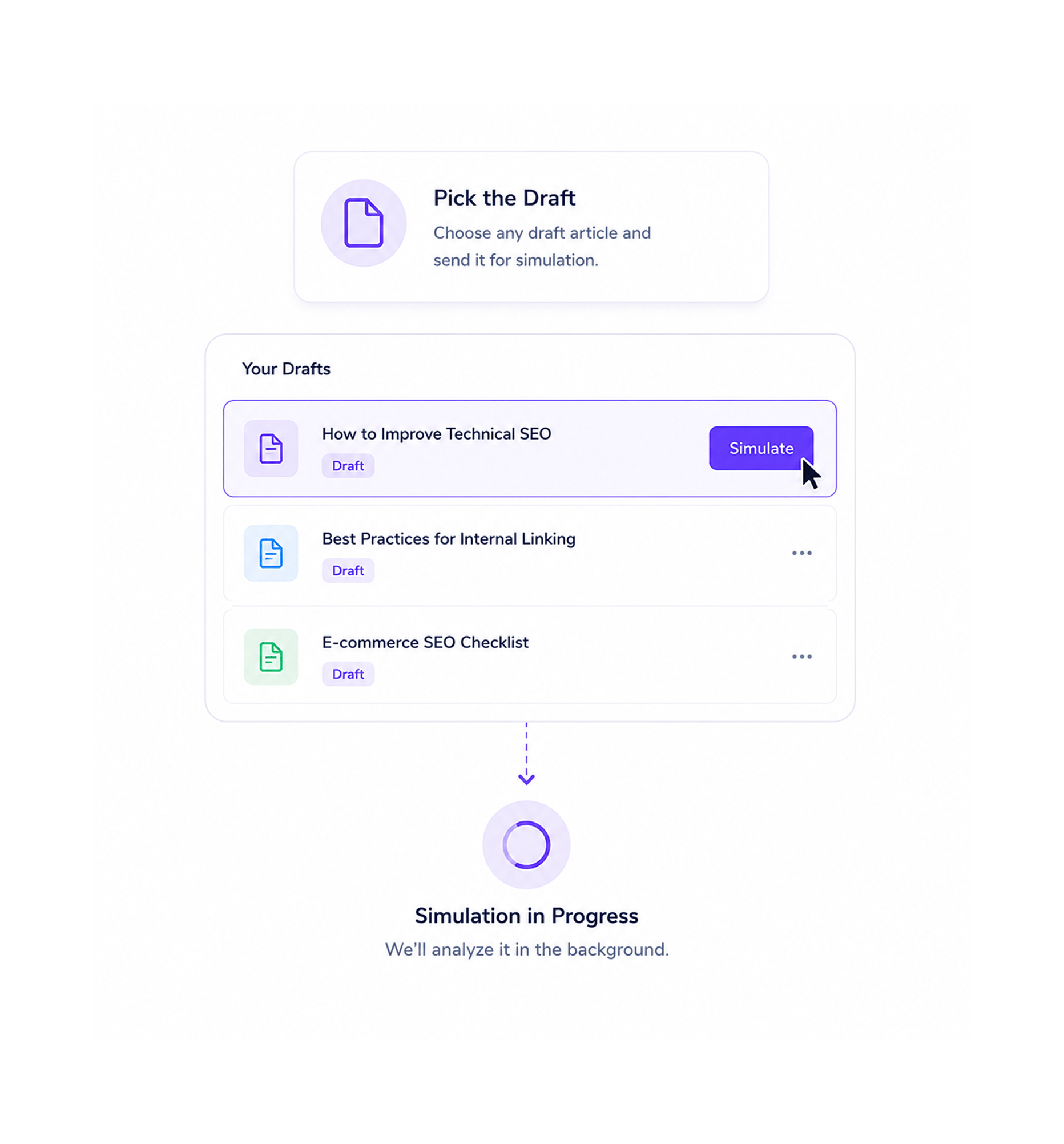
Pick the Draft
Any draft in Ranko can be sent into the simulator articles written by Article Writer, pages produced by Page Refresher, content imported from elsewhere. Articles already scheduled on the 90 Day Calendar can be simulated before they reach their publishing date. Articles in draft can be tested before the editor sends them on. The team picks the article they want pre flight confidence on, hits simulate, and the rest happens in the background.
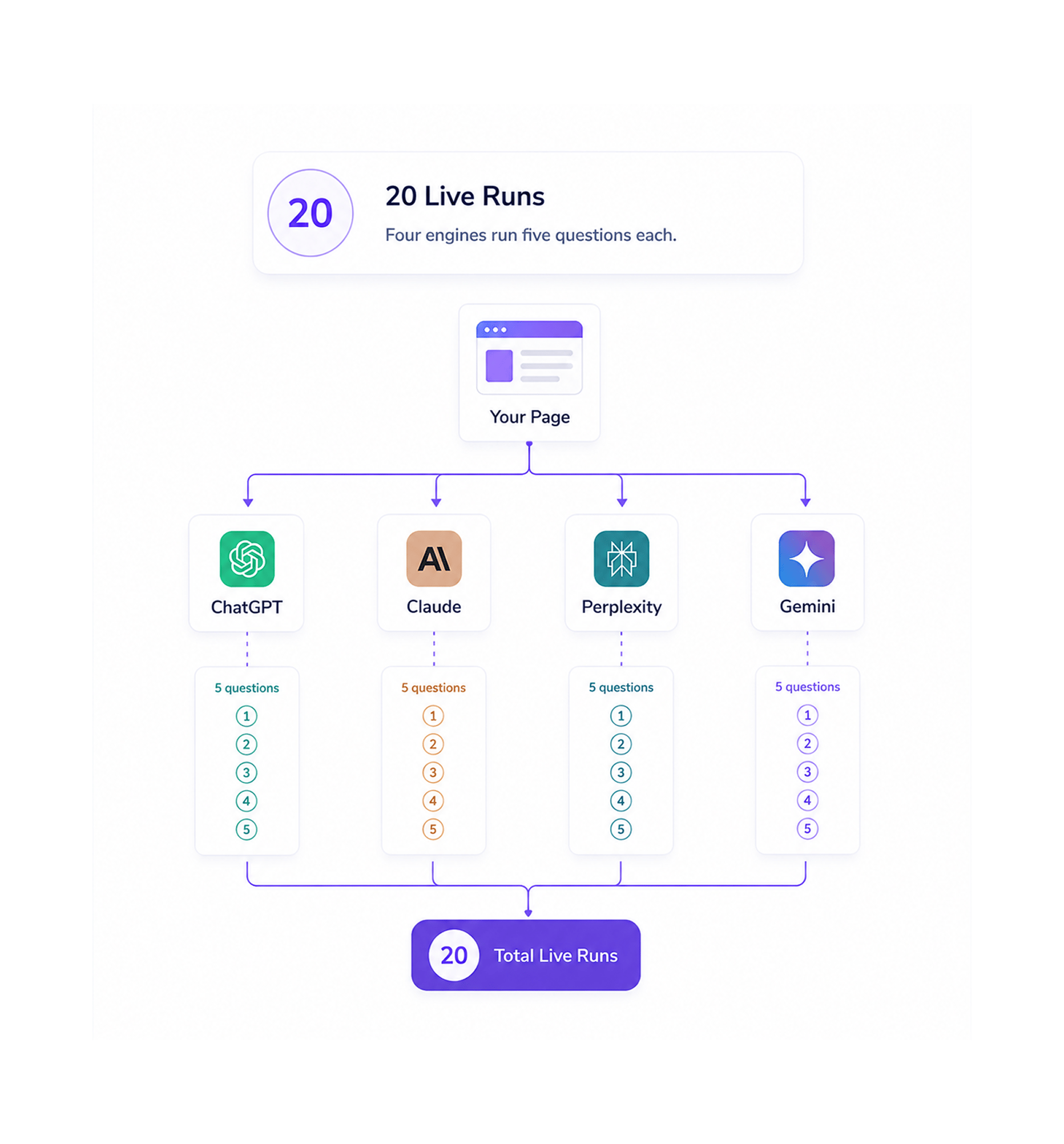
20 Live Runs
Ranko runs the page through ChatGPT, Claude, Perplexity, and Gemini with the five most relevant questions readers are likely to ask about the article's topic twenty live runs in total. Each engine asks each question independently, captures the answer, and records whether the page in front of the simulator was quoted as one of the sources. The four engines have genuinely different behaviour when they pick what to quote, which is why each one runs separately rather than being averaged into a generic verdict.
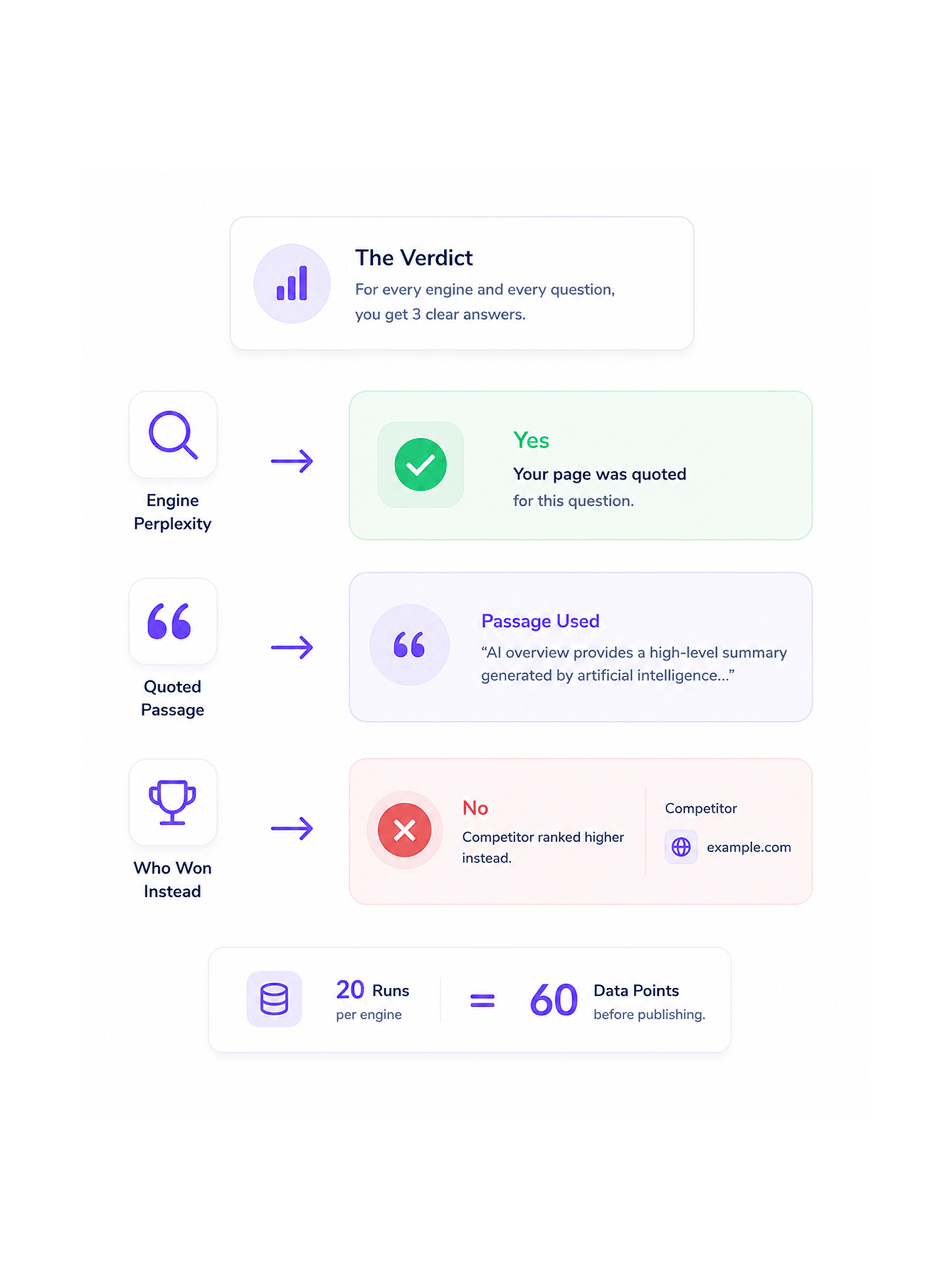
The Verdict
For every engine and every question, the simulation returns three pieces of intelligence. First, was your page quoted by this engine for this question a clear yes or no. Second, if yes, which exact passage was lifted as the quote the specific sentence or paragraph the engine pulled, so the team can see why that block worked. Third, if no, which competitor was picked instead the specific rival domain the engine reached for ahead of you. Three pieces of intelligence multiplied by twenty runs equals sixty data points the team has before publishing, instead of zero.
Refine or Ship
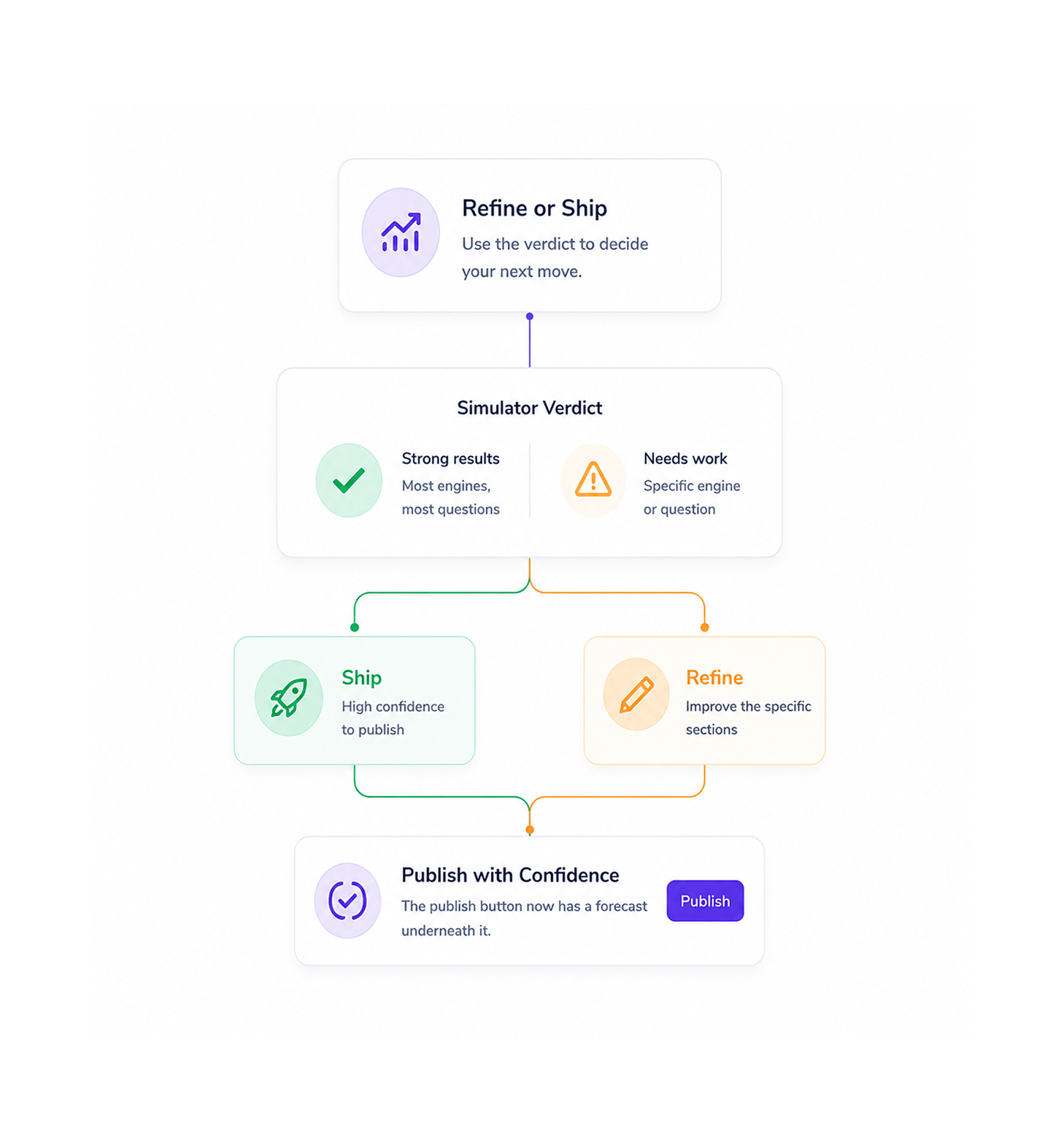
With the verdict in hand, the team decides what to do. Strong results across most engines and most questions mean the article is ready to publish with high confidence it will earn quotes. Weaker results on a specific engine or a specific question mean the team can identify exactly which sections need refining the passage a competitor's article won on, the question Ranko did not pull the team's page for, the engine where the page was visible but not picked. Refine the relevant sections, run the simulator again, and ship when the verdict matches the team's confidence threshold. The publish button finally has a forecast underneath it.
Once a team can run every draft through ChatGPT, Claude, Perplexity, and Gemini with five real questions before committing to publish and see exactly which passages got quoted, which competitor won where the page lost the old pattern of shipping articles and waiting weeks to find out whether they earned anything stops being acceptable. These are the changes that show up first.
Publishing without a pre-flight check is shipping into the dark and waiting weeks for analytics to tell the team whether the article worked. The Mention Simulator turns the publish decision into an informed one the team sees twenty live results across four engines before committing, knows which sections genuinely earn quotes and which do not, and ships with the confidence that the article will perform from day one rather than the hope that it might.
An overall forecast is useful. A per engine, per question, per passage forecast is genuinely actionable. The team sees not just whether the article works on average but which engines it wins on, which questions it gets quoted for, and which exact sentences are the ones doing the work. The granularity is what makes the simulator a refinement tool rather than just an evaluation tool.
The simulator does not just tell the team their article lost. It tells them which competitor was picked instead by name, by domain, by the specific page the engine reached for. That intelligence is the strategic answer that turns a failed simulation from a disappointment into a roadmap. The team sees exactly who is currently winning on that question, can study the competitor's page directly, and refines their own article specifically to displace the rival's claim on that question.
Refining an article in production means the version readers and engines saw first is the version with the problems. Pre publish refinement means the first version live is the best version the team can ship. The simulator turns the editorial revision loop from a post publish corrective process into a pre publish improvement process, which is the only loop where the team's compounding actually compounds rather than starting over each time.
An article that wins on ChatGPT but loses on Perplexity is still a partial win. An article that wins on three of four engines is a strong publish. An article that loses on all four needs another pass before live. The four engine simulation gives the team the precise picture of where the article works and where it falls short, which lets the team make a publish or refine call based on actual coverage rather than overall vibe.
Teams running the simulator regularly start noticing patterns which structural moves consistently earn quotes, which heading shapes tend to win on which engines, which competitors keep beating the team on which kinds of questions. The simulator stops being a yes/no tool and becomes a learning loop that teaches the team what actually works in the AEO landscape, which is the kind of compounding intelligence that no static playbook can match.
Live runs across ChatGPT, Claude, Perplexity, and Gemini. Five most relevant questions tested. Exact quoted passages identified. Competitors named when they win. The pre publish forecast layer your content engine has always needed.
15300+
Teams shipping with informed publish confidence, not hopeful publish guesses
Founders who want pre flight confidence on every article before it leaves the team, content marketing leads tired of publishing pieces and waiting weeks for analytics to confirm whether they worked, search and AEO specialists running structural experiments on draft variations and needing a way to test which version earns more quotes, editors doing final review who want a non subjective forecast to anchor the publish decision on, agencies whose clients expect every article to perform and would rather catch underperformers before they ship than after, growth teams at SaaS companies whose content sits in a competitive answer engine landscape and cannot afford to publish unproven material, ecommerce operators whose buying guides have to compete with established review sites for the quote, and any team treating AEO as a discipline rather than a hopeful bet all use Ranko's AI Mention Simulator as the pre publish prediction layer that turns shipping into an informed choice. Every team a small business simulating twelve articles a quarter or a larger organisation running hundreds gets the same four engine coverage, the same five most relevant questions, and the same per passage, per competitor intelligence.
Engines
Questions
Detail
Forecast
Ranko runs the article through ChatGPT, Claude, Perplexity, and Gemini with the five most relevant questions readers are likely to ask twenty live runs in total. Each engine runs independently because the four assistants have genuinely different behaviour when they choose what to quote, and averaging them into one verdict would hide the engine specific intelligence the team actually needs to make the publish call.
A complete pre publish quote forecast toolkit built into the same answer engine optimisation platform your team already uses. Live pre publish runs across all four AI engines, the five most relevant questions per article, exact quoted passage identification, competitor picked detection where the article loses, and an unlimited refine and resimulate loop come together so the team finally publishes with informed confidence rather than hopeful guesses.
Every simulation is a live run against the four AI engines, not a static prediction from a model. The team sees what the engines actually say about the article in the moment the simulation runs, which is the only kind of forecast worth acting on predictions made from stale training data have a way of being wrong precisely when they matter most.
ChatGPT, Claude, Perplexity, and Gemini all run independently for every simulation. The four engines have genuinely different behaviour when they choose what to quote, and the team finally sees exactly where the article wins, where it ties, and where it loses across the modern AI search landscape rather than across a generic single engine proxy.
For every article, Ranko runs the simulation with the five questions readers are most likely to ask about the topic. The questions come from the same AI Question Mining stream that drives the rest of the platform, so the team is testing against real prompts people actually type into the engines rather than synthetic questions made up for the test.
When the article is quoted, the simulator returns the exact passage that was lifted the specific sentence or paragraph the engine pulled. The team sees not just that the article worked but which block of the article was the one doing the work, which lets them double down on what is winning rather than guess at what made the difference.
When the article is not quoted, the simulator returns the specific competitor that was picked instead the rival domain, the page on that domain, and where applicable the exact passage from the competitor's content that the engine reached for. The intelligence turns a failed simulation from a disappointment into a competitive roadmap the team can actually act on.
The team can refine specific sections of the article based on the simulator's feedback and run the simulation again as many times as needed before publishing. There is no limit on the number of resimulations per article, no penalty for running multiple iterations, and the article only ships when the verdict matches the team's confidence threshold. The refinement loop is part of the editorial process, not a separate workflow.
Every simulation is a live run against the four AI engines, not a static prediction from a model. The team sees what the engines actually say about the article in the moment the simulation runs, which is the only kind of forecast worth acting on predictions made from stale training data have a way of being wrong precisely when they matter most.
ChatGPT, Claude, Perplexity, and Gemini all run independently for every simulation. The four engines have genuinely different behaviour when they choose what to quote, and the team finally sees exactly where the article wins, where it ties, and where it loses across the modern AI search landscape rather than across a generic single engine proxy.
For every article, Ranko runs the simulation with the five questions readers are most likely to ask about the topic. The questions come from the same AI Question Mining stream that drives the rest of the platform, so the team is testing against real prompts people actually type into the engines rather than synthetic questions made up for the test.
When the article is quoted, the simulator returns the exact passage that was lifted the specific sentence or paragraph the engine pulled. The team sees not just that the article worked but which block of the article was the one doing the work, which lets them double down on what is winning rather than guess at what made the difference.
When the article is not quoted, the simulator returns the specific competitor that was picked instead the rival domain, the page on that domain, and where applicable the exact passage from the competitor's content that the engine reached for. The intelligence turns a failed simulation from a disappointment into a competitive roadmap the team can actually act on.
The team can refine specific sections of the article based on the simulator's feedback and run the simulation again as many times as needed before publishing. There is no limit on the number of resimulations per article, no penalty for running multiple iterations, and the article only ships when the verdict matches the team's confidence threshold. The refinement loop is part of the editorial process, not a separate workflow.
Common questions about how the simulation actually runs against the four engines, where the five most relevant questions come from, what counts as quoted in the context of the simulator, what to do when no engine quotes the article, whether the team can simulate variations of the same draft side by side, and how this differs from Opportunity Score.
For every engine ChatGPT, Claude, Perplexity, and Gemini Ranko asks each of the five most relevant questions in a fresh session, with no special framing that would bias the engine toward the article being simulated. The engine answers naturally, drawing on whichever sources it would have used if a real user had asked the same question. The simulator then checks the engine's response to see whether the article was quoted, captures the passage that was lifted if so, identifies the competitor that was picked if not, and records the result. Five questions multiplied by four engines means twenty fresh sessions per article, all genuinely independent, all reflecting how the engines would actually respond to a real user in the moment the simulation runs.
Live runs across ChatGPT, Claude, Perplexity, and Gemini. Five most relevant questions per article. Exact quoted passages identified. Competitors named when they win. Unlimited refine and resimulate. The pre publish forecast layer your content engine has always deserved.