TL;DR: Most 30-60-90 day plan guides hand marketers a blank three-column table and call it a framework. This one builds the plan phase by phase, with role-specific goals, measurable checkpoints, and direct ties to business outcomes. You'll finish with a structure you can adapt to any marketing hire or new role this week.
What a 30-60-90 day plan is for a marketing role
A 30-60-90 day plan is a structured onboarding document that breaks a new marketer's first three months into three distinct phases: learn, apply, and lead. Each phase has a different primary objective, and that sequencing is the point. It is not a checklist of tasks to complete before your manager asks for an update.
Most generic onboarding plans treat all roles the same. A marketing role is different because your output — pipeline, brand equity, campaign performance — takes weeks to materialize. You cannot measure contribution at day 30. What you can measure is whether the right groundwork was laid.
The phase logic works like this: the first 30 days are diagnostic (what does the business actually need from marketing right now?), days 31-60 shift to execution on a narrow set of priorities, and days 61-90 focus on ownership and early results. Measuring what success looks like at each stage is a separate exercise, but the plan itself has to define the phases before you can track progress against them.
A well-built onboarding plan for marketers also connects directly to the standard structure of the broader marketing plan the team already runs on — so your 90-day work feeds into something, rather than sitting in isolation.
What to focus on in the first 30 days
The first 30 days have one job: understand before you act. New marketers who skip this phase and jump straight into campaigns often spend months fixing misaligned messaging or rebuilding audiences from scratch. The audit-and-learn phase is what separates a solid 30-60-90 day plan from a generic task list.
Here is what belongs in this phase:
Brand audit: Review existing brand guidelines, messaging documents, and recent campaign assets. Note where the voice is inconsistent, where positioning feels unclear, and which assets are actually being used versus sitting in a shared drive. This takes two to three days done properly.
Channel performance review: Pull 90 days of data from every active channel: paid, organic, email, social. You are not optimizing yet. You are building a baseline. Flag the two or three channels driving the most pipeline and the ones burning budget without results.
Stakeholder interviews: Talk to sales, product, and customer success before you touch a single brief. Ask each team what marketing is currently doing well, what is missing, and what one thing would make their quarter easier. These conversations surface the gaps no dashboard shows.
Competitor snapshot: Spend half a day reviewing three to five direct competitors. Look at their messaging, content cadence, and positioning. You do not need a 40-slide deck. You need enough context to know where your company has room to differentiate.
Define your marketing role goals: Based on what you have learned, draft two or three measurable targets for day 60. Tie each one to a real metric: MQL volume, email open rate, or cost per lead. Tracking how you will measure success before you start executing keeps the whole plan honest.
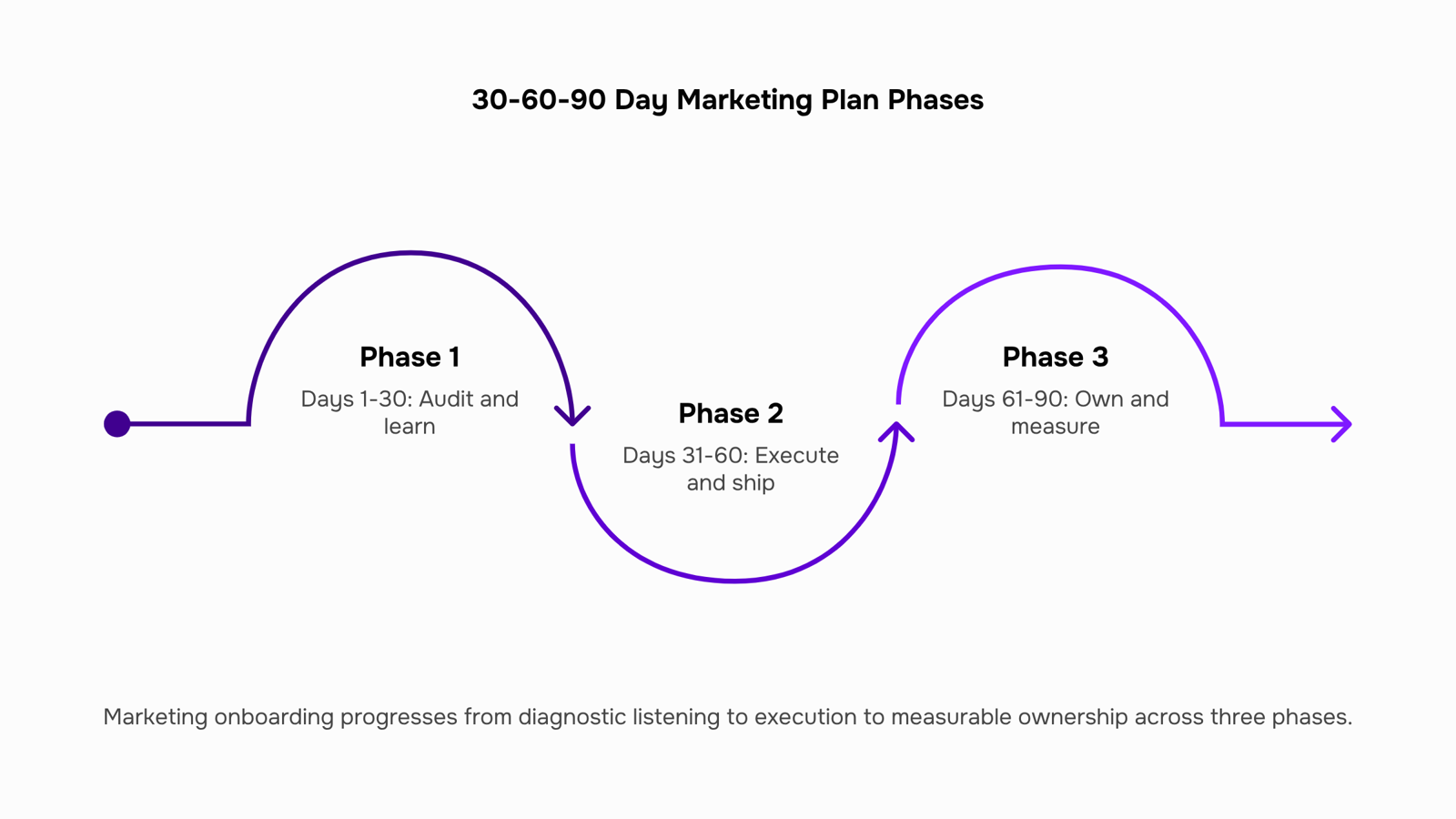
What to build and launch between days 31 and 60
By day 31, you've completed your audit, mapped the channels, and interviewed the stakeholders. Now the work shifts from gathering information to producing output.
The core focus here is execution on a short leash. Pick one or two marketing plan objectives you can move from draft to live before day 60. That might be a four-week content calendar built around the messaging gaps you identified in month one, a first email nurture sequence for an existing segment, or a paid campaign brief ready for budget approval. The point is to ship something real, not to plan more.
A useful sequence for this phase:
Draft and get feedback on one campaign by day 40. Use the channel data from your audit to choose the format. If organic search is underperforming, a content push makes sense. If the pipeline is thin at the top, paid or outbound deserves the first test.
Build a reporting baseline by day 45. Agree with your manager on two or three metrics you'll track at the day-60 checkpoint. Common choices: MQL volume, email open and click rates, or landing page conversion rate.
Launch and collect early data by day 55. Even a small sample tells you whether your hypothesis from the audit holds.
The day-60 checkpoint is your first real accountability moment in the 30-60-90 day plan. Come to that conversation with numbers, not just activity. "We sent 400 emails, opened at 28%, and generated 12 demo requests" is a milestone. "We launched an email campaign" is not.
For how to frame those metrics into a coherent success story, measuring progress at each phase covers the structure in detail.
If task ownership across the campaign is getting messy, Taro's task management keeps each deliverable assigned and visible without a separate project tool.
What to own and measure by day 90
By day 90, you're no longer learning the role — you're accountable for results. The question shifts from "what should I focus on?" to "what numbers prove I'm contributing?"
Three areas define full ownership at this stage of a 30-60-90 day plan for a marketing role.
Pipeline contribution: You should have at least one campaign that generated qualified leads, even if the volume is modest. A realistic benchmark for a new B2B marketer is one to two pipeline-contributing campaigns by the end of month three. Track MQLs sourced or influenced, not just impressions or clicks.
Channel performance benchmarks: Pick two or three channels you own and document a baseline. Email open rate, paid CPL, or organic traffic growth — the specific metric matters less than having a number you can defend and improve. Without a baseline, your 90-day marketing milestones have no reference point.
Reporting cadence: By day 90, you should be running a weekly or biweekly performance review, not waiting for your manager to ask. A short dashboard covering pipeline, channel metrics, and campaign status is enough. For a structured approach to what those reviews should include, tracking the right success metrics is worth reading alongside this.
The concrete success bar: at least one channel with a documented baseline, one pipeline-contributing campaign, and a repeatable reporting rhythm. If you can show all three, you've moved from onboarding to ownership.
For the broader structure behind these marketing role goals, the standard marketing plan format gives you a framework that holds up past day 90.
How to track a 30-60-90 day marketing plan without losing it in a spreadsheet
The plan-to-spreadsheet pipeline is where most 30-60-90 day plans die. A marketer writes sharp marketing plan objectives, pastes them into a shared Google Sheet, and by week three nobody is updating it. The doc becomes archaeology.
The fix is converting your plan into tracked work before day one starts. Each phase maps to a sprint. Each objective becomes an assigned task with a due date, an owner, and a clear definition of done. "Build SEO content calendar" is not a task. "Draft 12-topic content calendar in Notion by Friday, owner: you, reviewed by: hiring manager" is.
Here is what that looks like in practice:
Break each phase into weekly milestones tied to your marketing plan objectives.
Assign every milestone an owner, even if that owner is just you.
Set a review checkpoint at day 30, 60, and 90 to compare planned vs. actual.
Flag blockers as they appear rather than surfacing them at the checkpoint.
If you want to know how to measure whether the plan is working, the tracking layer is what makes measurement possible in the first place.
Taro, WorksBuddy's task and ownership agent, handles exactly this gap. It turns a written 30-60-90 day plan template into assigned sprints, surfaces ownership gaps before they stall progress, and keeps milestones visible without a manual status meeting.
How a 30-60-90 day plan supports career development
A 30-60-90 day plan isn't just an onboarding tool. When a marketer owns their own growth, the same structure becomes a career development framework: each phase maps a skill gap to a measurable outcome, so progress is visible rather than assumed.
The first 30 days surface what you don't know yet. Days 31-60 are where you apply that knowledge to real deliverables, building a track record. By day 90, you should have a portfolio of results you can point to in a performance review or promotion conversation.
This matters because most career growth stalls between reviews, not during them. A structured onboarding plan for marketers that extends into ongoing development gives you checkpoints before the annual review conversation arrives.
For a practical framework on tracking those checkpoints, measuring success in your 30-60-90 day plan is the logical next step.
Common mistakes that make 30-60-90 day marketing plans fail
Four failure modes show up repeatedly in 30-60-90 day marketing plans, and each one is avoidable.
Vague goals with no marketing metrics attached: "Build brand awareness" is not a milestone. "Increase organic sessions by 15% by day 60" is. Without a specific number tied to a channel, you cannot tell whether day 90 arrived successfully or not. Review how to measure success in a 30-60-90 day plan before you finalize any targets.
No checkpoint reviews between phases: Most plans are written once and reopened at day 90. Build a 15-minute review at day 30 and day 60 into the calendar before the plan starts.
Phase one that never ends: Discovery and research are necessary, but capping them at 30 days is the point. Teams that extend listening mode into week six lose the compounding benefit of acting on early findings.
Treating the plan as a document, not a workflow. A 30-60-90 day plan template helps, but your 90-day marketing milestones need to live inside a task system where ownership is visible daily.
Closing
A 30-60-90 day plan only works if it moves from document to tracked work. Most marketing plans live in a spreadsheet nobody checks, which means milestones slip, accountability vanishes, and by day 60 you're scrambling to remember what you committed to. The structure matters — phases, checkpoints, measurable outcomes — but the system behind it matters more.
Convert your plan into sprint-ready tasks the moment you finish drafting it. Assign each objective, set due dates, and build visibility so your manager and team see progress in real time, not in a quarterly review. Ready to move your plan into a system that actually tracks it? Explore how Taro turns your 30-60-90 day plan into accountable, sprint-ready work.
FAQ
How do I create a 30-60-90 day plan for a marketing role?
Break it into three phases: days 1-30 (audit and learn the business), days 31-60 (execute one to two campaigns), days 61-90 (own results and reporting). Each phase has specific deliverables tied to measurable outcomes, not just activity.
Can a 30-60-90 day plan be used for career development?
Yes. The framework works for any role transition because it sequences learning, execution, and ownership. The phase logic—diagnose, apply, lead—mirrors how professionals build credibility in any new position.
How can a 30-60-90 day plan help me achieve my business objectives?
It ties marketing work directly to business outcomes by anchoring each phase to measurable metrics: pipeline contribution, channel performance, and reporting cadence. This ensures your 90 days feed into the broader marketing plan, not sit in isolation.
What are some examples of successful 30-60-90 day plans for marketers?
A realistic example: month one audits channels and interviews stakeholders; month two launches a content calendar or email sequence; month three owns one pipeline-contributing campaign with documented baseline metrics and weekly reporting.
How do I know if my 30-60-90 day plan is working?
At day 90, you should have: at least one channel with a documented baseline, one pipeline-contributing campaign (even modest volume), and a repeatable weekly or biweekly reporting rhythm. If all three exist, you've moved from onboarding to ownership.


 Elena Petrova11 September 2026


