TL;DR: Most guides on risk control matrices stop at the definition or hand you a blank template with no context. This one walks IT company owners through building one from scratch — covering risk identification, qualitative versus quantitative scoring, control mapping, and the review cadence that keeps it accurate over time. You'll finish with a working matrix and a process to maintain it.
What is a risk control matrix?
A risk control matrix (RCM) is a structured document that maps each identified risk to a specific control, an owner, a likelihood rating, and a residual risk score after that control is applied. It answers two questions at once: what could go wrong, and what is actually being done about it.
IT project teams use it to make risk decisions visible and auditable. Instead of risks living in a project manager's head or scattered across status updates, the RCM puts every risk, its control, and its owner in one place. That matters most during scope changes, audits, or vendor reviews, when you need to show that controls exist and someone is accountable for them.
The document works for both qualitative assessments (high/medium/low ratings) and quantitative ones (probability-weighted financial exposure), which is where most generic definitions fall short. A well-built risk and control matrix handles either approach, or both in parallel, depending on what your stakeholders need.
Most mid-size IT organizations treat risk tracking as a spreadsheet exercise done once at project kickoff. The RCM is different because it is a living document, updated as risks change, controls fail, or new threats emerge.
For a deeper look at how teams actually run this process without it becoming a quarterly checkbox, what are the best practices for implementing a risk and control matrix covers the review cadence and ownership model in detail.
How to create a risk control matrix for your organization
Building a risk control matrix from scratch takes less time than most teams expect. The structure is straightforward once you know what each step produces.
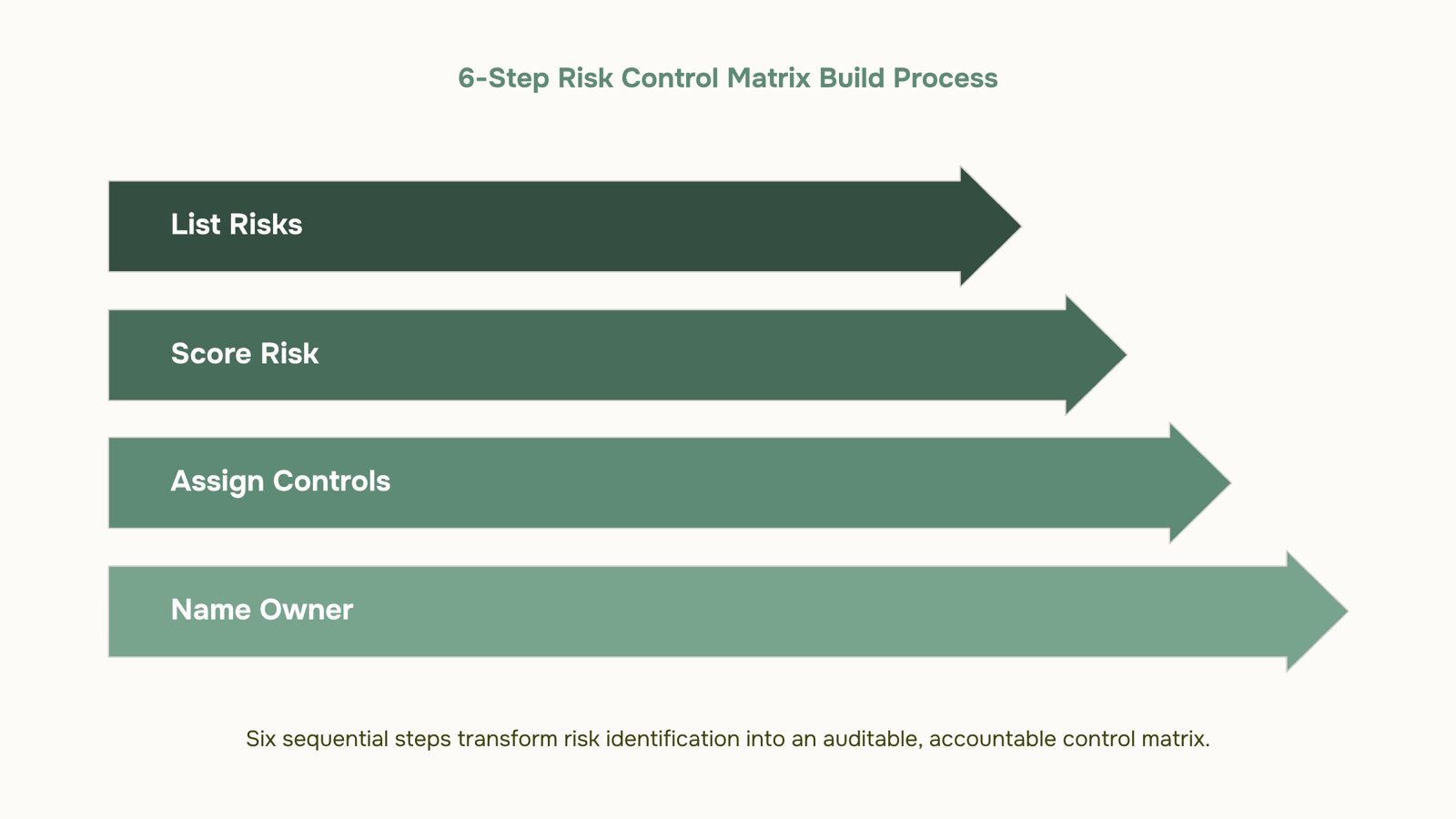
List every risk you can identify. Pull from past project post-mortems, your risk mitigation plan, and input from each department head. For IT projects specifically, include vendor dependencies, data security exposures, and integration failures. Don't filter yet. Volume at this stage is the point.
Score each risk by likelihood and impact. Assign a 1-to-5 scale to both dimensions. Multiply them to get a priority score. A vendor going offline mid-deployment (likelihood: 3, impact: 5) scores 15. A minor UI bug (likelihood: 4, impact: 1) scores 4. This single step separates the risks worth controlling from the ones worth monitoring.
Assign a control activity to every high-priority risk. A control activity is a specific action that reduces either the likelihood or the impact of the risk. "Conduct weekly vendor check-ins" is a control. "Communicate better" is not. Be precise. Vague controls don't get executed.
Name a control owner for each row. Every risk needs one person accountable for the control, not a team, not a role title. If two people own it, nobody owns it. This is where most project risk management efforts break down.
Calculate residual risk. After your control is in place, re-score the likelihood and impact. The new score is your residual risk. If it's still above your threshold (most teams set this at 10 or above on a 25-point scale), the control isn't strong enough. Escalate or add a secondary control.
Set a review cadence and stick to it. A risk control matrix that gets updated once at project kickoff is a compliance artifact, not a management tool. For active IT projects, a bi-weekly review is the minimum. Assign a standing agenda item. Use a risk alerts dashboard to flag changes between reviews so nothing slips through.
A completed matrix after these six steps gives you a working document, not just a filled-in risk control matrix template. The next section covers exactly which columns to include so you can audit your own version for completeness.
Key components of a risk control matrix
A risk control matrix without the right columns is just a spreadsheet with a name. These six elements are what separate a working risk and control matrix from one that looks complete but fails during an audit.
Risk description. A plain-language statement of what could go wrong and where. "Server downtime during deployment" is useful. "Technical risk" is not.
Likelihood rating. How probable is the event? Most teams use a 1-to-5 scale or a simple High/Medium/Low. Either works, as long as you apply it consistently across every row. This is where your risk assessment matrix logic lives.
Impact rating. How bad is the outcome if the risk materializes? Score it on the same scale as likelihood, and tie it to something real: revenue, uptime, compliance status, or client contracts.
Control activity. The specific action, process, or safeguard already in place to reduce the risk. Be precise. "Regular backups" is vague. "Daily automated backup to offsite storage with 4-hour recovery window" is a control you can test.
Control owner. One named person, not a team. If everyone owns it, no one does. Assign accountability at the individual level so follow-through is traceable.
Residual risk. The risk that remains after the control is applied. This is the column most teams skip, and it is the most important one for prioritization. A high inherent risk with a strong control might leave you with a low residual risk. A medium risk with no real control might leave you dangerously exposed.
Once you have all six columns populated, you can build a credible risk mitigation plan and know exactly where to act first.
Benefits of using a risk control matrix in project management
Maintaining a risk control matrix pays off in ways that show up directly in project outcomes, not just compliance checklists.
Fewer surprises at delivery. When every identified risk has a named owner and a control activity, your team stops discovering problems the week a milestone is due. PMI research consistently finds that projects with structured risk tracking are significantly more likely to finish on time and within budget.
Clearer accountability. The control owner column forces a decision most project risk management processes skip: who is actually responsible if this risk materializes? That single column eliminates the "I thought someone else had it" conversation.
Faster audit and compliance reviews. Auditors want evidence that controls exist and are monitored. A current RCM gives them that in one document instead of three separate spreadsheets.
Better prioritization. Residual risk scores let your team rank what needs attention this sprint versus what can wait. Without that ranking, every risk feels equally urgent.
Institutional memory. When a team member leaves, the matrix preserves the reasoning behind each control. New hires inherit context, not just tasks.
For teams that want to go further, pairing the matrix with a risk mitigation plan turns documented risks into executable responses before they escalate.
Qualitative vs quantitative risk assessment in an RCM
The same risk control matrix structure handles both assessment types. The choice between them comes down to data availability and project size.
Qualitative assessment assigns descriptive ratings: High/Medium/Low for likelihood and impact. It works well for early-stage scoping, smaller IT projects, or situations where historical data is thin. A five-person team evaluating a new vendor integration can complete a qualitative risk assessment matrix in a single working session. The tradeoff is subjectivity — two engineers may rate the same risk differently without a shared rubric.
Quantitative assessment replaces those labels with numbers: probability percentages, estimated financial exposure, or expected monetary value (EMV). This approach suits larger programs where you have incident history, budget data, or compliance requirements that demand defensible figures. The setup takes longer, but the output is harder to argue with in a board-level review.
Most IT teams use both. Qualitative ratings get risks onto the matrix fast during discovery; quantitative scoring gets applied selectively to the top-tier items before a major milestone. That hybrid approach keeps the risk mitigation plan grounded in real numbers where it matters most, without turning every sprint into a data-collection exercise.
If you want early signals before risks escalate to either tier, Taro surfaces every risk before your team discovers it the hard way.
How often to review and update your risk control matrix
Most teams review their risk control matrix once a quarter and call it disciplined. That cadence works until a sprint ships a new integration, a vendor changes scope, or a compliance deadline moves.
A practical review schedule runs on three levels:
Sprint or milestone level (every 2 to 4 weeks): check whether new technical dependencies or scope changes introduced risks not yet logged.
Quarterly review: reassess likelihood and impact scores, retire closed risks, and confirm control owners are still current.
Annual audit: rebuild the matrix from the risk register up, not just update cells.
Beyond the calendar, certain events should trigger an off-cycle review immediately: a production incident, a regulatory change, a key team member leaving, or a contract renegotiation. Waiting for the next scheduled review after any of these is how small risks become expensive ones.
If you want earlier warning before those triggers hit, Taro surfaces every risk before your team discovers it the hard way. Pair that visibility with a solid risk mitigation plan and your matrix stays current between reviews, not just during them.
Common risk control matrix templates and when to use them
Three formats cover most situations.
A simple spreadsheet template works for teams of 5 to 15 people running straightforward projects. List risks in rows, map controls in columns, assign an owner. It takes under an hour to build and is easy to share. Use this as your first risk control matrix template before adding complexity.
A weighted scoring model fits mid-size IT teams (15 to 50 people) where risks carry different financial or compliance consequences. Assign probability and impact scores, multiply them, and rank by priority. This handles both qualitative judgments and quantitative thresholds in the same view.
An integrated PM tool format suits larger teams or multi-workstream projects where risks need to connect directly to tasks and owners. Tools like Taro can surface risks before your team discovers them the hard way, which removes the gap between your matrix and your actual workflow.
Before picking a format, review your risk mitigation plan structure first.
Closing
A risk control matrix only works if it stays current. The moment you finish your first review, risks shift—vendors change, scope expands, new threats emerge. Static matrices go stale between quarterly check-ins, and by then you're managing yesterday's problems. That's why the best teams pair their matrix with a tool that watches for risk triggers in real time. Taro's risk prediction and alerts dashboard flags changes the moment they happen—vendor health drops, timeline slips, dependency issues surface—so your matrix stays accurate without manual check-ins between reviews. Your next step: build your first matrix using the six-step framework above, then ask yourself which risks in your current projects would benefit from continuous monitoring instead of waiting for the next review cycle.
FAQ
How do I create a risk control matrix for my organization?
Identify all risks, score each by likelihood and impact, assign a specific control activity to high-priority risks, name one owner per control, calculate residual risk after controls are applied, and set a bi-weekly review cadence. Six steps, one working document.
What are the benefits of using a risk control matrix in project management?
Fewer delivery surprises, clear accountability via named owners, faster audits, better sprint prioritization, and institutional memory when team members leave. PMI research shows structured risk tracking significantly improves on-time and on-budget delivery.
Can a risk control matrix be used for both qualitative and quantitative risk assessment?
Yes. The same structure handles High/Medium/Low ratings or probability-weighted financial exposure. Most teams use qualitative scoring (1-to-5 scales) for speed and consistency across all risk types.
How often should I review and update my risk control matrix?
Bi-weekly minimum for active IT projects. Assign a standing agenda item and use a risk alerts dashboard to flag changes between reviews so nothing slips through.
What are some common templates for a risk control matrix?
All effective templates include six columns: risk description, likelihood rating, impact rating, control activity, control owner, and residual risk score. The structure is the same; only the scoring scale (1-to-5, High/Medium/Low, or financial) changes based on your stakeholder needs.


 Elena Petrova15 September 2026


