TL;DR: Most agile planning guides explain the framework and leave you to figure out the execution. This one shows IT company owners how to build a plan that actually evolves sprint-to-sprint, with specific triggers for when to adjust scope, who owns what decisions, and what breaks first when the structure slips. You'll finish with a working model, not a document that expires at kickoff.
What Is an Agile Project Management Plan?
An agile project management plan is a structured but continuously updated guide that defines how your team will deliver work across iterative cycles. Unlike a waterfall plan, which locks scope, timeline, and budget before a single line of code is written, an agile plan treats those elements as adjustable based on what you learn each sprint.
The key word is "living." Most teams create the plan once during kickoff, then ignore it until something breaks. That's the failure point. A real agile plan gets reviewed at the end of every sprint, updated when priorities shift, and shared with stakeholders in near real-time, not at quarterly reviews.
In practice, the plan holds your product backlog, sprint cadence, team capacity, and definition of done. These four components connect: the backlog feeds the sprint, the sprint tests your capacity assumptions, and the retrospective updates all three. Understanding how they link is what separates effective project management processes from a document that collects dust.
Agile project planning, done right, is less about predicting the future and more about building a system that responds to it.
How Does an Agile Plan Differ From a Traditional Plan?
The core structural difference comes down to one question: how much do you know before work starts?
A traditional plan locks scope, timeline, and budget at the beginning. Every phase depends on the one before it. Change a requirement in week six and you're repricing the project, rescheduling teams, and updating a Gantt chart that was already out of date.
An agile project management plan works the opposite way. Scope is intentionally incomplete at the start. You define a clear goal, then let the work surface what comes next. Agile workflows run in short cycles — typically two-week sprints — where the plan updates at the end of each one, not once a year during a kickoff.
Dimension | Traditional plan | Agile plan |
|---|
Scope | Fixed upfront | Defined iteratively |
Timeline | Set at project start | Rolling, sprint by sprint |
Change process | Formal change request | Built into each cycle |
Plan updates | Rarely, if ever | Every sprint |
The practical result: agile project planning trades predictability of scope for adaptability to reality. That tradeoff works well for IT projects where requirements shift as the product develops. For fixed-bid contracts with locked deliverables, a traditional plan still fits better. Knowing which you're running matters before you build anything — starting from the right planning structure saves significant rework later.
What Are the Key Components of an Agile Project Management Plan?
Six components make or break an agile project management plan. Miss one and the plan either collapses mid-sprint or gets abandoned after the first retrospective.
Project vision and goals: A one- or two-sentence statement that answers why this project exists and what success looks like. Every backlog item should trace back to it. Without this anchor, sprint priorities drift.
Product backlog: The ordered list of everything the team might build. Good backlog management means each item is sized, prioritized, and tied to a user outcome, not just a task description. The backlog is a living document, not a one-time artifact.
Sprint structure: The cadence that turns backlog items into shipped work. Define sprint length (one or two weeks is standard for most IT teams), the ceremonies involved, and the capacity per sprint before you start. Vague sprint planning produces vague commitments.
Team roles: Product owner, scrum master, and delivery team each carry distinct accountability. Blurring these roles is one of the most common reasons agile plans stall. Document who owns what before the first sprint kicks off.
Definition of done: A shared checklist that every team member agrees on before work begins. "Done" means tested, reviewed, and deployable, not just coded.
Review cadence: Sprint reviews and retrospectives are not optional ceremonies. They are the mechanism that keeps the plan current. An agile project management plan that never gets revised is just a waterfall plan with different vocabulary.
For a broader look at how these components fit into effective project management processes, that context shapes how you sequence the build.
How Do You Build the Plan Step by Step?
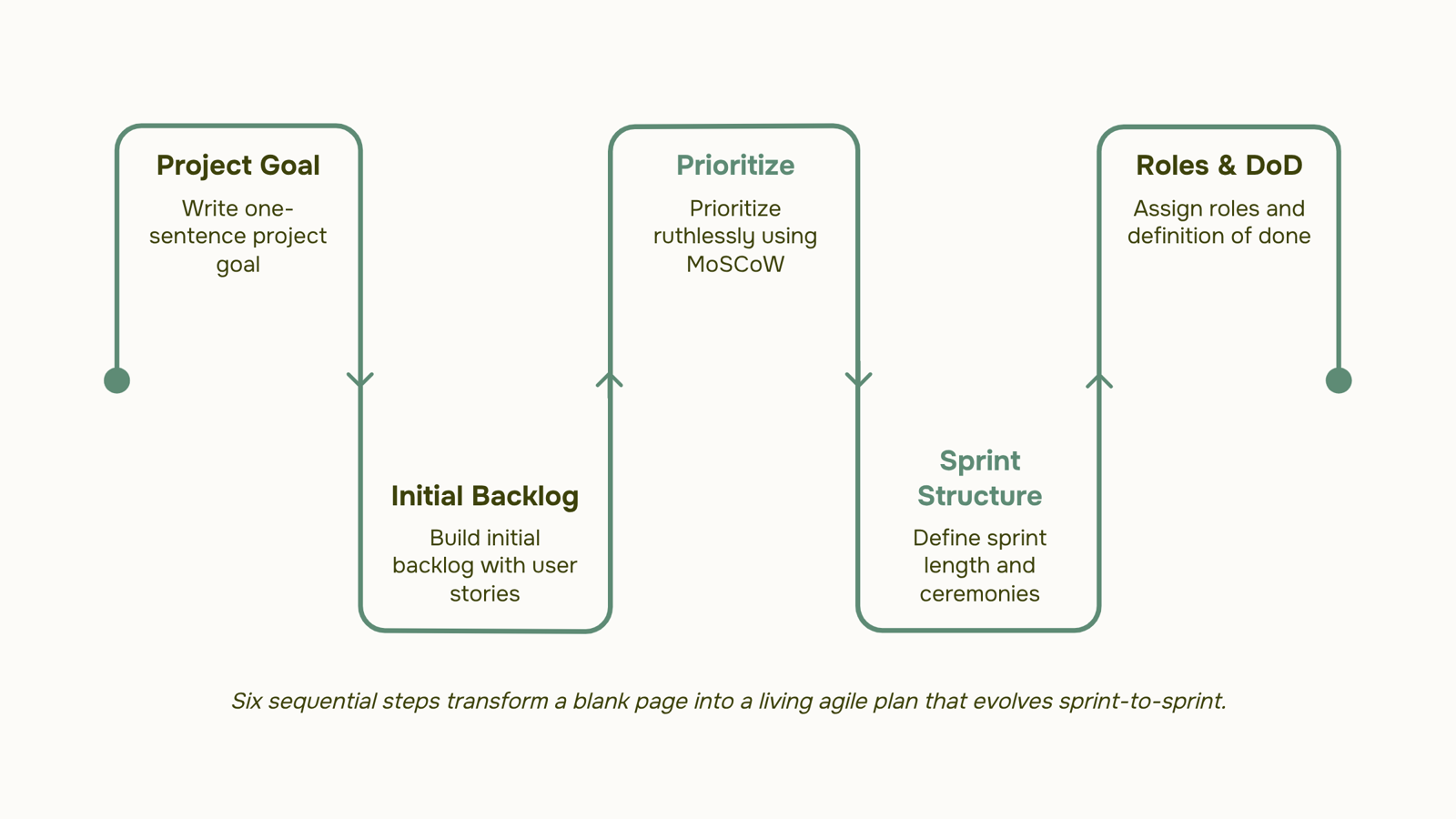
Six steps. That's all it takes to go from a blank page to a running sprint. Here's how to build an agile project management plan that actually gets used after week one.
Step 1: Write a one-sentence project goal: Before you touch a backlog or assign a single role, write down what done looks like for the whole project. Not a paragraph — one sentence. "Ship a client-facing reporting dashboard by end of Q3 that reduces support tickets by 20%." If your team can't agree on that sentence, the plan will drift the moment pressure hits.
Step 2: Build your initial backlog: Translate that goal into user stories. Keep them small enough to complete in a single sprint (two weeks is the standard). A story like "As a client, I can filter reports by date range" is testable and completable. "Improve reporting" is not. Effective backlog management means every item has an owner, an acceptance criterion, and a rough size estimate before sprint planning begins.
Step 3: Prioritize ruthlessly: Stack-rank the backlog by business value, not by who asked loudest. Use MoSCoW (Must have, Should have, Could have, Won't have) or simple T-shirt sizing to force real conversations about what ships first. The top 20% of your backlog should cover at least 80% of the project's core value.
Step 4: Define your sprint structure: Pick a sprint length and hold it. Two weeks works for most IT teams. Set fixed ceremonies: planning on Monday of sprint week one, a 15-minute daily standup, a review on the final Friday, and a retrospective the same afternoon. PI planning in agile adds a layer above this for teams running multiple squads, but for a single team, consistent sprint rhythm is the foundation.
Step 5: Assign roles and definition of done: Every sprint needs a product owner who accepts or rejects work, a scrum master who removes blockers, and developers who own delivery. Your definition of done should be written down: code reviewed, tests passing, deployed to staging, accepted by the product owner. Verbal agreements drift; written criteria don't.
Step 6: Run sprint one, then update the plan: This is where most agile plans fail. Teams build the plan, run the first sprint, and never revise the backlog or the estimates. After your first sprint review, reprioritize the backlog based on what you learned. Good project prioritization methods treat the plan as a living document, not a signed contract.
The plan you ship after sprint one will look different from the plan you started with. That's not a failure — that's agile working correctly.
The right agile project management software does four things: tracks sprint progress visually, manages backlog priority, shows team capacity, and flags blockers before they stall a sprint. If a tool can't do all four without switching views, it creates the same coordination overhead you were trying to eliminate.
For most IT teams, the shortlist looks like this:
Sprint boards that update in real time, so standup isn't a status-reporting exercise
Backlog views with drag-to-prioritize, so the next sprint starts from a ranked list, not a conversation
Time tracking at the task level, so velocity estimates improve sprint over sprint
Collaboration layer that ties comments, files, and decisions to the specific task, not a separate thread
Taro handles the execution layer of an agile project management plan directly: ownership, sprint assignments, and blockers live in one place rather than split across a board tool and a chat app. That matters most when your project planning process involves multiple workstreams running in parallel.
For teams also navigating PI planning across agile releases, a connected execution layer reduces the coordination cost significantly.
How Often Should You Review and Update the Plan?
Most teams treat plan review as optional. It isn't — it's the mechanism that keeps agile project planning honest.
Each layer of your plan has a different update cadence:
Sprint backlog: review every sprint, during planning and retrospective. If a retro surfaces a recurring blocker, reprioritize before the next sprint starts.
Release plan: revisit every two to three sprints, or immediately when scope shifts or a key team member's capacity changes.
Product roadmap: reassess quarterly, or when a client changes requirements in a way that affects more than one sprint.
The trigger matters as much as the timing. A sprint retrospective finding, a sudden resource gap, or a scope change mid-cycle are all valid reasons to update the plan that day, not at the next scheduled checkpoint.
The failure pattern is predictable: teams build a solid agile project management plan in week one, then treat it as fixed. By sprint four, the plan describes a project that no longer exists.
For sprint planning specifically, block 30 minutes before each sprint to confirm the backlog still reflects current priorities. That single habit prevents most mid-project drift.
Common Mistakes That Break Agile Plans Early
Three failure patterns show up in almost every agile project management plan that collapses before the third sprint.
Treating the plan as fixed: Agile planning is iterative by design. Teams that write a plan at kickoff and never revise it are running waterfall with a different vocabulary. If your sprint retros aren't feeding back into the plan, the plan is already outdated.
Skipping retrospectives under deadline pressure: This is the most common shortcut, and it compounds. Without retros, capacity problems and scope drift go unaddressed until they become blockers.
Building a backlog with no prioritization logic: A backlog with 200 items and no ranking system isn't a planning tool, it's a wishlist. Effective backlog management means every item has a clear owner, a business rationale, and a rough size estimate before it enters a sprint.
Understanding how agile development improves project efficiency makes it easier to see why each of these shortcuts erodes the system rather than just slowing it down.
Closing
An agile project management plan only survives first contact if your team treats it as a living system, not a document. The six components we covered—vision, backlog, sprint structure, roles, definition of done, and review cadence—only hold together when they're wired into a single source of truth your team actually uses every day.
The plan you build this week will be wrong by sprint two. That's not failure—that's the point. What matters is whether your team can see the backlog, track what's in flight, and update priorities without hunting through Slack threads or outdated spreadsheets. Ready to see how Taro handles sprint planning, backlog management, and task tracking so your plan stays current and your team stays aligned?
FAQ
How do I create an agile project management plan?
Start with one-sentence project goal, build a prioritized backlog of user stories, define sprint structure and ceremonies, assign roles, write your definition of done, then run sprint one and revise based on what you learn. The plan evolves every sprint—that's the design.
What are the key components of an agile project management plan?
Project vision, product backlog, sprint structure, team roles, definition of done, and review cadence. Each component connects: the backlog feeds sprints, sprints test capacity, retrospectives update all three. Miss one and the plan collapses.
How does an agile project management plan differ from traditional plans?
Traditional plans lock scope upfront; agile plans define it iteratively. Agile updates every sprint via formal ceremonies; traditional plans rarely change. Agile trades predictability of scope for adaptability to reality—critical for IT projects where requirements shift.
What tools can I use to implement an agile project management plan?
You need a tool that centralizes backlog management, sprint planning, task tracking, and team collaboration in one place. Spreadsheets and scattered docs kill agile plans. Look for platforms that keep your backlog current and ceremonies visible to the whole team.
How often should I review and update my agile project management plan?
At the end of every sprint. Sprint reviews and retrospectives are not optional—they're the mechanism that keeps the plan current. An agile plan that never gets revised is just waterfall with different vocabulary.


 Elena Petrova15 September 2026


