TL;DR: Most Scrum explainers stop at roles and ceremonies. This one shows IT company owners how each component connects inside a working sprint, where the handoffs happen, and which mechanics teams skip that cause sprints to collapse. You'll leave knowing exactly how Scrum runs end-to-end, not just what it is.
What is a scrum?
Scrum is a lightweight Agile framework that organizes work into short, fixed-length cycles called sprints, typically one to four weeks, so teams can ship working output and adjust course without waiting for a full project to finish.
Understanding what is a scrum in project management starts with that core mechanic: instead of planning everything upfront, a Scrum team commits to a defined scope for one sprint, delivers it, reviews what worked, and feeds that learning into the next cycle. The planning overhead stays low. The feedback loop stays tight.
IT teams adopt Scrum over ad-hoc project management for a specific reason: visibility. When work is invisible, priorities shift without warning and accountability disappears. Scrum surfaces both. A shared backlog shows what exists. A sprint commitment shows who owns what, this week, not "eventually."
What is a scrum in agile methodology, practically speaking? It is a defined set of roles (Product Owner, Scrum Master, developers), events (planning, daily standup, review, retrospective), and artifacts (product backlog, sprint backlog, increment) that together create a repeatable delivery rhythm. According to the Scrum Alliance, Scrum remains the dominant Agile framework in use across software teams globally.
For a deeper look at the principles underneath the process, the key principles of Agile Scrum methodology are worth reading before the sprint cycle walkthrough below.
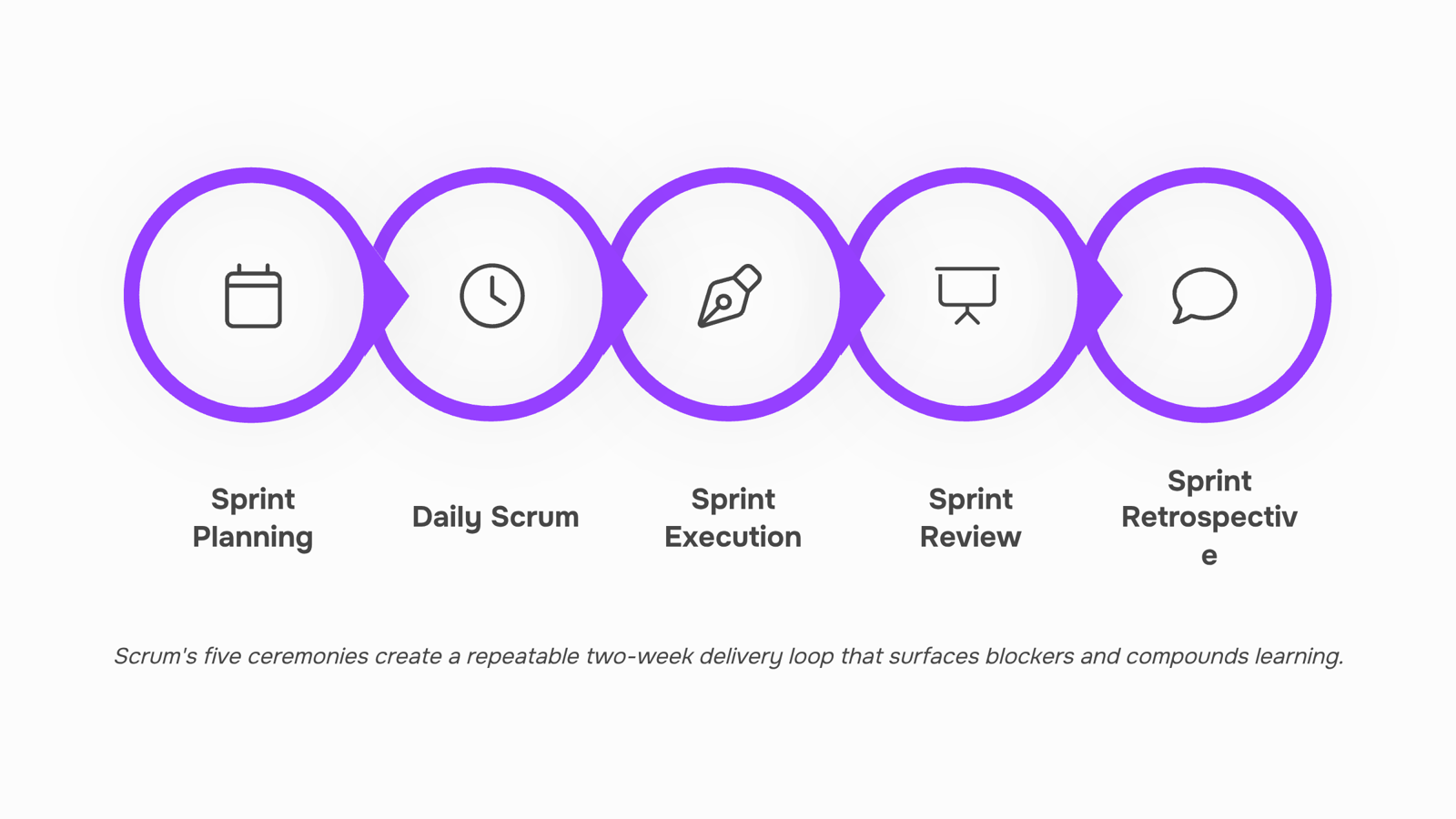
How the Scrum framework works: the sprint cycle
A sprint is the engine of Scrum. Understanding what is a scrum in agile methodology means understanding how a fixed-length iteration moves work from backlog to shipped — without the scope creep that kills ad-hoc projects.
Most IT teams run two-week sprints. Here is what that cycle looks like from start to finish:
Sprint Planning: The team pulls the highest-priority items from the product backlog and commits to what they can deliver in two weeks. The Product Owner sets the goal; the Development Team sizes the work. A session that runs longer than four hours is a signal the backlog needs grooming, not more meeting time.
Daily Scrum: A 15-minute standup — this is what most people mean by a scrum meeting — where each developer answers three questions: what did I finish, what am I working on today, what is blocking me. The Scrum Master removes blockers; the team does not solve problems inside this meeting.
Sprint Execution. The team builds. Work moves across a board (To Do, In Progress, Done). Scope does not change mid-sprint unless something critical breaks the sprint goal entirely.
Sprint Review: The team demos working software to stakeholders at the end of the sprint. Feedback feeds directly back into the product backlog. No demo means no feedback loop, which is where IT teams most often stall.
Sprint Retrospective: The team asks what went well, what did not, and what to change next sprint. Skipping this step is the single most common reason Scrum stops improving over time.
Each ceremony connects to the next. Sprint planning with the right tooling cuts setup time significantly, and Scrum's effect on team productivity compounds when retrospectives are actually acted on.
Scrum roles and what each one owns
Product Owner
The Product Owner owns the backlog. They decide what the team builds next, in what order, and why. Every item on the backlog has a business reason behind it, and the Product Owner is accountable for that reasoning. When stakeholders push for a new feature mid-sprint, the Product Owner is the one who decides whether it waits or jumps the queue.
Scrum Master
Understanding what is a scrum master means separating the role from a traditional project manager. The Scrum Master does not assign tasks or own the delivery timeline. They protect the team's process: running ceremonies correctly, removing blockers before they stall a sprint, and coaching the team toward self-organization. If a sprint keeps slipping because of an upstream dependency, fixing that dependency is the Scrum Master's job.
Development Team
The Development Team owns execution. In what is a scrum in project management terms, this is the group that turns backlog items into working, shippable output within the sprint. The team is cross-functional by design, meaning it holds every skill needed to complete a story without waiting on outside help. Typical team size runs three to nine people; smaller teams move faster, larger ones introduce coordination overhead.
Each role has a hard boundary. The Product Owner does not tell the team how to build. The Scrum Master does not set priorities. The Development Team does not negotiate scope directly with stakeholders. Those boundaries are what make the key principles of Agile Scrum methodology work in practice. When any one role bleeds into another, accountability blurs and sprint commitments become unreliable.
Scrum ceremonies: what each meeting is for and how often it runs
Scrum runs on five structured meetings. Each one has a fixed purpose and a time-box — meaning a maximum duration, not a target. Running them on schedule is what keeps the sprint cycle honest.
Sprint Planning
The team decides what work enters the sprint and how it will get done. Time-box: 8 hours for a four-week sprint (scale down proportionally for shorter ones). Runs once per sprint, at the start.
Daily Scrum
A 15-minute standup where the Development Team syncs on progress and surfaces blockers. This is what most people mean when they ask what is a scrum meeting — it's the daily check-in, not the whole framework. Runs every working day of the sprint.
Sprint Review
The team demonstrates completed work to stakeholders and collects feedback. Time-box: 4 hours for a four-week sprint. Runs once per sprint, at the end. The Product Owner uses this input to update the backlog.
Sprint Retrospective
The team inspects how they worked, not what they built, and commits to one or two process improvements. Time-box: 3 hours. Runs after the Sprint Review, before the next Sprint Planning. Skipping this one is the fastest way to let problems compound — more on that in the next section.
Backlog Refinement
Technically not an official Scrum ceremony in the Scrum Guide, but nearly every team runs it. The Product Owner and Development Team review upcoming backlog items, clarify requirements, and estimate effort. Recommended time: no more than 10% of sprint capacity. Cadence: mid-sprint, once or twice.
Understanding what is a scrum in agile methodology starts here — these five meetings are the heartbeat. For guidance on running each one well, see best practices for conducting effective scrum meetings.
Where Scrum breaks down and how to fix it
Scrum fails quietly. Teams don't abandon it all at once — they skip one ceremony, blur one boundary, and the whole system degrades. Here are the four failure points IT teams hit most, and the direct fix for each.
Skipped retrospectives: When sprints get busy, retros get cut. The team keeps repeating the same mistakes because there's no structured moment to name them. Fix: treat the retro as non-negotiable — 30 minutes, same slot, every sprint.
No Definition of Done: Without a shared, written DoD, "done" means something different to every engineer. Work ships incomplete, QA backlogs pile up, and trust erodes. Fix: write the DoD before sprint one and post it where the whole team sees it.
Overloaded sprints: Teams pull in more stories than velocity supports, then carry unfinished work forward. Two or three sprints of this and planning becomes fiction. Fix: use the previous sprint's actual velocity as the ceiling, not the team's optimistic estimate.
Absent Product Owner: If the PO isn't available to answer questions mid-sprint, developers make assumptions. Those assumptions cost rework. Fix: the PO commits to a same-day response window for blockers — no exceptions.
Understanding the key principles behind Agile Scrum helps explain why each of these failures is structural, not personal. Teams that know what is a scrum in project management — not just the ceremony list — catch these gaps before they compound.
Scrum in action: two real workflow scenarios
Scenario 1: Software sprint (2-week cycle)
A five-person dev team pulls eight story points from the backlog on Monday. The Product Owner has already ranked each item; the team has a written Definition of Done requiring code review, passing CI/CD checks, and updated documentation. Daily standups run 10 minutes in Jira. By day 12, six stories ship. The two that don't get returned to the backlog, not carried forward silently. The retrospective on day 14 surfaces one recurring blocker: review requests sitting idle for more than 24 hours. The team sets a new norm: reviews acknowledged within one business day. That single output makes the next sprint measurably faster.
Scrum's effect on team output compounds precisely because of this loop: plan, execute, inspect, adjust.
Scenario 2: IT operations (non-software)
What is a scrum in project management outside development? Consider an IT ops team handling infrastructure upgrades. They run two-week sprints with a backlog of network tickets, server migrations, and vendor renewals. The Product Owner is the IT manager. Each sprint goal is a specific system state: "VPN capacity increased by 30% before Friday." Standups flag blockers before they become outages.
This is Scrum applied to agile methodology beyond code, and it works because the cadence forces prioritization that ticket queues never do.
Scrum vs Kanban: which one fits your team
Dimension | Scrum | Kanban |
|---|
Cadence | Fixed sprints (1–4 weeks) | Continuous flow, no sprint boundary |
Roles | Product Owner, Scrum Master, Dev Team | No defined roles required |
Planning overhead | High — sprint planning, review, retro each cycle | Low — update the board as work arrives |
Backlog structure | Prioritized, sprint-scoped | Single continuous queue, WIP-limited |
Best fit | New feature development, predictable release cycles | Support queues, incident response, ongoing ops |
If your team asks "what is a scrum in project management" and the answer is a fixed delivery cadence with clear ownership, Scrum fits. If work arrives unpredictably — tickets, outages, ad-hoc requests — Kanban handles that better.
Most IT teams eventually run both. For the hybrid middle ground, what is the difference between Scrum and Scrumban covers when that crossover makes sense.
Closing
The sprint cycle is where Scrum lives or dies — and most IT teams get the theory right but the execution wrong. You now know how each ceremony connects to the next, where handoffs happen, and which skipped steps cause sprints to collapse. The difference between a team that ships reliably and one that watches scope creep kill every commitment isn't the framework itself; it's the coordination layer that keeps sprints moving without manual overhead. That's where Taro steps in — handling sprint planning, backlog ordering, and burndown tracking so your team runs Scrum without the friction. Ready to see how sprint coordination works without the busywork? Check out Taro's sprint feature.
FAQ
How does a Scrum framework work in Agile development?
Scrum organizes work into fixed-length sprints (typically two weeks) where teams commit to a defined scope, deliver working output, review feedback, and adjust course. Each sprint cycles through planning, daily standups, execution, review, and retrospective — creating a tight feedback loop that surfaces priorities and accountability.
What are the roles and responsibilities in a Scrum team?
The Product Owner prioritizes the backlog and owns what gets built. The Scrum Master protects the process and removes blockers. The Development Team executes and owns delivery. Each role has hard boundaries — when they blur, accountability disappears and sprints fail.
How often should Scrum meetings be held and what is their purpose?
Sprint Planning (once per sprint, start), Daily Scrum (every working day, 15 min sync), Sprint Review (once per sprint, demo feedback), Retrospective (once per sprint, process improvement), and Backlog Refinement (mid-sprint, clarify upcoming work). Each is time-boxed and purposeful.
Can Scrum be used in non-software development projects?
Yes. Scrum's core mechanic — fixed-length iterations, clear roles, feedback loops — works anywhere teams need visibility and course correction. Marketing, product, operations, and construction teams all run Scrum successfully.
What is the difference between a Scrum Master and a project manager?
A Scrum Master protects the team's process and removes blockers; they don't assign tasks or own timelines. A project manager typically owns delivery schedules and task allocation. The Scrum Master coaches toward self-organization; the PM directs execution.


 Elena Petrova15 September 2026


