TL;DR: Most scrum meeting guides cover the five ceremonies and call it a framework. This one shows IT team leads what actually breaks inside each meeting type and gives them a six-step operating model they can run from the next sprint. No training session required.
What scrum meetings are and why they exist
Professional conference table setup with meeting materials and digital devices representing organized scrum methodology
Scrum meetings, formally called scrum ceremonies, are structured events built into every sprint to create predictable moments for planning, alignment, and improvement. They are not status updates dressed up with agile vocabulary. Each ceremony has a defined purpose, a time-box, and an expected output.
The Scrum Guide defines five ceremonies:
Sprint planning — the team decides what to build and how. For a two-week sprint, this is time-boxed to eight hours maximum.
Daily scrum — a 15-minute sync where developers inspect progress toward the sprint goal and adjust their plan for the next 24 hours.
Sprint review — the team demonstrates completed work to stakeholders and collects feedback that shapes the next sprint.
Sprint retrospective — the team examines how they worked, not what they built, and commits to one or two process changes.
Sprint itself — the container event that holds all four ceremonies above.
Most teams conflate the review and retrospective, or skip the retrospective entirely when deadlines tighten. That collapses two distinct feedback loops into one, and the process never improves.
Understanding how scrum affects team output over time depends on running all five ceremonies with their intended outputs intact. The next section covers each one in detail, starting with sprint planning.
What each scrum meeting is supposed to accomplish
Each scrum meeting has a specific output. When teams lose sight of that, the ceremony becomes overhead instead of a tool.
Daily scrum is not a status report. Its output is a shared picture of whether the team is on track to meet the sprint goal, and a plan for the next 24 hours. The Scrum Guide (Schwaber and Sutherland, 2020) time-boxes it at 15 minutes regardless of team size. Following daily scrum best practices means keeping it focused on blockers and forward movement, not yesterday's accomplishments.
Sprint planning produces two things: a sprint goal and a sprint backlog the team believes it can deliver. Without both, the team is guessing at priority for the entire sprint. Understanding what sprint planning is designed to produce helps teams treat the sprint planning meeting as a commitment conversation, not a task-assignment session.
Sprint review is about inspecting the increment and adapting the product backlog based on stakeholder feedback. The output is a revised backlog, not a demo for its own sake. Teams that skip this conflate shipping with finishing.
Retrospective produces one thing: a concrete improvement the team will act on next sprint. Not a list of complaints. One change, owned by someone, with a clear definition of done.
When each ceremony produces its intended output, scrum affects team output in measurable ways. When they don't, the scrum meeting agenda becomes a calendar burden with no return. The fix is almost always clarity on what "done" looks like for the meeting itself.
How long scrum meetings should last
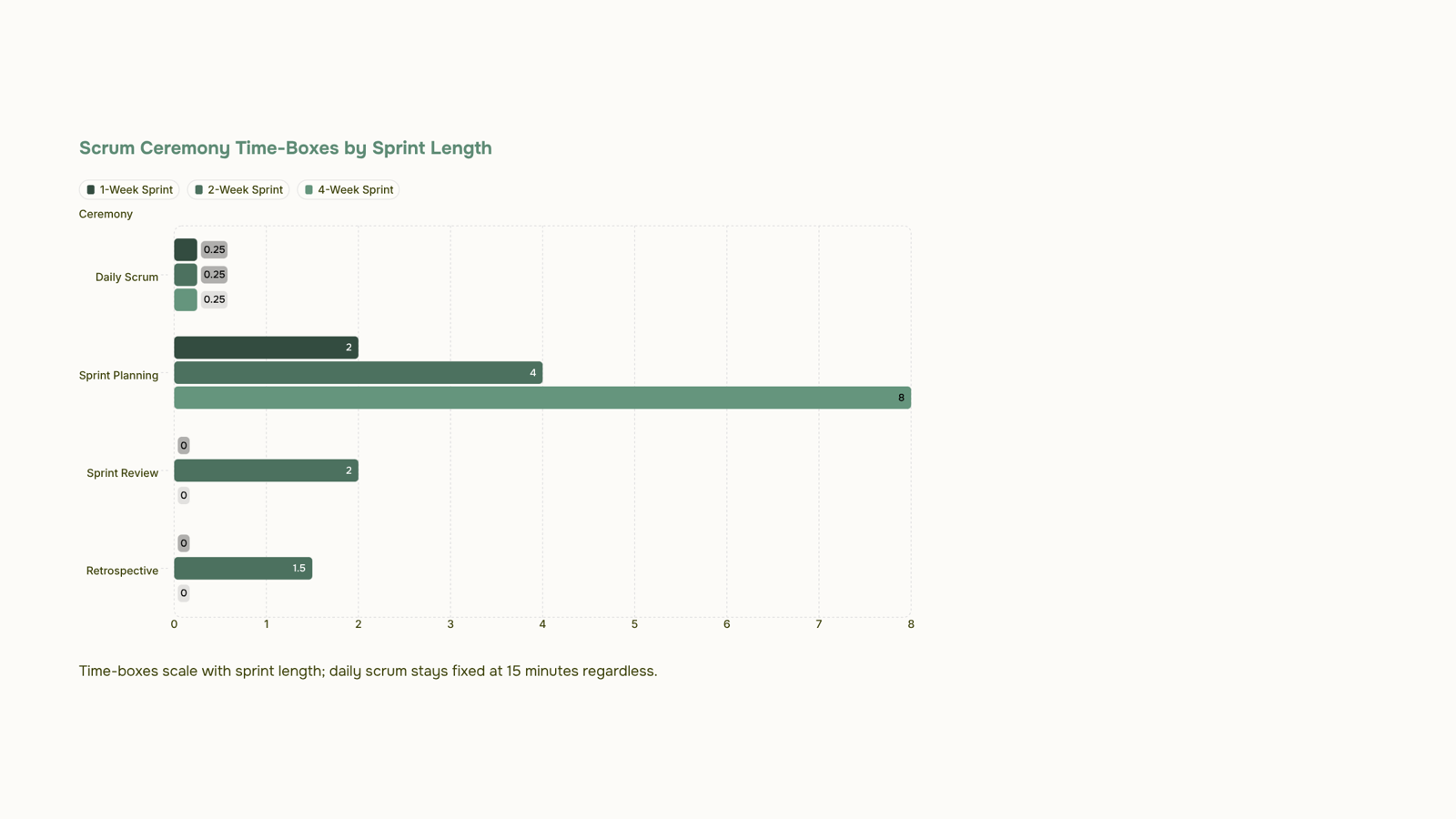
The Scrum Guide sets hard time-boxes for every ceremony, and they scale with sprint length, not team preference.
Ceremony | 1-week sprint | 2-week sprint | 4-week sprint |
|---|
Daily scrum | 15 min | 15 min | 15 min |
Sprint planning | 2 hours | 4 hours | 8 hours |
Sprint review | 1 hour | 2 hours | 4 hours |
Retrospective | 45 min | 1.5 hours | 3 hours |
The daily scrum stays flat at 15 minutes regardless of sprint length. That limit only holds if you enforce it: status updates that run long are the single most common reason effective stand-up meetings stop feeling worth attending.
Team size matters for planning and retrospectives specifically. Above eight people, a 4-hour planning session fills fast. Consider splitting into sub-teams with a sync at the end rather than stretching the time-box.
For a closer look at structuring the planning session itself, the sprint planning agenda breakdown covers what belongs in each block.
6 best practices for running effective scrum meetings
Start with a clear agenda, every time: No agenda means the team fills the silence with status theater instead of blockers. A scrum meeting agenda for a daily stand-up needs exactly three questions: what did you complete, what are you working on today, what is in your way. Sprint reviews and retrospectives need a written agenda shared at least 24 hours before. Outcome: the first 60 seconds of every meeting are productive, not orientation.
Protect the time-box: The Scrum Guide (Schwaber and Sutherland, 2020) sets the daily scrum at 15 minutes regardless of team size. When that boundary slips, the meeting becomes a planning session, and planning sessions need their own ceremony. Assign a facilitator whose only job is to call time and park off-topic threads in a follow-up channel. Outcome: the team trusts the meeting will end when it should, so attendance stays consistent.
Speak to the sprint goal, not your task list: The failure mode here is a round-robin of "I worked on ticket 4312 yesterday." That tells the team nothing about whether the sprint is on track. Train each person to frame their update against the sprint goal: "I finished the auth module, which closes the last blocker on the login flow we committed to." One sentence, goal-anchored. Outcome: the team hears progress in terms that matter, not ticket numbers. For a deeper look at how scrum affects team output over time, the pattern holds: goal-anchored communication is what separates high-performing agile teams from busy ones.
Surface blockers, do not solve them in the room: The daily scrum is a synchronization event, not a problem-solving session. When a blocker comes up, the facilitator logs it and schedules a follow-up with only the people who need to be there. Solving in the room burns 10 minutes for eight people who have no stake in the problem. Outcome: blockers get named and owned without hijacking the meeting.
Keep the right people in the room. Agile team meetings accumulate observers over time. Stakeholders join "just to stay informed," then start commenting, which shifts the dynamic from team sync to performance review. The daily scrum is for the development team. Stakeholders attend sprint reviews. Separating these is one of the core principles that scrum ceremonies are built on. Outcome: the team speaks freely about real blockers instead of managing up.
Close every meeting with a named owner for each action: The most common failure in daily scrum best practices is a blocker that gets named and then floats. Before the meeting ends, every open item needs a person and a deadline attached to it. "We'll look into that" is not an action. "Priya will confirm the API spec by 3pm today" is. Outcome: follow-through becomes the default, not the exception.
For a practical template on how to run an effective daily stand-up, these six practices map directly to the structure described there.
How to run scrum meetings remotely
Remote scrum meetings fail for one reason more than any other: teams transplant the in-person format without adjusting for time zones, async gaps, or camera fatigue.
Start with a time-zone ground rule. Pick a 30-minute window that falls within core hours for every participant. If no such window exists, split the team into regional pods and sync pod leads daily instead of running one sprawling call.
For distributed teams spanning more than two time zones, an async stand-up format often outperforms a live call. Each team member posts three lines in Slack or your project tool before their local noon: what they completed, what they are working on, and any blockers. A designated facilitator reviews the thread and flags blockers that need a live five-minute call. GitLab's own engineering teams use a similar model for remote scrum ceremonies.
When you do run live remote scrum meetings, keep the format tight:
Camera on, microphone muted until speaking
Screen-share the sprint board so updates are visual, not verbal
Hard stop at 15 minutes; blockers move to a separate call
Effective stand-up meetings in a remote context also need a single source of truth. A shared board visible to everyone before the call cuts the "wait, what sprint are we on?" confusion that eats the first three minutes.
How to tell if your scrum meetings are working
Three signals tell you whether your scrum meetings are actually working, without relying on gut feel.
Velocity trend is the clearest one. If your team's story points per sprint are flat or climbing over three to four sprints, your planning and daily scrums are doing their job. A declining trend usually means blockers are surviving stand-ups unresolved.
Blocker resolution time sharpens that picture. Track how long an impediment lives in your board from "raised" to "closed." Healthy daily scrum best practices keep that window under 24 hours for most blockers.
Retrospective action item completion rate is the one most teams skip. If fewer than half your retro actions get done before the next sprint ends, your scrum meetings are generating noise, not change.
These three metrics give you a feedback loop that's observable and repeatable. For a deeper look at how scrum affects team output over time, the pattern holds across team sizes.
Where to run your scrum ceremonies in one place
Scattered tools are the most common reason scrum meetings lose momentum. When your sprint board lives in one app, retrospective notes in another, and blockers in a third, the coordination overhead eats into the time your agile team meetings are supposed to protect. Centralizing sprint planning, daily stand-ups, and retros in one workspace means every participant walks in with the same context. Taro handles exactly this: task ownership, status updates, and retrospective action items tracked in one place, so nothing falls between tools. If you want the mechanics behind each ceremony, how scrum affects team output over time is worth reading next.
Closing
Effective scrum meetings come down to three things: clarity on what each ceremony produces, ruthless time-boxing, and a shared workspace where the team can see the sprint goal, task updates, and blockers in one place. When your daily stand-up, planning session, and retrospective all reference the same board and the same source of truth, the ceremonies stop feeling like overhead and start feeling like the rhythm that keeps the team moving. Start your next sprint with Taro open during every scrum meeting. Run your stand-up with the board visible, log blockers directly into the sprint view, and watch how much faster your team moves when everyone is looking at the same thing.
FAQ
What is the purpose of daily scrum meetings?
Daily scrum synchronizes the team on sprint progress and identifies blockers in 15 minutes. Its output is a shared picture of whether you're on track to meet the sprint goal and a plan for the next 24 hours.
How long should scrum meetings last?
Daily scrums are always 15 minutes. Sprint planning ranges from 2 hours (1-week sprint) to 8 hours (4-week sprint). Reviews and retrospectives scale similarly. Enforce the time-box; when it slips, the meeting becomes something else.
What are the best practices for conducting effective scrum meetings?
Use a clear agenda every time, protect the time-box with a facilitator, speak to the sprint goal not task lists, surface blockers without solving them in the room, keep only the right people present, and close with named owners for every action.
How can I ensure my team is getting the most out of scrum meetings?
Tie every update to the sprint goal, not individual tasks. Log blockers and actions in a shared workspace so nothing floats. Run all five ceremonies intact, especially the retrospective—skipping it means your process never improves.
What should a scrum meeting agenda include?
Daily scrum: what you completed, what you're working on today, what's blocking you. Sprint planning: sprint goal and sprint backlog. Reviews: stakeholder feedback on the increment. Retrospectives: one concrete process improvement to act on next sprint.


 Elena Petrova11 September 2026


