TL;DR: Most lead scoring guides define the concept and move on. This one shows IT company owners how points are actually assigned, weighted, and acted on — including the five signals that matter most, where manual models break down, and when automation takes over. You'll leave with a scoring framework you can map to your pipeline today.
What lead scoring actually means
Lead scoring is a method of assigning a numerical value to each prospect based on how closely they match your ideal customer and how they've behaved so far. That number tells your sales team who to call first, not who arrived first.
The distinction from lead tracking matters here. Tracking leads through your pipeline records where a lead is in your process. Scoring tells you how much that lead is worth pursuing right now. One is a location; the other is a priority signal.
A score typically reflects two categories of input. Fit criteria cover firmographic data: company size, industry, job title, budget range. Behavioral criteria cover actions: pages visited, emails opened, demo requests submitted. Lead scoring criteria examples from a typical B2B setup might weight a pricing-page visit at 15 points and a job title match at 20, while a single newsletter open earns 2.
The score is supposed to trigger something specific. A lead crossing a threshold, say 70 out of 100, should automatically route to a rep or queue a follow-up task. Without that trigger, the number is just a label. Most teams building scores in spreadsheets hit exactly this wall: the model exists, but nothing acts on it.
That's where automated lead qualification changes the equation, and why an AI lead scoring tool that scores and routes in the same system closes the gap spreadsheets leave open.
How lead scoring works in sales
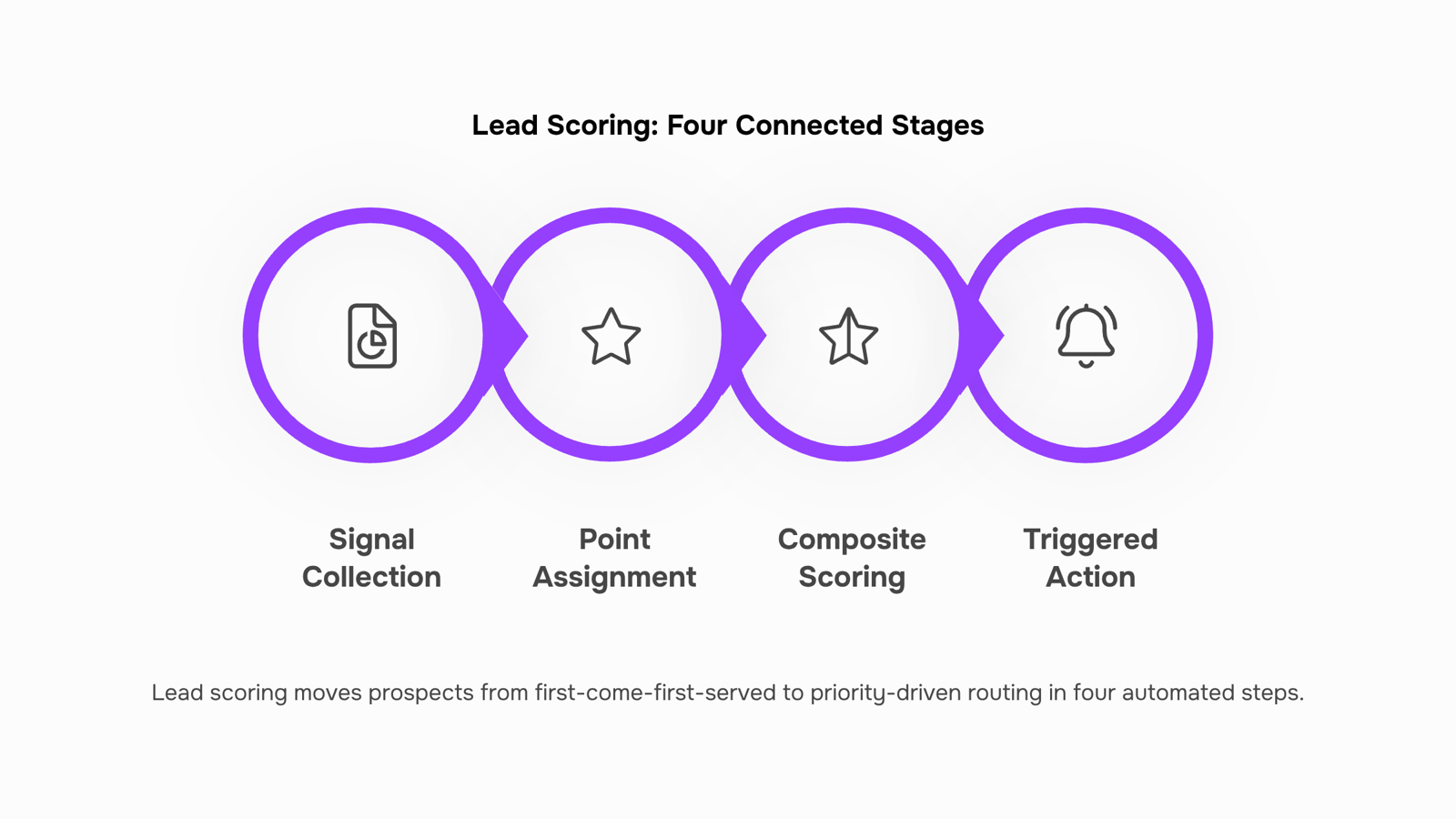
Lead scoring works in four connected stages, and understanding each one tells you exactly where deals get lost when the process breaks down.
Stage 1: Signal collection: Every interaction a lead has with your business generates a data point. Pages visited, emails opened, demo requests submitted, company size, industry, job title. A lead scoring engine criteria examples typically include both behavioral signals (what the lead does) and firmographic signals (who the lead is). The engine captures these continuously, not just at the moment of first contact.
Stage 2: Point assignment: Each signal gets a point value. A demo request might be worth 30 points. Opening a pricing email might be worth 10. Working at a 50-person IT company in your target vertical might add another 20. Visiting the pricing page twice in one week adds more. The exact weights depend on your sales history, but the logic is consistent: actions that correlate with closed deals score higher.
Stage 3: Composite scoring: Individual points roll up into a single 0–100 score. That number reflects the lead's overall fit and intent at this moment. For lead scoring for SaaS companies specifically, recency matters more than many teams expect. A lead who scored 70 three months ago and has gone quiet is not the same as a lead who just hit 70 after visiting your integration docs.
Stage 4: Triggered action: The score crosses a threshold and something happens automatically. A rep gets assigned. A follow-up sequence starts. A deal moves into the pipeline. This handoff is where most manual systems fail. Converting leads into sales depends on that trigger firing within minutes, not hours.
Lio assigns AI-generated scores from 0–100 in real time, so the moment a lead crosses your threshold, the right rep is already notified.
Five criteria that make a score meaningful
Not all scoring signals carry equal weight. These five criteria separate a model that predicts revenue from one that just sorts a spreadsheet.
Firmographic fit measures how closely a lead matches your ideal customer profile. For a SaaS company, that might be company size (50–500 employees), industry, and tech stack. A healthcare IT vendor would weight HIPAA-relevant org types higher. If the fit is wrong, no amount of engagement changes the outcome.
Behavioral engagement tracks what a lead actually does: pages visited, demos requested, pricing pages viewed, emails opened. A lead who reads your case studies three times in a week signals something a passive newsletter subscriber does not. This is where lead scoring criteria examples get specific, because the same action can mean different things depending on where it happens in the funnel.
Source quality reflects where the lead originated. Referrals and inbound organic leads close at higher rates than cold list imports. Assign points accordingly, and revisit those weights quarterly as your data accumulates.
Recency accounts for signal decay. A lead who downloaded a whitepaper six months ago and went quiet is not equivalent to one who did the same thing yesterday. Most teams underweight this criterion and end up chasing cold contacts while warm ones wait.
Intent depth goes beyond surface activity. Did the lead compare pricing tiers? Watch a full product demo? Submit a "contact sales" form? These actions indicate purchase readiness, not just curiosity. For lead scoring criteria in the healthcare industry or any regulated vertical, intent signals tied to compliance-related content often outperform generic engagement metrics.
Lio's AI Lead Scoring maps all five of these signals into a single 0–100 score, updated in real time as new activity comes in. Your reps see who is hot without manually cross-referencing five data sources.
Benefits of lead scoring for your sales team
When your reps treat every lead the same, the best ones go cold while the team works through a queue. That's the core problem lead scoring solves.
Here's what it changes in practice:
Faster response on the leads that matter: Scored leads give reps a clear call order. Instead of guessing, they open their queue and start at the top. Research from InsideSales suggests response time drops significantly when reps have a prioritized list rather than a flat inbox.
Better focus, less wasted effort: Understanding what is lead scoring also means understanding what it filters out. Low-fit leads stay in nurture; high-fit leads get human attention. Reps spend their hours where conversion is actually likely.
Higher conversion rates: B2B companies using lead scoring consistently report stronger pipeline-to-close ratios. The five-signal scoring framework behind most high-performing models ties directly to this outcome.
Cleaner pipeline visibility: When scores reflect real buying signals, your pipeline stops carrying dead weight. Forecasts get more accurate because the numbers behind them are grounded in behavior, not gut feel.
Lead scoring implementation inside a marketing automation or CRM platform compounds these gains. A score that lives in a spreadsheet goes stale; one that updates in real time, like Lio's AI scoring, keeps your team working from current data.
For the mechanics of automated lead qualification, the next section walks through the full setup.
How to implement lead scoring in five steps
Implementing lead scoring without a clear process produces a model that gets built once and ignored. Here is a five-step approach that keeps the model working after you ship it.
Define your ideal customer profile: Pull your last 12 months of closed-won deals and look for patterns: company size, industry, tech stack, job title of the buyer. These become your fit criteria. For most SaaS companies, three to five firmographic signals are enough to start.
Choose your behavioral signals: Fit tells you who could buy. Behavior tells you who is ready. Pricing page visits, demo requests, email opens, and repeated logins all signal intent. Weight recency heavily: a pricing page visit yesterday matters more than one from six weeks ago. A five-signal scoring framework gives you a starting template for which behaviors to track and how to weight them.
Assign point values and set thresholds: This is where most teams stall. Start simple: fit attributes get 10–20 points each, behavioral signals get 5–15 points depending on intent strength. Set three bands: cold (0–30), warm (31–60), hot (61–100). You can refine these thresholds after your first 30 days of data. For a deeper look at weighting logic, the best practices for assigning lead scores guide covers common calibration mistakes.
Wire scoring into your routing rules: A score sitting in a spreadsheet does nothing. When a lead crosses your hot threshold, something must happen automatically: assign to a rep, trigger a sequence, or book a call slot. This is the handoff moment most lead scoring implementation marketing automation guides skip entirely. Automated lead qualification explains how to connect score thresholds to routing logic without manual intervention.
Build a review cadence: Scores decay. A model calibrated in Q1 drifts by Q3 as your ICP shifts or a new competitor enters. Review conversion rates by score band monthly. If your hot leads are closing at under 20%, your threshold is too low.
Lio's AI lead scoring runs this entire cycle in a live CRM environment, assigning each lead a 0–100 score and updating it as new signals arrive, so your routing rules always act on current data rather than a snapshot from last quarter. For lead scoring software to stay useful, it needs to recalculate continuously, not just at import.
Lead scoring vs. lead qualification: what is the difference
Lead scoring assigns a number. Lead qualification assigns a judgment. They're related, but conflating them is how deals slip through.
Lead scoring answers "how interested and how fit is this prospect?" using weighted criteria like job title, company size, pages visited, and email engagement. The output is a number, say 0–100, built from your lead scoring criteria examples mapped to real buyer signals.
Lead qualification answers "should a rep spend time on this?" It's a human or automated judgment, typically mapped to a framework like BANT (Budget, Authority, Need, Timeline). Qualification uses the score as input, not a replacement for thinking.
| Lead Scoring | Lead Qualification |
|---|
Output | A number | A yes/no/not yet decision |
Who acts | System or marketing | Sales rep or AI routing rule |
When it runs | Continuously, on every signal | At a defined pipeline stage |
Risk if skipped | Reps chase the wrong leads | Scored leads stall with no owner |
The handoff between the two is where most teams lose deals. A score of 78 means nothing if no one has a rule that says "route to sales at 75." Automated lead qualification closes that gap by turning score thresholds into routing triggers automatically.
Closing
Lead scoring turns your pipeline from a first-come, first-served queue into a priority list driven by real buying signals. The five criteria—fit, engagement, source, recency, and intent—separate leads worth calling today from those still warming up. Map your scoring model to your sales history, set a threshold that matches your team's capacity, and wire it into your CRM so scores trigger action the moment they cross the line. The next step is to stop updating scores manually: Lio's AI Lead Scoring assigns and updates points in real time, so your reps act on hot leads within minutes instead of hours.
FAQ
How does lead scoring work in sales?
Lead scoring assigns a numerical value (0–100) to each prospect based on fit criteria (company size, industry, title) and behavioral signals (pages visited, demos requested, emails opened). When a score crosses your threshold, it triggers an automatic action—assignment to a rep, a follow-up sequence, or pipeline movement.
What are the benefits of using lead scoring in marketing?
Lead scoring prioritizes reps' time on high-intent prospects, reduces response time on the leads that matter, improves conversion rates, and cleans up pipeline visibility. Teams using scoring report stronger pipeline-to-close ratios because they're working from behavior, not gut feel.
How do I implement lead scoring in my CRM?
Map your five criteria (fit, engagement, source, recency, intent) to point values based on your sales history, set a threshold for routing, and configure an automated trigger so scores route leads to reps or queues without manual intervention. Test the model against past closed deals first.
What are the best lead scoring models for B2B businesses?
The five-signal model—firmographic fit, behavioral engagement, source quality, recency, and intent depth—outperforms single-factor approaches. Weight intent signals (demo requests, pricing comparisons) highest; recency decay matters more than most teams expect.
What is a good lead score threshold for routing to a sales rep?
Start at 70 out of 100 if your model is new; adjust based on your team's capacity and conversion data. A threshold too low floods reps with unqualified leads; too high leaves warm prospects in nurture. Revisit quarterly as your scoring accuracy improves.
How often should you update your lead scoring criteria?
Review weights quarterly against closed-deal data to see which signals actually predicted revenue. Recency thresholds may shift seasonally. If your product, market, or buyer profile changes, recalibrate fit criteria immediately.


 Elena Petrova11 September 2026


