TL;DR: Most content on B2B lead funnels stops at the diagram. This one treats the funnel as an operational system — showing IT company owners exactly what breaks at each stage, how to measure it, and how automation closes the gaps before leads go cold. You'll leave with a framework you can wire up this week.
What Is a B2B Lead Funnel and Why Does It Break
A b2b lead funnel is the path a prospect travels from first hearing about your company to signing a contract. It maps every stage where your team must take action — and every stage where leads quietly disappear.
Most IT company owners assume their funnel is working because leads are coming in. The real problem is what happens after. Leads enter at the top, hit a slow follow-up, and go cold before a rep ever has a meaningful conversation. Research consistently shows that the majority of leads that don't convert were never properly followed up with — not lost to a competitor, just lost to silence.
The structural failures are predictable:
No clear handoff between marketing and sales, so qualified leads sit in a queue
Follow-up sequences that run on manual effort, which means they stop the moment someone gets busy
No lead scoring, so reps spend equal time on a cold contact and a ready buyer
A b2b sales pipeline that tracks deals but ignores the nurture steps that move leads into those deals
Understanding lead generation funnel best practices helps, but diagnosis comes first. The sections below walk each funnel stage so you can spot exactly where yours is leaking.
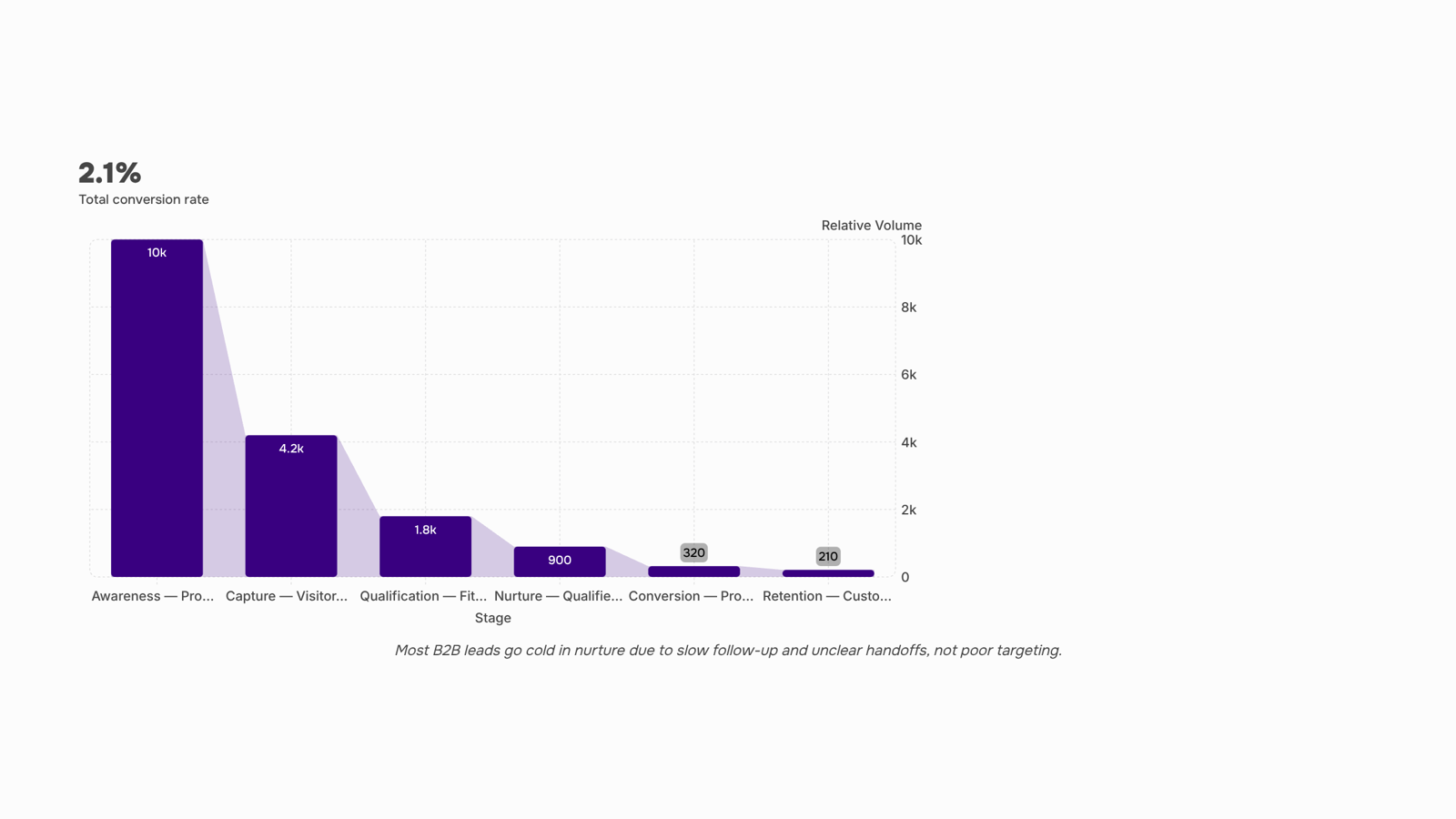
What Are the Stages of a B2B Lead Funnel
Each stage of a B2B lead funnel has one job. When a stage fails, leads don't disappear quietly — they stall, go cold, or land in a competitor's pipeline. Here's what each stage does and what a broken version looks like in practice.
Awareness: A prospect learns you exist through search, a referral, or a LinkedIn post. Failure here looks like traffic that never converts to contact — usually because the message is too generic to signal relevance to an IT buyer.
Capture: A visitor takes an action: fills out a form, books a call, downloads something. Failure is a leaky form with no follow-up sequence, or a lead that sits in a spreadsheet for three days before anyone touches it. Research on lead response time consistently shows that speed-to-contact is one of the strongest predictors of conversion.
Qualification: This is where lead qualification in B2B earns its weight. You're separating real prospects from noise using criteria like company size, tech stack, budget signal, and decision-making authority. Failure looks like reps chasing unqualified leads while real buyers go untouched.
Nurture: Qualified leads that aren't ready to buy need a reason to stay warm. Failure here is silence — no follow-up, no relevant content, no touchpoints until the rep remembers to check in. Most leads that go cold do so here. B2B email nurturing done well keeps qualified prospects moving without requiring manual effort from your team.
Conversion: The prospect becomes a customer. Failure is a proposal that never gets a response because no one followed up at the right moment.
Retention: The customer renews, expands, or refers. Failure is treating the funnel as finished at the signed contract.
Use this as a self-diagnostic. If your B2B lead funnel stages are intact but conversion is still weak, the next section shows where qualification breaks down first.
How Do You Capture and Qualify Leads at the Top of the Funnel
Most IT companies treat top-of-funnel capture as a single-channel problem: run ads, collect form fills, hand leads to sales. The reality is that your best prospects arrive through four or five channels simultaneously — LinkedIn outreach, inbound content, referrals, webinar sign-ups, and cold email — and without a system that consolidates them, half get lost before anyone qualifies them.
The first operational baseline is multi-source capture: every channel feeds one CRM, not separate spreadsheets or tool-specific inboxes. If a lead from a LinkedIn message and a lead from a contact form land in different places, your qualification logic breaks immediately. Building that consolidated capture layer is the prerequisite before any qualification criteria matter.
Qualification at this stage comes down to four signals:
Fit: company size, industry, and tech stack match your ICP
Intent: the lead took a specific action (downloaded a pricing guide, requested a demo, replied to a sequence)
Authority: the contact can influence or make a purchase decision
Timeline: there is an active need, not a vague future interest
A lead that clears fit and intent but fails authority is still worth nurturing. A lead that clears all four moves to SQL status and needs a response fast. Research consistently shows that slow follow-up is the most common reason qualified leads go cold — not poor targeting.
For IT companies running multiple b2b lead generation strategies at once, the qualification criteria need to be defined before leads arrive, not decided case-by-case when a rep has a free hour.
How Do You Build a Pipeline That Moves Leads Through Each Stage
A pipeline without defined next actions is just a list of names. Every lead in your b2b sales pipeline needs a clear status and a specific trigger that moves it forward — otherwise leads pile up at whatever stage requires the least effort, and your b2b lead funnel conversion rate quietly collapses.
The fix is structural. Define each stage by what the lead has done, not what you hope they'll do. A lead isn't "in consideration" because you sent one email. They're in consideration because they replied, clicked a pricing link, or booked a call. Behavioral criteria make stages objective and make stagnation visible.
A practical five-stage structure for IT services looks like this:
New — lead captured, not yet contacted
Contacted — first outreach sent, awaiting response
Qualified — confirmed budget, authority, and timeline
Proposal — scope or pricing sent
Won / Lost — decision recorded with a reason
The "reason" field on Won/Lost is where most teams skip. Logging why a deal closed or died is how you find the stage where your b2b lead funnel actually breaks. If 60% of losses happen at Proposal, you have a pricing or timing problem, not a lead quality problem.
Each stage should also carry a maximum idle time. If a lead sits in Contacted for more than five business days with no activity, it needs an automated follow-up or a manual flag. Evox handles this with pipeline automation that triggers sequences based on stage and inactivity — so no lead goes cold by default.
For a deeper look at best practices for building a lead generation funnel, including how to sequence touchpoints across stages, that guide covers the full architecture.
What Are the Key Metrics to Track in a B2B Lead Funnel
Four numbers tell you whether your b2b lead funnel is working or quietly leaking revenue.
Stage-to-stage conversion rate shows what percentage of leads move from one funnel stage to the next. A healthy rate from MQL to SQL for IT services companies sits around 13%, according to Demand Gen Report benchmarks. If yours is below 10%, the problem is usually qualification criteria, not volume.
Lead response time is the metric most IT owners underestimate. Responding to a new lead within five minutes makes conversion significantly more likely than waiting an hour or more, and most teams are nowhere near that window. Every hour of delay is a compounding drop-off risk.
MQL-to-SQL ratio tells you whether marketing is sending sales the right leads. A ratio below 1:5 (one SQL for every five MQLs) usually signals a targeting problem upstream, not a sales problem.
Pipeline velocity combines deal count, average deal size, win rate, and sales cycle length into one number: how fast revenue moves through your funnel. The formula is straightforward: (number of deals × average deal value × win rate) ÷ average sales cycle in days. A drop in velocity almost always traces back to one of the first three metrics above.
Tracking these manually across a spreadsheet means you're always looking at yesterday's problem. Evox's funnel and conversion reports surface all four in one view, so you can see exactly where drop-off is happening before it becomes a pipeline gap, not after.
Once you know which stage is leaking, the fix is usually automation, which the next section covers.
Can Marketing Automation Actually Improve Your B2B Lead Funnel
Yes, but only if you wire it to the right funnel stage.
Most teams adopt marketing automation for b2b funnel efficiency and immediately point it at the wrong problem. They automate newsletters while leads go cold waiting for a follow-up. The fix is matching each automation action to the specific stage where drop-off is happening.
At the top of the funnel, the job is instant routing. A new inbound lead should hit a rep's inbox within five minutes of form submission. Research consistently shows that response time is one of the strongest predictors of whether a lead converts at all — and most IT companies are responding in hours, not minutes. Automated lead routing removes that gap entirely.
At the middle of the funnel, lead nurturing in b2b is where automation earns its keep. A prospect who downloaded a case study but hasn't booked a call isn't cold — they're waiting for the right nudge. A three-to-five email sequence triggered by that download, spaced over two weeks, keeps the conversation moving without a rep manually tracking every contact.
At the bottom of the funnel, lead scoring triggers tell your reps when to act. When a prospect opens four emails in three days and visits your pricing page, that behavior should automatically raise their score and push an alert to the assigned rep. Without that trigger, reps are guessing who to call.
Evox handles all three of these layers inside one workflow: routing rules, multi-step sequences, and behavior-based scoring that fires alerts the moment a lead shows buying intent. Your reps stop chasing and start responding to signals.
Closing
Your IT company probably already has leads coming in. The gap isn't volume — it's what happens next. Most teams lose qualified prospects to slow follow-up, unclear handoffs between marketing and sales, and no system that moves leads through defined stages before they go cold. A B2B lead funnel that converts isn't about getting more leads. It's about capturing every lead from every source, qualifying them against consistent criteria, and triggering the next action automatically so nothing stalls. Start by mapping your current funnel against the five stages above. Where do leads sit longest? That's where your system is breaking. Lio consolidates leads from every channel into one CRM, scores them automatically, and routes qualified prospects to your reps with zero delay. See how it works with a free trial.
FAQ
How do I create a B2B lead funnel that converts?
Define each funnel stage by what the lead has done, not what you hope they'll do. Consolidate all lead sources into one system, set clear qualification criteria upfront, and automate follow-up so nothing stalls between stages.
What are the stages of a B2B lead funnel?
Awareness, Capture, Qualification, Nurture, Conversion, and Retention. Each stage has one job; when any stage fails, leads go cold or disappear into a competitor's pipeline.
How do I optimize my B2B lead funnel for better conversion rates?
Track stage-to-stage conversion rates to spot where leads leak. Set maximum idle times per stage and automate follow-up when leads stall. Speed-to-contact is one of the strongest predictors of conversion.
What are the key metrics to track in a B2B lead funnel?
Stage-to-stage conversion rate, response time, qualification rate, and win/loss reason. These four metrics reveal whether your funnel is working or leaking revenue at a specific stage.
Can I use marketing automation to improve my B2B lead funnel?
Yes. Automation removes manual follow-up delays and ensures no lead goes cold by default. Trigger sequences based on stage and inactivity so qualified leads move forward without requiring constant rep effort.


 Elena Petrova15 September 2026


