TL;DR: Most guides on quote management treat it as a document problem. This one treats it as a sales process, walks IT company owners through the seven steps where deals most often stall between quote sent and deal closed, and shows what to automate so follow-ups, approvals, and revisions stop falling through the cracks.
What quote management actually means in sales
Quote management is the end-to-end process of creating, sending, tracking, revising, and following up on sales quotes until a deal closes or dies. It is not the same as building a PDF proposal and emailing it.
For IT companies specifically, a quote typically includes scope definitions, licensing tiers, implementation fees, and revision history. Each of those layers creates a decision point where a deal can stall. Estimate and quote management means owning every one of those points, not just the document itself.
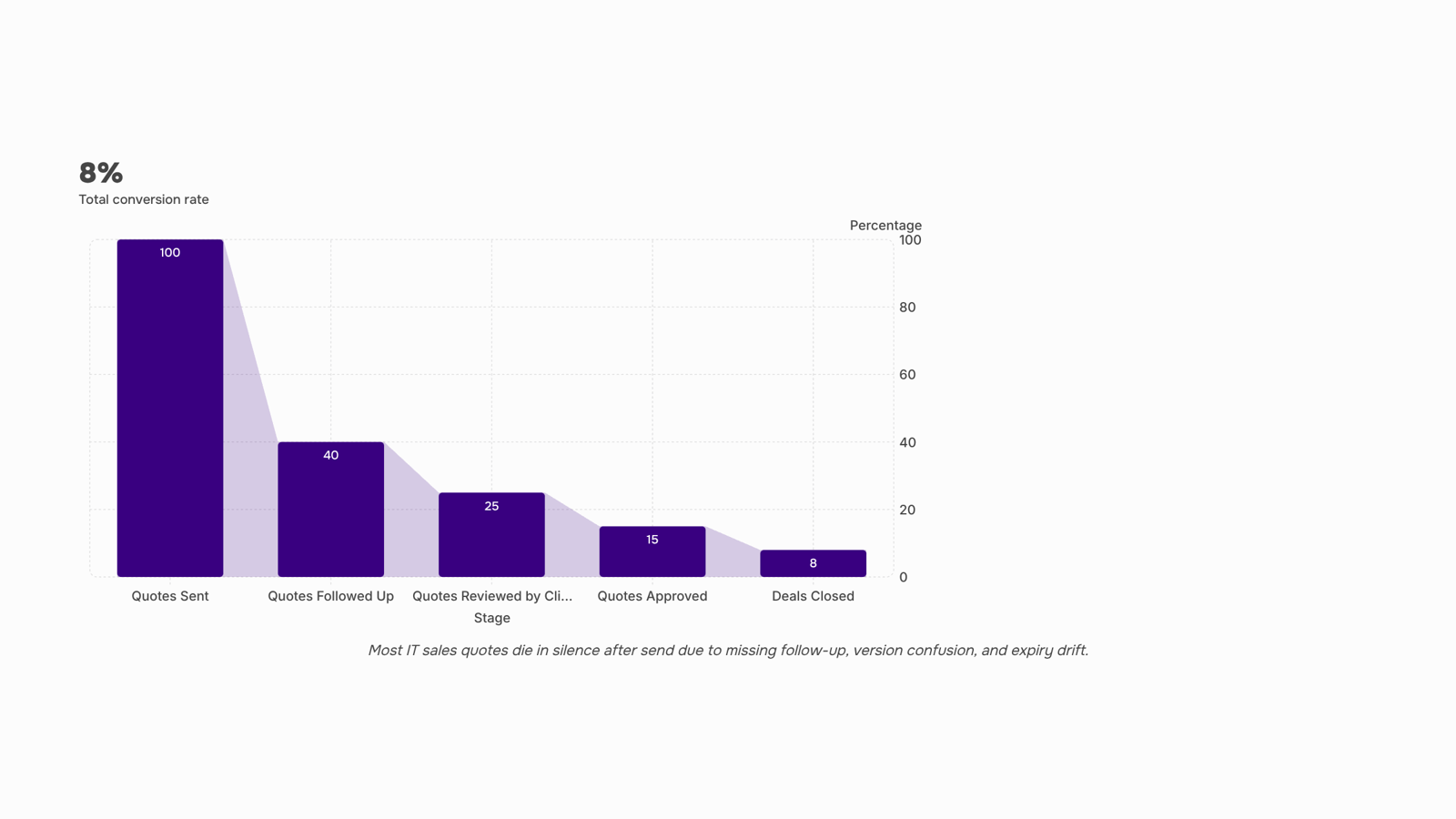
The process matters because most deals don't die at the proposal stage. They die in the silence after it. A quote sent without a structured follow-up cadence is effectively a guess. Research from Salesforce suggests a significant share of B2B quotes never receive a single follow-up from the rep who sent them. That alone explains a lot of lost revenue.
Good quote management also prevents version confusion, where a client approves a quote that no longer reflects the current scope, and it keeps expiry dates from quietly killing deals you thought were warm.
The next section covers the four specific failure points where IT companies lose deals most often. If you want to understand why most sales quotes never get a response, that pattern starts here.
Why most IT sales teams lose deals at the quote stage
Four specific problems account for most lost IT deals at the quote stage.
Slow turnaround is the first. When a prospect asks for a quote covering server licensing, implementation hours, and a support tier, they're often comparing you against two or three others. A 48-to-72-hour delay hands that window to whoever responds first.
No follow-up is the second, and the most preventable. Most quotes go out and then go silent. Research consistently shows that a significant share of B2B quotes never receive a single follow-up from the sending rep. Why most sales quotes never get a response is a pattern, not a one-off failure.
Version confusion is the third. IT quotes change. Scope gets revised, licensing tiers shift, a hardware line item gets swapped. Without a quote management system tracking revisions, prospects end up approving an outdated version, which creates billing disputes before the project even starts.
Expired quotes are the fourth. A quote sent in January with 30-day pricing that a prospect revisits in March creates an awkward renegotiation. Most teams using manual processes have no alert when that window closes.
A proper sales quote management software setup removes all four failure points without adding work to your sales rep's day. The 7 steps ahead show exactly how.
7 best practices for quote management that close more deals
Seven steps won't fix a broken process unless each one targets a real failure point. These are ordered by where deals actually die, not by what sounds logical in a blog post.
1. Set a quote turnaround target and hold to it
In IT services, the first vendor to respond with a complete, accurate quote wins a disproportionate share of deals. Aim for 24 hours on standard engagements, 48 hours on complex multi-tier licensing proposals. If your team regularly takes five or more days, that's a process problem, not a capacity one. Map where the time goes before you add headcount.
2. Standardize your quote structure before you write the first line
Version confusion starts when every rep builds quotes from scratch. Create a master template that covers scope summary, licensing tiers, implementation fees, exclusions, and payment terms. A managed services provider quoting a 50-seat Microsoft 365 migration, for example, should pull from the same structure every time, with only the client-specific variables changing. Consistency also makes internal review faster.
3. Tie every quote to a CRM record from the moment it's created
A quote that lives in a Word document or email thread is invisible to your pipeline. Using a CRM with quote management built in, or a dedicated integration, means every version is timestamped, linked to the opportunity, and visible to whoever manages the deal next. When a rep is out sick or a deal gets reassigned, nothing falls through. This is the single biggest structural fix most IT companies skip.
4. Define expiry dates and communicate them at send
Quotes without expiry dates create two problems: pricing drift when costs change, and stalled deals where the prospect feels no urgency. Set a standard validity window (30 days works for most IT service agreements) and state it clearly in the quote body, not buried in the footer. A prospect who knows a quote expires on March 15 behaves differently from one who assumes the price is open-ended.
5. Build a follow-up sequence before you hit send
Most IT service quotes go unanswered not because the prospect lost interest, but because no one followed up. According to Salesforce research, a significant share of B2B quotes never receive a single follow-up from the sending rep. The fix is mechanical: decide your follow-up cadence (day 3, day 7, day 14) before the quote leaves your outbox, and assign ownership explicitly. Following up on sales quotes is its own discipline, and the teams that treat it that way close more of what they send.
6. Track quote status actively, not reactively
"Sent" is not a pipeline stage. Your team needs to know whether a quote has been opened, forwarded internally, or ignored. The best software for quote management gives you read receipts or engagement signals so you can prioritize follow-up on quotes that are being reviewed versus ones that haven't been opened. A quote sitting unread on day 8 needs a different response than one that's been opened four times by three people.
7. Review win/loss data by quote type, not just by rep
Most post-mortems focus on who lost the deal. The more useful question is which quote configurations win and which don't. If your flat-rate managed services quotes close at 40% but your time-and-materials quotes close at 18%, that's a pricing structure problem worth fixing. A quote management system that logs outcomes against quote type gives you the data to make that call. Without it, you're adjusting the wrong variable.
These seven steps work together. Standardizing structure (step 2) makes turnaround faster (step 1). CRM linkage (step 3) makes status tracking possible (step 6). And win/loss review (step 7) tells you whether the whole process is actually working. The next section covers which of these steps are best handled by automation and what that looks like in a live IT services workflow.
How to streamline your quote management process with automation
Three steps in the seven-step framework are strong candidates for automation: follow-up reminders, status triggers, and expiry alerts.
Follow-up reminders are where most IT service quotes die quietly. Research from Salesforce consistently shows that a significant share of B2B quotes never receive a single follow-up from the sending rep. If you want to understand why most sales quotes never get a response, the short answer is that manual tracking fails under volume. A rule-based trigger in your online quote management software that fires 48 hours after delivery removes that failure entirely.
Status triggers move a quote through review, approved, and revision-requested states without anyone checking a spreadsheet. When a client approves, good quote management software can convert an accepted quote to an invoice in one click, cutting re-entry errors on licensing tiers and scope line items.
Expiry alerts notify both your rep and the client before a quote lapses, giving you a natural reason to re-engage rather than restart.
If you want to automate quote follow-up reminders without writing a single line of code, rule-based workflow tools make this straightforward. The next section covers what to look for when choosing the right quote management software for your industry so you can evaluate options against your actual workflow.
What to look for in quote management software
Before you evaluate any quote management software, settle on four criteria that actually separate useful tools from ones that just look good in a demo.
Version control and audit trail: IT quotes change. Scope shifts, licensing tiers get revised, discounts get approved after the fact. A system without version history means your team is guessing which number the client actually saw.
CRM and PSA integration depth: A tool that syncs quote status back to your CRM in real time removes the manual update step that causes follow-up gaps. Check whether it writes back to deal stage or just logs a note.
Approval workflows: If a rep can send a quote without a manager sign-off on non-standard pricing, margin leaks quietly. Good sales quote management software enforces approval gates before the quote leaves the building.
Expiry and follow-up automation: The best software for quote management does more than generate a PDF. It triggers a follow-up task when a quote goes unread for 48 hours and flags expiring quotes before they go cold.
If your business quotes physical products alongside services, the criteria shift slightly. This breakdown of quotation software for manufacturing companies covers where the evaluation diverges.
Common quote management mistakes and how to avoid them
Four mistakes account for most lost deals in IT sales.
Quoting before scoping is the most expensive one. When a rep sends numbers before confirming requirements, the client either rejects the price or requests a revision, and each revision cycle adds days to a deal that should have closed in one round.
No follow-up plan is a close second. Most B2B quotes go unanswered not because the prospect said no, but because no one followed up. Why most sales quotes never get a response explains the pattern in detail. You can automate quote follow-up reminders without writing a single line of code using a basic workflow tool.
Poor version control creates a third failure point. When a client references "the quote you sent" and your team has three versions in email threads, trust erodes fast.
Run your current estimate and quote management process against these three checkpoints before evaluating any quote management system.
Closing
Quote management isn't about the document—it's about the process that turns a sent quote into a closed deal. The teams that win are the ones who standardize their structure, track status actively, and automate the three steps where deals die in silence: follow-ups, approvals, and expiry alerts. Steps 5 through 7 are where most IT companies leak revenue, and they're also where automation pays the fastest dividend.
If your team is still managing quotes through email threads and manual follow-up lists, you're competing with one hand tied. Revo's workflow automation handles follow-up sequences, status tracking, and expiry alerts without requiring a rep to remember. Ready to see how it works in a live IT services workflow? Explore Revo's automation capabilities and run your next quote cycle without the gaps.
FAQ
Q. How can I streamline my quote management process?
A. Standardize your quote structure, link every quote to your CRM, set expiry dates upfront, and automate follow-up sequences before the quote goes out. Revo's workflow automation handles steps 5–7 (follow-ups, approvals, expiry alerts) without manual tracking.Q. What are the best practices for quote management in sales?
A. Hit 24–48 hour turnaround, use a consistent template, tie quotes to CRM records, define expiry dates, build follow-up cadences before sending, track status actively (not just 'sent'), and review win/loss data by quote type to optimize pricing structure.Q. What tools can I use for effective quote management?
A. A CRM with integrated quote management or a dedicated quote software that tracks versions, timestamps, and engagement signals. Revo's automation layer adds rule-based follow-ups, status triggers, and expiry alerts on top of your existing workflow.Q. How does quote management software improve sales productivity?
A. It removes manual follow-up tracking, prevents version confusion, sends expiry alerts automatically, and surfaces engagement signals so reps prioritize warm leads. Salesforce data shows most B2B quotes never get a follow-up—automation fixes that gap.


 Elena Petrova11 September 2026


