TL;DR: TL;DR: Most content on price quotes explains what they are. This one gives IT company owners a field-by-field comparison framework — vendor by vendor — so you can spot hidden costs, scope gaps, and pricing traps before you sign. You also get a repeatable process for turning the winning quote into a contract without losing the details that matter.
What Is Actually in a B2B Software Price Quote?
A B2B software price quote is a formal document a vendor sends that breaks down exactly what you're buying, at what price, and under what conditions. It's the starting point for every negotiation, and it's where most IT buyers get caught off guard.
A complete B2B software price quote should include these line items:
Base subscription fee: The per-seat or flat monthly/annual cost for the core product
Implementation and onboarding: Setup fees, data migration, and configuration work — often quoted separately and easy to miss
Support tier: Whether you're getting email-only, a dedicated account manager, or something in between, and what that costs
API and integration fees: Per-call charges or flat fees for connecting the software to your existing stack
Contract terms: Minimum commitment length, auto-renewal clauses, and early termination conditions
Overage pricing: What happens when you exceed your seat count, storage limit, or API call volume
Generic finance content covers the basics, but IT-specific line items like API overages and data migration costs rarely appear in standard quote templates. Those are exactly the charges that cause a final invoice to diverge from the original quote.
Before you accept any quote, map each line item against your actual usage. A vendor who handles customer and vendor records in one place makes that audit faster. Understanding the full quote to cash lifecycle also helps you spot where costs can shift after you sign.
What Factors Affect the Price Quote You Receive?
Two vendors quoting the same platform can send you numbers that are thousands of dollars apart. The difference usually comes down to four variables.
Seat count is the most obvious one. Most B2B software prices per user, so a 20-seat quote and a 50-seat quote are structurally different documents. Watch for minimums buried in the terms — some vendors require you to purchase 25 seats even if you only need 12.
Contract length changes the unit price significantly. Annual contracts typically run 15–20% cheaper than month-to-month, but they also lock in your commitment before you've fully evaluated fit. A custom price quote should always show both options so you can compare the real cost of flexibility.
Support tier is a common source of quote variation that buyers miss. Basic support (email only, 48-hour SLA) might be included; dedicated onboarding, a named account manager, or 24/7 phone access often adds 10–20% to the base price.
Implementation and data migration scope is where software pricing factors diverge most sharply. One vendor may quote implementation as a flat fee; another bills hourly. If you're migrating from an existing system, get that scoped explicitly — it's one of the most common line items that causes the final invoice to exceed the original quote.
Understanding how these variables connect to what happens after you sign is just as important. The quote to cash process and how you manage vendor terms over time both depend on getting this detail right upfront.
How to Get a Price Quote That Reflects Your Actual Needs
Before you request a B2B software price quote, write down exactly what you're buying. Vendors default to their standard tiers unless you give them a reason not to. A custom price quote requires you to hand them specifics: current seat count, expected growth over the contract term, which integrations you need on day one, and whether you need dedicated onboarding or can self-serve.
Send that information in writing before the first call. This does two things: it filters out vendors who can't meet your requirements, and it makes the quotes you do receive comparable against each other. When one vendor quotes 15 seats with API access and another quotes 20 seats without it, you're not comparing the same thing.
Three items most IT buyers forget to specify upfront:
Data migration scope (how much historical data moves over, and who does the work)
Support tier (business-hours email versus 24/7 with a named account manager)
Contract exit terms (what it costs to leave before the renewal date)
Once you have quotes in hand, the next step is mapping each one against total cost of ownership, not just the monthly line item. Managing that process gets easier when your quote-to-cash workflow and vendor records sit in the same system.
How to Compare Price Quotes from Different Software Vendors
When you receive quotes from multiple vendors, the instinct is to sort by total price and pick the lowest number. That approach misses most of what determines actual cost.
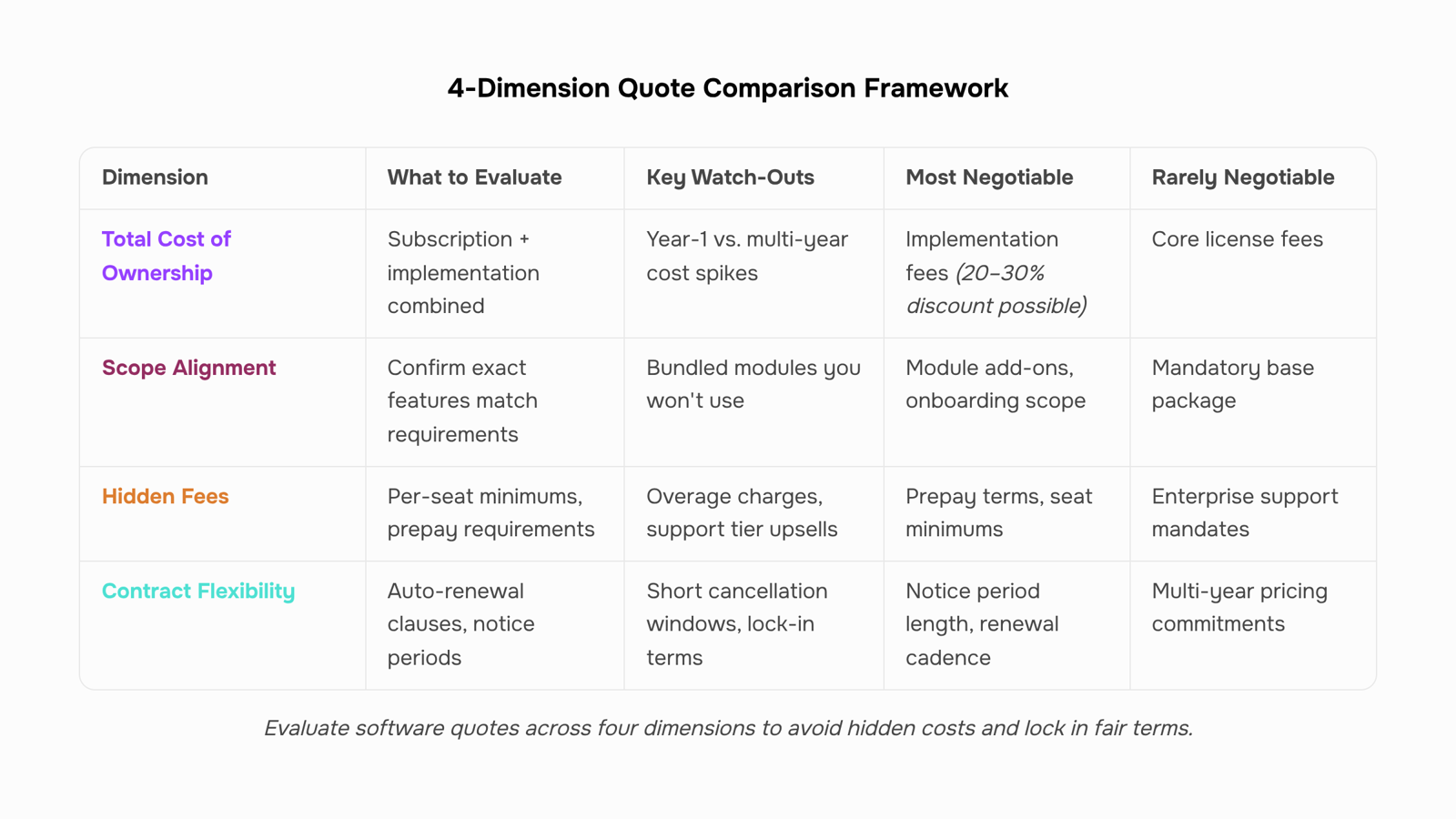
A useful comparison framework works across four dimensions.
Total cost of ownership goes beyond the subscription line. Add implementation fees, data migration charges, training costs, and any API overage rates that apply once your team hits normal usage. A quote that looks 20% cheaper at the headline often lands higher once those line items are included. Build a simple spreadsheet: one row per vendor, one column per cost category, and a 12-month and 36-month total at the bottom.
Scope alignment is where most comparisons break down. Before you score any quote, confirm it covers the exact feature set you specified in your requirements document. Vendors frequently quote on their standard tier, then note in the fine print that the features you asked about require an upgrade. Flag any quote where the scope is ambiguous and ask for a written confirmation of what's included.
Hidden fees in software pricing factors tend to cluster around a few categories: per-seat minimums that charge you for users you haven't added yet, annual prepay requirements buried under a monthly price, and professional services billed at hourly rates that aren't capped. When you compare software vendor quotes, request a complete fee schedule, not just the subscription rate.
Contract flexibility determines your exit cost if the product underperforms. Look at auto-renewal clauses, notice periods for cancellation, and whether the vendor offers a month-to-month option at a premium you can actually evaluate. A two-year lock-in at a 10% discount is only worth it if you're confident in the fit.
Once a quote clears this framework, the next question is what happens after you accept it. The quote-to-cash process connects the accepted price quote directly to invoicing, so the number you agreed on is the number that appears on your first bill. Keeping that handoff clean matters, especially when you're managing multiple vendor relationships through a single vendor management workflow.
Which Parts of a Software Price Quote Are Negotiable?
Most B2B software price quotes have more flexibility than vendors initially signal. Knowing which lines to push on saves real money.
Implementation fees are the most negotiable item on almost any quote. Vendors price these with margin built in, and many will discount 20–30% if you commit to a faster onboarding timeline or bring your own project lead.
Annual vs. monthly billing is another lever. Vendors prefer annual contracts for cash flow reasons, which means they'll often drop the per-seat rate by 10–15% to get you there. Ask for the annual price with a quarterly payment schedule as a middle ground.
User minimums are negotiable more often than buyers expect, especially when you're under their standard floor. Counter with a 12-month ramp clause: start at your actual user count, scale up at a defined milestone.
What vendors rarely move on: core license fees tied to published pricing tiers, and SLA terms in enterprise contracts where legal has already signed off.
One practical step: when you compare software vendor quotes side by side, flag every fee that doesn't appear on all three documents. That asymmetry is your opening. A vendor who buries implementation costs while a competitor itemizes them is telling you something about how they'll handle the quote-to-invoice handoff later.
What Happens After You Accept a Quote?
Accepting a quote feels like the finish line. It isn't. The handoff from accepted price quote to first invoice is where most IT buyers discover the gap between what was agreed and what gets billed.
The problem is usually documentation, not bad faith. A sales rep closes the deal, the account gets handed to implementation, and the original quote lives in someone's email thread. By the time the invoice arrives, the line items have shifted: a "free" onboarding session is now a billable project phase, or the seat count was rounded up without notice.
To close that gap, do three things the moment you sign:
Convert the accepted quote to a formal order document that both sides countersign. This locks scope before implementation starts.
Map every line item from the quote directly to the invoice template the vendor will use. If they don't match, ask why in writing before work begins.
Set a calendar reminder 30 days before each renewal to pull the original quote and compare it against what you're actually being charged.
The quote-to-invoice step is also where payment terms quietly change. Net-30 discussed in negotiation sometimes becomes Net-15 on the invoice. Check the terms field on every invoice against what the quote stated.
For teams managing multiple vendor contracts at once, tracking follow-ups and agreed terms in one place prevents the version-control problem that turns a clean deal into a billing dispute six months later.
Common Mistakes When Comparing Software Price Quotes
Comparing headline price is the most common error IT buyers make when evaluating software vendor quotes. The number on page one rarely reflects total cost once you add implementation fees, data migration, API overage charges, and per-seat scaling.
Renewal terms are the second blind spot. A competitive first-year rate can jump 30–40% at renewal if the contract includes uncapped escalation clauses. Read that section before you sign anything.
Third: most buyers skip the payment terms entirely, then face invoice surprises that don't match what was agreed. A connected quote-to-cash workflow closes that gap by locking agreed terms before the deal moves forward.
When you compare software vendor quotes, software pricing factors like support tiers and user limits matter as much as the base price. Track them in one vendor record so nothing gets lost between tabs.
Closing
Comparing price quotes isn't about finding the cheapest option—it's about spotting what's actually included, what's hidden, and whether the vendor's terms let you walk away if the fit isn't right. Once you've narrowed down to a winner, the real risk begins: losing track of what was agreed between 'yes' and 'paid'. INZO connects your accepted quote directly to your invoice and payment workflow, so scope, price, and payment terms stay locked in sync. No gaps, no surprises on the first bill.
Ready to stop the quote-to-invoice disconnect? Start by mapping your next software comparison using the four-dimension framework from this guide—total cost of ownership, scope alignment, hidden fees, and contract flexibility. Which of these dimensions typically trips up your vendor evaluations?
FAQ
How do I get a price quote for B2B software?
Write down your exact requirements—seat count, integrations, support tier, and data migration scope—and send them to the vendor in writing before the first call. This ensures quotes are comparable and filters vendors who can't meet your needs.
What factors affect the price quote for a software solution?
Seat count, contract length, support tier, and implementation/data migration scope drive most variation. Annual contracts run 15–20% cheaper than month-to-month; dedicated support adds 10–20% to base price; custom implementation scopes differ sharply between vendors.
Can I get a custom price quote for my business needs?
Yes. Vendors default to standard tiers unless you specify otherwise. Provide seat count, growth projections, required integrations, and onboarding preferences upfront to unlock custom pricing that matches your actual needs.
How do I compare price quotes from different software vendors?
Build a spreadsheet comparing total cost of ownership (subscription plus implementation, migration, training), scope alignment against your requirements, hidden fees, and contract flexibility. Calculate 12-month and 36-month totals to see the real cost.
What is included in a typical price quote for B2B software?
Base subscription fee, implementation and onboarding, support tier, API and integration fees, contract terms (length and auto-renewal), and overage pricing. Most quotes miss IT-specific line items like API overages and data migration—always verify these explicitly.


 Elena Petrova15 September 2026


