TL;DR: Most guides confirm that electronic signatures are legal and move on. This one covers the conditions that actually determine whether a signature holds up when challenged: intent, authentication, tamper-evidence, and audit trail requirements. IT company owners will leave knowing exactly what their signing workflow needs to satisfy, and what gaps create exposure.
Are electronic signatures legally binding?
Digital contract with verification badge on tablet, symbolizing legally binding electronic signatures
Yes, electronic signatures are legally binding in the United States. The ESIGN Act (15 U.S.C. § 7001), signed into law in 2000, establishes that a contract or signature cannot be denied legal effect solely because it is in electronic form. Most states reinforce this through the Uniform Electronic Transactions Act (UETA), which 49 states have adopted. If you want to understand what an electronic signature is and how it works before going further, that context helps.
The three-state gap matters here. Illinois, New York, and Washington did not adopt UETA. Each has its own electronic signature statute, so the baseline rules differ slightly from the federal framework. For most commercial transactions, the ESIGN Act covers the gap, but state-specific rules can apply to certain document types.
The ESIGN Act also excludes specific categories entirely: wills, testamentary trusts, family law documents like adoption orders, court orders, and notices of utility termination, among others listed under 15 U.S.C. § 7003. An e-signature on any of those documents carries no legal weight regardless of platform.
Knowing that e-signatures are permitted is only half the answer. Courts also apply a separate evidentiary standard when a signature is disputed, which is where most IT company owners get caught off guard. The next section covers the four conditions a court looks for when deciding whether a specific signature actually holds.
What makes an electronic signature legally binding?
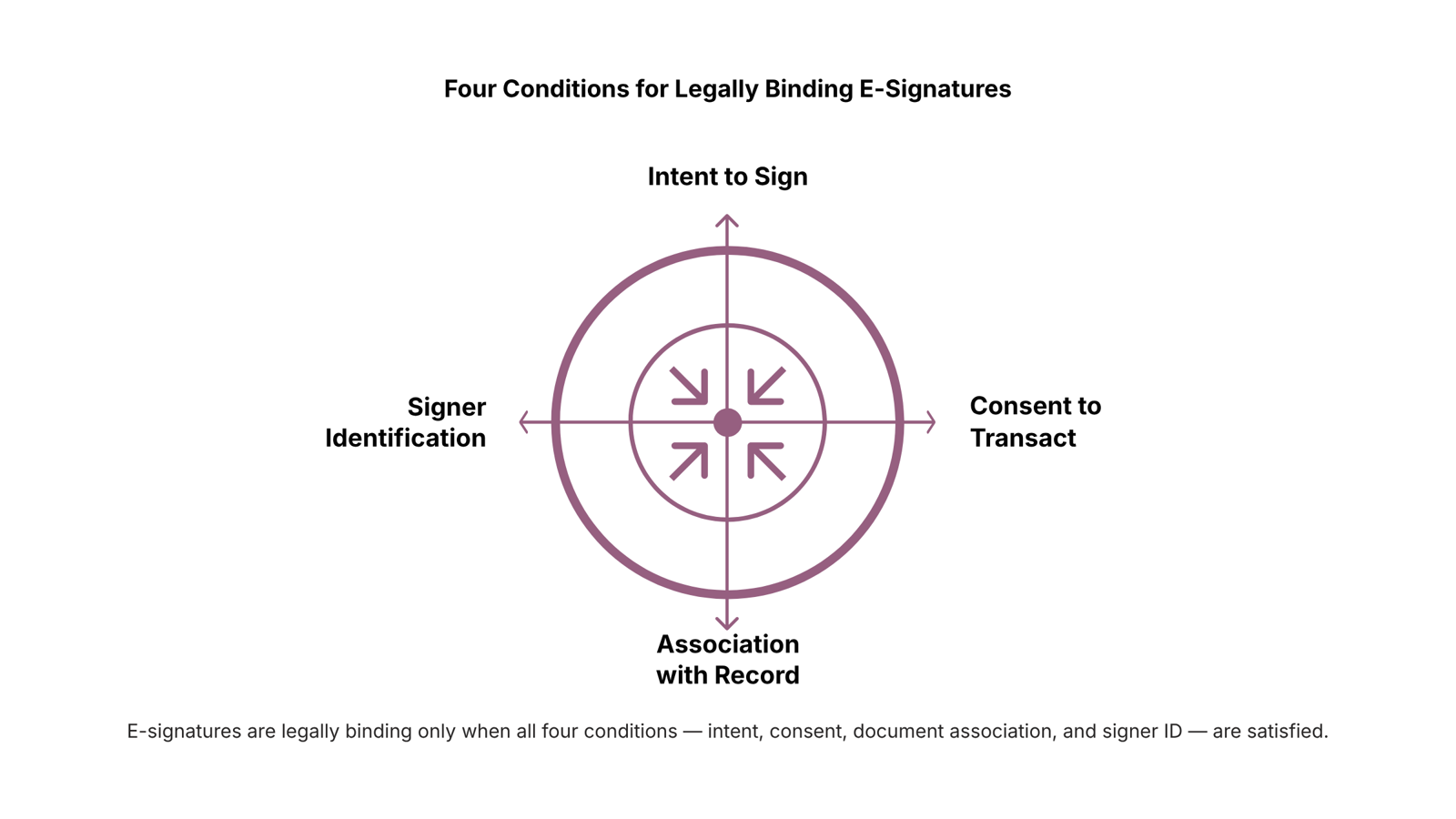
Courts and regulators look at four specific conditions when deciding whether an electronic signature holds up — not just whether one exists.
Intent to sign: The signer must take a deliberate action: clicking "I agree," typing a name, or drawing a signature. A passive action, like opening an email, doesn't meet this bar. The behavior has to signal agreement, not just receipt.
Consent to transact electronically: Both parties must agree to conduct business this way. Under the ESIGN Act electronic signature requirements, consumer consent must be affirmative and informed — the party has to know they're giving up a paper document before they agree to the electronic version.
Association with the record: The signature must be logically linked to the document being signed, not just appended to any file. A timestamp, a document hash, or an audit trail that ties the signature to the exact version of the record satisfies this condition. This is also where tamper-evidence matters — how e-signing compares to traditional signatures on security and tamper-evidence explains why that association is harder to fake electronically than on paper.
Signer identification: The process must capture enough information to attribute the signature to a specific person — an email address, IP address, phone-based authentication, or a knowledge-based verification step. The stronger the identification, the easier the signature is to defend if challenged.
What makes an electronic signature legally binding isn't the technology itself. It's whether the signing process produces evidence of all four conditions. A signature collected without consent language, or one that can't be tied to a specific signer, can fail in court even if it looks valid on the surface. For higher-stakes documents, advanced electronic signatures add identity verification layers that directly address the identification condition.
Are electronic signatures legally binding in all states?
Whether electronic signatures are legally binding in the US depends partly on which state you're in — though the short answer is yes, in most cases.
The federal ESIGN Act (15 U.S.C. § 7001) establishes baseline validity nationwide. The Uniform Electronic Transactions Act (UETA) fills in the state layer, and 47 states have adopted it. The three that haven't — Illinois, New York, and Washington — each passed their own electronic signature statutes. Those laws reach similar conclusions, but the specific requirements differ, so if you're executing contracts in those states, check the local statute directly rather than assuming UETA applies.
Jurisdiction aside, certain document types are excluded from ESIGN Act coverage regardless of where you operate. Under 15 U.S.C. § 7003, wills and testamentary trusts, court orders, notices of foreclosure or eviction, and documents governed by the Uniform Commercial Code (outside Articles 2 and 2A) fall outside federal protection. Real estate deeds add another layer: some states accept electronic signatures on deeds; others still require wet ink or notarization. State-level rules vary most in real estate, which is where IT companies handling property-related client contracts get caught off guard.
The practical rule: confirm the document type isn't excluded, then confirm which statute governs the state where the contract is executed. Those two checks cover most of the risk before you send anything for signature.
Electronic signatures vs digital signatures: which is legally binding?
Both are legally binding in the US — but they are not the same thing, and the difference matters when a signature gets challenged.
An electronic signature captures intent: a typed name, a drawn mark, a checkbox. It satisfies ESIGN and UETA because it shows the signer meant to sign. If you want a deeper look at what an electronic signature is and how it works, that distinction is worth understanding before you build any signing workflow.
A digital signature adds cryptographic verification on top of that intent. It uses a certificate-based key to bind the signer's identity to the document and flags any post-signing changes. That makes it harder to dispute in court, not because it's more "legal," but because it produces stronger evidence. For the full breakdown, see advanced electronic signatures and how they differ from standard e-signatures.
On the electronic signature vs digital signature legal question: courts treat both as valid under ESIGN. The gap isn't validity — it's proof. A digital signature gives you a verifiable chain of custody. A basic electronic signature gives you intent, but if the other party disputes identity or document integrity, you'll need supporting records to fill that gap.
For contracts where disputes are likely, digital signatures carry meaningfully less risk.
What can invalidate an electronic signature in a dispute?
Four failure conditions knock otherwise valid e-signatures out of disputes — and most guides don't name them clearly.
No audit trail: The ESIGN Act requires that a signature reflect the signer's intent, but intent is hard to prove without a timestamped record of who signed, when, and from where. If your platform can't produce a log showing IP address, device, and signing sequence, opposing counsel will challenge it.
No verified signer identity: A typed name in a box satisfies the legal threshold under ESIGN Act electronic signature requirements, but it doesn't prove the right person typed it. In a dispute, the evidentiary threshold is higher. Courts want to see that you took reasonable steps to confirm identity — email authentication, SMS verification, or access codes at minimum.
No tamper-evidence on the document: If the file can be edited after signing without detection, the signature is effectively worthless in court. Advanced electronic signatures use cryptographic hashing to lock document state at signing. Standard e-signatures don't do this automatically — your platform has to.
Missing consent records: ESIGN requires that signers affirmatively consent to doing business electronically. If you can't show that consent was captured and stored, the entire agreement can be challenged. This is the requirement most IT company owners skip.
What makes an electronic signature legally binding isn't just the signature itself — it's the evidence package around it. A signed PDF with no audit trail, no identity verification, and no tamper-seal is a legal liability, not a legal document. How e-signing compares to traditional signatures on tamper-evidence explains why the storage method matters as much as the signing method.
How to ensure electronic signatures are legally binding
Whether electronic signatures are legally binding depends less on the tool you use and more on what your workflow produces as evidence.
Four things must exist in your process:
Audit trail with timestamps: Every signing event needs a log entry showing when each signer opened the document, when they signed, and from which IP address. Without this, you cannot prove the signature happened at a specific time.
Device and identity capture: The audit trail should record the signer's IP address, device type, and browser. This is what separates a defensible signature from one a signer can plausibly deny. If you want a stronger identity bar, advanced electronic signatures add verified ID checks on top of this baseline.
Tamper-evident document storage: Once signed, the document must be sealed so any post-signature alteration is detectable. Most compliant platforms hash the final document and embed that hash in the audit record. How e-signing compares to traditional signatures on tamper-evidence covers what that protection actually looks like in practice.
Documented signer consent: ESIGN requires that signers affirmatively consent to transact electronically. That consent record must be stored alongside the signed document, not just assumed.
Sigi handles all four automatically: every workflow produces a timestamped audit log, IP and device capture, a hashed document record, and a consent confirmation tied to each signer. If a signature is ever challenged, the evidence package is already built.
For context on what makes a contract binding beyond the signature itself, the underlying contract requirements apply regardless of signature format.
Document types where electronic signatures are not legally binding
Even if you've confirmed what an electronic signature is and built a compliant workflow, certain document types sit outside ESIGN's reach entirely. Under 15 U.S.C. § 7003, electronic signatures are not legally binding in the US for:
Wills, codicils, and testamentary trusts
Adoption and divorce proceedings
Court orders and official court documents
Notices of cancellation for utilities, health insurance, or life insurance
Certain real estate documents, including notices of foreclosure and eviction
These exclusions apply federally. State law can add more. Illinois, New York, and Washington each operate under their own electronic signature statutes rather than UETA, so the exclusion list can differ depending on where your counterparty is located.
The practical guardrail: before routing any document through an e-signature workflow, check whether it appears on the federal exclusion list and verify the governing state's rules. If you're regularly collecting signatures from multiple parties across different states, build that check into your intake process, not as an afterthought.
Closing
Meeting the legal standard for e-signatures and being able to prove it in a dispute are two different bars. You can have a signature that satisfies ESIGN on paper and still lose a case because you can't produce the audit trail, tamper-evidence record, or signer identification data a court will demand. The question isn't whether e-signatures are legal — they are. The question is whether your signing workflow generates the evidence that proves it. Check whether your current process captures IP addresses, timestamps, document hashes, and device information on every signed document. If it doesn't, you're carrying risk you don't need to carry.
FAQ
Are electronic signatures legally binding in the US?
Yes. The ESIGN Act (2000) establishes that contracts cannot be denied legal effect solely because they are electronic. UETA reinforces this in 47 states; Illinois, New York, and Washington have their own statutes with similar outcomes.
What makes an electronic signature legally binding?
Courts look for four conditions: intent to sign (deliberate action), consent to transact electronically (informed agreement), association with the record (tied to the exact document version), and signer identification (traceable to a specific person). All four must be provable.
Are electronic signatures legally binding in all states?
Yes, under federal ESIGN Act baseline. State variations exist in Illinois, New York, and Washington. Certain documents — wills, court orders, real estate deeds in some states — are excluded regardless of location.
How do I ensure my electronic signatures are legally binding?
Confirm the document type isn't excluded, obtain informed consent to sign electronically, capture signer identity (email, IP, or authentication), and generate an audit trail with timestamps and tamper-evidence records tied to the exact document version.
Are digital signatures and electronic signatures both legally binding?
Yes, both are valid under ESIGN. Digital signatures add cryptographic verification, which produces stronger proof in disputes but isn't required for legal validity. Use digital signatures for high-risk contracts.
Can an electronic signature be challenged in court?
Yes. Common invalidation grounds: no audit trail, unverified signer identity, missing consent language, or inability to prove the signature is tied to the specific document version. Strong evidence of all four binding conditions defeats most challenges.


 Marcus Thompson10 September 2026


