TL;DR: Most articles on quality control in project management stop at definitions. This one moves straight to a 6-step implementation process built around the failure points IT project leads actually hit: unclear acceptance criteria, defects caught too late, and no feedback loop between delivery and planning. Read on to get a process you can apply to your next project.
What quality control in project management actually means
Abstract 3D visualization of quality control process with digital checklist interface and geometric workflow elements
Quality control in project management is the process of inspecting actual deliverables against predefined acceptance criteria to catch defects before they reach the client or the next project phase.
It sits inside the broader discipline of project quality management, which covers everything from setting quality standards at the start of a project to auditing processes mid-run. Quality control is the output-focused slice of that discipline: you have something tangible, you measure it, and you decide whether it passes or fails.
For IT teams, that might mean reviewing a build against functional requirements, running user acceptance tests on a feature, or checking a deliverable against the scope baseline. The inspection happens after work is produced, not before.
This distinction matters because many teams treat quality management as a single activity and end up doing neither part well. Knowing where quality checkpoints fit across the stages of project management helps you schedule control activities at the right moments rather than bolting them on at the end.
A solid project management checklist that covers the elements most teams skip typically includes quality checkpoints. Most teams skip them until rework forces the issue.
Quality assurance vs. quality control: the difference that matters
Quality assurance (QA) and quality control (QC) solve different problems at different points in a project. Conflating them leads to the wrong fix at the wrong time.
Quality assurance is process-focused and preventive. It asks: are we working in a way that will produce a good result? QA happens before and during execution — defining quality standards in projects, setting review cadences, and building the conditions that make defects unlikely.
Quality control is output-focused and detective. It asks: does this specific deliverable meet the standard? QC happens after work is produced — inspecting code, reviewing a deliverable against acceptance criteria, or running a test cycle to catch what slipped through.
A practical way to keep them separate: QA writes the checklist; QC checks the box. Both are part of project quality management, but they operate at different levels.
This article focuses on QC — the inspection and verification work that determines whether outputs are actually shippable. If you want to see how change control and quality control work together to prevent scope-driven defects, that connection becomes especially clear once your QC process is running.
How quality control affects project success
A structured quality control process does four measurable things for a project.
Fewer late-stage defects. Defects caught during execution cost a fraction of what they cost after delivery. PMI's research consistently shows rework can consume 20–25% of total project budget when quality checks happen too late or not at all. Catching a missed acceptance criterion in week two is a one-hour fix. Catching it after client sign-off is a scope negotiation.
Clearer delivery criteria. Quality control forces the team to define "done" before work starts. That definition becomes the benchmark every output is measured against, which removes the ambiguity that causes last-minute revision cycles.
Faster stakeholder sign-off. When deliverables arrive with documented evidence they meet agreed standards, stakeholders spend less time questioning and more time approving. A project management checklist that covers the elements most teams skip shows how pre-delivery verification shortens review cycles in practice.
Reduced rework cost. This is where project quality management pays back the most. Rework is expensive not just in hours, but in team morale and schedule compression. Quality checkpoints fit at specific stages of project management — and placing them correctly is what separates teams that ship clean from teams that fix things twice.
How to implement quality control in project management in 6 steps
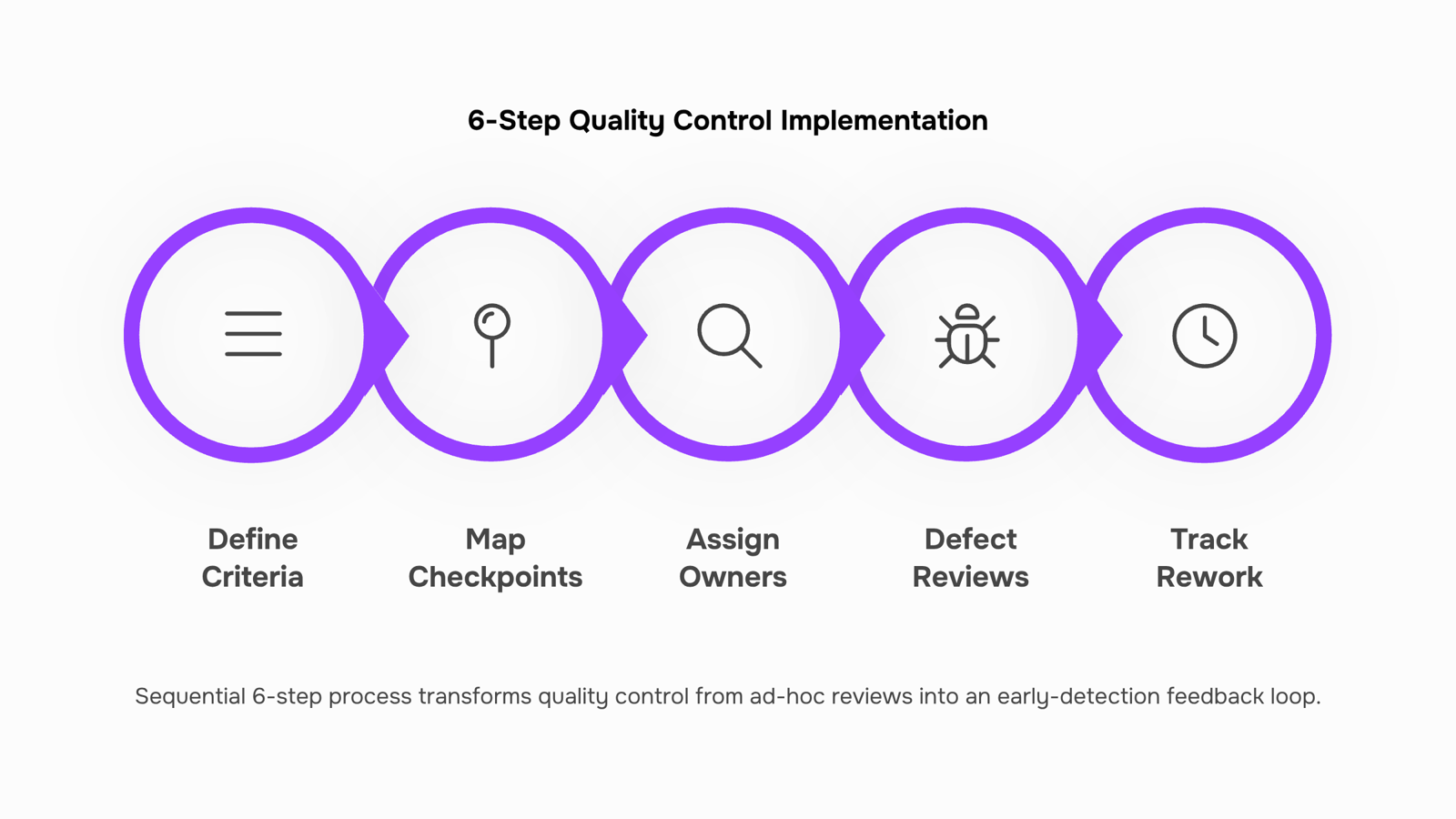
Implementing a quality control process without a clear sequence is how teams end up running ad-hoc reviews at the end of a project, when fixing anything costs the most. These six steps give you a repeatable structure from kickoff to close.
Define acceptance criteria before work starts. For every deliverable, write down what "done and correct" looks like in measurable terms. Not "the API should be fast" but "the API returns a response in under 200ms under 500 concurrent users." Teams that skip this step spend the back half of the project arguing about whether something passed, not actually testing it. If you want a starting point, a project management checklist that covers the elements most teams skip is a practical reference for what to document at kickoff.
Map quality checkpoints to project milestones. Don't wait until delivery to check quality. Assign a specific review gate to each major milestone: requirements sign-off, design approval, code review, UAT, and final handoff. Each gate should have an owner, a checklist, and a pass/fail criterion. This is where project milestone tracking connects directly to quality — checkpoints only work if they're tied to a real schedule event, not a floating "we should review this soon."
Assign clear ownership for each quality gate. Someone specific needs to be responsible for signing off at each checkpoint. Shared ownership means no ownership. On a typical IT project, this is the QA lead for technical deliverables and the project manager for scope and documentation. If your team is smaller and roles overlap, document who covers what explicitly rather than assuming.
Run structured defect reviews, not informal feedback loops. When a deliverable fails a checkpoint, log the defect with enough detail to reproduce it: what was expected, what was observed, severity, and who owns the fix. A shared defect log does two things. It prevents the same issue from slipping through twice, and it gives you data at the end of the project on where your process broke down. Informal Slack threads don't do either.
Track rework against your original estimates. Rework is the most direct signal that your quality control process has a gap. If a feature takes three rounds of revision, that's not a developer problem — it's a criteria or review problem. Log rework hours separately from original estimates so you can see the real cost. PMI research consistently puts rework at 10–15% of total project cost for software projects; if your numbers are higher, the defect log from step four will tell you where to look.
Run a quality retrospective at project close. A close-out retrospective focused specifically on quality — not general lessons learned — asks three questions: which checkpoints caught real defects, which ones were rubber-stamped, and which defects made it to production anyway. The answers update your project quality checklist for the next project. Without this step, you repeat the same gaps.
One practical note on steps four and five: how change control and quality control work together to prevent scope-driven defects is worth reading alongside this framework. Scope changes that bypass the change control process are one of the most common sources of late-stage defects, and no quality control process fully compensates for uncontrolled scope creep.
The six steps above are sequential for a reason. Acceptance criteria inform the checkpoints. Checkpoints drive the defect log. The defect log feeds the retrospective. Skip one and the next step loses its input.
Best practices for quality control in project management
Five habits separate teams that catch defects early from those that discover them in production.
Document acceptance criteria before work starts. Vague requirements are the leading cause of rework. For each deliverable, write the specific conditions it must meet to be accepted, and get sign-off from the client or stakeholder before development begins. A project management checklist that covers the elements most teams skip can help you standardize this across every project.
Run a defect review at each milestone. Don't wait for the final delivery to surface quality issues. At every milestone, compare outputs against your documented quality standards in projects and log any gaps before the next phase opens.
Assign a named QC owner per workstream. Shared responsibility means no responsibility. One person should own the project quality checklist for each workstream and be accountable for sign-off.
Tie change requests to quality impact. Scope changes introduce defects. Change control and quality control work together to prevent scope-driven defects, so every change request should include a quality risk assessment before approval.
Place quality checkpoints at stage gates. Knowing where quality checkpoints fit across the stages of project management keeps reviews from becoming an afterthought added only at the end.
Most teams run quality control across three or four disconnected tools: a spreadsheet for acceptance criteria, a separate task tracker for milestones, a shared doc for review sign-offs, and email threads for defect follow-up. Each handoff between tools is a place where something gets missed.
The tool categories that actually matter for a quality control process are:
Project milestone tracking — flags when a deliverable is due for review, not just due for delivery. Without this distinction, QC reviews get skipped under deadline pressure.
Checklist and acceptance criteria tools — capture the definition of "done" before work starts. A project management checklist that covers the elements most teams skip is worth reviewing if yours feels thin.
Review and approval workflows — route deliverables to the right reviewer automatically, log the decision, and block progression until sign-off is recorded.
The overhead drops significantly when these three functions live in one place. Track quality checkpoints and task-level acceptance criteria in one place rather than reconciling three tools after every sprint.
Understanding where quality checkpoints fit across the stages of project management helps you decide which tool handles which function — and where change control and quality control work together to prevent scope-driven defects.
Closing
Quality control only works when it's woven into your actual workflow — not bolted on as an afterthought. The 6-step process in this article turns quality from a checkpoint activity into a feedback loop that catches defects early, clarifies what "done" means before work starts, and gives you real data on where your process is breaking down.
But a process on paper isn't a process in practice. If you're running quality gates across spreadsheets, Slack threads, and separate documents, you're spending more time coordinating the control than actually controlling quality. Taro is where acceptance criteria, task-level checkpoints, defect logs, and milestone tracking live in one system — so your quality control framework runs inside your actual project workflow, not alongside it. Ready to move from framework to execution?
FAQ
Q. How do you implement quality control in project management?
A. Define acceptance criteria before work starts, map quality checkpoints to project milestones, assign clear ownership for each gate, log defects in a shared system, track rework separately, and run a retrospective at close. Each step prevents defects from slipping through to the next phase.Q. What are the best practices for quality control in project management?
A. Write measurable acceptance criteria upfront, assign a specific owner to each quality gate, use a structured defect log instead of informal feedback, tie checkpoints to real milestones, and track rework hours to identify process gaps. PMI research shows this reduces rework from 20–25% of budget to 10–15%.Q. What tools are used for quality control in project management?
A. Defect tracking systems, acceptance criteria documentation, milestone tracking platforms, and shared checklists. Taro consolidates these into one system so quality gates, task-level criteria, and rework tracking don't depend on separate spreadsheets or documents.Q. How does quality control impact project management success?
A. It reduces late-stage defects, clarifies delivery criteria before work starts, speeds stakeholder sign-off, and cuts rework costs. Defects caught early cost a fraction of what they cost after delivery — the difference between a one-hour fix and a scope negotiation.Q. What are the benefits of quality control in project management?
A. Fewer costly rework cycles, faster stakeholder approvals, clearer "done" criteria, and measurable data on where your process breaks down. Teams that implement structured QC consistently reduce total project cost and improve on-time delivery.Q. What is the difference between quality assurance and quality control in a project?
A. Quality assurance is preventive and process-focused — it sets standards and builds conditions that prevent defects. Quality control is detective and output-focused — it inspects deliverables against those standards after work is produced. QA writes the checklist; QC checks the box.


 Elena Petrova15 September 2026


