What are the benefits of implementing lean portfolio management
TL;DR: Most content on lean portfolio management recycles SAFe definitions without telling you what to actually do on Monday. This article gives IT company owners a working mental model and a six-step process you can map to your real project intake, prioritization, and resource decisions. No certification required.
What lean portfolio management actually means
Most IT teams already manage a portfolio of projects. The problem is how they manage it. Traditional approaches treat the portfolio like a static list: rank projects by size or political weight, assign budgets annually, and hope delivery follows. It rarely does.
Lean portfolio management applies Lean and systems thinking to how your organization funds, prioritizes, and governs work across that portfolio. As SAFe describes it, it aligns strategy and execution by connecting investment decisions to the actual flow of value through the business. The unit of focus shifts from individual projects to value streams — the end-to-end sequences of work that produce outcomes customers or internal teams depend on.
The concept draws from Lean manufacturing principles (reduce waste, optimize flow) and Agile delivery thinking, then applies both at the portfolio level rather than the team level. SAFe formalizes it as a discipline, but you don't need a SAFe certification to use it. The core ideas are accessible to any IT owner running four or more concurrent initiatives.
Where traditional project portfolio management asks "which projects do we fund?", lean portfolio management asks "how do we keep value flowing without overloading the system?" That shift in question changes how you allocate people, how you make funding decisions, and how you prioritize work across your portfolio when demand exceeds capacity — which, for most IT teams, is most of the time.
Key principles that make lean portfolio management work
Five principles separate lean portfolio management from conventional project governance. Each one removes a specific failure mode IT teams run into when managing multiple projects at once.
Work in progress limits cap how many initiatives run concurrently. Most IT teams carry more active projects than their capacity supports, which splits attention and slows everything down. Setting explicit WIP limits forces a real conversation about what actually starts versus what sits in a backlog. The result is fewer half-finished projects and faster throughput on the ones that matter.
Continuous funding replaces the annual budget cycle with rolling investment decisions tied to value streams. Instead of locking capital into a fixed project list in January, your team can redirect spend when priorities shift mid-year. That flexibility matters more than most IT owners realize until a market change forces a pivot.
Decentralized decision-making pushes routine choices down to the teams doing the work. When every call escalates to leadership, delivery slows and engineers wait. Lean portfolio management for IT projects defines clear decision rights so that teams resolve day-to-day blockers without a queue forming at the top.
Portfolio flow treats your initiative backlog the same way a Kanban board treats tasks: visible, sequenced, and actively managed. When you can see where work stalls across the full portfolio, you can fix the constraint rather than add more resources to a broken system. Atlassian describes this visibility as central to what lean portfolio management actually delivers.
Strategy alignment connects every funded initiative to a business outcome. If you can't draw a line from a project to a strategic goal, that project is a candidate for the backlog. This is where lean portfolio management principles overlap with how mature teams prioritize work across their portfolio rather than defaulting to whoever asks loudest.
Benefits of implementing lean portfolio management
Five concrete outcomes make the case for lean portfolio management better than any framework diagram.
Faster delivery: WIP limits force your team to finish work before starting new work. Most IT teams carry more concurrent projects than they can actually deliver well — and each handoff delay compounds. Capping active initiatives means work moves through the system instead of stacking up. Teams that apply this discipline consistently report shorter cycle times and fewer projects stuck in "almost done" limbo.
Better resource allocation: When funding follows strategy rather than annual budget cycles, you stop paying for projects that no longer matter. Resource allocation in portfolio management becomes a live decision, not a once-a-year spreadsheet exercise. You can redirect capacity to high-value work within weeks, not the next fiscal year.
Reduced waste: According to PMI, lean portfolio management helps organizations identify and eliminate work that doesn't connect to a strategic outcome. That includes features nobody asked for, initiatives that duplicate effort, and meetings that exist to report on reports. Cutting that waste frees up capacity without hiring.
Clearer prioritization: When you prioritize work across your portfolio using explicit criteria — value, risk, strategic fit — the "everything is urgent" problem largely disappears. Teams stop context-switching because someone above them changed their mind. Decisions get made at the right level, faster.
Tighter strategy-to-execution alignment: This is where lean portfolio management for IT projects pays off most visibly. Your PMO or project governance function can trace every active initiative back to a strategic objective. When something doesn't trace, it gets cut or deprioritized — before it consumes six months of engineering time.
How lean portfolio management differs from traditional portfolio management
The core difference comes down to control. Traditional portfolio management centralizes decisions at the top: annual budgets get locked, projects get approved in batches, and your PMO or project governance function owns the roadmap. Lean portfolio management distributes that authority closer to the teams doing the work, so resource allocation in portfolio management becomes a continuous activity rather than a once-a-year negotiation.
The table below maps the four dimensions where the shift is most visible.
Dimension | Traditional PM | Lean Portfolio Management |
|---|
Funding model | Annual project budgets, approved upfront | Continuous funding to value streams; budgets flex quarterly |
Decision authority | Centralized (PMO, steering committee) | Decentralized to value stream owners and teams |
Planning cadence | Annual or semi-annual planning cycles | Rolling planning; priorities reviewed every 4–8 weeks |
WIP handling | No formal WIP limits; projects stack up | Explicit WIP limits enforced at portfolio level |
The WIP row matters most for IT teams. Traditional approaches let work pile up until delivery quality drops. Lean portfolio management sets a ceiling before that happens.
If you're coming from project portfolio management built around annual cycles, the funding model shift tends to be the hardest organizational change. The planning cadence change is usually the easiest place to start.
Six steps to apply lean portfolio management to your IT projects
These six steps follow a deliberate sequence. Each one builds on the last, so resist the urge to jump to step four before you've done the work in steps one and two.
Map your value streams: Identify the end-to-end flows that deliver value to customers or internal stakeholders — not org chart lines, but actual work paths. For an IT team, this might mean tracing the journey from a feature request through development, QA, and deployment. Value stream management starts here, before you touch a single board or budget line.
Audit your current work in progress: List every active initiative across your portfolio. Most IT teams discover they're running far more concurrent projects than they realized, which is where delivery quality starts to slip. If your team can't name the top three priorities without checking a spreadsheet, the audit will tell you why.
Set work in progress limits: Once you know what's running, cap it. Work in progress limits force prioritization decisions that meetings never do. A practical starting point for a 10-person IT team: no more than three active epics per value stream at any time. Anything above that threshold gets queued, not started.
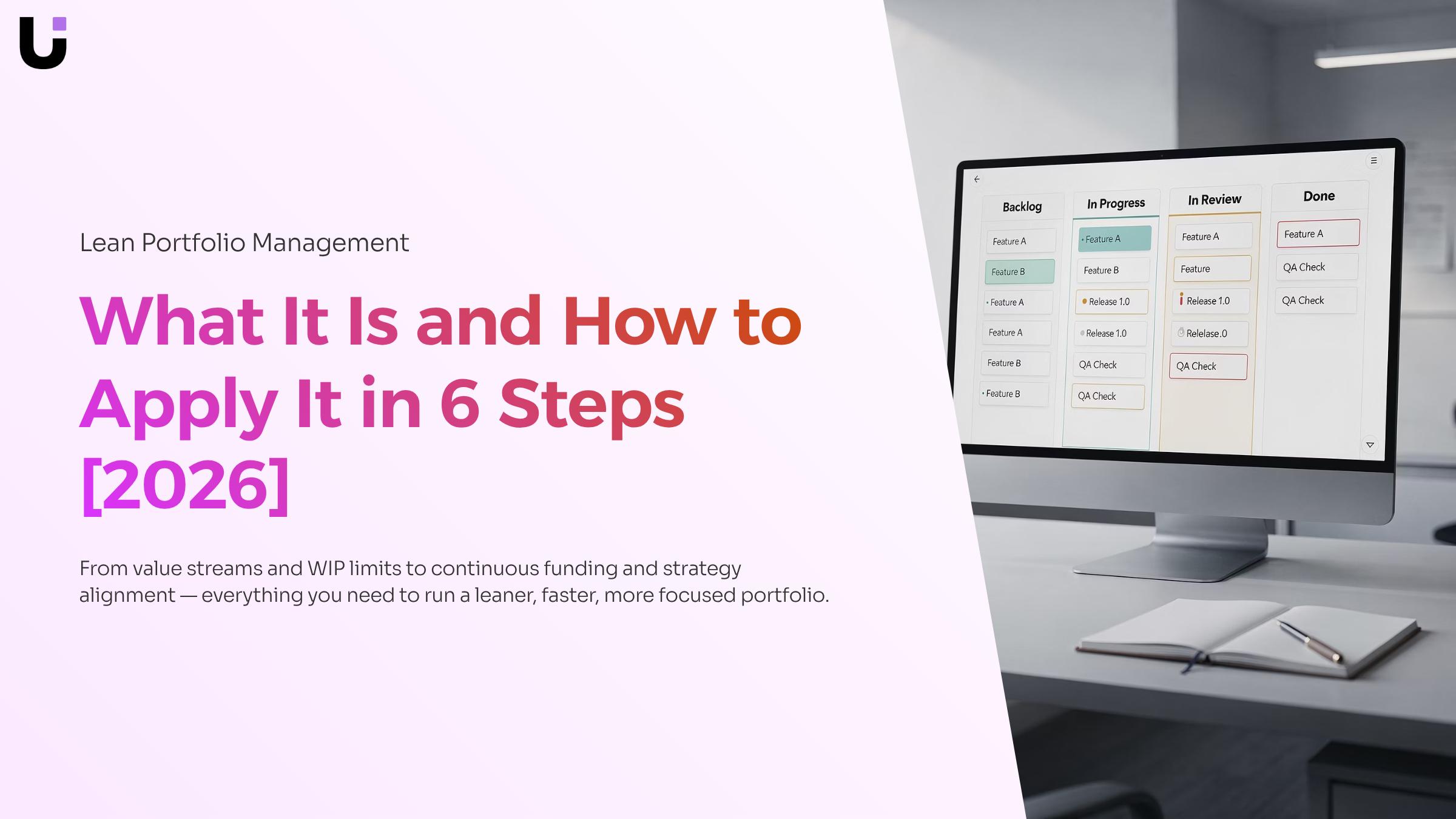
Build a portfolio kanban board: Visualize your capped work in a single view: columns for backlog, in progress, in review, and done. A portfolio kanban board operates at the initiative level, not the task level — each card represents a project or epic, not a ticket. One IT services firm reduced status-meeting time by moving this board to a shared tool their leads checked daily instead of weekly.
Shift to continuous funding cycles: Replace annual budget locks with shorter allocation cycles, typically quarterly. This lets you prioritize work across your portfolio based on current data rather than last year's assumptions. When a high-priority initiative surfaces mid-year, continuous funding means you can move budget to it without waiting for the next planning season.
Run regular portfolio reviews: Cadence matters more than format. A 60-minute monthly review covering WIP status, blockers, and upcoming funding decisions is more useful than a quarterly all-hands that produces a slide deck. Your PMO or project governance function should own this rhythm and keep it tight.
If managing time across multiple concurrent projects is already a pressure point for your team, steps two and three will surface the root cause faster than any retrospective. Start there, then build forward.
The six-step framework above only holds if your data is current. When WIP limits live in one spreadsheet, portfolio kanban boards in another, and sprint data in a third, the overhead of reconciling them quietly kills lean discipline.
A single work management tool removes that friction. With Taro, you can run your portfolio kanban board, track WIP per team, and review sprint backlogs from one workspace. When a new initiative lands, you add it to the board, assign it to a value stream, and immediately see whether the team has capacity or is already at its WIP limit. No manual status updates. No stale data in a Friday report.
This matters especially for lean portfolio management for IT projects, where teams often carry more concurrent work than they can realistically finish. Taro's real-time task visibility makes that overload visible before it becomes a missed deadline, which is the core promise of lean portfolio management.
Closing
Lean portfolio management isn't a framework you implement once—it's a shift from asking 'which projects do we fund?' to 'how do we keep value flowing without overloading the system?' The six-step process gives you the structure, but the biggest reason lean portfolio management stalls in practice is visibility. Teams revert to spreadsheets and status meetings because they have no single place to see WIP, sprint progress, and portfolio flow together. That fragmentation kills the discipline. Taro brings those views into one workspace, so you can manage portfolio kanban and sprint tracking without context-switching between tools. Ready to see how it works?
FAQ
Q. What are the benefits of implementing lean portfolio management?
A. Faster delivery through WIP limits, better resource allocation tied to strategy, reduced waste, clearer prioritization, and tighter strategy-to-execution alignment. Teams report shorter cycle times and fewer projects stuck in limbo.
Q. How does lean portfolio management improve resource allocation?
A. Funding follows strategy with rolling investment decisions instead of locked annual budgets. You redirect capacity to high-value work within weeks, not the next fiscal year, and stop paying for projects that no longer matter.
Q. What are the key principles of lean portfolio management?
A. Work in progress limits, continuous funding tied to value streams, decentralized decision-making, visible portfolio flow, and strategy alignment. Each removes a specific failure mode IT teams hit when managing multiple projects.
Q. How can I apply lean portfolio management to my IT projects?
A. Follow the six-step process: define value streams, set WIP limits, establish decision rights, create a portfolio backlog, implement continuous prioritization, and measure flow metrics. Map each step to your real project intake and resource decisions.
Q. What tools are available for lean portfolio management?
A. Tools like Taro combine portfolio kanban and sprint tracking in one workspace, eliminating the visibility gaps that cause teams to revert to spreadsheets. The right platform keeps WIP, progress, and portfolio flow visible without context-switching.
Q. What is the difference between lean portfolio management and traditional portfolio management?
A. Traditional PM centralizes decisions and locks budgets annually; lean portfolio management distributes authority to teams and funds continuously. Lean enforces WIP limits and reviews priorities every 4–8 weeks instead of letting work pile up.
Q. What are WIP limits and why do they matter in lean portfolio management?
A. WIP limits cap how many initiatives run concurrently, forcing a real conversation about what actually starts. They eliminate the half-finished project problem and ensure work moves through the system faster instead of stacking up.


 Elena Petrova15 September 2026


