TL;DR: Most content on agile software benefits stops at "faster delivery and better collaboration" without connecting either to the workflow problems IT company owners actually lose sleep over. This piece maps each benefit to a specific operational pain point — shifting client requirements, sprint planning chaos, cross-team misalignment — and shows how agile software tools put the methodology to work, not just on paper.
What is agile software and why it matters
Agile software is an approach to building and maintaining software through short, iterative cycles rather than one long sequential plan. Each cycle, called a sprint or iteration, produces working software that teams can test, review, and adjust before the next cycle begins. That feedback loop is the core mechanism behind most of the benefits you'll read about in this article.
Agile software development methodology emerged from the 2001 Agile Manifesto, which prioritized working software over documentation and customer collaboration over contract negotiation. Today it covers several frameworks, including Scrum, Kanban, and SAFe. The key principles of agile scrum methodology share one structural commitment: deliver small, testable increments and correct course early.
This matters for IT company owners because the cost of a wrong assumption compounds fast. A six-month waterfall project can absorb three months of work before anyone notices a requirement was misread. An agile sprint surfaces that same problem in two weeks.
Agile also works at small scale. A five-person development team running two-week sprints gets the same feedback benefits as a 200-person enterprise program, often with less overhead. The difference between agile and SAFe matters mainly once your team grows past a certain coordination threshold, not before.
How agile software development works
The agile software development life cycle runs in short, repeatable cycles called sprints, typically one to four weeks long. Each sprint follows the same sequence, which is what makes the process predictable even when requirements change.
Plan the sprint: The team pulls a prioritized set of work items from the product backlog, estimates effort, and commits to what can be delivered by the sprint end. Scope is fixed for that cycle.
Design and build: Developers write, review, and integrate code within the sprint. There is no waiting for a separate design phase to close before work begins.
Test continuously: QA runs alongside development, not after it. Bugs surface within days, not weeks, so the cost to fix them stays low.
Review and demo: At sprint end, the team shows working software to stakeholders. Feedback is collected and fed directly into the next backlog.
Retrospect: The team spends 30 to 60 minutes identifying what slowed them down and what to change next sprint. This is the mechanism behind continuous improvement, not a slogan.
The most common framework for running these cycles is Scrum. In Scrum, a designated product owner manages the backlog, a scrum master removes blockers, and the development team self-organizes around the sprint goal. Daily standups keep everyone aligned without lengthy status meetings.
Understanding this cycle matters because how agile development improves project efficiency is a direct result of the structure above, not a side effect of good intentions.
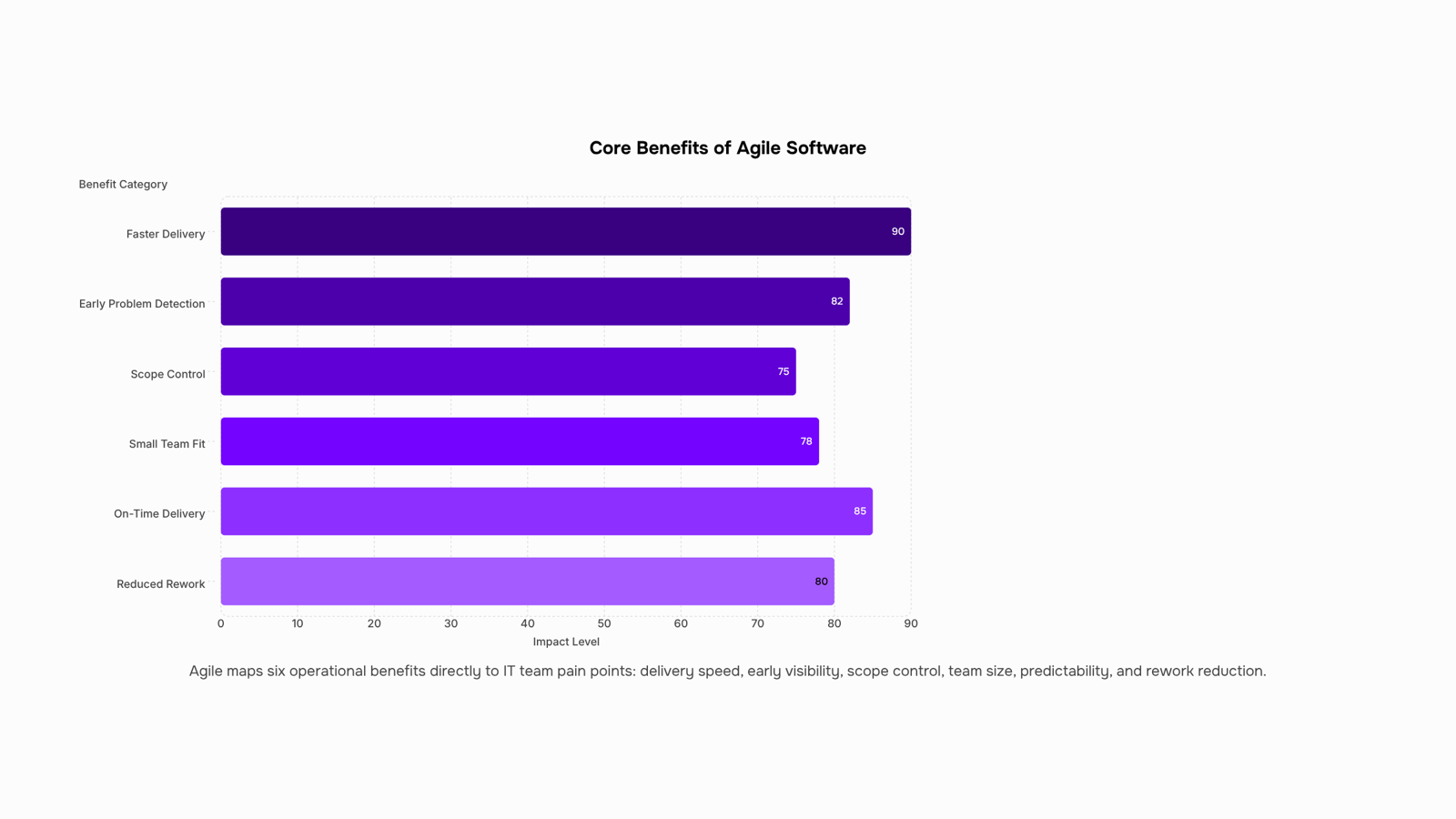
Core benefits of using agile software
Five benefits stand out when you map agile software methodology to the specific problems IT teams run into daily.
1. Faster delivery on working software
Agile breaks work into short sprints, typically one to four weeks, so your team ships something functional at the end of each cycle instead of waiting months for a big release. That cadence alone reduces the gap between what clients expect and what they get. Teams using agile consistently report shorter delivery cycles compared to waterfall projects, where requirements freeze early and scope drift compounds silently.
2. Earlier visibility into what's going wrong
Waterfall surfaces problems at integration or UAT, often too late to fix cheaply. Agile surfaces them at the sprint review, when the cost to course-correct is low. Daily standups and sprint retrospectives create structured moments to catch blockers before they become delays. For IT company owners managing multiple client projects, that early warning system is worth more than any single feature.
3. Scope control that actually works
Scope creep is the most common reason IT projects run over budget. Agile handles this through a prioritized backlog: new requests go into the backlog and get weighed against existing priorities, rather than silently expanding the current sprint. That one structural constraint keeps delivery timelines honest. The key principles behind agile scrum methodology reinforce this discipline at the team level.
4. Better fit for small IT teams
A common objection is that agile software management tools are built for large enterprises. In practice, the opposite is often true. Small teams, under 15 people, benefit most from agile's lightweight ceremonies because they can't absorb the overhead of formal change-control processes. A two-person sprint planning session takes 30 minutes. A formal change request board does not.
5. Measurable improvement in on-time delivery
Agile teams tend to hit their delivery commitments more consistently than teams on fixed-scope plans, because sprint commitments are scoped to what the team can actually finish. Velocity data from previous sprints informs the next one, so estimates improve over time rather than staying optimistic and wrong. If you want to see how scrum specifically improves team productivity, the mechanism is in how sprint commitments are set, not just how work is tracked.
6. Reduced rework from continuous client feedback
Agile builds client review into the process at every sprint, not just at final delivery. That means misalignments get caught after two weeks of work, not after six months. For IT owners billing on time and materials, less rework directly protects margin.
How agile software improves team collaboration
Most articles stop at "agile improves collaboration" without explaining why. The mechanism matters.
In agile software development, collaboration is structural, not aspirational. Sprint ceremonies force it. A daily standup gives every team member three minutes to surface blockers before they compound. A sprint retrospective creates a fixed moment to name what broke and agree on one change. These aren't optional check-ins — they're the rhythm that keeps a distributed IT team aligned without a manager chasing updates.
Shared backlogs are the other half. When every developer, QA engineer, and product owner works from the same prioritized list, there's no ambiguity about what comes next. Ownership is visible. Conflicts surface in the backlog, not in production.
Understanding what scrum is in agile software development helps here: scrum assigns explicit roles (Product Owner, Scrum Master, development team) so decisions don't stall waiting for the right person to weigh in.
This matters for small IT teams especially. A five-person shop running agile software gets the same structural clarity as a 50-person enterprise team — the ceremonies scale down, the visibility doesn't. Scrum has measurable effects on team productivity precisely because it removes the informal, invisible coordination tax that kills small-team output.
Real-time task visibility closes the loop. When anyone on the team can see what's in progress, blocked, or done, collaboration stops depending on memory or Slack threads.
How agile software helps with sprint planning
Sprint planning is where agile software development either pays off or falls apart. Without a structured tool, sprint ceremonies become calendar chaos: backlog items live in spreadsheets, velocity data sits in someone's head, and the team spends the first 30 minutes of every planning meeting just getting aligned on what's in scope.
A dedicated agile software management tool changes that sequence. Before the meeting starts, the backlog is already prioritized and visible to everyone. During planning, the team pulls items into the sprint based on capacity, not guesswork. After kickoff, each task has an owner, a status, and a place in the board.
Here is what that looks like for a typical 12-person IT services team:
The product owner grooms the backlog in Taro the day before planning, tagging items by priority and effort estimate.
During the sprint planning meeting, the team pulls from the prioritized list into a two-week sprint, using the Kanban board to visualize WIP limits.
Daily standups run against the same board, so blockers surface in real time rather than at the retrospective.
Taro's Scrum and Kanban support handles this cycle without requiring a separate tool for each phase. For teams that want to go deeper on the ceremony side, sprint planning best practices in agile development covers the facilitation layer in detail.
Is agile software suitable for small IT teams
Yes, agile software methodology works well for small IT teams — often better than it does for large ones.
Smaller teams move through sprint ceremonies faster, have fewer coordination layers, and can act on retrospective feedback in days rather than weeks. A three-person development team running two-week sprints can realistically close a full feedback loop — plan, build, review, adjust — before a 50-person team finishes its planning meeting.
The parts of agile that don't scale down cleanly are the ones that assume dedicated roles. If no one on your team can act as a full-time Scrum Master or Product Owner, those responsibilities need to be shared deliberately, not ignored. Understanding the key principles behind Scrum helps small teams decide which ceremonies to keep and which to trim.
What scales perfectly: task visibility, sprint-based prioritization, and blockers surfacing early. Those benefits apply whether your team has 3 people or 30. Tools that support both Scrum and Kanban boards, like Taro, let small teams pick the structure that fits without overbuilding their process.
How AI is changing agile software in 2026
AI is quietly reshaping how agile software development teams plan and execute work — not by replacing judgment, but by removing the lag between data and decisions.
Three changes are already visible in 2026. First, automated sprint forecasting tools analyze historical velocity and team capacity to predict completion dates with more accuracy than manual estimation. Second, AI-assisted backlog prioritization scores items by business impact, dependency risk, and effort, so product owners spend less time debating order and more time building. Third, real-time blocker detection flags stalled tickets before they derail a sprint — something a weekly standup often catches too late.
For IT company owners using an agile software management tool that connects planning to execution, these features reduce the gap between what the team commits to and what actually ships.
The principles behind agile scrum methodology haven't changed — AI just closes the feedback loop faster.
Closing
Agile software isn't a philosophy—it's a operating system for IT teams that need to ship faster, catch problems early, and keep scope from drifting. The benefits are real: shorter delivery cycles, earlier visibility into what's breaking, and measurable improvements in on-time delivery. But here's what separates teams that talk about agile from teams that live it: the tool running your sprints has to be built for the methodology, not bolted onto it after the fact.
Taro is built specifically for this. It's where agile methodology meets the workflow that actually executes it—sprint planning that doesn't spiral, backlog prioritization that sticks, and retrospectives that drive real change. If you're ready to move from understanding agile benefits to delivering them, schedule a 30-minute call to see how Taro runs your sprints.
FAQ
How does agile software improve team collaboration?
Agile builds collaboration into structure through daily standups, sprint reviews, and retrospectives that surface blockers before they compound. Shared backlogs eliminate ambiguity about priorities, so teams stay aligned without constant status chasing.
What are the key features of agile software development?
Short iterative sprints (1-4 weeks), continuous testing alongside development, sprint reviews with stakeholder feedback, retrospectives for continuous improvement, and a prioritized backlog that controls scope creep.
How can agile software help with sprint planning?
Agile fixes scope for each sprint, so teams estimate what they can realistically finish rather than committing to unlimited work. Velocity data from previous sprints improves estimates over time, making delivery timelines honest and hitting commitments consistently.
Is agile software suitable for small teams?
Yes. Small teams under 15 people benefit most because agile's lightweight ceremonies scale down without overhead. A two-person sprint planning session takes 30 minutes—no formal change-control boards needed.
What is the difference between agile software and traditional project management?
Waterfall freezes requirements upfront and surfaces problems at integration; agile delivers in short cycles and catches misalignments at sprint review, when fixes are cheap. Agile also controls scope through a prioritized backlog instead of absorbing silent scope creep.


 Natalie Brooks11 September 2026


