TL;DR: Most articles on lead distribution software list features and stop there. This one connects each benefit to a measurable sales outcome — response time, rep utilization, conversion rate — and shows exactly where automated routing breaks down without the right logic underneath it. You'll leave with a clear picture of what good distribution actually produces, and where the gaps tend to hide.
What Lead Distribution Software Actually Does
Lead distribution software sits between the moment a lead arrives and the moment a rep picks up the phone. It captures incoming leads from every source — web forms, paid ads, third-party platforms — and assigns each one to the right rep automatically, based on rules you define. Territory, product line, rep capacity, lead score: the routing logic runs in the background, invisibly, every time.
The mechanism matters because speed does. Real-time lead assignment removes the manual triage step that typically adds 30 to 90 minutes between a lead submitting a form and a rep seeing it in their queue. For IT company owners running lean sales teams, that gap is where deals go cold.
What the software actually executes, step by step:
A lead enters from any source — ad click, referral, demo request
The system reads the lead's attributes against your routing rules
The matching rep receives the lead instantly, with full context attached
The assignment is logged, timestamped, and tied back to the originating source
That last point matters for attribution. The full lead management process only works when you can trace each lead from source to close. Distribution software creates that audit trail automatically.
Lio's Smart Lead Distribution layer handles this routing natively, so the workflow above runs without manual intervention or a patchwork of zaps connecting separate tools.
What Breaks Without It
Manual lead assignment fails in predictable ways, and the cost shows up directly in closed revenue.
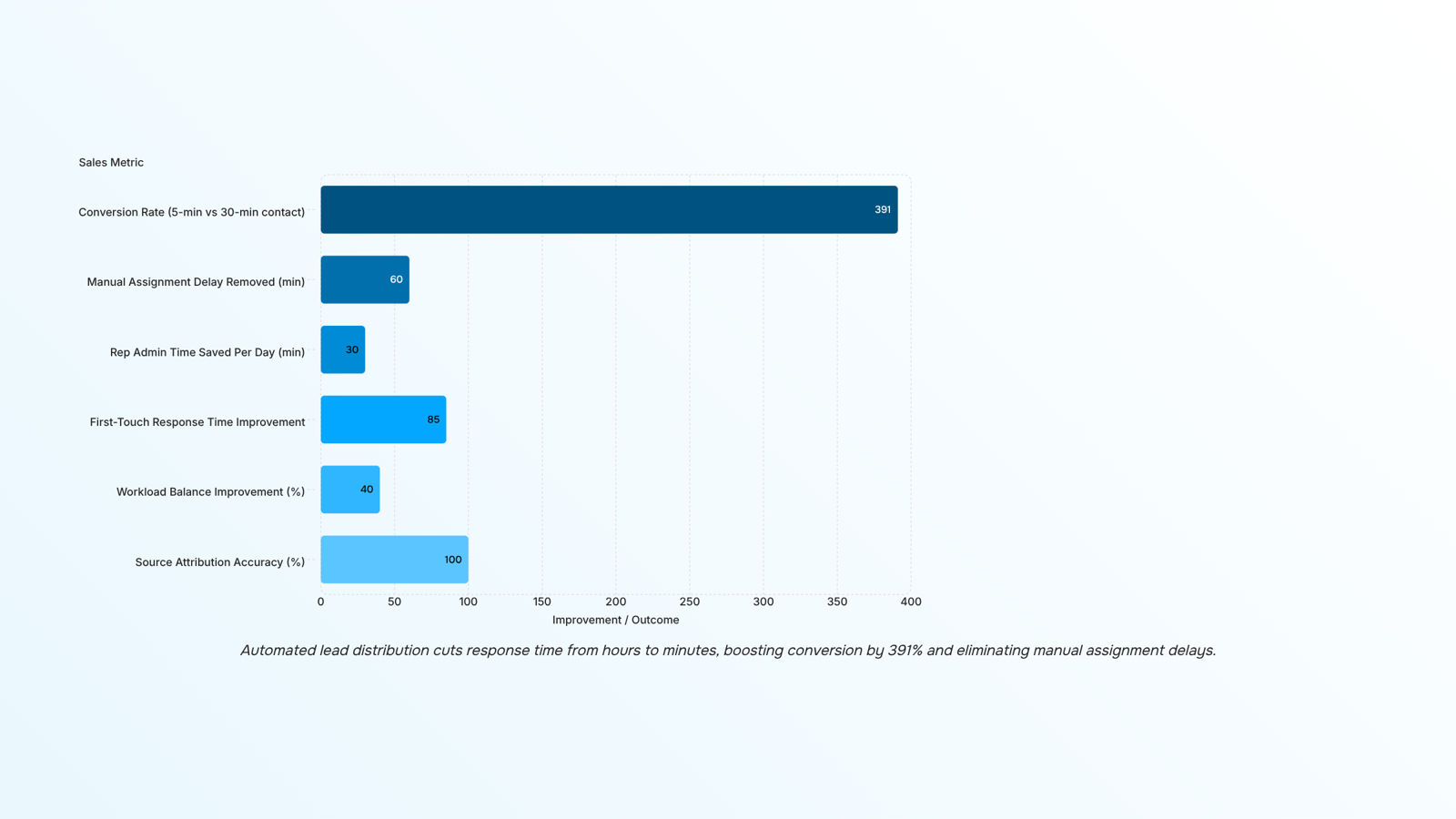
Speed is the first casualty: A rep manually scanning a shared inbox, deciding who to forward a lead to, and then logging it takes 20 to 40 minutes on a good day. Research from Velocify found that contacting a lead within the first minute increases conversion rates by 391% compared to waiting 30 minutes. On a lean IT sales team, that delay is almost always the default.
Rep cherry-picking is the second: Without automated lead routing logic, the rep who checks Slack first gets the enterprise prospect. The rep who was on a call gets the SMB. Workload skews, resentment builds, and your pipeline data becomes meaningless because rep performance reflects access, not ability.
Source attribution disappears: When leads come in through five channels and get assigned by whoever is around, you lose the thread. You can't tell which campaign produced qualified leads and which produced noise. That makes lead management decisions guesswork rather than data.
Leads fall through entirely: A lead that arrives at 4:58 PM on a Friday and sits in a shared queue over the weekend is, functionally, a lost lead. No owner, no follow-up trigger, no record of what happened.
These aren't edge cases. For IT company owners running sales teams of two to ten reps, this is the baseline state before a structured system is in place.
The Core Benefits of Lead Distribution Software
Manual assignment breaks in predictable ways: slow first touch, reps skimming for easy deals, no record of which campaign actually produced revenue. Lead distribution software fixes each of those failure points by turning a human coordination problem into a rules-based process.
Faster first contact: Speed matters more than most teams realize. Research consistently shows that leads contacted within five minutes of showing interest convert at significantly higher rates than those who wait 30 minutes or more. Automated lead distribution software routes the moment a form is submitted, a call ends, or an ad converts — no manager in the loop, no queue to clear.
Even workload across the team: Without routing rules, reps with seniority or proximity to the inbox grab the best leads. Everyone else gets leftovers. Round-robin and weighted lead routing distribute volume according to capacity, territory, or skill set — so a lean IT sales team of four doesn't have two reps carrying 70% of the pipeline while the other two go quiet.
Source attribution you can actually act on: When leads are assigned manually, the trail goes cold fast. Which campaign, which channel, which partner sent the lead that closed? Lead distribution software captures and preserves that data at the point of assignment. You stop guessing which ad spend is working and start reallocating budget with real numbers behind the decision.
Less admin, more selling time: Sorting, assigning, and following up on uncontacted leads takes real hours each week. Automating that handoff — through a tool like Lio, which applies smart distribution rules the moment a lead enters the system — removes the coordination overhead entirely. Reps open their queue and find assigned, prioritized leads waiting. Managers stop playing traffic cop.
The compounding effect matters here. Faster response plus balanced workload plus clean attribution adds up to a pipeline where fewer leads go cold, rep performance is easier to compare fairly, and the cost of each acquired lead actually reflects in closed revenue.
How Lead Distribution Software Improves Sales Productivity
When a lead comes in and no one claims it, the clock starts running against you. Research consistently shows that leads contacted within five minutes are far more likely to convert than those reached after 30 — and on lean IT sales teams, that window closes fast when reps are manually sorting inboxes or waiting on a manager to assign work.
Automated lead distribution software removes that sorting layer entirely. The moment a lead hits your system, routing rules fire: territory, product interest, rep capacity, or any combination you define. No one has to decide who takes it. The rep gets a notification and starts the conversation.
The productivity shift happens in three places:
Reps stop triaging and start selling. Manual assignment can consume 20-40 minutes per rep per day on busy teams.
Managers stop playing traffic cop. Without a routing system, team leads spend real time redistributing leads that sat too long or landed with the wrong person.
Real-time lead assignment means no lead ages in a queue. Response time drops from hours to minutes without anyone working harder.
For IT company owners running sales teams of five to fifteen people, this matters more than it does at enterprise scale. You don't have a dedicated ops person to manage the queue. The system has to do it.
Lio handles this through Smart Lead Distribution, which routes and assigns leads the moment they're captured, so your team's first action is always a conversation, not an admin task.
Features That Actually Matter When Evaluating Options
Four features separate lead distribution software that actually works from software that just looks good in a demo.
Rule-based routing is the foundation. Without it, your team is manually deciding who gets what — which means delays, favoritism, and leads falling through the gaps. Good routing logic assigns based on territory, product line, rep capacity, or any combination of those. How that routing logic determines which rep gets which lead matters more than most buyers realize until they're six months in and reps are arguing over assignments.
Multi-source capture matters because IT company owners rarely have a single lead channel. Leads come from web forms, paid campaigns, referrals, and inbound calls — sometimes all in the same day. A tool that only pulls from one source forces your team to manually consolidate the rest, which defeats the purpose of automating your lead generation workflow in the first place.
Lead status tracking gives managers visibility without micromanaging. You need to see, at a glance, which leads are new, contacted, qualified, or stalled. Without it, pipeline reviews become guesswork.
Bulk operations sound minor until you're reassigning 200 leads because a rep left the company. The ability to re-route, re-score, or update lead status in bulk saves hours of manual cleanup that no one budgets for.
Lio's Smart Lead Distribution handles all four in a single workflow, which matters for lean sales teams where one person often wears multiple hats. For a broader view of how these features fit together, the full lead management process guide is worth reading before you evaluate vendors.
CRM Integration: What to Check Before You Commit
"We integrate with your CRM" means almost nothing without a follow-up question: which direction does data flow?
Most tools sync one way — leads push into your CRM, but updates made by reps (status changes, notes, reassignments) never come back. That breaks lead routing logic fast, because your distribution rules are firing against stale data.
Before you commit to any lead distribution software, ask vendors these four things:
Bidirectional sync or one-way push? If rep activity in the CRM doesn't update the distribution layer, your routing rules lose accuracy within days.
Custom field mapping? Standard fields rarely match how IT sales teams qualify leads. You need to map your own scoring criteria, not work around a preset schema.
Trigger support? Can a CRM status change (e.g., "Qualified") fire a re-route or follow-up task automatically, or does someone have to do that manually?
Conflict resolution? When both systems update the same record simultaneously, which one wins?
If the vendor can't answer questions three and four specifically, the integration is shallower than the marketing copy suggests. Check the lead management tools comparison for how different platforms handle this in practice.
How Much Does Lead Distribution Software Cost
Pricing for lead distribution software splits into two models: per-seat (typically $25–$75 per user/month) and platform-tier (flat monthly fees starting around $99–$299 for small teams). What drives cost up is complexity — custom routing rules, CRM field mapping, and real-time scoring each add to the base price.
For a lean IT company running a small sales team, platform pricing usually wins. You pay once, not per rep added.
Before comparing vendors, check what's included in lead routing logic and whether scoring is built in or an add-on. Lio's Smart Lead Distribution bundles routing and scoring at the platform level — no per-feature upsells.
Closing
Good lead distribution software does one thing well: it removes the human coordination step between a lead arriving and a rep starting the conversation. That speed, combined with balanced workload and clean source attribution, is what separates teams that convert leads into revenue from teams that watch them go cold. The question isn't whether your team needs it — it's whether you can afford to keep assigning leads manually. Start by mapping your current routing logic (territory, capacity, product fit) and then look for a tool that can automate exactly that. Lio's Smart Lead Distribution and Real Time Lead Routing implement the routing logic and multi-source capture described here, so your team moves from manual triage to instant assignment.
FAQ
What are the benefits of using lead distribution software?
Faster first contact (leads contacted within five minutes convert 391% better), even workload across reps, accurate source attribution, and less admin overhead. On lean sales teams, this compounds into fewer cold leads and fairer rep performance comparison.
How does lead distribution software improve sales productivity?
It removes manual sorting and assignment, which can consume 20-40 minutes per rep per day. Reps open their queue to assigned, prioritized leads ready to call. Managers stop playing traffic cop.
What features should I look for in a lead distribution software?
Rule-based routing (territory, capacity, product line), real-time assignment, multi-source lead capture, and source attribution tracking. Without these, you're back to manual triage.
Can lead distribution software integrate with my existing CRM?
Yes. Good lead distribution software connects to your CRM natively so leads appear in reps' queues with full context attached. The assignment is logged and traced back to the originating source automatically.
How much does lead distribution software cost?
Pricing varies by vendor and volume. Most charge per user or per lead routed. The ROI typically appears within 60-90 days on lean sales teams through faster conversion and reduced admin time.
What is the difference between lead distribution and lead routing?
Lead routing is the logic that decides who gets a lead (territory, capacity, skill). Lead distribution is the full system that captures leads from all sources and executes that routing automatically.
Does lead distribution software work for small sales teams?
Yes. Small teams benefit more because they lack dedicated ops staff to manage manual assignment. Automation removes the coordination burden and ensures no lead sits unowned over a weekend.


 Elena Petrova11 September 2026


