TL;DR: Most articles on AI in marketing and sales hand you a tool list and leave the integration work to you. This one explains how each automation mechanism actually works, then maps it to a seven-step sequence an IT company owner can run without a dedicated marketing ops team. You'll finish with a clear build order, not a wishlist.
What AI in marketing and sales actually means
Most definitions of AI in marketing and sales stop at content generation: write faster, produce more copy, fill the calendar. That framing misses the operational core.
AI in marketing and sales automation means automating the lead pipeline itself: capturing leads, scoring them by fit and intent, routing them to the right rep, triggering follow-up sequences, and feeding clean data into forecasting. Content generation is one small slice of that.
The distinction matters because the failure point for most IT company owners isn't content volume. It's response time. Research consistently shows that leads contacted within five minutes convert at dramatically higher rates than those reached an hour later, yet most teams without automation take 24 hours or more to respond.
The seven-step framework in this article covers the full pipeline: from first-touch capture through qualified handoff to sales. If you want to go deeper on specific pieces, predictive lead scoring and revenue forecasting and AI-driven sales forecasting once your pipeline data is clean are worth reading alongside this one.
How AI improves your marketing and sales strategy
AI doesn't improve marketing and sales by replacing your team's judgment. It removes the delays and manual steps that kill deals before your team even gets involved.
The clearest example is lead response time. Research consistently shows that B2B leads contacted within five minutes convert at significantly higher rates than those reached after 30 minutes. Most IT company sales teams can't hit that window manually. AI-powered lead management routes and scores leads the moment they enter your pipeline, so the first touchpoint happens in seconds, not hours.
Beyond speed, AI improves conversion by filtering out noise. Manual qualification means a rep spends time on leads that were never going to buy. AI tools for sales automation score leads against your actual closed-won data, so your team works the 20% of leads that drive 80% of revenue.
Cost per lead drops as a result. When your pipeline is cleaner and your follow-up is automated, you spend less on outreach that goes nowhere. Choosing the right AI email marketing tool for your sequences compounds this: personalized, timed follow-ups outperform batch-and-blast emails without adding headcount.
The strategic value of AI in marketing and sales is that these three outcomes compound. Faster response raises conversion. Higher conversion lowers cost per lead. Cleaner pipeline data then feeds more accurate sales forecasting, which makes your next quarter's targets easier to hit.
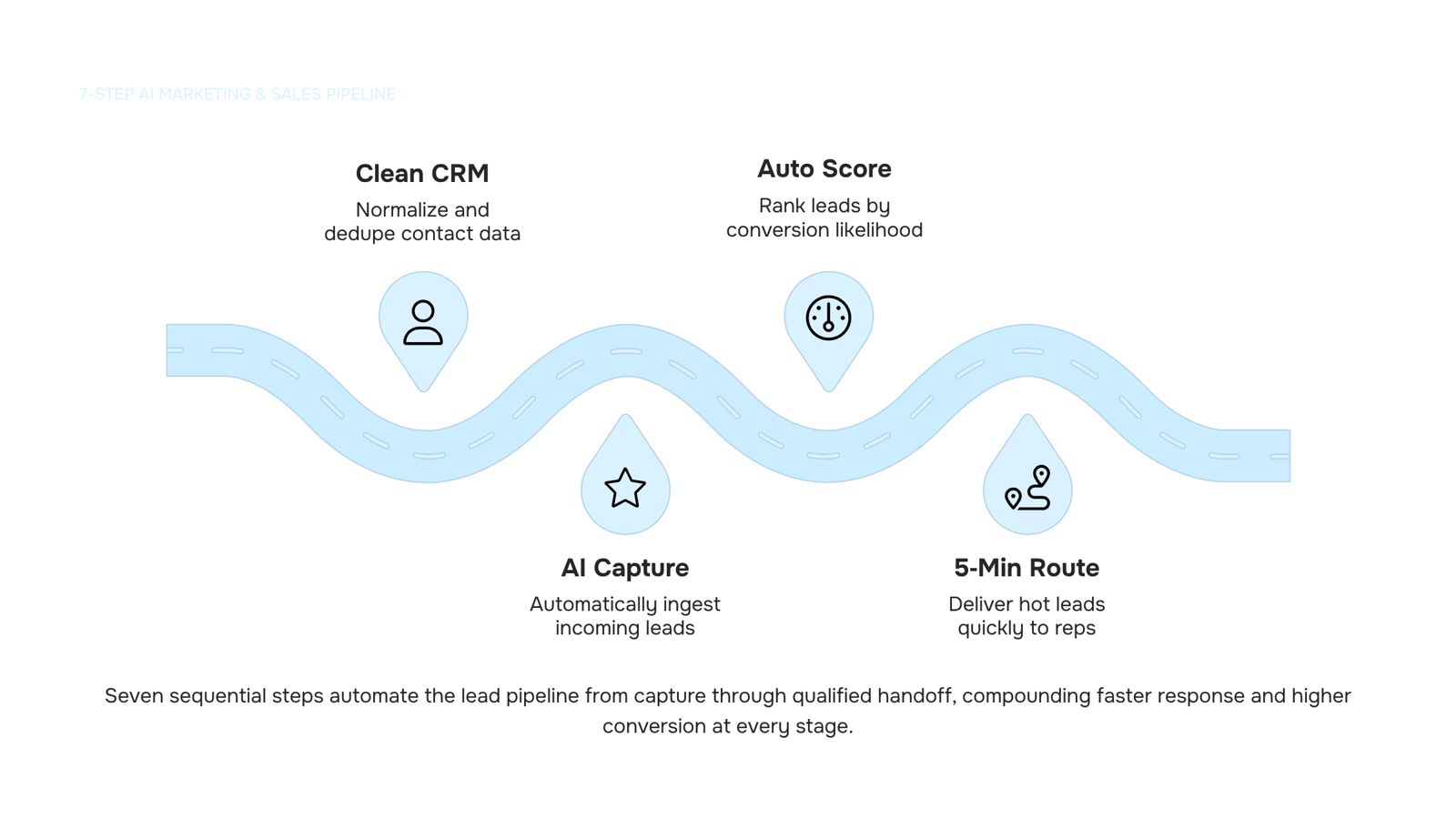
7 steps to put AI to work across your pipeline
Treat this as a sequence, not a checklist. Each step builds on the previous one, and skipping ahead usually means rework.
Clean your CRM data before touching any AI tool: AI surfaces patterns in your existing data. If your contact records have duplicate entries, missing company sizes, or inconsistent lead sources, the model trains on noise. Spend one week auditing field completeness in your CRM before connecting any AI layer. Setting up a sales automation solution before adding AI on top is the step most teams skip, and it's why their AI recommendations feel random three months later.
Deploy AI-powered lead capture at every entry point: Forms, chat widgets, and inbound email aliases should all feed a single lead object. AI reads firmographic signals (company size, industry, job title) at the moment of capture and tags each record before a human ever sees it. This is where ai-powered lead management starts earning its cost.
Score leads automatically using behavioral and firmographic signals: Set scoring rules based on actions that correlate with closed deals in your historical data: visited pricing page, opened three emails, attended a webinar. AI tools for sales automation can update scores in real time as new behavior comes in, so your sales rep always works the hottest record first. For teams that want to go further, predictive lead scoring and revenue forecasting extend this into pipeline projections.
Route qualified leads to the right rep within five minutes: Research consistently shows that B2B leads contacted within five minutes of showing intent convert at significantly higher rates than those reached an hour later. AI routing rules match lead attributes to rep capacity and territory, removing the manual triage step that creates that delay.
Trigger personalized email sequences the moment a lead is routed: The first three emails in a sequence do most of the qualification work. AI email marketing automation personalizes subject lines, send times, and body copy based on the lead's industry and behavior. A mid-market IT services lead gets a different sequence than a startup founder, automatically. For a deeper look at building these sequences, choosing the right AI email marketing tool covers the decision criteria.
Use AI to summarize calls and update deal records without manual entry: Conversation intelligence tools transcribe sales calls, extract next steps, and push updates directly to your CRM. A five-person IT sales team reclaims roughly 30 to 45 minutes per rep per day that previously went to post-call admin.
Feed closed-won and closed-lost data back into your scoring model: This is the step that turns a one-time setup into a compounding system. Every closed deal teaches the AI which early signals actually predicted revenue. Over a quarter, your lead scores get sharper, your sequences get more targeted, and AI-driven sales forecasting becomes reliable enough to plan headcount against.
The full value of ai in marketing and sales comes from connecting these steps into one pipeline, not running each in isolation.
How AI chatbots improve customer engagement
AI chatbots handle the part of customer engagement that kills lean IT sales teams: the gap between a visitor showing interest and a human being available to respond. Research consistently shows that B2B leads go cold within minutes of first contact, not hours.
The mechanism is straightforward. A chatbot qualifies the visitor with three to five structured questions, scores the response against your ICP criteria, and either books a meeting directly or routes the lead to the right rep, all without a human in the loop. That's the "always-on" part of ai chatbots customer engagement that actually moves pipeline.
The mistake most IT teams make: deploying a chatbot with no handoff rule. The bot qualifies a lead at 11 PM, no one picks it up until morning, and the conversation dies. Set a hard rule: any lead scoring above your threshold triggers an immediate Slack alert or calendar hold, not just a CRM entry.
For teams already using ai in marketing and sales, pairing chatbot qualification with predictive lead scoring sharpens who the bot prioritizes.
How to measure the ROI of AI in your marketing and sales
Measuring the ROI of ai marketing and sales automation comes down to three numbers: lead response time, conversion rate, and cost per qualified lead (CPL). Track these before and after deployment, and the math runs itself.
Lead response time is the fastest win to show. B2B leads contacted within five minutes are dramatically more likely to convert than those reached after 30 — AI routing closes that gap automatically. Measure average response time in your CRM for 30 days pre-AI, then 30 days post-deployment.
Conversion rate lift is your second metric. Take qualified leads from the same source, split by period, and compare close rates. A 10-to-15-person IT sales team typically sees the clearest lift on inbound demo requests, where AI qualification filters out tire-kickers before a rep touches the lead.
CPL ties it together. Divide total sales and marketing spend by the number of qualified leads generated. If AI cuts manual qualification hours by even five hours a week, that labor saving drops directly into your CPL calculation.
A simple spreadsheet works: four columns, two rows (before/after), one formula per metric. If you want to go further, predictive lead scoring and revenue forecasting tools can project ROI forward, not just backward. That's where measuring ROI of AI in marketing shifts from reporting to planning.
Real risks of using AI in marketing and sales
The risks of ai in marketing and sales are real, but most apply unevenly depending on team size.
For a 5-to-15-person IT sales team, three risks actually bite:
Bad input data produces bad output: If your CRM has duplicate contacts, stale company names, or untagged deal stages, AI scoring tools amplify those errors rather than fix them. Setting up a clean sales automation foundation before layering AI on top is the step most teams skip.
Over-automation kills trust: Automated follow-ups sent at the wrong cadence, or with the wrong context, cost you deals. A sequence tool with no human review checkpoint is the common failure point.
Vendor lock-in on proprietary models: Switching AI platforms mid-pipeline means retraining scoring logic and rebuilding integrations.
Enterprise-scale risks, like model bias audits and regulatory compliance under the EU AI Act, matter less until you cross roughly 50 seats or enter regulated verticals.
The fix for all three: start narrow, measure one metric, then expand.
Tool type | What the AI does | Best fit |
|---|
Lead routing (e.g., Lio) | Scores, qualifies, and assigns inbound leads in under 2 minutes | IT teams losing deals to slow follow-up |
Email sequencing | Personalizes and sends follow-up sequences based on prospect behavior | Teams running ai email marketing automation at scale |
CRM enrichment | Pulls firmographic data and updates contact records automatically | Sales reps spending 30+ min/day on manual data entry |
Conversation intelligence | Transcribes calls, flags objections, suggests next steps | Managers coaching a 5-to-10-person sales team |
For a deeper look at ai-powered lead management and scoring tools, the criteria shift depending on your pipeline volume. Teams evaluating broader business automation options will find the lead routing category overlaps heavily with workflow tools.
Closing
The seven-step framework above shows you where AI actually earns its cost in your pipeline: not in content generation, but in response time, qualification, and routing. Start by auditing your CRM data this week, then map which step is your current bottleneck. Most IT company owners find it's Step 3 (lead scoring) or Step 4 (routing within five minutes). Once you know where you're losing deals, the tool choice becomes obvious. If instant lead capture and qualification is your gap, Lio is built exactly for that workflow—it captures leads, scores them against your ICP, and routes them to the right rep in seconds, no manual triage. See how it fits your pipeline.
FAQ
How can AI improve my marketing and sales strategies?
AI removes delays that kill deals: leads contacted within five minutes convert dramatically higher than those reached later. It also filters noise by scoring leads against your closed-won data, so your team works only the 20% that drives 80% of revenue, lowering cost per lead and improving forecast accuracy.
What are the best AI tools for marketing and sales automation?
The best tool depends on your bottleneck. Lead capture and routing (Lio), email sequences (Evox), workflow gaps (Revo), and forecasting all have dedicated solutions. Start with Step 1 (clean CRM data), then identify which step in your pipeline is slowest—that's where your first tool should go.
How do AI-powered chatbots improve customer engagement?
Chatbots qualify visitors with three to five structured questions, score them against your ICP, and route hot leads to reps or book meetings instantly. They close the gap between visitor interest and human availability, ensuring no lead goes cold in the first five minutes.
What are the risks of using AI in marketing and sales?
The biggest risk is training AI on dirty data. Duplicate CRM records, missing fields, and inconsistent lead sources make AI recommendations feel random. Audit your CRM completeness before connecting any AI layer, or you'll rework the setup three months in.
How long does it take to see results from AI in sales automation?
Response time improvements show in days once lead routing is live. Conversion lift and forecast accuracy take a quarter as the AI learns from closed-won and closed-lost data. Compound results come from connecting all seven steps, not running them in isolation.


 Elena Petrova11 September 2026


