TL;DR: Most "AI in sales" content stops at tool names and category labels. This article explains the mechanism behind each use case: what the AI is actually doing with your data, why that produces a sharper decision, and what changes in how your team works as a result. The focus is forecasting, conversion, and closing — with enough specificity to act on.
AI in sales, for this conversation, means systems that process your pipeline data to surface decisions your reps would otherwise make too slowly or miss entirely. Not chatbots. Not content drafts. AI-powered sales analytics.
Here is what that looks like in practice. A deal sits at proposal stage for 12 days with no email reply and no meeting booked. A rep might flag it on Friday's call. An AI system flags it Tuesday morning, cross-references historical close rates for similar deals at that stage, and tells the rep exactly what signal changed.
That gap, between "noticed Friday" and "acted Tuesday," is where revenue leaks.
The same logic applies to lead prioritization: the system scores based on behavioral signals, not gut feel. Most teams using sales task automation find reps spend less time on manual data entry and more time on accounts that are actually moving.
What is AI-powered sales forecasting?
Modern desk with monitor displaying sales forecasting analytics and upward trending data visualization in professional blue and silver tones
AI-powered sales forecasting is the practice of using machine learning models to predict revenue outcomes from pipeline data, rather than relying on rep self-reporting or manual spreadsheet reviews.
Instead of asking reps what they think will close, the system analyzes what has historically closed: deal stage, time in stage, engagement signals (email opens, meeting frequency, contract views), and firmographic fit. It weights those signals against your historical close rates by segment, then produces a probability score for each deal in the pipeline.
The practical output is a forecast number your finance team can actually interrogate. If a deal has been in "proposal sent" for 45 days with no response, the model discounts it automatically. A rep would not. That gap is where predictive pipeline management earns its keep.
For small IT sales teams, the value compounds quickly. One or two stalled deals can distort your entire quarter's outlook. AI in sales forecasting surfaces those deals before they quietly slip, giving you time to re-engage or reforecast before the damage is done.
Best ways to use AI in sales forecasting
1. Forecast your pipeline from activity signals, not rep opinion
Rep self-reporting is the default forecasting method for most sales teams, and it consistently overstates pipeline health. Reps anchor on optimism. Managers aggregate that optimism into a number they present to stakeholders, and the actual close rate tells a different story at quarter end.
AI forecasting replaces that cycle. The model reads activity signals across every deal: email response rates, call frequency, time-since-last-touch, proposal views, and silence windows. It cross-references those signals against closed-won patterns in your CRM and produces a probability score for each deal.
A deal with no stakeholder contact in 12 days and a close date two weeks out gets flagged automatically, before the forecast call, not during it. That shift alone removes the quarter-end surprise most sales managers dread.
If you also want to connect pipeline signals to cash flow projections, Inzo's AI forecasting layer can map expected close dates to revenue timing, so you are not caught off guard by gaps between booked and collected. For a broader look at predictive tools, this breakdown of AI tools for forecasting and analytics covers the category in more depth.
2. Score and qualify leads before your reps touch them
Most AI lead scoring systems assign a number between 0 and 100 to every inbound lead. What separates useful scoring from noise is which signals feed that number.
Firmographic fit covers the basics: company size, industry, revenue band, and tech stack. A 200-person IT services firm that already runs a PSA tool fits your ICP better than a 12-person retail shop, and the model weights that accordingly. Behavioral signals layer on top: which pages the lead visited, how long they spent on your pricing page, whether they opened your last two emails, and whether they requested a demo or just downloaded a whitepaper.
The practical result: reps open their queue and see a ranked list.
Leads above 70 get called today.
Leads between 40 and 70 go into a nurture sequence.
Leads below 40 get deprioritized until behavior changes.
That structure alone removes the guesswork that eats 20 to 30 percent of a rep's day on manual triage.
To track which leads are actually moving, the scoring model needs a feedback loop: closed-won and closed-lost outcomes feed back into the model so it recalibrates over time. Without that loop, you are scoring against assumptions, not results.
3. Personalize your sales approach at scale
Most reps personalize by gut feel: they skim a LinkedIn profile, note the company size, and write a message that is "relevant enough." That approach does not scale past 20 accounts, and it misses the signals that actually predict a response.
AI reads the full picture before your rep opens a new tab. It pulls firmographic data alongside behavioral signals: which emails the contact opened, which pricing page they visited, how long they spent on a case study. From that, it surfaces a suggested message angle, the right channel (email, LinkedIn, or phone), and the optimal send window, without the rep doing the research manually.
A concrete example: a contact at a 40-person IT services firm visits your security integrations page twice in one week. AI flags that pattern, maps it to similar accounts that converted, and recommends leading with a security ROI angle rather than a generic product overview. The rep writes one targeted message instead of a templated blast.
Teams that act on behavioral signals rather than demographic fit alone see measurably better conversion rates, because the outreach matches where the buyer actually is in their thinking. For teams already using smart scores and prioritization to rank inbound leads, layering personalization signals on top means the highest-priority accounts also get the most relevant first touch.
4. Automate the tasks that slow your team down
Sales reps in IT companies spend a significant portion of their time on work that never touches a prospect: logging calls, updating deal stages, scheduling demos, routing inbound leads to the right person. That time adds up fast, and it compounds across a team.
Here are the five automation points with the highest return in an IT sales workflow:
Lead routing. AI reads firmographic data and engagement signals to assign inbound leads to the right rep in seconds. The rep opens a warm, pre-scored conversation instead of a cold queue.
Follow-up sequencing. AI triggers personalized follow-up emails based on where a prospect dropped off. The rep reviews and approves; they do not write from scratch.
Meeting scheduling. AI handles back-and-forth availability matching. The rep shows up to the call, not the calendar negotiation.
Data entry. Call transcripts, email threads, and contact updates sync automatically to your CRM. The rep spends that time on the next conversation.
Deal-stage updates. AI monitors activity signals (email opens, proposal views, silence windows) and flags when a deal should move forward or needs attention. The rep makes the call; AI surfaces the evidence.
When you automate sales tasks at this level, AI in sales forecasting also gets more accurate, because the pipeline data feeding your forecasts is cleaner and more current. For a broader view of the best sales software for automating tasks, that comparison covers the tooling layer in more detail.
5. Use sales analytics to make faster decisions
Most sales managers make pipeline calls based on rep-reported deal stages. That is a problem, because reps are optimistic by nature and update CRM fields inconsistently. AI-powered sales analytics fixes this by pulling activity signals and surfacing which deals are actually moving versus which ones just look healthy on paper.
A real-time pipeline dashboard built on these signals does three things a spreadsheet review cannot:
Flags deal risk early. If a deal has had no stakeholder contact in 12 days and the close date is two weeks out, the system marks it at risk before the forecast call, not during it.
Identifies rep performance gaps. Not "Alice is behind quota" but "Alice's conversion rate from demo to proposal dropped 18% this quarter" — specific enough to coach against.
Shows conversion drop-off by stage. Predictive pipeline management tells you whether you are losing deals at discovery, proposal, or negotiation, so you fix the right stage.
The practical result: managers spend less time asking "where does this deal stand?" and more time on the deals that need intervention.
6. Increase sales conversions with behavioral scoring
The gains from AI depend on what you are actually automating. AI lead scoring produces the most consistent conversion lift in B2B contexts. The model is not just ranking leads by company size or title. It is weighing behavioral signals — email open sequences, page visit depth, demo request timing — against closed-won patterns in your CRM. Reps stop pitching cold accounts and focus on accounts already showing buying behavior.
Automated follow-up compounds the effect. Most deals go cold not because the prospect said no, but because no one followed up at the right moment. AI-triggered sequences fix the timing problem without adding rep workload.
Where the gains get overstated:
The underlying CRM data is dirty or incomplete.
The model trains on too few closed deals (fewer than 90 days of records).
Reps override the scoring manually because they do not trust it.
A scoring system trained on 18 months of clean pipeline data performs differently from one trained on 90 days of patchy records. The mechanism is sound; the output quality depends on the input quality.
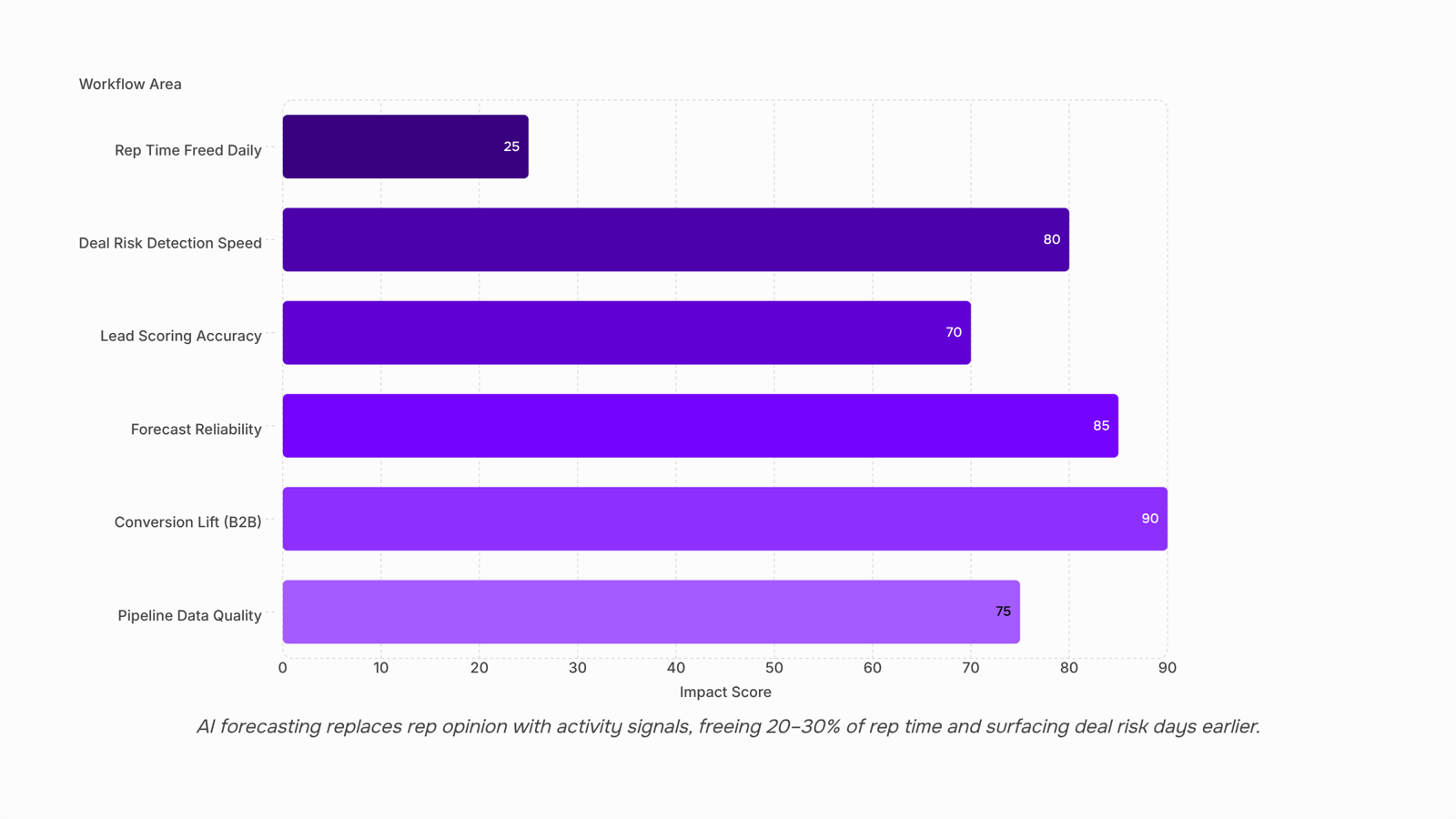
Key benefits of AI in sales forecasting
Using AI across your forecasting and pipeline workflow produces compounding returns. The benefits below are tied to specific work outcomes, not general claims.
Faster deal risk detection. AI surfaces stalled deals days before a manager would catch them in a weekly review, giving your team time to re-engage rather than reforecast.
Cleaner pipeline data. Automated data entry and deal-stage updates mean the numbers feeding your forecast reflect actual activity, not what a rep remembered to log.
Higher rep productivity. Removing manual triage, data entry, and scheduling gives reps back 20 to 30 percent of their day to spend on accounts that are actually moving.
More accurate revenue projections. Probability scores weighted against historical close rates give finance a number they can interrogate, not an optimistic aggregate from the sales floor.
Targeted coaching opportunities. Stage-level conversion data tells managers exactly where deals are dropping off, so coaching is specific and actionable rather than quota-based.
Consistent follow-up timing. AI-triggered sequences remove the human delay that lets warm prospects go cold between touches.
Benefit | Without AI | With AI |
|---|
Deal risk detection | Caught at weekly forecast call | Flagged 3 to 5 days earlier via activity signals |
Pipeline data quality | Rep-reported, inconsistently updated | Auto-synced from calls, emails, and CRM activity |
Rep time on selling | 60 to 70% after manual tasks | 85 to 90% with routing and entry automated |
Forecast accuracy | Optimistic aggregate from rep opinions | Probability scores weighted on historical close rates |
Coaching specificity | "You're behind quota" | "Demo-to-proposal conversion dropped 18% this quarter" |
Follow-up consistency | Depends on rep memory and workload | AI-triggered at the right stage, every time |
Conclusion
AI in sales works because it removes the gap between noticing a problem and acting on it. Your reps already have the instincts to close deals faster. AI gives them the data and the time to act on those instincts.
Start with the use case that costs you the most right now. If reps spend too much time on manual triage, automate lead routing and scoring first. If your forecasts consistently miss, build a predictive model from your historical close rates. The mechanism is the same across all six use cases: surface the signal earlier, let your team act faster.
Ready to see how lead scoring and routing work together? Check out our automated lead qualification guide to walk through a real workflow.
FAQ
Q. What are the best ways to use AI in sales forecasting?
A. Analyze historical close rates, deal stage, time in stage, and engagement signals instead of relying on rep self-reporting. AI surfaces stalled deals automatically — like proposals with no response after 45 days — so you reforecast before quarter-end surprises hit.Q. How can AI help me personalize my sales approach?
A. AI pulls firmographic data and behavioral signals — which pages a prospect visited, email opens, time on pricing — to recommend the right message angle and send window. Your rep writes one targeted message instead of a templated blast.Q. What AI tools can I use to automate sales tasks?
A. Automate lead routing, follow-up sequencing, meeting scheduling, data entry, and deal-stage updates. Lio handles lead capture, scoring, and routing in one place; Evox manages cold email sequences; Revo builds custom workflows for gaps unique to your process.Q. How does AI-powered sales analytics improve decision-making?
A. AI processes pipeline data to surface decisions reps would otherwise make too slowly or miss entirely. It cross-references signals against historical outcomes, so you act on what actually predicts a close, not what feels right.Q. Can AI really increase my sales conversions?
A. Yes. Teams using behavioral signals and personalization instead of demographic fit alone see measurably better conversion rates. Lead scoring removes 20 to 30 percent of manual triage time, freeing reps to focus on accounts actually moving.


 Elena Petrova15 September 2026


