TL;DR: TL;DR: Most guides hand you a sequence template and call it done. This one breaks down the timing mechanics that actually move open and reply rates: send-day logic, inter-email spacing, and behavior-triggered adjustments built for IT service sales cycles where a 48-hour delay can mean a lost deal.
What an email sequence actually is
3D render of email sequence timeline with staggered message cards and timing indicators on a professional interface
An email sequence is a series of emails sent automatically to a specific contact on a predetermined schedule or triggered by a specific action. As Monday.com puts it, it's "a series of emails automatically sent to a lead, prospect, or customer on a set schedule using marketing automation".
That distinction matters. A one-off campaign hits your entire list at once. A newsletter goes out on a recurring calendar date regardless of where a contact is in their buying journey. An email sequence, by contrast, is tied to the individual recipient's timeline: when they signed up, when they downloaded something, or when your rep added them to a pipeline.
A nurture email sequence might span 90 days with variable gaps between messages. A sales outreach sequence might fire five touches over two weeks. The structure changes, but the principle stays constant: each email builds on the last, and the spacing between them is a design decision, not an afterthought.
This is exactly why automating your email marketing workflow pays off. You set the delays once, and the system handles delivery per-contact without manual scheduling.
Why timing determines whether your sequence works
You can write the sharpest email in your industry and still watch it die in an inbox because you sent it on the wrong day or followed up too soon. The content matters, but the interval between emails is the variable that separates sequences that convert from sequences that get ignored.
Here's why: B2B prospects typically need five to eight touchpoints before they respond to a cold email sequence. If those touchpoints land too close together, you trigger spam filters and annoyance. Too far apart, and you lose the thread of familiarity you were building.
Data from Instantly's research confirms the sweet spot: send Tuesday to Thursday, 9-11 AM, with 3-7 day intervals between messages. That spacing protects deliverability while keeping you top of mind.
Most teams pick a fixed delay (say, three days) and apply it uniformly across every email sequence they run. That's the mistake. Effective sequences adapt timing based on prospect engagement, not arbitrary calendars. If a lead opened your second email twice but didn't reply, the third email should arrive sooner, not later.
This is where the best time to send a sales follow-up email shifts from guesswork to signal-driven decisions. Evox handles this with sequence automation that adjusts delays based on recipient behavior, so your timing reacts to what prospects actually do.
How timing rules differ by sequence type
A cold sales outreach sequence and an onboarding email sequence operate on completely different clocks, yet most teams copy-paste the same 3-day gap between every email regardless of context. Here is how spacing logic actually breaks down:
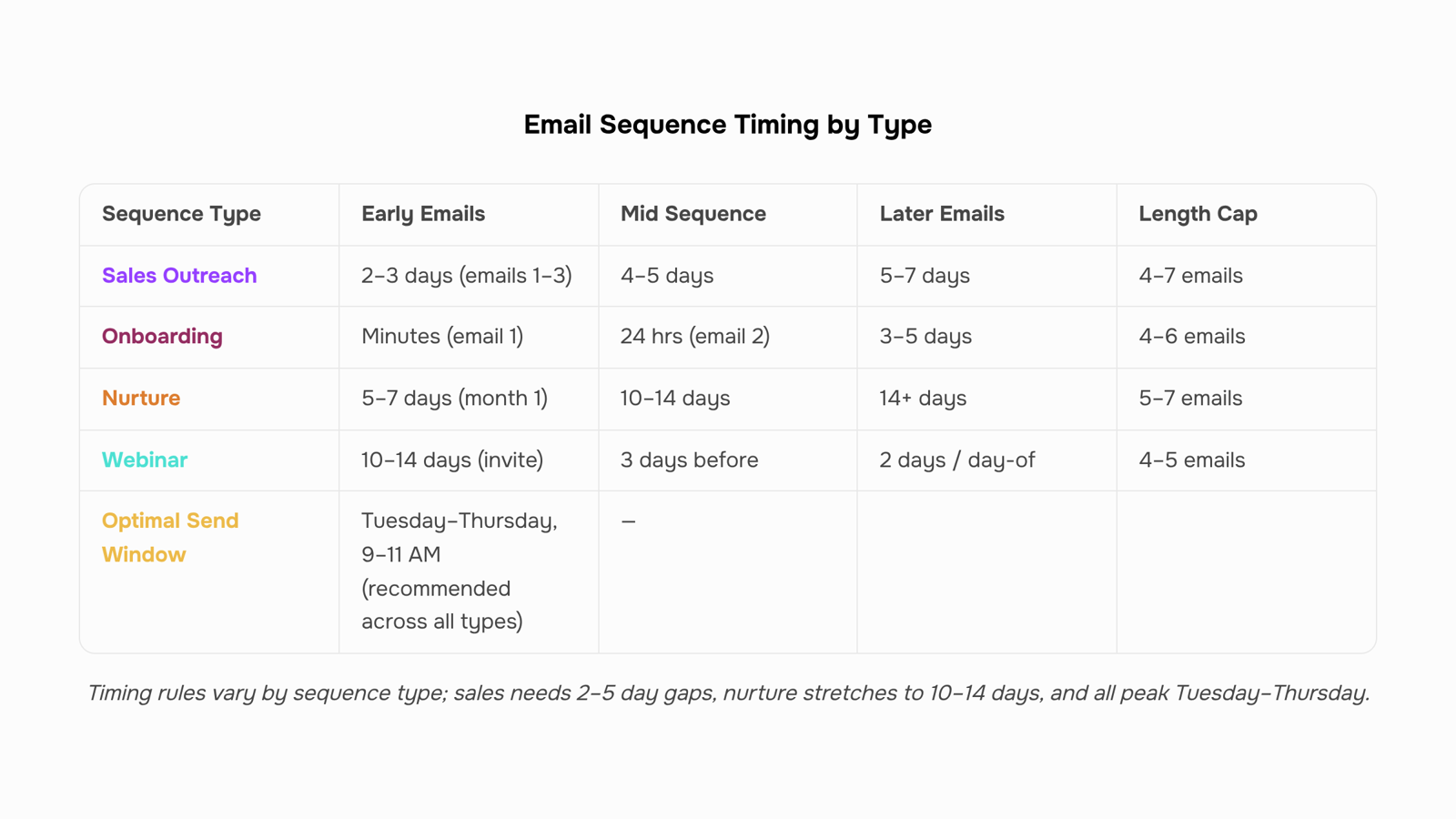
Sales outreach: Prospects are cold. They need repeated, low-friction touches before they recognize your name. Spacing of 2–3 days between the first three emails works, then stretch to 4–5 days for follow-ups four through six. Compress tighter than that and you trigger spam complaints. Go wider and you lose the thread of recognition entirely.
Onboarding email sequence: New signups are warm and motivated right now. Your first email lands within minutes of signup. The second hits 24 hours later. The third arrives on day 3 or 4. After that, you can widen to weekly. The logic: activation windows are short, and every day of silence increases the chance they forget why they signed up. For a deeper breakdown, see best practices for onboarding sequence timing.
Nurture email sequence: These run long (60–90 days) and the reader is not ready to buy. Space emails 5–7 days apart for the first month, then stretch to 10–14 days. You are building familiarity, not urgency. Pushing harder just trains them to ignore you. If you are building a 90-day cadence, the frequency guidelines for a nurture sequence cover the math in detail.
Webinar email sequence: These are event-driven with a hard deadline. Send the invite 10–14 days out, a reminder at 3 days, another at 24 hours, and a final nudge 1 hour before. Post-event, the replay email goes out within 4 hours while attention is fresh.
The pattern: urgency and intent dictate spacing. When you build sequences in a tool that supports variable delays per step, like Evox's send time optimization, you can encode these rules once and let them run without manual calendar math. No single email sequence template works across all four types.
Six timing best practices to apply to any sequence
These six practices work across any email sequence type. Adapt them to your specific cadence (sales, nurture, onboarding), but treat each as a non-negotiable baseline.
1. Pick send days based on your buyer's work rhythm.
For B2B IT services, Tuesday through Thursday consistently produce the highest open and reply rates. Monday inboxes are flooded with weekend catch-up. Friday attention drops off after lunch. If your prospects are IT company owners, they're triaging tickets Monday morning and mentally checked out by Friday at 3 PM. Stack your sends mid-week.
2. Space emails 3 to 5 days apart for sales sequences, longer for nurture.
A cold outreach sequence with daily emails signals desperation and tanks deliverability. Three to five business days between touches gives your prospect time to read, consider, and respond without feeling pressured. Nurture sequences can stretch to 7 to 14 days between emails. For guidance on longer cadences, see how to set frequency for a 90-day nurture sequence.
3. Send between 9 and 11 AM in the recipient's local time zone.
Not your time zone. Theirs. A 9:15 AM send lands near the top of the inbox when your prospect starts their day. If you're targeting prospects across multiple regions, you need software that adjusts delivery windows per contact. Evox handles this with delay-based automation that respects each lead's local send window.
4. Adjust spacing based on behavior signals.
If a prospect opens your second email but doesn't reply, shorten the gap to your third touch by one day. If they click a link, trigger a follow-up within 24 hours while intent is fresh. Static timing ignores buying signals. The best email sequence software for sales teams in 2026 and beyond connects send time optimization to open and click data automatically.
5. Cap your sequence at 4 to 7 emails.
Beyond seven touches without a reply, you're burning sender reputation for near-zero return. Most positive replies land between emails two and four. Set a hard stop. You can always re-enroll cold leads into a different sequence 60 to 90 days later with a fresh angle.
6. Define exit conditions before you launch.
Every email sequence needs clear rules for when a contact leaves: they reply (positive or negative), they book a meeting, they unsubscribe, or they hit the sequence cap. Without exit conditions, leads get emailed after they've already said yes, or worse, after they've said no. Build these as automation rules, not manual checks. For more on automating your email marketing workflow, the principle is the same: define the trigger, define the exit, then let the system run.
Common timing mistakes that kill response rates
Four mistakes show up in almost every underperforming email sequence, and each one is fixable once you spot it.
Sending too fast. Stacking three emails within 48 hours signals desperation, not persistence. Recipients mentally file you as spam before your value proposition lands. A nurture email sequence needs breathing room between touches, typically 3 to 5 days for warm leads, 5 to 7 for cold.
Waiting too long. The opposite problem. If your second email arrives 14 days after the first, the recipient has forgotten who you are. You lose the context you built in email one and effectively start over.
Ignoring time zones. Sending at 9 AM your time means hitting inboxes at 2 AM for prospects in a different region. Most teams skip this when automating their sequences, then wonder why open rates crater for half their list.
Not adjusting for opens or clicks. A prospect who opened your last three emails but never replied needs a different cadence than one who hasn't opened anything. Treating both identically in your email sequence template wastes the behavioral data you already have. As one analysis notes, most teams don't actually know who they're writing to, and timing without context is just guessing louder.
Audit your current sequences against these four. The next section covers how to fix them with automation.
How to automate your sequence timing without manual work
The timing rules from the framework section only work if they fire without you remembering to hit send. That means building delay-based steps directly into your email sequence so each follow-up triggers automatically after a set interval.
In Evox, you configure this by setting delay rules between each step of a multi-step campaign. A typical cold outreach cadence might look like: Day 0 send, 3-day delay, follow-up, 5-day delay, value-add email. The queue system handles delivery timing so messages land during your recipient's peak window. For deeper guidance on window selection, see how send time optimization in Evox adjusts delivery based on engagement data.
What separates the best email sequence software for sales teams 2026 from basic schedulers is behavior-triggered adjustment. If a lead opens but doesn't reply, the next delay shortens. If they click a link, the system can accelerate the cadence or branch to a different message. Most teams sending Tuesday through Thursday, 9-11 AM, with 3-7 day intervals see the strongest reply rates.
Once your delays and conditions are set, you stop managing calendars and start automating your email marketing workflow end to end.
Frequently asked questions
How many emails should a sales email sequence include? Most teams see results with four to six messages. Your sequence length isn't one-size-fits-all; it depends on deal size and audience warmth (GrowthList).
What's the best day to send B2B emails? Tuesday through Thursday mornings consistently outperform weekends. See our breakdown of the best time to send a sales follow-up.
How should onboarding email sequence timing differ? Compress it: four to five messages over seven to ten days keeps new users engaged without fatigue. More detail in our onboarding email sequence timing guide.
Should I pause a sequence when someone replies? Yes. Any decent email sequence tool auto-pauses on reply to prevent awkward overlap.
Closing
The timing framework you just walked through—send days, inter-email spacing, behavior triggers, and exit conditions—only works if you enforce it consistently across every sequence your team runs. Manual scheduling drifts. Calendars get missed. Delays slip. Evox removes that friction by automating the entire cadence: you set the delays once, define your send windows, and the system adjusts delivery per recipient's local time zone while monitoring opens and clicks to trigger behavior-based follow-ups automatically. Test your sequence timing with a free trial, or jump straight to the send time optimization feature to see how your 3-to-5-day spacing actually performs against your prospect list.
FAQ
What is an effective email sequence for sales?
An effective sales sequence spaces 4 to 7 emails across 2 to 3 weeks with 3-to-5-day gaps, sends Tuesday through Thursday at 9–11 AM, and adjusts timing based on opens and clicks. Most positive replies land between emails two and four.
How do I create an automated email sequence?
Define your sequence type (sales, nurture, onboarding), set delays between each email, choose send days and times, and use automation software like Evox to trigger sends based on recipient actions or calendar intervals without manual scheduling.
Can email sequences improve my conversion rates?
Yes. B2B prospects need five to eight touchpoints before responding. Proper spacing (3–7 days) keeps you top of mind without triggering spam filters, and behavior-triggered adjustments let you capitalize on engagement signals when intent is highest.
How do I personalize an email sequence for my target audience?
Adjust spacing and send times by sequence type: sales outreach uses 2–3 day gaps; onboarding compresses to 24 hours between first emails; nurture stretches to 5–14 days. Personalize further by triggering follow-ups based on opens, clicks, or role-specific content.
How many emails should a sequence have?
Cap sequences at 4 to 7 emails. Beyond seven touches without a reply, you damage sender reputation for minimal return. Most conversions happen between emails two and four; set a hard stop and re-enroll cold leads 60–90 days later with fresh angles.
What is the right gap between emails in a follow-up sequence?
Sales sequences: 3–5 days between touches. Nurture sequences: 5–14 days. Onboarding: 24 hours for the first two, then 3–4 days. Shorten gaps by one day if a prospect opens but doesn't reply; trigger immediate follow-ups after clicks while intent is fresh.


 Elena Petrova15 September 2026


