TL;DR: Most guides on requirements management hand you a checklist and leave the hard part — stakeholder alignment, scope control, and traceability — to figure out on your own. This one gives IT team leads a concrete framework: how to run structured elicitation sessions, document requirements in a traceable format, and prevent scope creep before it derails delivery. You'll leave with steps you can apply to your next project kickoff.
What requirements management means
Requirements management is the process of capturing, documenting, prioritizing, and tracking everything a project must deliver — from the first stakeholder conversation through final sign-off.
Two categories matter here. Functional requirements define what the system does: a user logs in, a report exports as CSV, an invoice generates on approval. Non-functional requirements define how well it does it: response time under 200ms, 99.9% uptime, SOC 2 compliance. Skipping the second category is one of the most common reasons IT projects miss acceptance criteria late in delivery.
Before you can manage requirements, you need to know whose requirements count. Map your stakeholders before the first requirements session so you're not discovering missing voices in week six.
Once you have requirements, they need a priority order. Methods like MoSCoW prioritization give your team a shared language for what ships in sprint one versus what waits.
The next section covers why this process directly affects scope creep, rework cycles, and sprint planning — the outcomes that make requirements management worth the investment.
Why requirements management improves project outcomes
Poor requirements management is one of the most consistent predictors of project failure. The Standish Group has tracked this for decades, and the pattern holds: incomplete or misunderstood requirements lead directly to scope creep, rework, and missed deadlines.
Here is what a structured requirements management process actually changes:
Reduced scope creep: When requirements are documented and baselined before work starts, every change request is visible and deliberate. Stakeholders can't quietly expand scope because the boundary is already written down.
Faster stakeholder sign-off: Ambiguity is what slows approvals. A clear, prioritized requirements document (especially when you prioritize requirements using MoSCoW) gives reviewers something concrete to approve or push back on, not a vague brief.
Fewer rework cycles: Requirements defects caught before development cost a fraction of what they cost after. Fixing a misunderstood requirement in discovery takes an hour; fixing it post-build can take weeks.
Cleaner sprint planning: When you convert each approved requirement into a tracked task, sprint backlog grooming becomes mechanical rather than interpretive. Teams stop debating what "done" means because the requirement already defines it.
The right requirements management software enforces this discipline automatically, keeping documentation, status, and ownership in one place rather than scattered across email threads.
Best practices for gathering requirements from stakeholders
Good requirements management starts before any tool or template. It starts with how you pull information out of the people who hold it.
These five techniques cover the situations most software delivery teams actually face:
Structured interviews — One facilitator, one stakeholder, a prepared question set. Use this when you need depth from a single decision-maker or when group dynamics would suppress honest answers. Output: a verbatim transcript you can trace back to a named source.
Requirements workshops — Bring the right cross-functional group into a time-boxed session and work toward consensus in real time. Use this when conflicting priorities need to surface and get resolved together, not in separate email threads. Output: a ranked list of agreed requirements, signed off in the room.
User story mapping — Walk through the user journey left to right, then stack requirements vertically by priority. This technique connects directly to agile backlog structure, which is why it fits teams already running sprints. Output: a visual backlog ready to feed into sprint planning.
Document analysis — Review existing contracts, legacy specs, compliance mandates, and support tickets before you talk to anyone. Use this when stakeholders are unavailable or when you need to map your stakeholders before the first requirements session and understand the landscape first. Output: a baseline requirements list that prevents re-asking obvious questions.
Observation (contextual inquiry) — Watch users do the actual work instead of asking them to describe it. People consistently underreport workarounds and manual steps. Output: requirements that reflect real behavior, not idealized behavior.
No single technique covers every gap. A typical software project combines at least three: interviews for executive context, a workshop to align the team, and document analysis to anchor everything in existing constraints. Once you have the raw input, prioritize requirements using MoSCoW before anything goes into a tracker.
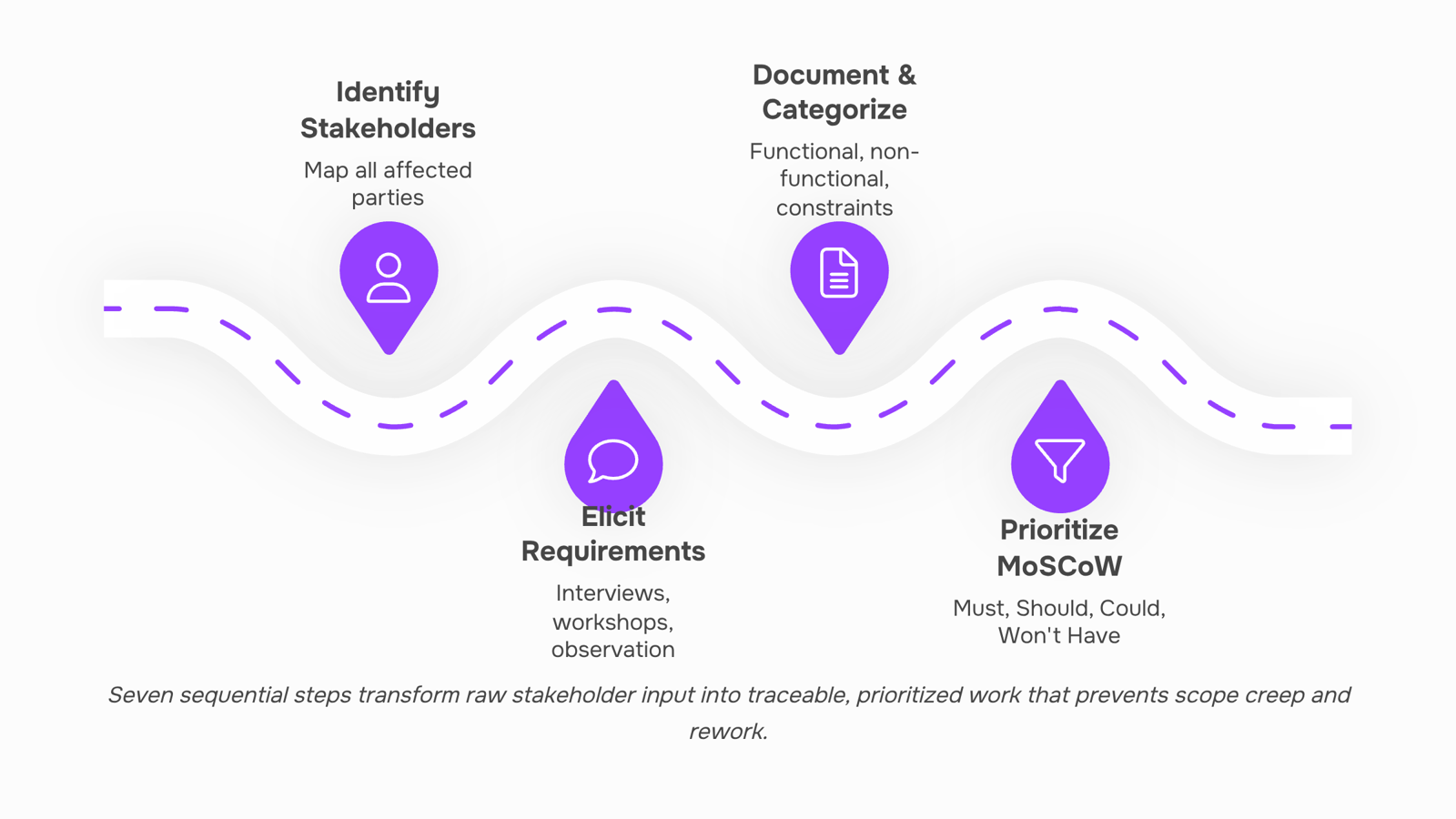
7 steps to build a requirements management process
A requirements management process without clear stages collapses at the first scope change. Here are the seven steps that hold it together.
1. Identify your stakeholders List every person whose work shapes or is shaped by the system. Missing a stakeholder at this stage means discovering their requirements after development starts. Map your stakeholders before the first requirements session to avoid that rework cost later.
2. Elicit requirements Run structured interviews with decision-makers, workshops with cross-functional groups, and observation sessions with end users. Each method surfaces a different layer: interviews reveal intent, workshops surface conflicts, observation catches what people forget to mention. For a billing module, watching an accounts team process invoices live will expose edge cases no interview would catch.
3. Document and categorize Write every requirement in a single source of truth, not scattered across emails and slide decks. Label each one: functional (what the system does), non-functional (performance, security), or constraint (regulatory, budget). A software team building a client portal, for example, would separate login behavior (functional) from a two-second page load requirement (non-functional) from a GDPR compliance rule (constraint).
4. Prioritize with MoSCoW Sort requirements into Must Have, Should Have, Could Have, and Won't Have this release. This forces stakeholders to make real trade-off decisions before the sprint starts, not during it. Prioritize requirements using MoSCoW if your team is new to the method, or choose a prioritization method that fits your team if you need an alternative framework.
5. Convert requirements into tracked tasks An approved requirement sitting in a document delivers nothing. Break each one into actionable work items with an owner, due date, and acceptance criteria. Convert each approved requirement into a tracked task so nothing gets lost between the requirements document and the sprint board.
6. Review and get sign-off Walk stakeholders through the documented, prioritized requirements before any build work starts. Capture written approval, even a simple email confirmation. This single step is what separates a change request from a scope dispute later.
7. Monitor and control changes Requirements will change. The question is whether changes go through a controlled process or arrive as informal Slack messages. Log every change request, assess its impact on scope and timeline, and get re-approval before updating the backlog. A lightweight change log inside your requirements management software is enough for most teams under 20 people.
Not every requirements management tool fits agile work. A tool built for waterfall documentation will slow your sprints down, not support them. Before you evaluate any option, run it against these five criteria.
Traceability: Each requirement should link forward to a test case and backward to the stakeholder who raised it. Without that chain, you can't answer "why does this feature exist?" six months later.
Task linkage: Requirements that live in a separate document from your backlog create drift. A good requirements management tool connects approved requirements directly to sprint tasks, so nothing gets built without a traceable origin. You can convert each approved requirement into a tracked task inside the same system rather than copying across tools.
Version history: Stakeholders change their minds. The tool needs to record every revision with a timestamp and author, not just overwrite the previous state.
Sprint integration: Requirements should map to sprints natively, not through a manual export. If your team uses two-week cycles, the tool should reflect which requirements are in scope for each one.
Role-based access: Stakeholders who can edit requirements without a review gate introduce silent scope changes. Separate read, comment, and edit permissions by role.
A tool that clears all five criteria makes requirements management a live part of delivery, not a document you revisit only when something breaks.
Common mistakes that break requirements management
Four mistakes show up repeatedly in requirements management failures, and each one has a straightforward fix.
Collecting requirements once and never updating them: Stakeholder priorities shift mid-project. Treat your requirements as a living document with a scheduled review at every sprint boundary, not a one-time deliverable.
Skipping non-functional requirements: Performance thresholds, security standards, and uptime targets get discovered late, which is exactly when rework costs the most. Define them alongside functional requirements from the start.
No single owner per requirement: When everyone is responsible, no one is. Assign one named person to each requirement so accountability is unambiguous, especially as scope changes.
Treating requirements as separate from the task backlog: A requirement that lives in a document but never becomes an assigned work item will drift. Link every requirement directly to the tasks that deliver it.
Poor requirements definition is a leading driver of IT project failure, which means fixing these four gaps is also a form of risk management.
Static documents don't enforce ownership. A requirements spreadsheet tells you what was agreed; it doesn't tell you who's responsible, whether anything has changed, or whether the work is actually moving.
Moving requirements into a work management system like Taro closes that gap. Each requirement becomes a task or subtask with an assigned owner, a status, and a clear link to the sprint or project it belongs to. Non-functional requirements get the same treatment as features, not a footnote in a separate doc.
This is where requirements management software earns its keep. With the right requirements management tools, a stakeholder can check progress without scheduling a meeting, and scope changes get captured as task updates, not lost in an email thread.
Closing
Requirements management isn't a phase you complete and move on from — it's the connective tissue between what stakeholders need and what your team actually builds. When you run structured elicitation sessions, document requirements in a traceable format, and prioritize before work starts, you eliminate the friction that derails most projects: scope creep, rework cycles, and sign-off delays.
But a requirements document sitting in a shared drive doesn't drive delivery. The moment an approved requirement becomes a tracked task — with an owner, acceptance criteria, and a sprint assignment — it stops being a artifact and starts being work. Ready to see how IT teams connect stakeholder requirements directly to sprint execution? Check out how Taro's task management keeps requirements traceable from discovery through delivery.
FAQ
What is requirements management in software development?
Requirements management is capturing, documenting, prioritizing, and tracking everything a project must deliver — from stakeholder conversations through final sign-off. It covers functional requirements (what the system does) and non-functional requirements (performance, security, compliance).
What are the best practices for gathering requirements from stakeholders?
Use structured interviews for depth from single decision-makers, workshops to align cross-functional groups and resolve conflicts, user story mapping to connect to agile backlogs, document analysis to establish baselines, and observation to catch real behavior. Most projects combine at least three techniques.
What tools are used for requirements management in agile projects?
Task management tools that connect requirements directly to sprint work are most effective. They keep documentation, status, and ownership in one place rather than scattered across emails, preventing scope creep and accelerating sign-off.
What is the difference between requirements management and scope management?
Requirements management defines what must be delivered and prioritizes it. Scope management controls the boundary around those requirements — preventing unauthorized additions and tracking approved changes.
How do you handle changing requirements mid-project?
Document the baseline requirements before work starts so every change is visible and deliberate. Use a change control process: evaluate impact, update priority, and convert approved changes into new tracked tasks rather than letting them slip in untracked.


 Elena Petrova15 September 2026


