What are the best practices for writing a mail rappel
TL;DR: Most follow-up email guides tell you to wait three days and try again. This one gives IT company owners a seven-step writing framework with specific timing rules, tone adjustments per sequence position, and automation triggers that keep mail rappel cadences running without manual tracking. You'll finish with a system you can configure this week.
What a mail rappel actually is
Professional 3D render of organized business desk with email templates and structured documents
A mail rappel is a follow-up email sent after an initial message received no reply. The term comes from French ("rappel" means reminder), but in a business context it means one specific thing: a deliberate, timed nudge designed to re-open a conversation without annoying the recipient.
That distinction matters. A mail rappel is not a marketing blast or a newsletter. It targets one person, references a prior exchange, and asks for a specific next step. Knowing how to write a reminder email that hits all three of those marks is what separates a reply from a delete.
Most teams treat follow-ups as an afterthought. The rest of this article treats them as a system, covering frequency, structure, tone, and the subject lines that actually get opens before the seven-step framework begins.
Why a well-timed mail rappel matters for your pipeline
Most first-touch emails go unanswered. That's not a failure of your pitch; it's the reality of crowded inboxes. According to Yesware, 70% of email chains stop after a single message, yet sequences with at least one follow-up see significantly higher reply rates. Deals don't stall because prospects aren't interested; they stall because no one followed up.
For IT company owners, the pipeline cost is direct. A delayed or missing email rappel client touchpoint can push a 30-day sales cycle to 60 days, or kill it entirely when a competitor follows up first. Reply rates on follow-up emails consistently outperform first-touch messages once you get the timing and framing right, which is exactly what follow-up email best practices come down to in practice.
The mechanics matter too. A vague "just checking in" line loses deals that a specific, value-adding follow-up would have closed. Getting the subject lines right is half the open-rate battle before your words even land.
The framework in this article gives you a repeatable system, not a one-off template. Each step builds toward a follow-up sequence your team can run consistently, at the right intervals, without guessing.
How often to send a mail rappel to clients
Follow-up email frequency depends almost entirely on where the relationship stands.
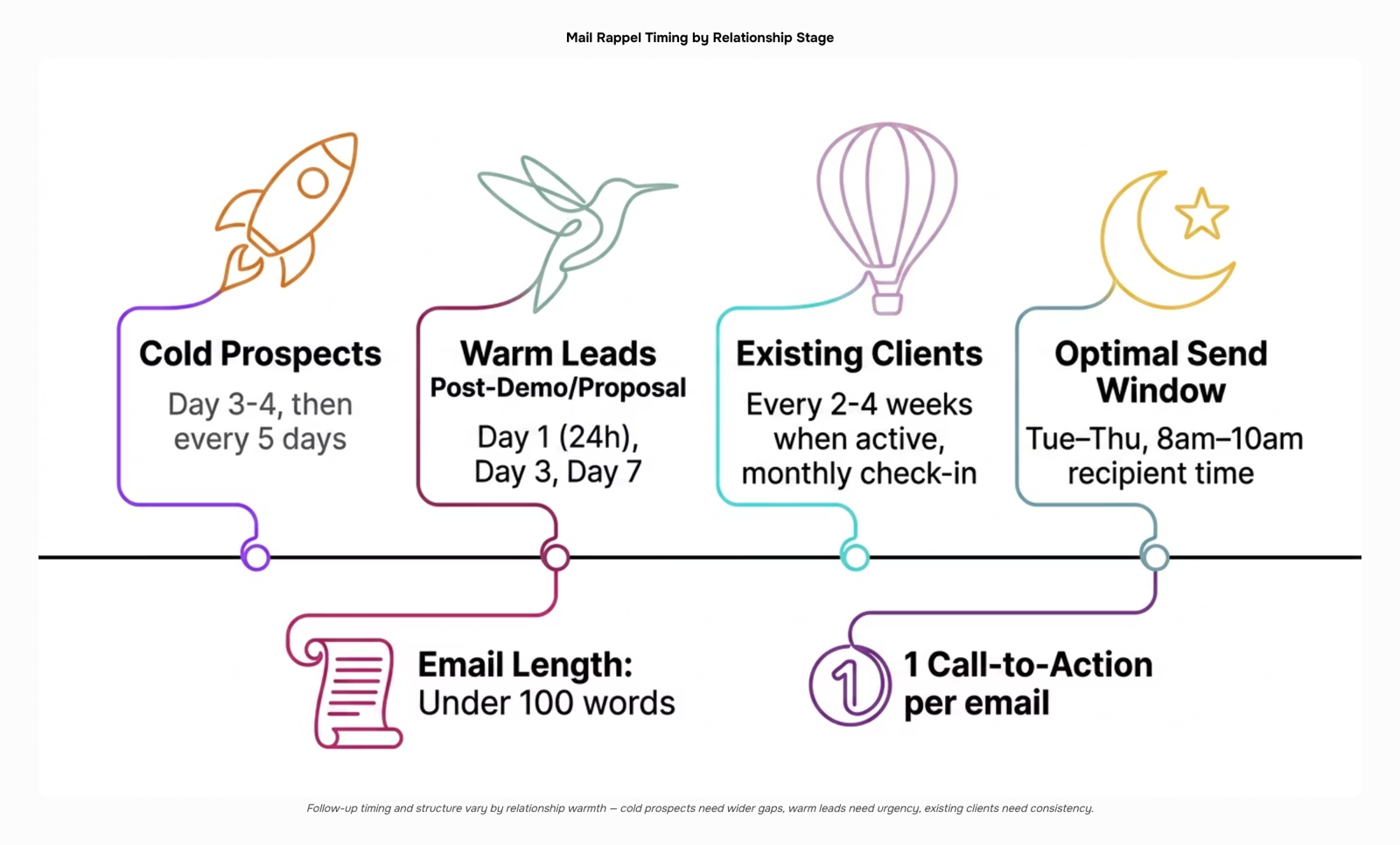
Cold prospects move slowly. Send a first outreach, wait 3 to 4 business days, then follow up once or twice more at 5-day intervals. After three unanswered emails, stop. Pushing past that point damages deliverability and your sender reputation.
Warm leads who have shown intent (a demo request, a replied email, a clicked link) deserve tighter timing. Follow up within 24 hours of the trigger, then again at day 3 if you hear nothing. A third touch at day 7 is reasonable. Beyond that, move them to a lower-frequency nurture sequence.
Existing clients need a different frame entirely. An email rappel to a current client is a relationship check-in, not a sales push. Once every 2 to 4 weeks is appropriate for active accounts; monthly for quieter ones.
A practical rule: the warmer the relationship, the shorter the gap. The colder the contact, the more you need subject lines and templates for follow-up emails that earn attention on their own.
If managing these sequences manually feels unsustainable, automating your follow-up sequences with Evox removes the tracking overhead entirely.
7 best practices for writing a mail rappel that gets a reply
Each step below maps to a specific failure point in follow-up emails. Fix the step, fix the failure.
Write a subject line that signals continuation, not a cold pitch: Reference the prior exchange directly. "Re: our call Thursday" outperforms "Following up" in open rates because it gives the reader immediate context. For subject lines and templates for follow-up emails, the rule is simple: if the subject could belong to any email, rewrite it.
Open with their name and one specific detail: "Hi Sarah, following up on the proposal I sent Monday" is better than "Hope you're doing well." The specific detail proves you're not blasting a list. It also gives the reader a mental anchor before you ask anything of them.
Add a one-sentence context reminder: Don't assume they remember the original email. A brief recap, "We spoke about cutting your onboarding time from two weeks to three days," does two things: it reminds them why they were interested, and it re-frames your ask around their problem, not your pipeline.
Include exactly one call to action: The most common reason follow-up emails go unanswered is that they ask for too much. One question, one link, one decision. "Does Thursday at 2pm work for a 20-minute call?" is answerable in five seconds. "Let me know your thoughts on the proposal, timeline, and budget" is not.
Calibrate tone to relationship stage: A cold prospect gets a professional, low-pressure note. A warm lead who went quiet gets a slightly more direct nudge. An existing client gets something closer to a conversation. Mismatching tone to stage is one of the most common follow-up email best practices that gets ignored in practice. For guidance on staying professional without sounding stiff, email etiquette rules to keep your tone professional covers the specific lines worth watching.
Keep the email under 100 words: Most follow-ups fail because they try to re-sell the entire offer. Your original email did that job. The mail rappel has one job: get a response. Strip everything that doesn't serve that goal. If you find yourself explaining features or adding context beyond the one-sentence reminder, you're writing the wrong email.
Send at the right time, not just the right interval: Tuesday through Thursday, between 8am and 10am in the recipient's timezone, consistently outperforms Friday afternoons or Monday mornings. Knowing how to write a reminder email matters less if it lands when the inbox is already buried. If you're managing more than a handful of active follow-up threads, an automated follow-up email sequence handles the scheduling and send-time logic so you're not tracking it manually.
The full framework works because each step removes a specific friction point: unclear subject lines lose opens, weak openers lose attention, missing context loses the thread, multiple CTAs lose decisions, wrong tone loses trust, long emails lose patience, bad timing loses the window.
For a deeper look at structure and phrasing across the full email, writing professional emails that get replies covers the mechanics that apply before you even get to the follow-up stage.
Mail rappel vs. email marketing: what is the difference
The confusion is understandable: both involve email, both want a reply. But the mechanics and goals are completely different.
Email marketing is one-to-many. You're sending a campaign to a segmented list, optimizing for open rates and click-throughs, and measuring success in aggregate. Think newsletters, product announcements, or nurture sequences. For a deeper look at how those campaigns are structured, this breakdown of beginner email marketing tactics is a useful starting point.
A mail rappel is one-to-one. It's triggered by a specific prior interaction, a proposal you sent, a demo you ran, an invoice that's gone quiet. The goal isn't awareness; it's a single, concrete response from a specific person. Tone, timing, and context are calibrated to that relationship, not to a segment.
The practical difference: an email marketing follow-up re-engages a cold list with fresh content. A mail rappel picks up a live conversation that stalled. Drip campaigns sit somewhere in between, which is why the three tactics get conflated.
Use email marketing to build pipeline. Use a mail rappel to move a specific deal, relationship, or decision forward. Mixing them up means sending the wrong message at the wrong moment, and losing the reply you actually needed.
How to use mail rappel to improve customer engagement
Three scenarios where a structured email rappel client sequence consistently moves things forward:
Post-proposal: Send within 24 hours of submitting. Reference one specific line from the proposal ("the migration timeline on page 4") to signal you read the room, not just hit send.
Post-demo: Follow up 48 hours later with one question: "Which part of the demo was most relevant to what you're solving right now?" One question gets more replies than a summary paragraph.
Post-invoice: If payment is overdue by five days, a short, neutral reminder outperforms a formal notice. Keep it two sentences. No apology, no pressure.
In each case, the sequence works because it's triggered by a real interaction, not a calendar. That's what separates mail rappel from broadcast email. For the mechanics of each message, subject lines and templates for follow-up emails covers the specifics.
Automate your mail rappel process so nothing slips
Manual follow-up tracking breaks at scale. When you're managing post-proposal, post-demo, and post-invoice threads across a dozen active clients, something always slips through.
An automated follow-up email sequence removes that risk. You define the timing, the message variation, and the stop condition (reply received), then the system runs it. Evox handles exactly this: multi-step email marketing follow-up sequences with built-in delays, automatic task creation on replies, and a queue system that keeps volume manageable without flooding inboxes.
A practical setup: send the first mail rappel 48 hours after the trigger event, a second at day five, a third at day ten. Each message references the previous one. The sequence stops the moment a reply comes in.
For the underlying message craft, subject lines and templates for follow-up emails is worth reviewing before you build your sequence.
Closing
A mail rappel works because it's deliberate, timed, and tied to a specific next step. The seven-step framework gives you the structure; the timing rules keep you from annoying prospects; and the tone calibration ensures you land the right note for each relationship stage. The system only works if it runs consistently, which is why most teams that nail follow-up email reply rates eventually move to automation. Start this week by auditing your last five follow-up emails against the framework. Which step is costing you the most replies?
FAQ
Q. What is the purpose of a mail rappel?
A. A mail rappel is a timed, targeted follow-up email designed to re-open a conversation after an initial message goes unanswered. It references the prior exchange and asks for one specific next step, without re-selling the entire offer.Q. How often should I send a mail rappel to my clients?
A. Cold prospects: 3-4 days, then 5-day intervals, max three emails. Warm leads: 24 hours, then day 3, then day 7. Existing clients: every 2-4 weeks. The warmer the relationship, the shorter the gap.Q. What are the best practices for writing a mail rappel?
A. Use a subject line that signals continuation, open with a specific detail, add one-sentence context, include exactly one call to action, match tone to relationship stage, keep it under 100 words, and send Tuesday-Thursday between 8-10am in their timezone.Q. How can I use mail rappel to improve customer engagement?
A. Follow-up sequences with at least one mail rappel see significantly higher reply rates than single-touch emails. Timing it right and calibrating tone to relationship stage keeps engagement warm without creating friction or burnout.Q. What are the differences between mail rappel and email marketing?
A. Mail rappel is one-to-one, references a prior exchange, and asks for a specific reply. Email marketing is one-to-many, goes to a segmented list, and optimizes for opens and clicks, not direct conversation.Q. How many follow-up emails should I send before stopping?
A. For cold prospects: stop after three unanswered emails. Pushing past that damages sender reputation. For warm leads: up to three touches over 7-10 days is reasonable. Move them to nurture after that.Q. What subject line works best for a mail rappel?
A. Reference the prior exchange directly: 'Re: our call Thursday' or 'Following up on the proposal I sent Monday.' If the subject could belong to any email, rewrite it. Specificity signals you're not blasting a list.


 Elena Petrova15 September 2026


