TL;DR: Most funnel articles stop at the diagram. This one maps each stage of a B2B lead generation funnel to a specific tooling decision and a measurable handoff criteria, so IT company owners know exactly what to automate, what to measure, and where leads are actually dying before they reach sales.
What a B2B lead generation funnel actually is
A B2B lead generation funnel is the structured path a potential buyer travels from first hearing about your company to becoming a qualified opportunity your sales team can close. It ends the moment a lead is handed to sales — not when a deal is won.
That last point is where most teams get confused. A sales funnel tracks what happens after handoff: demos, proposals, negotiations. The lead generation funnel covers everything before that: attracting the right companies, capturing their contact details, and filtering out the ones who will never buy.
The b2b lead funnel stages typically run from awareness through capture, qualification, and handoff. Each stage has a different owner, a different tool, and a different failure mode. Awareness breaks when targeting is too broad. Capture breaks when forms or landing pages create friction. Qualification breaks when no one defines what "ready" actually means.
Getting this structure right before choosing tools matters because the wrong tool at the wrong stage creates gaps, not fixes. For a closer look at how each stage should be built in practice, the principles hold whether your team is five people or fifty.
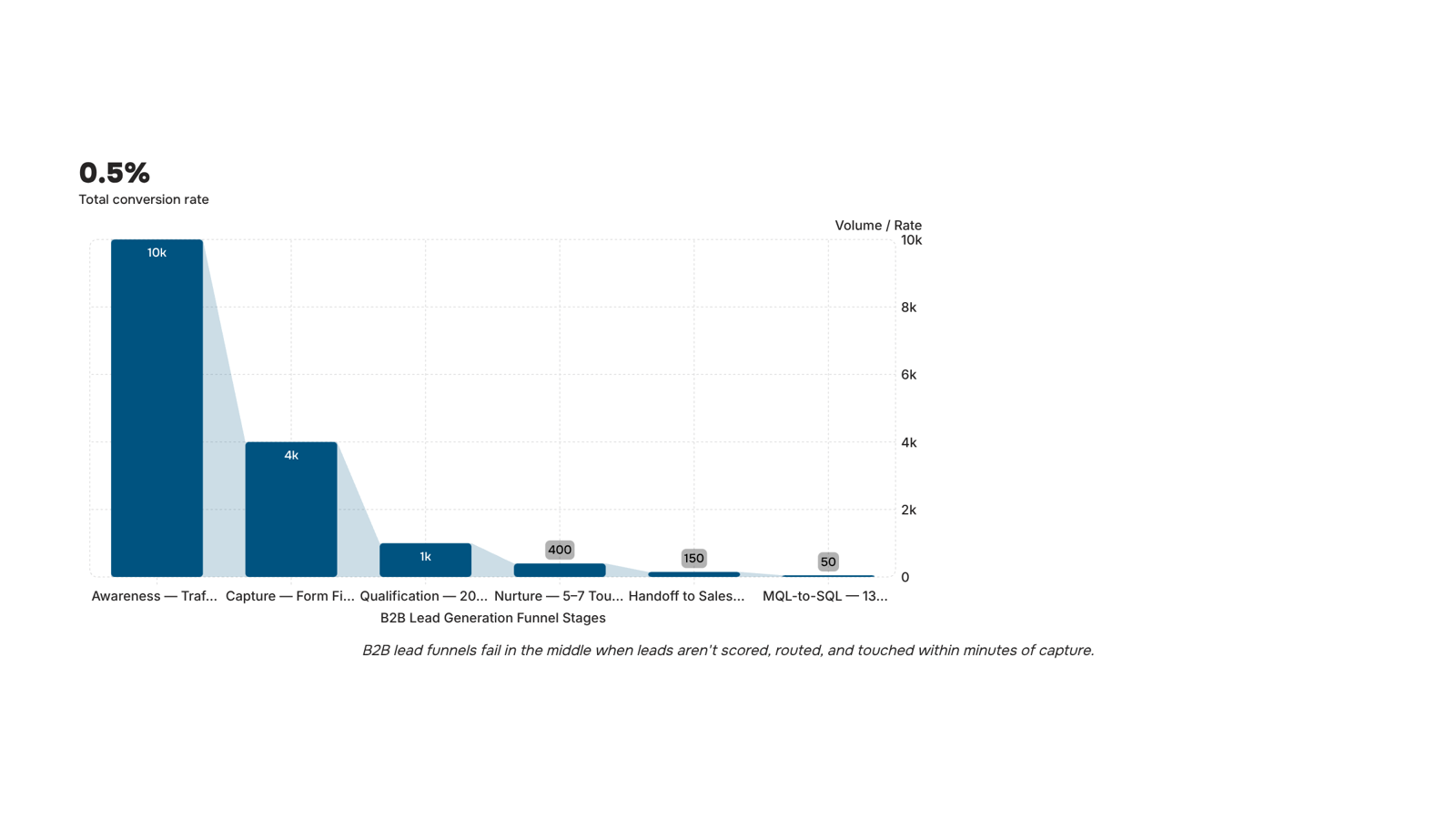
The key stages every B2B funnel needs
Most B2B lead generation funnels fail not because the top is too narrow, but because the middle has no structure. Each stage needs a defined input, a clear action, and a measurable output before the next stage begins.
Awareness is where a prospect first encounters your company, through search, a LinkedIn post, or a referral. Your job here is distribution, not conversion. The metric is traffic and reach, not leads.
Capture is where intent gets recorded. A form fill, a content download, a demo request. Every capture point should feed a single system, not scatter across three spreadsheets and a shared inbox. If a lead enters your b2b lead funnel stages at this point and nobody owns it, it stalls here permanently.
Qualification is the stage most IT services teams skip or do informally. A structured lead qualification process asks: does this company match your ICP by size, budget, and buying timeline? Leads that don't meet the threshold should be nurtured, not handed to sales. Research from Harvard Business Review found that contacting a lead within an hour makes conversion seven times more likely than waiting even two hours.
Handoff is where marketing ends and sales begins. A clean handoff means the rep receives context, not just a name. Conversation history, engagement signals, and qualification score all travel with the lead.
For a deeper look at how these stages connect in practice, How to Build a B2B Lead Funnel That Actually Converts covers the sequencing in detail.
Why most B2B funnels leak before the sales call
Three failure points account for most of the gap between a full pipeline and a booked calendar.
Slow response time: Research from Harvard Business Review found that contacting a prospect within an hour makes a meaningful conversation nearly seven times more likely than waiting even two hours. For a managed IT services firm running paid search, that window closes fast. A lead fills out a "get a quote" form at 2 p.m. and books with a competitor by 3 p.m.
No qualification criteria: Without a defined threshold, reps chase every inbound contact regardless of company size, budget, or intent. The b2b funnel conversion rate drops not because leads are poor quality, but because no one filtered them. Good lead management software enforces that filter automatically.
Disconnected tools: When your form tool, CRM, and email platform don't share data, leads fall into gaps. A contact who downloaded a case study gets the same cold intro as someone who never heard of you.
These three problems compound each other. Fix the qualification criteria first, then build the follow-up sequence around the leads that actually match your ICP.
How to build your B2B lead generation funnel in 6 steps
Build the funnel in the right order and each step has a clear exit condition. Skip the order and you end up with what the previous section described: leads captured but never qualified, or qualified but never followed up.
Here are the six steps, each with a tool category recommendation and a done-when condition so you know when to move on.
Define your ICP with hard criteria: List the firmographic and behavioral attributes that make a prospect worth pursuing: company size, tech stack, budget authority, and the specific pain signal that indicates timing. Done when: your sales team can disqualify a lead in under two minutes without asking a manager.
Build your capture layer: Set up the forms, chatbots, or intent-data feeds that pull leads into a central record. This is where lead capture automation pays off most directly. A lead that enters a CRM automatically, with source and timestamp attached, is already more useful than one that arrives in a spreadsheet three days later. Done when: every inbound lead lands in one system with no manual data entry required.
Enrich and score on entry: The moment a lead hits your CRM, append firmographic data (company size, industry, tech stack) and assign a score based on ICP fit. Most teams skip this step or do it weekly in batch. That delay is what causes the slow-response problem covered earlier. Research consistently shows that contacting a lead within five minutes of capture is dramatically more effective than waiting even 30 minutes. Done when: every new lead has a score before the first rep sees it.
Route leads to the right rep or sequence: Use your lead qualification process to split leads into tracks: high-fit leads go to a rep immediately; mid-fit leads enter a nurture sequence; low-fit leads get deprioritized or disqualified. Done when: no lead sits unassigned for more than 15 minutes during business hours.
Run multi-step follow-up sequences: This is the step most IT services teams under-invest in. A single email is not a sequence. A real sequence has 5 to 7 touches across email, with timing and messaging tied to lead behavior (opened, clicked, visited pricing). Nurturing leads through email once they enter your pipeline with behavior-triggered steps is what separates a b2b lead generation funnel that converts from one that just collects contacts. Evox handles this layer, running automated sequences that adjust based on what each lead actually does. Done when: every lead in your pipeline receives a follow-up within 24 hours of any intent signal, without a rep manually triggering it.
Measure and close the loop: Track MQL-to-SQL conversion, time-in-stage, and reply rate by sequence. Use a sales pipeline builder that surfaces these numbers without a manual export. Done when: you can identify which funnel stage is losing the most leads in under five minutes.
For a deeper look at how these steps connect to specific tool choices, the best practices for building a lead generation funnel covers sequencing decisions in more detail. The next section maps each stage to the tool category that handles it.
The table below maps each funnel stage to the tool category that does real work there, with the specific capability that matters. Use it to audit your current stack against what a functional b2b lead generation funnel actually requires.
Funnel stage | Tool category | Capability that matters |
|---|
ICP targeting | Data enrichment | Firmographic filtering by industry, headcount, tech stack |
Lead capture | Form + intent tracking | Behavioral triggers, not just form fills |
Lead scoring | Lead management software | Score by engagement signal, not just demographic fit |
Qualification | CRM + routing logic | Auto-assign based on score threshold and rep capacity |
Nurture | Email automation | Multi-step sequences triggered by behavior, not calendar |
Conversion | Sales engagement | Lead-to-customer conversion workflow with activity logging |
Re-engagement | Segmentation + sequencing | Dormant lead detection with separate cadence |
Most lead management software handles one or two of these stages well and leaves the rest to manual work. The gap that kills most IT company funnels sits between capture and nurture: a lead fills out a form, gets logged in a CRM, and waits for a rep to act. Research consistently shows that response time in that window is one of the strongest predictors of conversion.
Lio handles capture and scoring. Evox picks up from there, running the nurture sequences and managing the lead-to-customer conversion workflow so no qualified lead sits idle. For a deeper look at nurturing leads through email once they enter your pipeline, that's covered separately.
How to measure whether your funnel is working
Four metrics tell you whether your b2b lead generation funnel is generating revenue or just generating activity.
Lead-to-MQL rate measures how many raw leads meet your qualification threshold. For IT services businesses, a healthy range sits between 20–30%. Below 15% usually means your lead capture is pulling in the wrong audience, not that your nurturing is broken.
MQL-to-SQL rate is where most funnels quietly fail. Industry benchmarks for B2B SaaS and IT services put a healthy MQL-to-SQL conversion rate at 13–20%. If you're below that, the gap is usually in scoring logic or handoff timing, not messaging.
Time-to-first-response is the metric most IT company owners underestimate. Research consistently shows that responding within five minutes of a lead's first action makes conversion dramatically more likely. Beyond an hour, most leads have mentally moved on.
Funnel velocity combines all three: how fast does a lead move from capture to closed? A slow velocity with high conversion rates means your pipeline is healthy but understaffed. A fast velocity with low conversion means you're rushing leads who aren't ready.
When you have Evox's funnel and conversion reports running, these numbers surface automatically by campaign and stage. That matters because the fix for a low MQL-to-SQL rate looks nothing like the fix for a slow first-response time. You need to see them separately to act on them correctly.
Closing
The difference between a pipeline that fills and one that stalls isn't the volume of leads you capture—it's whether they move through qualification and into a rep's hands before intent cools. Most IT company funnels lose leads in that middle gap: captured but unassigned, sitting for hours while prospects shop competitors. The fastest way to close that gap is to automate the capture-to-qualification step, so every inbound lead gets scored, routed, and touched within minutes, not days. Start by copying a pre-built pipeline template designed for IT services, then layer in the automation that keeps leads moving. See how Lio handles this step automatically—try it free today.
FAQ
What are the key stages of a B2B lead generation funnel?
Awareness (first encounter), Capture (intent recorded), Qualification (ICP fit assessed), and Handoff (to sales with context). Each stage has a defined input, action, and measurable output before the next begins.
How do I create an effective B2B lead generation funnel?
Define your ICP first, build a capture layer that feeds one system, enrich and score leads on entry, route high-fit leads to reps immediately, run multi-step nurture sequences, and measure MQL-to-SQL conversion. Done when no lead sits unassigned beyond 15 minutes.
What are the best tools for building a B2B lead generation funnel?
Use a CRM for lead capture and routing, lead enrichment software for firmographic data, email automation for multi-step sequences, and a sales pipeline builder that surfaces conversion metrics. The key is integration—disconnected tools create gaps where leads stall.
How can I optimize my B2B lead generation funnel for better conversion rates?
Contact leads within an hour of capture (seven times more likely to convert than waiting two hours), enforce strict qualification criteria so reps chase only ICP-fit prospects, and run behavior-triggered nurture sequences instead of one-off emails. Measure by stage to find where leads are actually dying.
How is a B2B lead generation funnel different from a sales funnel?
A lead generation funnel ends when a qualified lead is handed to sales. A sales funnel tracks what happens after: demos, proposals, negotiations. Lead generation owns awareness through qualification; sales owns the close.


 Elena Petrova15 September 2026


