TL;DR: Most guides list B2B sales tactics in isolation. This one sequences seven steps into a connected system, showing IT company owners exactly where automation removes the manual drag between lead capture, qualification, and follow-up that kills conversion speed.
What a B2B sales strategy actually is
Modern 3D business workspace with sales graph and geometric growth elements representing B2B sales strategy
A b2b sales strategy is a documented plan that defines how your team identifies, pursues, and converts other businesses into customers. It answers who you sell to, what problems you solve for them, which channels you use to reach them, and how you move a prospect from first touch to closed deal.
This is different from tactics. Cold email, LinkedIn outreach, and demo calls are tactics. Your b2b sales strategy is the logic that decides which tactics fire, in what order, for which accounts. Without that logic, reps default to whatever worked last quarter, and pipeline becomes unpredictable.
The distinction matters more in b2b vs b2c sales because B2B deals involve multiple stakeholders, longer cycles (often months), and higher contract values. Ad-hoc selling collapses under that complexity.
A documented b2b sales process gives your team a shared playbook: consistent qualification criteria, defined handoff points between marketing and sales, and clear rules for how quickly reps respond to inbound leads. That structure is what separates teams that forecast accurately from teams that guess.
Why your B2B sales strategy determines pipeline quality
A documented b2b sales strategy does four things that ad-hoc selling cannot.
It shortens your b2b sales funnel by removing dead weight. When your team knows exactly which accounts to pursue and which signals qualify a lead, they stop wasting cycles on prospects who were never going to close. That clarity alone can cut how long a typical B2B sales cycle runs by weeks.
It closes the speed-to-lead gap. Most B2B teams take hours or days to respond to inbound interest. A strategy defines who responds, how fast, and with what message. Without that, leads go cold before your team responds.
It aligns marketing and sales on the same definition of "qualified." When both teams share scoring criteria, marketing stops sending junk leads and sales stops ignoring good ones. Your b2b lead generation strategy produces higher-conversion pipeline instead of higher-volume noise.
It makes your process repeatable across hires. A new rep with a documented playbook ramps in weeks. A new rep without one copies whatever the last person did, good or bad.
The cost of skipping this work is not "slower growth." It is a pipeline full of leads your team cannot close, burning time you cannot recover.
B2B vs. B2C sales: what changes and why it matters
The b2b vs b2c sales difference that burns IT company owners most: consumer playbooks assume one buyer making a fast, emotional decision. Your b2b sales process involves multiple stakeholders evaluating ROI over weeks or months. Here is where the two diverge on four dimensions:
Dimension | B2C | B2B |
|---|
Cycle length | Minutes to days | Weeks to months (how long a typical B2B sales cycle runs) |
Stakeholders | 1, maybe 2 | 6+ (Gartner, 2023) |
Decision logic | Emotional, impulse-driven | ROI-based, committee-approved |
Content role | Brand awareness, social proof | Education, objection handling, technical validation |
That stakeholder count matters. When six people need to agree, your content does selling in rooms you never enter. A one-page case study or ROI calculator travels through Slack threads and forwarded emails in ways a sales call cannot.
This is exactly why copying a B2C funnel (ad, landing page, checkout) fails for IT services. You need a strategy that accounts for longer nurture cycles, leads who are not ready to buy yet, and consensus-driven purchasing.
Build your B2B sales strategy in 7 steps
Your b2b sales strategy needs a sequence, not a collection of tactics. These seven steps build on each other. Skip one and the rest underperform. Work through them in order, and you have a repeatable system you can hand to any new rep.
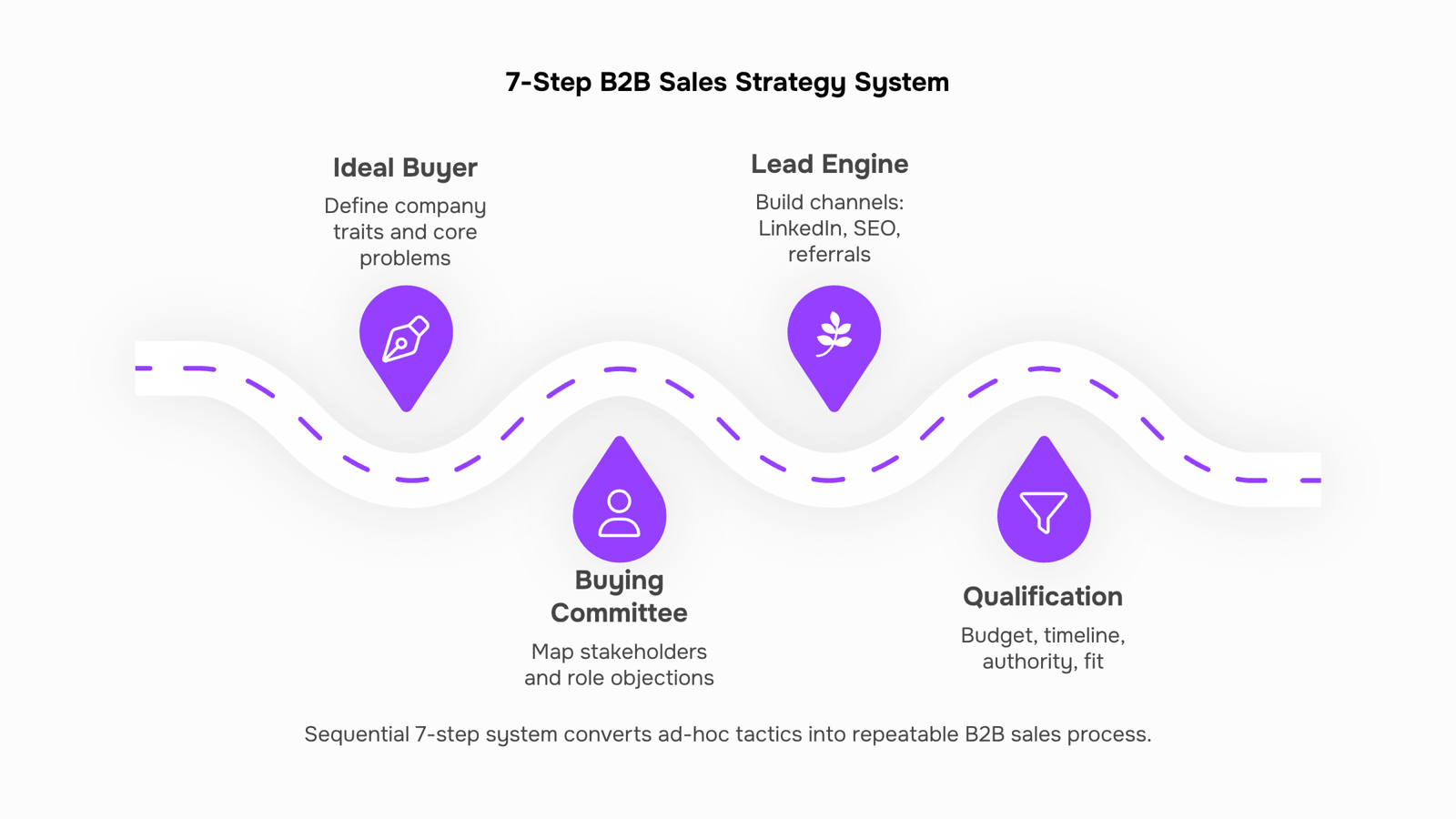
1. Define your ideal buyer profile and the problem you solve for them.
Start with the company characteristics (size, industry, tech stack) and the specific person who signs off. Then articulate the problem in their language, not yours. If you sell workflow automation to 20-person IT shops, your profile might be: "Owner-operators running a services firm on spreadsheets who lose 5+ hours a week on manual follow-ups." Customer research is the first step in B2B sales, and everything downstream depends on getting this right.
2. Map the buying committee and their objections.
Most B2B deals involve multiple stakeholders with different concerns. The technical lead cares about integration. The finance person cares about payback period. List each role, their likely objection, and the proof point that answers it. A two-person deal and a six-person deal require different content and different timelines, so know which you are selling into before you build outreach.
3. Build a lead generation engine with multiple channels.
Pick two to three channels where your buyers already spend attention. For IT company owners, that often means LinkedIn content, SEO-driven blog posts, and referral partnerships. Your b2b lead generation strategy should produce inbound interest and give your outbound team warm targets. If you need a deeper breakdown, see these proven B2B lead generation strategies.
4. Set up lead qualification criteria before leads arrive.
Define what makes a lead worth a rep's time. Use explicit criteria: budget range, timeline, authority to sign, and fit with your ICP. Lead qualification prevents your team from spending hours on prospects who were never going to buy. Score leads on these dimensions and route only qualified ones to sales conversations.
5. Compress your response time to under five minutes.
This is where most IT companies lose deals they already won on paper. A lead fills out a form, and nobody responds for hours or days. Sales automation closes that gap. Set up instant routing and templated first-touch messages so a qualified lead hears from you within minutes. If you want to understand why leads go cold before your team responds, the data is stark: response time is the single highest-leverage variable in conversion.
6. Create stage-specific content that moves deals forward.
Content marketing b2b sales is not about publishing blog posts and hoping. Each piece should map to a buying stage. Top-of-funnel: educational posts that build trust. Mid-funnel: case studies and comparison guides that answer objections. Bottom-funnel: ROI calculators and implementation timelines that reduce perceived risk. Assign one asset per stage and track which ones actually get shared inside buying committees.
7. Automate the repetitive steps so reps sell instead of administrate.
Follow-up sequences, meeting scheduling, proposal generation, invoice reminders. These eat hours every week and add zero strategic value. Automate the repetitive parts of your sales process so your team spends time on conversations, not copy-paste. Lio handles lead capture and routing the moment a prospect raises their hand, connecting that signal to your CRM and your reps without manual handoffs. Paired with Evox for automated follow-up sequences, you get a system where no lead sits untouched and no rep wastes time on data entry.
The difference between strategy and execution is that strategy decides what happens and in what order. These seven steps give you the order. Now you need the discipline to build each one before moving to the next, and the tooling to keep the system running without constant babysitting. Understanding how long a typical B2B sales cycle runs helps you set realistic expectations for when results appear.
How content marketing fits into your B2B sales strategy
Content marketing b2b sales works differently at each stage of the b2b sales funnel, and treating it as one blob wastes budget.
Awareness: Publish educational posts and short videos that name the problem your buyer hasn't articulated yet. The goal is search visibility and first-touch trust, not pitching. B2B content marketing helps companies build brand reach and earn trust before a sales conversation starts.
Consideration: Comparison guides, case studies, and ROI calculators help buying committees (often six or more stakeholders) evaluate options. Link these assets to proven B2B lead generation strategies so traffic converts into named contacts.
Decision: Personalized one-pagers, pricing breakdowns, and demo recordings reduce friction for the final sign-off.
The critical gap most teams miss: content generates the lead, but if your response time lags, that lead goes cold. Pair content with automation so new contacts get a reply in minutes, not days. You can automate the repetitive parts of your sales process to close that gap.
How to measure whether your B2B sales strategy is working
Revenue is a lagging indicator. By the time it drops, the damage happened weeks ago. To measure b2b sales success at each pipeline stage, track these four metrics:
Lead response time. How many minutes between a form submission and a rep's first reply. Most teams assume they're fast. Measure it. If you're averaging over 30 minutes, leads are cooling before anyone touches them.
Qualification rate. What percentage of inbound leads pass your ICP filter and move to discovery. A rate below 20% usually means your targeting or messaging is off, not that your reps are underperforming.
Stage-to-stage conversion rate. Track each handoff in your b2b sales process separately: discovery to proposal, proposal to negotiation, negotiation to close. One weak transition tells you exactly where to intervene.
Average deal cycle length. Measure in days from first qualified meeting to signed contract. If cycles are stretching, check whether your nurture sequences are doing enough work between touches or if deals are stalling at multi-stakeholder review.
Tracking these metrics gives you an unbiased look at how reps perform individually and as a team, which means you fix the process, not just pressure the people.
Common mistakes that stall B2B sales strategies
Four patterns kill momentum more often than bad messaging does.
No ICP definition. Starting outreach without a documented ideal customer profile means your b2b lead generation strategy targets everyone and converts no one. D-eship notes that starting with a market segment that's too large is a top B2B sales mistake.
Slow lead follow-up. If your lead response time (tracked in the previous section) exceeds five minutes, you're losing deals to whoever replies first.
Skipping lead qualification. Reps who pitch before confirming budget, authority, and timeline fill the pipeline with stalled deals.
No closed-lost feedback loop. Without post-mortem data flowing back to marketing, you repeat the same positioning failures quarter after quarter. Consider how you can automate your B2B sales process to close these gaps faster.
Closing
Your b2b sales strategy is not a document that sits in a folder. It is the logic that decides which leads your team pursues, how fast they respond, and what proof points close deals. When those seven steps work together—from buyer definition through automation—your pipeline stops being a guess and starts being predictable. The difference between high-performing teams and the rest often comes down to step five: how fast a qualified lead gets routed to the right rep and hears a relevant first message. That speed compounds. Start there. What is one step in your current process where leads sit waiting for human action?
FAQ
What are the most effective B2B sales strategies for generating leads?
Multi-channel lead generation (LinkedIn, SEO, referrals) combined with fast qualification and instant routing. Response time under five minutes is the single highest-leverage variable in conversion.
How do I develop a B2B sales strategy that drives conversions?
Define your ideal buyer and their problem, map the buying committee, pick two to three lead channels, set qualification criteria before leads arrive, compress response time, create stage-specific content, and automate repetitive admin work.
What are the key differences between B2B and B2C sales strategies?
B2B involves six+ stakeholders, longer cycles (weeks to months), ROI-based decisions, and requires educational content. B2C is one buyer, fast cycles, emotional decisions, and brand-driven. B2B content must travel through Slack and email to people you never meet.
What role does content marketing play in a B2B sales strategy?
Content does selling in rooms you never enter. Map each piece to a buying stage: top-funnel builds trust, mid-funnel answers objections, bottom-funnel reduces risk. Track which assets get shared inside buying committees.
How do I measure the success of my B2B sales strategy?
Track response time to qualified leads, conversion rate by stage, sales cycle length, pipeline predictability, and which content pieces get shared inside buying committees. Forecast accuracy is the truest measure.
How long does it take to see results from a new B2B sales strategy?
Response time improvements show results within weeks. Full pipeline impact takes 60 to 90 days as deals move through longer B2B cycles. New reps ramp in weeks with a documented playbook versus months without one.


 Elena Petrova15 September 2026


