TL;DR: Most metric lists give you definitions without diagnostic value. This one maps each sales performance metric to the specific pipeline failure it exposes, so when a number drops, you know exactly where to look and what to fix. Built for IT company owners running small-to-mid sales teams.
Sales performance metrics are quantifiable data points that measure how effectively your team converts pipeline into revenue. The definition matters because it draws a line between metrics that diagnose behavior and vanity numbers that just make dashboards look busy.
The difference comes down to one question: can you act on it? A metric like "total proposals sent" feels productive but tells you nothing about quality. Compare that to win rate or average deal cycle length, where a shift signals something specific you can fix.
What are sales performance metrics worth tracking? They share three traits:
Tied to a decision. If the number moves, someone on your team changes what they do tomorrow.
Attributable. You can trace the result to a rep, a stage, or a channel, not just "the market."
Time-bound. You measure it over a window short enough to intervene, not just confirm what already happened.
Vanity numbers fail at least one of these tests. Website visits, raw lead counts, or LinkedIn followers might feed into your marketing KPIs, but they are not sales performance metrics unless your team can act on them within a sales cycle.
The next distinction, leading versus lagging, determines when you can act.
Leading vs. lagging metrics: why the difference matters
Lagging metrics tell you what already happened. Revenue closed, quota attainment, win rate. They confirm whether your strategy worked, but by the time they move, the quarter is over. You cannot coach a rep on a deal that already closed-lost.
Leading metrics measure the activities and conditions that predict those outcomes. Calls booked, proposals sent, pipeline created this week. They give you a window to intervene before the lagging number disappoints. As Geckoboard puts it, leading indicators "measure the activities you think will help you reach your goal, and can be tracked on a more ongoing basis".
The practical difference: lagging metrics are your scoreboard, leading metrics are your steering wheel. Most teams over-index on the scoreboard and wonder why they cannot course-correct mid-quarter.
Pair one of each for a complete picture. A single leading metric without its lagging counterpart is just busywork tracking. A single lagging metric without its leading counterpart is a post-mortem. Here is how pairing works in practice:
Leading metric | Lagging metric it predicts | What the pair tells you |
|---|
Discovery calls booked/week | Win rate | Whether pipeline quality or volume is the bottleneck |
Proposals sent | Revenue closed | Whether deals stall at pricing or never reach that stage |
Speed-to-lead (minutes) | Conversion rate | Whether response time or qualification is the gap |
New qualified pipeline created | Quota attainment | Whether reps will hit target next month |
When you review sales performance metrics and KPIs, always ask: "Can I still change this number?" If yes, it is leading. If no, it is lagging, and you need to find the leading metric upstream that drives it.
This distinction also shapes how often you review. Leading metrics deserve weekly (sometimes daily) attention. Lagging metrics get monthly or quarterly reviews. Teams that check both on the same cadence either panic over noise or react too late.
For a deeper look at activity-level tracking, see sales productivity metrics. And if you want leading indicators surfaced automatically rather than pulled from spreadsheets, AI lead scoring handles that without manual tagging.
Not every metric deserves a slot on your sales performance metrics dashboard. The ones below are prioritized by pipeline stage, from first touch to closed revenue, so you can spot problems where they actually form rather than after the quarter ends.
1. Lead-to-opportunity conversion rate Formula: (Qualified opportunities created ÷ total leads) × 100. Answers: "Are we attracting the right buyers, or just filling the top of the funnel with noise?" For B2B IT services, a healthy range sits between 5% and 15% depending on channel mix. If yours is below 5%, the issue is targeting or qualification criteria, not rep effort.
2. Opportunity win rate Formula: (Closed-won deals ÷ total opportunities) × 100. Answers: "Once a deal enters the pipeline, how often do we actually close it?" This is the single clearest signal of sales execution quality.
3. Average deal cycle length Formula: Mean days from opportunity creation to closed-won. Answers: "How long does money take to arrive?" Track this per deal size. A 90-day cycle on a $15K contract is fine; 90 days on a $3K contract means something is stuck.
4. Pipeline coverage ratio Formula: Total pipeline value ÷ quota target. Answers: "Do we have enough active deals to hit the number?" Most teams need 3× to 4× coverage. Below 3× and you are relying on every deal closing, which they will not.
5. Average revenue per account (ARPA) Formula: Total revenue ÷ number of active accounts. Answers: "Are we landing bigger contracts over time, or drifting toward low-value work?" ARPA trending down while win rate holds steady usually means your team is discounting or chasing smaller buyers.
6. Sales velocity Formula: (Number of opportunities × average deal value × win rate) ÷ average cycle length. Answers: "How fast is the pipeline generating revenue per day?" This is the compound metric. When one of the four inputs drops, velocity tells you before quarterly revenue does.
7. Follow-up response time Formula: Median minutes from lead assignment to first rep outreach. Answers: "Are reps acting on leads while intent is still warm?" This leading indicator pairs directly with win rate. Teams that respond within 5 minutes convert at significantly higher rates than those waiting hours.
These seven sales performance metrics and KPIs give you coverage across the full funnel. You are measuring input quality (lead conversion), execution (win rate, cycle length, follow-up speed), and output (velocity, ARPA). For a deeper look at activity-level numbers like calls per day and emails sent, see the most important sales productivity metrics to track.
One practical note: review leading metrics (pipeline coverage, follow-up time) weekly. Review lagging metrics (win rate, ARPA, velocity) monthly. That cadence gives you time to intervene without drowning in dashboards.
How to use metrics to spot skill gaps in your sales team
A single metric rarely tells you whether a rep lacks skill or simply works a weak territory. You need combinations. Compare two reps with similar pipeline volume but different win rates. If Rep A converts at 35% and Rep B at 12%, the gap points toward execution, not opportunity quality. But if Rep B's leads consistently score low on ICP fit, you're looking at a territory or marketing-sourcing problem, not a coaching one.
The separation method works like this:
Pull each rep's activity metrics (calls, demos booked, proposals sent) alongside outcome metrics (win rate, average deal cycle length).
Normalize for lead quality. If your system scores inbound leads, filter so you're comparing reps against the same quality band.
Look for pattern breaks. A rep with high activity but low conversion likely struggles with discovery or objection handling. A rep with low activity but decent conversion may have a motivation or capacity issue, not a skill deficit.
This is where sales productivity metrics become useful alongside your sales performance metrics. Activity volume without quality context is noise.
A skills gap analysis should also pull in buyer feedback and lost-deal reasons to rank where improved execution would actually move revenue. Without that input, you're guessing which skill to coach.
Lio surfaces these metric combinations per rep automatically, so you spend review time deciding what to fix rather than assembling spreadsheets to figure out what are sales performance metrics actually telling you.
How often to review and adjust your sales metrics
Not every metric deserves the same review frequency. Match the cadence to the decision speed the metric supports.
Daily: Check activity metrics (calls made, emails sent, demos booked). These are leading indicators. If a rep's pipeline activity drops on Tuesday, you catch it Tuesday, not Friday. Your sales performance metrics dashboard should surface these without anyone pulling a report.
Weekly: Review conversion rates between pipeline stages and response time to new leads. Weekly gives you enough volume to spot a real pattern versus a single bad day. As Zendesk notes, weekly metrics give your team a micro view of performance so they can course-correct before month-end.
Monthly: Evaluate quota attainment, average deal size, and win rate. Monthly smooths out deal-timing noise and shows whether the changes you made weekly are compounding or canceling out.
Quarterly: Reassess which sales performance metrics you track at all. Territory assignments shift, product lines change, ICPs evolve. A metric that mattered in Q1 (say, demo-to-trial conversion) might become irrelevant if you shift to a product-led motion in Q3. Everstage recommends reviewing KPIs and benchmarks quarterly to keep measurement aligned with strategy.
The rule: if you can act on it today, review it today. If it takes a quarter to change the underlying condition, reviewing it daily just creates noise.
Turning metric drops into action: a simple diagnostic chain
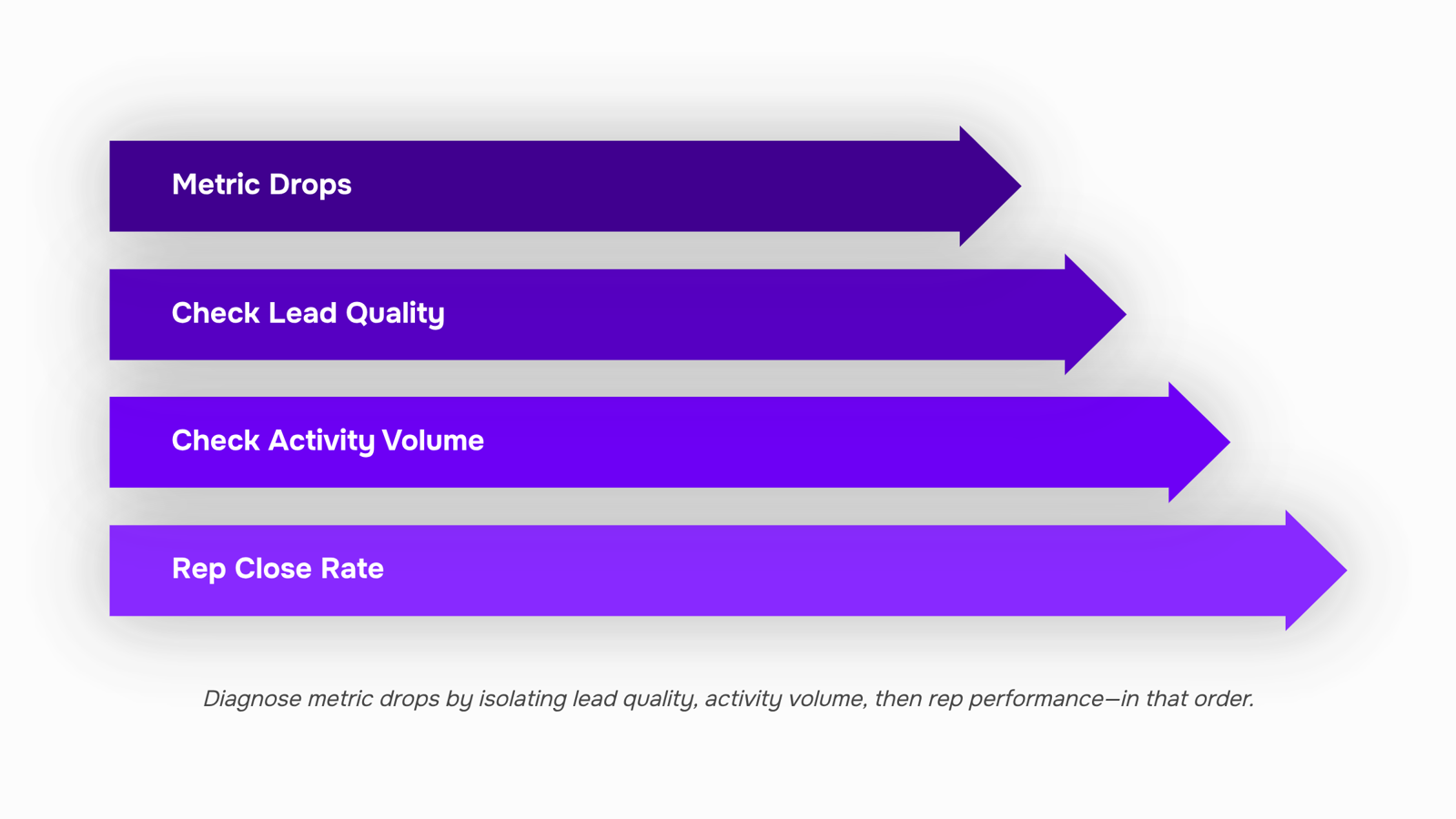
When a number drops on your dashboard, resist the urge to blame reps immediately. Instead, run a three-step diagnostic chain that isolates the actual failure point in your sales performance metrics.
Check lead quality first. A falling conversion rate often starts upstream. Compare your ICP fit score distribution this period against last. If the proportion of low-fit leads increased, the problem is sourcing, not selling. Look at how marketing KPIs feed into your sales performance picture before touching anything on the sales side.
Check activity volume. If lead quality held steady, look at outreach counts. Did reps make fewer calls, send fewer emails, or book fewer demos? A drop in sales productivity metrics like touches per opportunity often explains the gap before close rates do.
Check rep-level close rate. Only after ruling out quality and volume should you examine individual performance. Filter by rep. If one person's numbers tanked while others held, that's a coaching conversation. If everyone dipped, revisit steps one and two more carefully.
This sequence matters because most teams skip straight to step three and waste a quarter on training that addresses the wrong problem. As GreatBigStorm's diagnostic framework recommends, break the metric into its core drivers before assigning blame. Treating your sales performance metrics and KPIs as a connected chain, not isolated numbers, means you fix the right thing first.
Closing
The seven metrics above form a diagnostic chain: they expose where pipeline breaks down, from lead quality through deal execution to revenue velocity. But the framework only works if your underlying data is clean and current. Manual CRM updates introduce lag that makes leading indicators useless—you cannot steer on data from last Friday. Lio captures and scores leads the moment they arrive, so your dashboard reflects what's happening now, not what your reps remembered to log. Start by auditing which of these seven metrics you're already tracking reliably, then ask: where is manual entry creating blind spots?
FAQ
What are the most important sales performance metrics to track?
Lead-to-opportunity conversion rate, win rate, average deal cycle length, pipeline coverage ratio, ARPA, sales velocity, and follow-up response time. Each exposes a specific pipeline failure, from targeting through execution to revenue output.
What is the difference between leading and lagging sales performance metrics?
Leading metrics (calls booked, proposals sent, response time) predict future outcomes and let you intervene mid-quarter. Lagging metrics (revenue closed, win rate) confirm what already happened. Pair one of each for a complete picture.
How can I use sales performance metrics to improve sales team productivity?
Review leading metrics weekly to spot activity gaps early, and lagging metrics monthly to measure execution quality. When a metric drops, trace it upstream to the specific behavior or stage causing it, then coach or adjust territory accordingly.
Can sales performance metrics help me identify skill gaps in my sales team?
Yes, but only by comparing combinations. Two reps with similar pipeline but different win rates signals an execution gap. If one rep's leads consistently score low on ICP fit, the gap is territory or sourcing, not skill.
How often should I review and adjust my sales performance metrics?
Review leading metrics (pipeline coverage, follow-up time) weekly. Review lagging metrics (win rate, ARPA, velocity) monthly. This cadence gives you time to intervene without dashboard noise.
What should I put on a sales performance metrics dashboard?
Include at least one leading and one lagging metric per pipeline stage. Prioritize metrics you can act on within a sales cycle. Avoid vanity numbers like total leads or website visits unless they directly drive a decision your team makes tomorrow.


 Elena Petrova15 September 2026


