TL;DR: Most OKR explainers stop at the definition and move on. This one shows IT company owners exactly what OKR meaning looks like in practice: how it connects to business strategy, where it diverges from KPIs, and a five-step setup you can run with your leadership team this quarter.
What OKR stands for and means
OKR stands for Objectives and Key Results. An Objective is a clear, qualitative goal that describes where you want to go. Key Results are the two to five measurable outcomes that tell you whether you got there. Together, they form a goal-setting framework Andy Grove built at Intel in the 1970s, later brought to Google by John Doerr in 1999.
The distinction matters. An Objective sounds like "become the most reliable IT partner in our region." A Key Result sounds like "reduce average incident response time from 4 hours to 45 minutes by Q3." One sets direction; the other defines proof.
What separates OKRs from a simple to-do list is that Key Results measure outcomes, not activity. "Hold 10 client check-ins" is a task. "Increase client retention from 78% to 90%" is a Key Result. That shift forces your team to think about impact, not just effort.
OKRs also operate on a cycle, typically quarterly, which keeps goals from going stale. For IT company owners, that cadence matters: priorities shift fast, and a 90-day window is short enough to stay honest.
Understanding the okr meaning is the foundation. Once your team agrees on what objectives and key results actually are, you can use them as a translation layer between company strategy and daily work, which is exactly how OKRs, KPIs, and tasks connect in practice.
How OKRs connect to your business strategy
Think of OKRs as a translation layer. Your company sets a direction — grow into a new market, reduce churn, improve delivery speed — and OKRs convert that direction into specific targets every team can act on. Without that translation, strategy stays in the boardroom while teams execute against disconnected priorities.
OKR alignment works in two directions. Leadership sets company-level Objectives that reflect the strategy. Teams then write their own Objectives and Key Results that support those company goals. A sales team's OKR to increase qualified pipeline by 30% connects directly to a company Objective around revenue growth. That vertical link is what makes OKRs different from a general goal-setting exercise.
The horizontal connection matters just as much. When teams publish their OKRs openly, cross-functional dependencies become visible before they become blockers. An engineering team and a product team can spot conflicting priorities in week one instead of week eight.
John Doerr, who brought the framework from Intel to Google in 1999, described OKRs as a tool for making sure "the right things get done." The emphasis is on right, not just done. That distinction is the whole point of connecting OKRs to strategy rather than treating them as a productivity checklist.
For a practical look at how OKRs, KPIs, and tasks connect in practice, the relationship between these layers becomes clearer once you see them mapped side by side.
Objectives and key results only hold strategic weight when the chain from company goal to team metric is explicit and visible.
Why OKRs improve focus and alignment on your team
OKR alignment does one thing most goal-setting methods skip: it makes the connection between company strategy and individual work visible to everyone on the team, not just leadership.
Here are four concrete outcomes teams see after adopting the OKR framework:
Clarity on what matters. Each objective forces a choice. When a team commits to three objectives per quarter, they're also deciding what they won't chase. That trade-off is where focus actually comes from.
Faster decision-making. When priorities are written down and shared, teams stop waiting for manager approval on every small call. The OKR goal setting process gives people a reference point they can use independently.
Cross-team alignment. Departmental OKRs that ladder up to company objectives expose conflicts early, before they become missed deadlines. A product team and a sales team working from the same parent objective will surface their dependencies in week one, not week eight.
Built-in accountability. Key results are measurable by design. At the end of a quarter, a score of 0.4 out of 1.0 is a fact, not an opinion. That removes the ambiguity that makes performance conversations uncomfortable.
How OKRs, KPIs, and tasks connect in practice goes deeper on the accountability layer, specifically how key results differ from the KPIs most IT teams already track.
If you want to see which tools surface these signals automatically, OKR tracking software that connects goals to daily work covers the practical options.
Set up OKRs in 5 steps
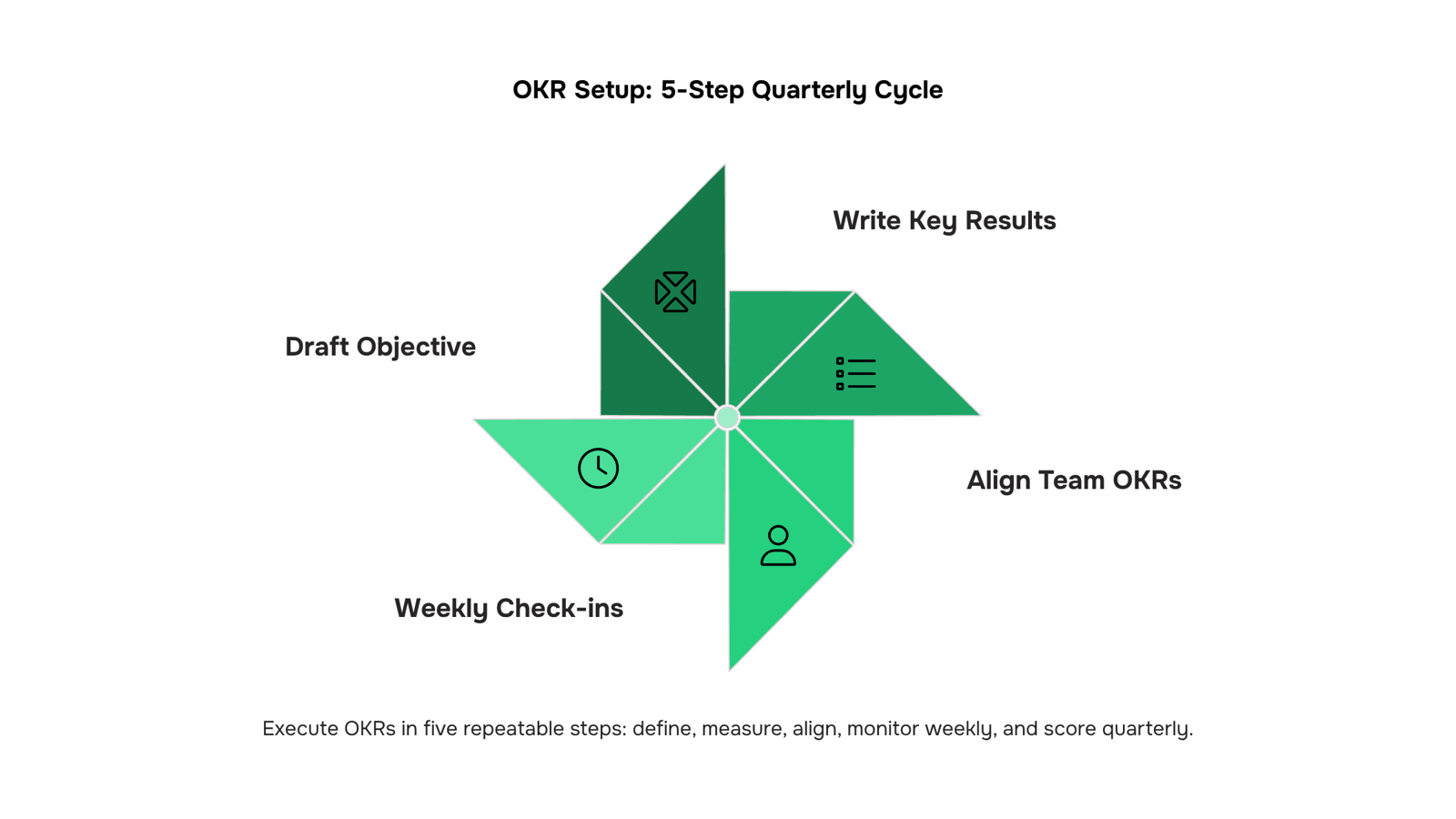
The OKR framework runs on a five-step cycle. Run it once and you have a repeatable rhythm you can use every quarter.
Draft one clear objective: Write a qualitative statement that describes where you want to go, not how you'll get there. "Become the most reliable IT partner for mid-market clients in our region" works. "Improve service delivery" does not. The objective should be ambitious enough that hitting 70% of it still counts as progress.
Write 2 to 4 key results per objective: Key results are the measurable outcomes that tell you whether you reached the objective. Each one needs a number: a baseline, a target, and a deadline. "Reduce average ticket resolution time from 48 hours to 24 hours by end of Q3" is a key result. "Improve response time" is not. Limit yourself to four per objective or you'll dilute focus.
Align OKRs across the team: Once leadership sets company-level objectives and key results, team leads draft their own OKRs that connect upward. This is where OKR goal setting pays off: a developer's key result should trace back to a product objective, which traces back to a revenue objective. If a team OKR doesn't connect to anything above it, cut it. For a deeper look at how OKRs, KPIs, and tasks connect in practice, that alignment logic is worth understanding before you cascade.
Run a weekly check-in, not a monthly review: Most teams set OKRs and revisit them at the end of the quarter. By then, it's too late to course-correct. A 15-minute weekly check-in per team, where each person rates their key results on a 0 to 1 confidence scale, surfaces blockers early. If a key result drops below 0.3 confidence in week four, you still have time to act.
Score and learn at the end of the quarter: Score each key result from 0 to 1. Google's original guidance, carried forward from Andy Grove's work at Intel, treats 0.6 to 0.7 as the target zone. Consistently hitting 1.0 means your targets were too easy. Consistently hitting below 0.4 means something structural is broken, not just execution. Hold a 30-minute retrospective: what did you learn, what changes next quarter, what carries forward?
If you want a tool that maps this cycle to daily work rather than a separate spreadsheet, OKR tracking software that connects goals to daily work is worth a look before you start Q1.
OKRs vs KPIs: what the difference means for your team
The confusion between OKRs and KPIs is real, and it slows teams down. Both involve numbers. Both track performance. But they answer different questions, and mixing them up produces goals that look measurable but drive no real change.
Here's how they compare across four dimensions:
Dimension | OKRs | KPIs |
|---|
What it measures | Progress toward a new outcome | Health of an existing process |
Cadence | Quarterly (sometimes annual) | Ongoing, often monthly or weekly |
Ownership | Team or individual driving change | Function or role maintaining a standard |
Action it drives | Stretch, experiment, shift direction | Monitor, maintain, alert on deviation |
A KPI tells you whether your support team is hitting a 4-hour response time. An OKR asks: what would it take to cut resolution time in half this quarter? Same domain, different purpose.
The practical rule: KPIs guard the floor; OKRs raise the ceiling. You need both. A team running only KPIs optimizes what already exists. A team running only OKRs can hit every objective while a core metric quietly degrades.
For IT company owners, the OKR meaning becomes clearest when you map each objective to at least one KPI it should move. That connection is what turns the OKR framework into a system rather than a planning ritual. How to Connect OKRs, KPIs, and Tasks: A Practical Guide for 2026 covers that wiring in detail.
Using OKRs alongside other goal-setting frameworks
OKRs don't replace frameworks you already use — they layer on top of them differently depending on what each framework does.
SMART goals define a single target with precision. OKR goal setting adds ambition and a measurable path: the Objective sets direction, the Key Results confirm you got there. Use SMART criteria to write tighter Key Results, not as a substitute for the OKR framework itself.
Balanced Scorecard tracks performance across four perspectives — financial, customer, internal process, learning. OKRs sit inside that structure as the quarterly execution layer, translating strategic priorities into time-bound outcomes.
The practical rule: if your current framework answers "where are we going strategically," OKRs answer "what does the team ship this quarter to get there." They're complementary, not competing.
For how OKRs, KPIs, and tasks connect in practice, that distinction becomes especially clear at the execution level.
OKR alignment breaks down when objectives live in a slide deck and tasks live somewhere else entirely. Your team ends up checking two systems, and the connection between daily work and quarterly goals disappears within weeks.
The fix is straightforward: track your objectives and key results inside the same tool where work gets assigned and completed. When a key result updates automatically as tasks close, progress is visible without anyone chasing status in a meeting.
Taro connects goal tracking to task execution directly. Each key result links to the tasks driving it, so ownership is clear and slippage shows up early, not at the end of the quarter.
If you're still choosing a platform, the best OKR tracking software for teams breaks down what to look for before you commit.
Closing
OKRs work because they force a choice: what matters most, and how will you know you got there. That clarity cascades from strategy to execution, turning boardroom priorities into team-level metrics in a way most goal-setting methods skip. The five-step cycle keeps the framework honest—weekly check-ins catch drift early, quarterly scoring removes ambiguity, and the next cycle builds on what you learned. If your team is ready to move beyond spreadsheets and connect OKRs to the daily work that drives them, Taro keeps objectives, key results, and the tasks that power them in one place so nothing falls through the cracks between planning and execution. Start with step one this week: draft one clear objective for your next quarter and share it with your leadership team.
FAQ
What does OKR stand for and what does it mean?
OKR stands for Objectives and Key Results. An Objective is a qualitative goal describing where you want to go; Key Results are two to five measurable outcomes proving you got there. Together, they form a framework Andy Grove built at Intel in the 1970s.
How do OKRs relate to overall business strategy?
OKRs translate strategy into action. Leadership sets company-level Objectives reflecting strategy; teams write OKRs supporting those goals. This vertical link ensures the right priorities cascade from boardroom to execution.
What is the difference between OKRs and KPIs?
OKRs are aspirational targets set quarterly and scored at the end; KPIs are ongoing health metrics tracked continuously. OKRs drive change; KPIs monitor baseline performance. Both matter, but they answer different questions.
Can OKRs be used in conjunction with other goal-setting frameworks?
Yes. OKRs work alongside KPIs, tasks, and initiatives. The key is clarity: OKRs set the what and why, KPIs track ongoing health, and tasks define the daily work. Mixing frameworks without that clarity creates confusion.
How do OKRs support alignment and focus within an organization?
OKRs force trade-offs—committing to three objectives means deciding what you won't chase. Publishing OKRs openly exposes cross-team dependencies early and gives teams a reference point for independent decision-making.
How many OKRs should a team set per quarter?
Aim for one to three Objectives per team, with two to four Key Results per Objective. This limit forces focus. Too many OKRs dilute priorities; too few leave strategy gaps.


 Elena Petrova15 September 2026


