What is a punchlist in construction project management
TL;DR: Most punchlist articles define the term and stop there. This one gives construction project managers a repeatable six-step process to build, assign, and close a punchlist before handover, including the specific triggers, ownership rules, and sign-off criteria that prevent items from stalling. You'll also get a direct comparison to the snag list so the two terms stop causing confusion on cross-border projects.
What a punchlist is in plain terms
A punchlist (sometimes called a snag list in the UK and Australia) is a formal document created near the end of a construction project that records every item of work that is incomplete, defective, or not built to specification. It is generated after a project reaches substantial completion, the point defined in AIA contract documents where the owner can occupy and use the space for its intended purpose, even though minor work remains.
Think of it as the final quality control gate before ownership transfers. The general contractor, owner, and architect walk the site together, note every unresolved issue, assign responsibility, and set a deadline for resolution. Nothing on the list is optional: outstanding punchlist items typically delay final payment and certificate of occupancy.
A construction punchlist is not a general to-do list. It is a contractually significant record. Getting it right matters the same way a project management checklist that prevents tasks from slipping through matters at any other phase: without one, accountability disappears and disputes follow.
Why a punchlist matters for project closeout
A punchlist turns the messy final stretch of a project into a documented, defensible process. Without one, "we're done" is a conversation. With one, it's a contract.
Four outcomes make the business case:
Accountability by name. Each item is assigned to a specific subcontractor or crew, so there's no ambiguity about who fixes the cracked tile or the misaligned door frame. A quality control punchlist removes the "I thought they were handling it" problem entirely.
Faster owner sign-off. Owners and architects can walk the site against a numbered list rather than relying on memory. That structured review compresses the gap between substantial completion and final payment.
Fewer defect disputes. When defects are logged before handoff, with dates and photos, neither side can credibly argue about what was present at closeout. The list is the record.
A cleaner project closeout checklist. A completed punchlist feeds directly into your closeout package: warranties, as-builts, and O&M manuals. Nothing gets submitted until the list clears.
The same discipline that makes a punchlist work applies to project management checklists that prevent tasks from slipping through at any stage. And if your team needs a phase gate review before final project sign-off, the punchlist is the natural trigger for that gate.
Key items every punchlist should include
A thorough construction punchlist covers more ground than most teams expect. Grouping punchlist items by category keeps the walkthrough systematic and makes it harder to miss something that surfaces as a dispute later.
Structural and finish work Walls, ceilings, floors, and trim. Check for cracks, incomplete paint, misaligned tiles, or gaps in flooring. These are the most visible defects and the first thing an owner notices at handoff.
Mechanical, electrical, and plumbing (MEP) Confirm fixtures operate correctly, outlets are live, HVAC units cycle as specified, and plumbing has no leaks. MEP failures are the most common source of defect disputes at closeout.
Doors, windows, and hardware Every door should latch, lock, and swing without binding. Windows seal properly. Hardware matches the spec sheet.
Site and exterior Grading, landscaping, parking surfaces, and exterior lighting. Incomplete site work frequently delays the certificate of occupancy.
Safety and code compliance Fire suppression, exit signage, handrail heights, and ADA clearances. These items block occupancy permits if missed.
Punch items from prior inspections Any deficiency flagged in earlier phase gate reviews before final sign-off that was deferred belongs here explicitly, not assumed resolved.
Documentation As-builts, warranties, O&M manuals, and attic stock. Missing documentation is one of the most overlooked categories on a quality control punchlist, and it routinely delays final payment.
A project management checklist that prevents tasks from slipping through uses the same category logic: named owners, clear criteria, no ambiguous items.
How to build a punchlist in 6 steps
Building a quality control punchlist from scratch is where most project managers lose time — not because the work is hard, but because there's no agreed-upon process. Here are six steps that take you from first site visit to final sign-off.
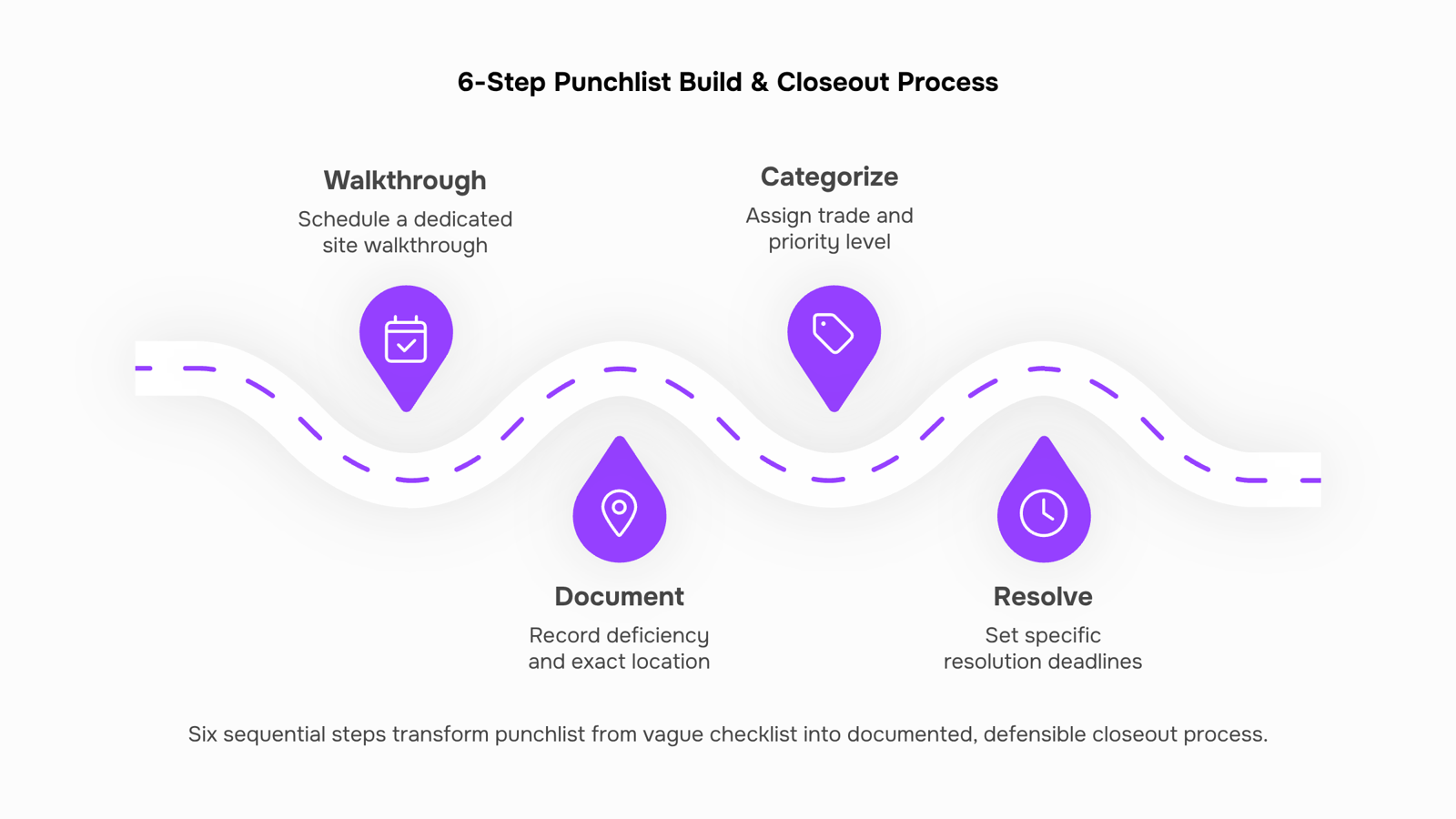
Schedule a dedicated walkthrough before substantial completion. Walk the site with your superintendent, the owner's representative, and the architect present at the same time. One joint walkthrough catches more than three separate ones and eliminates the "I didn't see that" disputes later. Bring a floor plan you can annotate on-site.
Document every deficiency with location, photo, and responsible party. For each item you find, note the room or grid reference, attach a photo, and assign it to a specific subcontractor — not just a trade category. "Painter" creates ambiguity; "Martinez Painting, Unit 4B ceiling" does not. This is the difference between a list that gets actioned and one that sits in someone's inbox.
Categorize items by trade and priority. Group items so each subcontractor receives only their work. Then flag anything that blocks occupancy or safety as high priority — those go first. A project management checklist that prevents tasks from slipping through uses the same logic: ownership plus priority is what converts a list into completed work.
Set a resolution deadline for each item. Vague deadlines produce vague results. Assign a specific date to every line item, not a blanket "two weeks." For items that depend on material delivery or re-inspection, note that dependency explicitly so no one is waiting without knowing why. Use your phase gate review before final project sign-off as the hard backstop date.
Distribute and confirm receipt. Send each subcontractor their portion of the list in writing and get acknowledgment back. A verbal handoff is not a handoff. If you're managing a 40-unit residential building, that might mean 12 separate distribution emails with read receipts or a shared field management platform where subs confirm acceptance.
Conduct a re-inspection and close each item formally. Once a subcontractor reports an item complete, verify it on-site before marking it closed. The project closeout checklist isn't done until every item has a verified close date, not just a "completed" status from the sub. If you need to prioritize which punchlist items to resolve first during a compressed closeout window, tackle anything tied to certificate of occupancy before cosmetic finishes.
A concrete example: on a 20,000 sq ft commercial fit-out, a typical punchlist walkthrough surfaces 80 to 150 items across five to eight trades. Running steps 3 through 6 in a shared tracking tool rather than a spreadsheet cuts average resolution time because every sub sees their open items in real time, not after a weekly email.
Punchlist vs. snag list: what is the difference
The terms mean the same thing in practice. The difference is geography and contract tradition.
Punchlist is the standard term in North American construction. It appears in AIA contract documents, ties directly to the substantial completion milestone, and triggers the final payment process once all items are resolved.
Snag list is the equivalent in the UK, Ireland, Australia, and most Commonwealth markets. Same concept: a documented list of defects, incomplete work, and items that don't meet spec, compiled before the owner accepts the building.
When comparing snag list vs punchlist across four dimensions, the distinction is mostly cosmetic:
Dimension | Punchlist | Snag list |
|---|
Origin | North American construction practice | UK/Commonwealth construction practice |
Usage region | US, Canada | UK, Ireland, Australia, New Zealand |
Scope | Defects, incomplete work, spec deviations at closeout | Identical scope, same closeout function |
Sign-off process | Owner accepts after contractor resolves items | Same process, different contract language |
The underlying workflow is identical. Both require a site walkthrough, documented items with owners and deadlines, and a re-inspection before final acceptance. A phase gate review before final project sign-off applies equally to both.
If your project spans international teams or contracts, agree on one term at kickoff. The label doesn't matter. The process does.
Common punchlist mistakes that delay project sign-off
Four mistakes show up on nearly every delayed closeout, and each one is preventable.
Vague item descriptions. "Fix door" tells no one what's actually wrong. Write "re-hang master bedroom door, which drags on threshold and won't latch." A specific quality control punchlist item gets fixed on the first visit; a vague one generates three clarification calls and a second site trip.
No assigned owner. If a punchlist item has no name attached, it belongs to everyone, which means no one moves on it. Assign one person per item before the list leaves the site walk.
No deadline. An open-ended item stays open. Set a completion date for every line, and flag anything past seven days for escalation. Unclear ownership and missing deadlines are two of the eight elements that consistently cause task failure across project types.
Skipping re-inspection. Marking an item closed without a physical sign-off is how defect disputes start. Build a formal re-inspection step into each closeout stage so substantial completion is documented, not assumed.
A spreadsheet punchlist works until two people edit the same row at the same time. After that, you have conflicting versions, missed updates, and a closeout meeting where nobody agrees on what is actually done. Moving your construction punchlist into a task-based tool fixes that by giving every item a single owner, a hard due date, and a live status anyone on the team can see.
Start by converting each defect into a discrete task. One item, one owner, one due date. Attach the inspection photo directly to the task so the assignee sees exactly what needs fixing without hunting through an email thread. This removes the single biggest source of punchlist confusion: items that are "assigned" to a trade in a spreadsheet column but have no clear deadline and no one person accountable.
Why most tools fall short
Most generic project tools were not built for construction closeout. They handle tasks well enough, but they do not understand the dependencies that make a punchlist different from a regular to-do list. An item on a punchlist is not done when someone marks it complete. It is done when a re-inspection confirms the fix, the photo is logged, and the milestone gate clears.
Tools like Trello or Monday.com can track tasks, but they require manual configuration to enforce re-inspection steps, and they do not connect closeout progress to billing or certificate milestones out of the box. You end up building workarounds, which is the same problem you had with the spreadsheet, just with a better interface.
How Taro manages your punchlist
Taro is a task and milestone tracking agent inside WorksBuddy, and it is built for exactly this kind of structured closeout work. It turns your punchlist into a managed workflow rather than a static document.
Here is what Taro does that generic tools do not:
Each punchlist item becomes a tracked task with an assigned owner, a due date, and an attached photo or note from the site inspection.
Taro flags overdue items automatically, so you are not manually chasing subcontractors two days before the owner walkthrough.
Re-inspection is logged as a dependent step inside the same task. An item cannot move to "closed" until the follow-up check is recorded, which prevents the most common closeout mistake: signing off on work that was never verified.
Milestone gates tie punchlist progress to project closeout phases, so your team cannot advance to final sign-off while open items remain unresolved.
Taro connects with other WorksBuddy agents. If a billing milestone in Inzo depends on closeout completion, that dependency is visible and tracked in one place, not split across two separate tools.
That last point matters more than it might seem. Construction closeout is not just a quality problem. It is a cash flow problem. Delayed sign-off means delayed invoicing, and delayed invoicing means your team absorbs the cost of a project that is functionally complete. Taro closes that gap by making closeout progress and billing milestones part of the same connected system.
What your day looks like once Taro is running
You open the project dashboard in the morning and see exactly how many punchlist items are open, which ones are overdue, and who owns each one. You are not sending status-check emails. You are not rebuilding a spreadsheet after someone overwrites a row. You run your phase gate review with a live list that already reflects what has been inspected and what has not.
Before the closeout sprint begins, set priorities directly inside Taro when you create each task. A simple triage works well here:
Items that block the certificate of occupancy go first.
Items that affect safety go second.
Cosmetic items go last.
Setting that order inside the task means the assignee knows the sequence without a separate conversation. No briefing call, no follow-up message, no ambiguity about what to tackle today.
The dependent step structure in Taro also enforces the one rule that most closeout processes skip under deadline pressure: nothing closes without a re-inspection log. The task stays open until the re-inspection step is completed. That single guardrail is worth more than any checklist you could hand a subcontractor, because it is built into the workflow rather than relying on someone remembering to follow a process.
Closing
A punchlist transforms the final stretch of a construction project from a vague, dispute-prone scramble into a documented, defensible process. The six-step framework gives you a repeatable way to build, assign, and close items before handover, but only if every item has a named owner, a deadline, and a verification step. The difference between projects that close on time and those that don't often comes down to whether the punchlist is treated as a contractual record or a casual checklist. If your team is managing punchlist items across spreadsheets or email threads right now, you're losing visibility and creating bottlenecks. The next step is to move punchlist tracking into a system where ownership, due dates, and real-time status are visible to everyone at once. That's where Taro comes in: it lets you assign punchlist items to specific trades, set dependencies and deadlines, and see which items are blocking final sign-off before they delay your closeout. Ready to see how it works?
FAQ
What are the key items to include in a construction punchlist?
Include structural and finish work, MEP systems, doors and hardware, site and exterior work, safety and code compliance, prior inspection deficiencies, and documentation. Missing any category routinely delays certificate of occupancy or final payment.
How can I use a punchlist to ensure quality control in my project?
Conduct a joint walkthrough with the owner, architect, and superintendent before substantial completion. Document every deficiency with location, photo, and responsible party, then assign specific deadlines and verify completion on-site before closing each item.
What is the difference between a punchlist and a snag list?
They are the same document; punchlist is the US term and snag list is used in the UK and Australia. Both record incomplete or defective work near project end and trigger final payment and occupancy approval.
Who is responsible for completing punchlist items?
Each item is assigned to a specific subcontractor or crew responsible for that trade. The general contractor verifies completion on-site before marking items closed and releasing final payment.
When should a punchlist be created during a project?
Create a punchlist after the project reaches substantial completion, the point where the owner can occupy and use the space for its intended purpose. This is the formal quality control gate before handover and final payment.


 Elena Petrova15 September 2026


