TL;DR: Most PI planning content describes the agenda and stops there. This one explains what actually happens inside each phase, what outputs determine whether the event worked, and which preparation failures cause the whole thing to collapse before day one ends. IT company owners running scaled Agile teams will leave with a clearer picture of what good PI planning produces and what bad PI planning costs.
What is agile PI planning?
Agile PI planning (Program Increment planning) is a structured, time-boxed event where every team on an Agile Release Train (ART) aligns on what they will build over the next 8 to 12 weeks. It sits at the heart of the Scaled Agile Framework, serving as the single moment when business priorities, technical capacity, and cross-team dependencies get resolved in one room, not across a chain of disconnected meetings.
A program increment is typically a fixed planning window covering four development sprints plus one innovation and planning sprint. PI planning in SAFe produces three concrete outputs: team PI objectives (what each team commits to), a program board (a visual map of cross-team dependencies and milestones), and a risk register (impediments flagged and owned before work starts). These outputs are what separate a well-run PI from a quarterly kickoff that generates slide decks instead of commitments.
If your teams regularly discover mid-sprint that another team's work blocks theirs, that is a symptom of skipped or shallow program increment planning. The event exists precisely to surface those conflicts at the planning table, not after the sprint has started. Once the PI closes, tracking sprint commitments against team PI objectives keeps the plan from drifting into noise.
How does PI planning work?
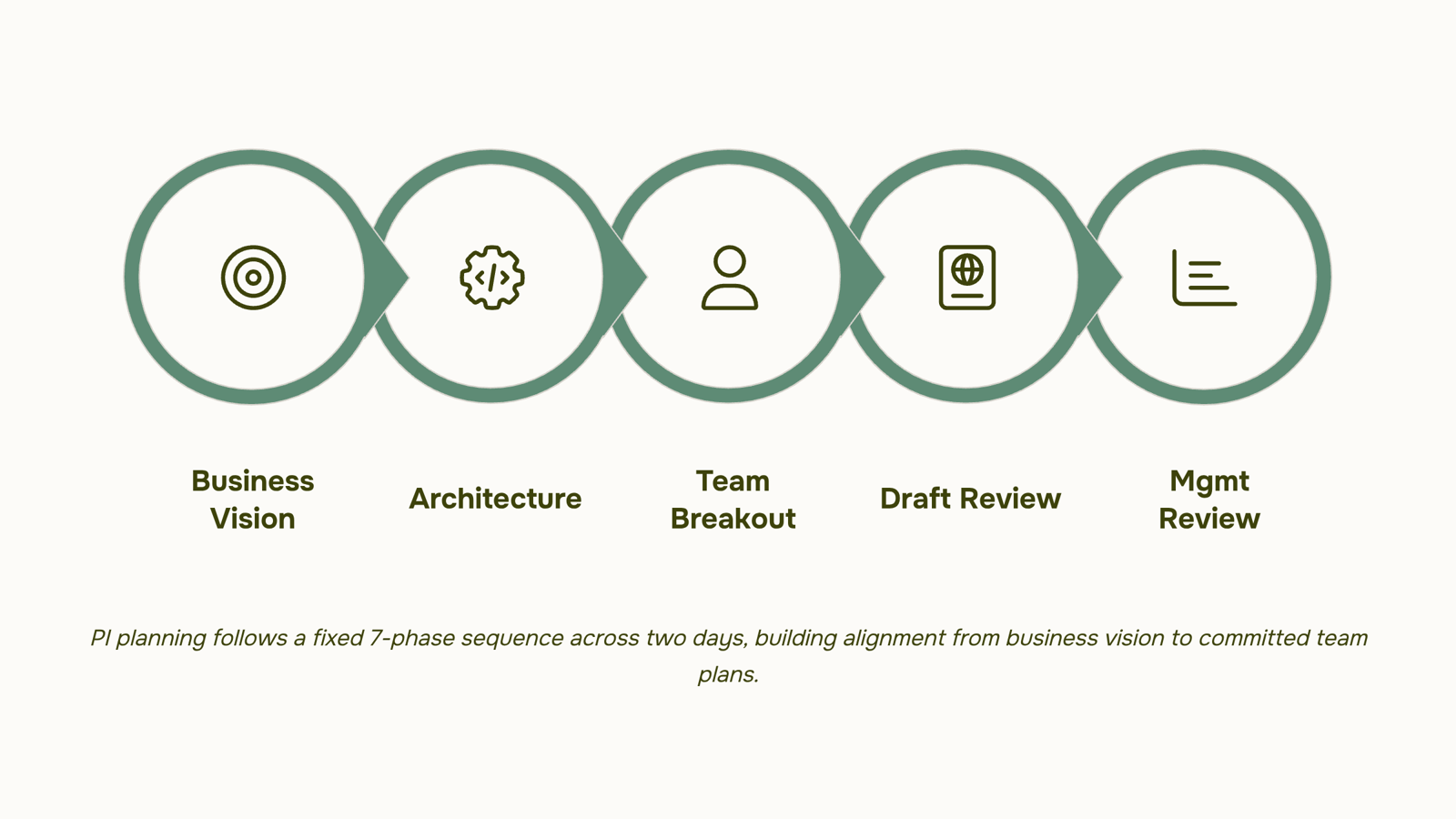
A PI planning event runs across two days and follows a fixed sequence. The structure is intentional: each phase builds on the previous one so that by the end, every team on the agile release train has committed to the same set of goals.
Business context and vision: Senior leaders open with the current portfolio state and product vision. Teams hear what the business needs before they plan anything.
Architecture and development practices briefing: The chief architect walks through technical constraints, shared components, and any platform changes that affect the upcoming program increment. This prevents teams from planning work that conflicts at the integration layer.
Team breakout sessions (iteration 1): Each team drafts its iteration plans for the PI, identifies dependencies, and flags risks. This is where program increment planning shifts from theory to actual sprint-level commitments.
Draft plan review: Teams present their draft objectives to the full group. Cross-team dependencies surface here, often for the first time.
Management review and problem-solving: Scope, capacity, and dependency conflicts get resolved. Leaders adjust priorities rather than leaving teams to absorb impossible loads silently.
Team breakout sessions (iteration 2): Teams revise plans based on the management review and finalize their PI objectives.
Final plan review and confidence vote: Each team presents its committed objectives. The group votes on overall confidence. A low vote triggers immediate re-planning rather than a quiet failure six weeks later.
For a deeper look at the purpose of PI planning inside SAFe, the sequencing above maps directly to how SAFe defines a healthy planning cadence. Once the event closes, track sprint commitments and team PI objectives so nothing slips between planning and delivery.
What PI planning produces: the four key outputs
When agile PI planning ends, four things should exist that didn't before the event started.
Team PI objectives are written commitments from each team: what they'll deliver in the coming program increment, with a business value score attached. Vague intent doesn't count here. If a team can't assign a number, the objective isn't ready.
The program board maps dependencies across teams on a shared visual. It shows which team needs what from whom, and when. Any cross-team dependency that isn't on the board is a risk hiding in plain sight.
The risk register captures every ROAM item (Resolved, Owned, Accepted, or Mitigated) surfaced during planning. PI planning in SAFe treats this as a required output, not an optional artifact. Risks that go unclassified before the increment starts tend to resurface as blockers mid-sprint.
The confidence vote is the final gut-check. Each team votes on whether the plan is executable. A fist-of-five below three signals the plan needs adjustment before anyone leaves the room.
These four outputs are what separate a productive program increment planning event from a two-day meeting. Once they exist, track sprint commitments and team PI objectives after the event so nothing falls through between planning and delivery.
How to prepare for a PI planning event
Good PI planning preparation separates events that produce real commitments from ones that produce a wall of sticky notes nobody acts on. Most teams underinvest here, then blame the format when the program board falls apart by week three.
Work through these five steps before your agile release train walks into the room:
Align leadership on vision: The Release Train Engineer and product management need a shared program vision and top features ready at least two weeks out. If product is still negotiating priorities the morning of, teams cannot plan.
Prepare the architectural runway: Architects should identify enablers that teams will need in the upcoming program increment. Surprises here create dependencies that derail capacity planning.
Distribute pre-reading: Share the vision, roadmap, and any relevant metrics with all teams 48 to 72 hours before the event. Teams that arrive informed cut the first morning's ramp-up time by roughly half.
Confirm logistics and tooling: Book rooms, set up the digital program board, and test video conferencing if teams are distributed. One broken screen share derails a 50-person session fast.
Define the planning timebox: Set the agenda, assign facilitators per team breakout, and publish it. Ambiguity about who runs which session is the most avoidable failure in PI planning preparation.
For a deeper look at the terminology behind these steps, what PI planning stands for in Agile is a useful primer before your first event.
Benefits of PI planning for agile teams
Done well, program increment planning produces outcomes that show up in delivery metrics, not just retrospective notes.
Cross-team alignment: Every agile release train leaves the event with shared objectives and a visible program board. Teams stop discovering conflicts in sprint three because they surfaced them in the planning room.
Dependency reduction: Mapping dependencies across 5 to 12 teams during the event catches blockers before they become delays. PI planning in SAFe treats this as a primary output, not a side effect.
Faster delivery cadence: Committed team PI objectives create a 10 to 12 week delivery contract. Fewer mid-increment surprises mean fewer replanning cycles.
Realistic capacity planning: Teams set stretch goals separately from committed objectives, so leadership gets an honest forecast instead of sandbagged estimates.
Improved risk visibility: ROAM (Resolved, Owned, Accepted, Mitigated) exercises surface program-level risks before the increment starts.
After the event, track sprint commitments and team PI objectives in one place so progress stays visible between PI boundaries.
Common challenges during PI planning and how to avoid them
Four failure modes show up repeatedly across agile PI planning events, and each one is preventable with the right preparation.
Underprepared product owners arrive without ranked, estimated features. Teams spend the first half of day one asking clarifying questions instead of planning. Fix this during PI planning preparation: product owners should finalize the top 10 features and acceptance criteria at least one week before the event.
Missing architecture input means teams design solutions that conflict at the integration layer. Bring system architects into pre-PI sync calls, not just the event itself.
Dependency conflicts surfaced too late turn the program board into a negotiation session on day two. Teams should map cross-team dependencies in draft form before the PI planning event starts.
Shallow confidence votes hide real risk. A team voting 3 out of 5 is signaling a problem. Facilitate a brief round-robin so every team names its biggest blocker before the vote closes.
Prioritizing work after the PI planning event gets easier when these four issues are resolved before the room fills up.
The biggest shift in 2026 isn't that AI tools generate PI plans — it's that they handle the tedious work that happens after the two-day event ends.
During a program increment planning cycle, teams leave with a program board full of dependencies and a backlog that still needs sprint-level assignment. Manually mapping those dependencies across 8 to 12 agile release train teams takes days. AI-assisted tools now flag cross-team conflicts automatically, surface items with no clear owner, and suggest sprint assignments based on team capacity data from previous increments.
Where this matters most is post-PI execution. Confidence votes surface intent; sprint tracking reveals reality. When commitments start slipping in week two, most teams find out in week four.
Taro's built-in AI monitors sprint commitments against team PI objectives in real time, flagging drift before it compounds. You can track sprint commitments and team PI objectives after the event without waiting for a retrospective to surface what went wrong.
Closing
PI planning only works if the commitments it produces—team PI objectives, the program board, the risk register—actually guide the work that follows. Too many teams treat the event as a box to check, then let sprint execution drift away from what the room agreed to. The real value emerges when you track those commitments with the same discipline the planning event required. That's where most scaled Agile teams stumble: the plan is solid, but nothing connects it to daily sprint work. Taro bridges that gap by pulling your team PI objectives and dependencies directly into sprint execution, so nothing slips between the program board and delivery. Start tracking your next PI's commitments from day one.
FAQ
What is PI planning in SAFe?
PI planning is a two-day, time-boxed event where every team on an Agile Release Train aligns on what they'll build over the next 8–12 weeks. It produces three concrete outputs: team PI objectives, a program board mapping cross-team dependencies, and a risk register—turning quarterly planning into executable commitments instead of slide decks.
How do you prepare for a PI planning event?
Align leadership on vision two weeks prior, prepare the architectural runway, distribute pre-reading 48–72 hours out, confirm logistics and tooling, and define the planning timebox with assigned facilitators. Skipping these steps is the most avoidable failure in PI planning preparation.
What are the benefits of PI planning for agile teams?
Teams achieve cross-team alignment, surface dependencies before they become blockers, reduce mid-increment surprises, and lock in a 10–12 week delivery contract. The result: fewer replanning cycles and faster delivery cadence across the Agile Release Train.
How do you facilitate a successful PI planning session?
Follow the fixed sequence: business context, architecture briefing, team breakouts (iteration 1), draft review, management problem-solving, team revisions (iteration 2), and final confidence vote. A fist-of-five vote below three signals the plan needs adjustment before anyone leaves the room.
What are the most common challenges during PI planning?
Unprepared leadership vision, architectural surprises, teams arriving uninformed, logistical failures, and undefined timebox ownership. The biggest: letting commitments drift after the event ends instead of tracking them through sprint execution.
How long does a PI planning event typically take?
A PI planning event runs across two full days. The fixed sequence—business context, architecture briefing, two team breakout iterations, reviews, and confidence vote—is designed to surface and resolve all cross-team dependencies before work starts.


 Elena Petrova15 September 2026


