TL;DR: Most MRM content is written for enterprise marketing teams with dedicated ops staff. This piece explains what marketing resource management actually involves, why it matters when your team is small and your budget is fixed, and how to apply its core principles using project management tools you likely already have.
What is marketing resource management
Marketing resource management (MRM) is the discipline of planning, allocating, and tracking a marketing team's time, budget, and creative assets in one coordinated system.
Without it, budget approvals live in email threads, creative files scatter across shared drives, and no one has a clear view of who is working on what. For a 10-50 person team, that coordination gap is where campaigns slow down and budget gets wasted. According to Gartner's CMO Spend Survey, roughly 26% of marketing budgets are lost to poor planning and misaligned execution.
MRM technology brings those moving parts together. A typical platform connects workload and budget dashboards with full task management with statuses, priorities, and dependencies, so managers can see capacity and spend in the same view. Some platforms add AI-powered task prioritization to surface which work needs attention first.
MRM is often confused with project management, but the distinction matters. Project management tracks whether tasks are done. MRM tracks whether the right resources are being used on the right work, at the right cost, to produce the right output. A content team running a product launch needs both: task tracking to execute, and resource visibility to avoid burning budget on low-priority deliverables before the campaign even goes live.
How does marketing resource management work
MRM operates as a repeating five-step cycle. Each step feeds the next, which is why breaking the chain at any point tends to produce the budget waste and missed deadlines that plague under-resourced marketing teams.
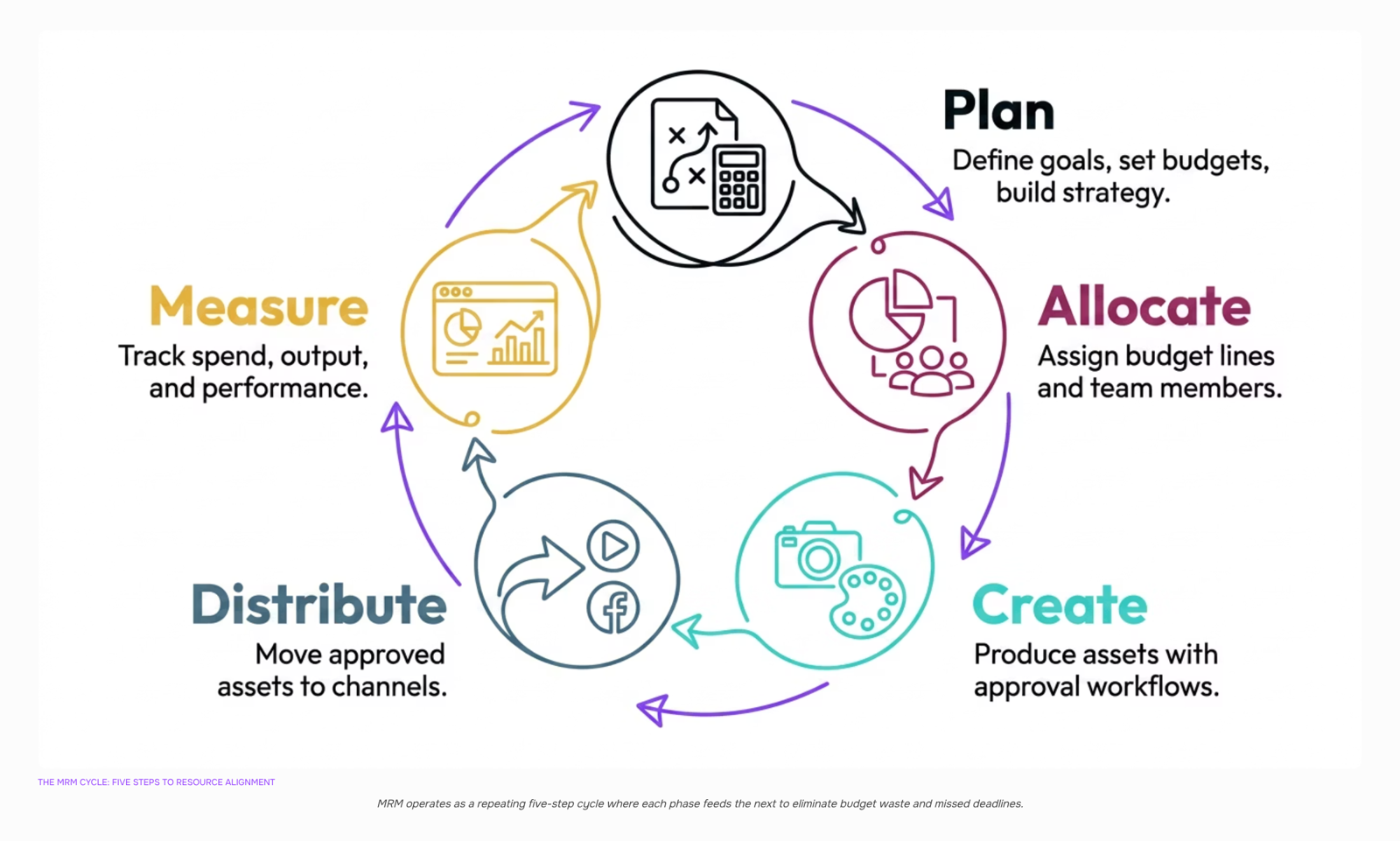
Plan. The cycle starts with campaign planning: defining goals, setting budgets, and building a project calendar. For a 10-50 person service company, this is where a marketing resource management service for service companies earns its keep — turning a scattered mix of spreadsheets and email threads into a single source of truth for what's happening and when.
Allocate. Once the plan exists, resources get assigned. That means budget lines, team members, and time. AI-powered task prioritization can flag when a team member is over-capacity before a deadline slips, not after.
Create. Assets get produced — copy, graphics, video, templates. MRM keeps these tied to the campaign brief and the approval workflow, so nothing ships without sign-off and nothing gets lost in a shared drive folder no one maintains.
Distribute. Approved assets move to the right channels on the right dates. The planning calendar controls sequencing; full task management with statuses, priorities, and dependencies keeps each step visible to the whole team.
Measure. Spend, output, and performance data feed back into the next planning cycle. Workload and budget dashboards make this review fast — you can see what was budgeted versus spent and where team capacity was under- or over-used.
The cycle then repeats. Each iteration should produce tighter estimates and fewer surprises than the last.
1. Budget Management
Budget management in an MRM platform centralizes marketing spend tracking, allocation, and forecasting in one place. Instead of maintaining separate spreadsheets per campaign, teams see total budget, committed spend, and remaining funds in real time. According to Gartner's CMO Spend Survey, roughly 26% of marketing budgets are wasted due to poor coordination — budget management tools address that directly.
2. Digital Asset Management
Digital asset management (DAM) is the centralized storage, tagging, and retrieval of brand files: logos, images, copy templates, and video. Without it, marketers spend an average of 3-4 hours per week searching for approved assets, according to Bynder's DAM industry benchmarks. A built-in DAM eliminates version confusion and keeps brand-approved files a single search away.
3. Workflow Automation
Workflow automation routes tasks, approvals, and notifications through predefined rules so nothing stalls waiting for a manual handoff. For marketing resource management technology serving 10-50 person teams, this is where the most time is recovered. Platforms that support full task management with statuses, priorities, and dependencies handle the sequencing that would otherwise live in someone's inbox.
4. Campaign Calendar and Planning
A campaign calendar gives every stakeholder a shared view of what launches when, who owns it, and what depends on what. This is especially useful for marketing resource management studio for consultants managing multiple client timelines simultaneously. AI-powered task prioritization can surface scheduling conflicts before they become delays.
5. Analytics and Reporting
Analytics in an MRM platform measure campaign performance, resource utilization, and budget efficiency in one dashboard. Workload and budget dashboards let team leads see where capacity is over-committed before a deadline slips, not after.
Benefits of implementing marketing resource management
Implementing MRM produces measurable gains across five dimensions that matter to 10-50 person teams as much as to enterprise marketing departments.
Reduced budget waste: According to the Gartner CMO Spend Survey, a significant share of marketing budgets is lost to poor coordination and duplicated work. Centralizing spend tracking under one system closes that gap. Teams running a marketing resource management service for service companies report fewer surprise overruns when approvals and budgets live in the same place.
Faster time-to-market: Workflow automation removes the back-and-forth that stalls campaigns. When task dependencies are mapped and statuses are visible, full task management with statuses, priorities, and dependencies replaces email chains.
Brand consistency: A single digital asset library means every designer, agency partner, and regional team pulls from the same approved files. This matters especially in marketing resource management studios for banking, where compliance requires version control on every asset.
Better prioritization: AI-powered task prioritization surfaces what needs attention first, so teams stop reacting and start planning.
Real-time visibility: Managers using workload and budget dashboards can spot bottlenecks before they delay delivery, not after the campaign has already missed its window.
Each benefit compounds the others. Faster approvals protect budgets. Better asset control protects brand. Visibility protects all of it.
How marketing resource management differs from project management
Project management tracks tasks, owners, and deadlines. Marketing resource management does that and governs the assets, budgets, and brand standards that campaigns run on. The overlap is real, but the scope is different enough that using one as a substitute for the other creates gaps.
Dimension | Project Management | Marketing Resource Management |
|---|
Scope | Task completion | Campaign lifecycle + asset governance |
Primary users | Cross-functional teams | Marketing teams specifically |
Asset focus | Files attached to tasks | Versioned brand assets, templates, usage rights |
Budget tracking | Project-level spend | Channel-level and campaign-level spend |
Campaign lifecycle | Start-to-finish delivery | Planning through post-campaign analysis |
A general project management tool handles full task management with statuses, priorities, and dependencies well. Where it falls short is the marketing-specific layer: which logo version is approved, which campaign has remaining budget, which asset is cleared for paid use.
MRM fills that layer. It connects workload and budget dashboards to the actual creative work, so a 15-person marketing team can see capacity and spend in the same view rather than toggling between a task board and a spreadsheet.
Use project management when the work is cross-departmental and deadline-driven. Add MRM when the work is marketing-specific and the assets, budgets, and brand consistency need their own governance layer.
Marketing resource management in real workflows
Three scenarios show how MRM principles apply in practice for service companies — not just enterprise marketing departments.
An IT consultancy running quarterly campaigns uses MRM to coordinate across a small team where the same person often writes copy, manages the budget, and briefs the designer. A structured MRM workflow assigns each deliverable to a named owner, ties it to a budget line, and stores all approved assets in one shared library. When the Q3 campaign wraps, the team reviews what was used, what wasn't, and adjusts the Q4 brief accordingly — without hunting through email threads for the final logo file.
A real estate brokerage managing listing assets deals with a different problem: volume and turnover. Agents need approved templates for property flyers, social posts, and email blasts — fast, and without waiting on a central marketing contact. Realtor marketing resource management software solves this by giving agents self-serve access to brand-approved templates while keeping the broker in control of what gets published. A real estate agent marketing resource management app extends that access to mobile, so an agent can pull a listing template from the parking lot. The result is fewer off-brand materials in the field and less back-and-forth with the office.
A law firm coordinating thought-leadership content needs to track which attorney is contributing which article, when each piece clears compliance review, and where the final PDFs live for distribution. A marketing resource management studio for law firms maps each content piece to a campaign, a budget owner, and a publication date — so the marketing coordinator isn't managing this in a spreadsheet.
Teams looking to connect these workflows to broader automation will find marketing automation workflow tools a useful next step.
How AI is changing marketing resource management in 2026
Three shifts are reshaping marketing resource management technology in 2026, and they're moving faster than most 10-50 person teams realize.
AI-driven budget reallocation moves spend decisions from quarterly spreadsheet reviews to near-real-time signals. Instead of discovering mid-quarter that a campaign channel underperformed, systems flag the variance and suggest a reallocation within hours.
Predictive workload balancing analyzes historical project data to flag capacity crunches before they hit. If your team completed eight similar deliverables last year, the system can estimate whether the current sprint is realistic — not after the deadline slips, but two weeks before it.
Automated asset tagging cuts the time marketers spend searching for files, which DAM industry research from Bynder estimates at roughly 20% of a marketer's week. AI reads file content and assigns metadata on upload, so assets are findable without manual taxonomy work.
For smaller service firms, these aren't enterprise luxuries — they're the features that make MRM worth adopting at all.
Closing
Marketing resource management isn't a luxury for enterprise teams with dedicated ops staff. It's a discipline that closes the gap between planning a campaign and executing it without waste. The core cycle—plan, allocate, create, distribute, measure—works whether you're managing five people or fifty. If your team already runs campaigns through a project management tool, the next step is adding resource-allocation visibility and AI prioritization to close the MRM gap. That's where you move from tracking tasks to tracking whether the right resources are hitting the right work at the right cost. Start by auditing where your budget approvals and asset files actually live today, then ask: could we see all of that in one place?
FAQ
Q. What is marketing resource management and how does it work?
A. MRM is the discipline of planning, allocating, and tracking a marketing team's time, budget, and creative assets in one coordinated system. It operates as a five-step cycle: plan campaigns, allocate resources, create assets, distribute them, and measure results to feed the next cycle.Q. How can marketing resource management improve my team's productivity?
A. MRM removes coordination gaps—budget approvals, asset searches, and approval workflows—that scatter across email and shared drives. Centralizing these in one system with task visibility and workflow automation eliminates back-and-forth delays and lets teams focus on execution instead of coordination.Q. What are the key features of a marketing resource management platform?
A. Core features include budget management and real-time spend tracking, digital asset management for centralized file storage, workflow automation for approvals and task routing, campaign calendars for shared visibility, and analytics dashboards showing resource utilization and budget efficiency.Q. How does marketing resource management differ from project management?
A. Project management tracks whether tasks are done. MRM tracks whether the right resources are used on the right work at the right cost, governing assets, budgets, and brand standards alongside task execution. MRM is broader in scope and budget-aware.Q. What are the benefits of implementing marketing resource management software?
A. Key benefits include reduced budget waste (Gartner reports 26% of marketing budgets lost to poor coordination), faster time-to-market through workflow automation, brand consistency via centralized asset control, better prioritization with AI tools, and real-time visibility into bottlenecks before they delay delivery.Q. Do small service companies need a dedicated MRM platform?
A. Not necessarily a dedicated platform—many 10-50 person teams close the MRM gap by adding resource-allocation visibility and AI prioritization to their existing project management tool. The discipline matters more than the tool; the key is seeing capacity, budget, and work in the same view.


 Elena Petrova15 September 2026


