TL;DR: Most PI Planning guides walk you through the agenda and stop there. This one gives IT company owners the five preparation steps that determine whether the event produces real commitments or just fills a room for two days. You'll leave with a concrete prep checklist tied to outcomes, not ceremony.
What PI planning means in plain terms
PI planning (Program Increment planning) is a structured, time-boxed event where every team inside an Agile Release Train (ART) aligns on what they'll build over the next 8 to 12 weeks. It comes from the Scaled Agile Framework (SAFe), which is the most widely adopted enterprise agile framework for coordinating multiple teams toward a shared product goal.
The event itself typically runs two days. Teams review business objectives, surface dependencies between squads, and commit to a set of features they can realistically deliver inside the program increment. The output isn't a wish list — it's a set of team PI objectives with confidence votes attached.
For IT company owners running distributed or multi-team projects, that distinction matters. Most agile ceremonies operate at the single-team level. PI planning operates at the program level, meaning it forces cross-team conversations that would otherwise happen too late — or not at all.
The pi planning meaning is often reduced to "a big planning meeting," but that undersells it. It's the mechanism that converts a product roadmap into committed, dependency-mapped work across every team simultaneously.
If your teams currently plan in silos and reconcile conflicts mid-sprint, understanding how project prioritization connects to PI planning is a useful starting point before the prep steps below.
Why PI planning matters for your agile teams
Skipping PI planning doesn't just slow teams down. It creates the kind of misalignment that compounds across an entire program increment: teams building toward different goals, dependencies discovered too late to resolve, and rework that eats into delivery capacity you can't recover.
The concrete outcomes of running agile PI planning well are specific enough to measure:
Cross-team alignment: Every team leaves the event with a shared set of objectives tied to the same business goals. There's no ambiguity about what "done" looks like at the program level.
Dependency visibility: Teams surface blockers and hand-offs in the room, not three sprints in. Dependencies that would have caused a two-week slip get flagged and owned before the increment starts.
Faster delivery: When teams plan together, they stop re-planning mid-sprint. Scope is stable, priorities are agreed, and the first sprint starts with real momentum.
Reduced rework: The biggest source of rework in multi-team programs isn't bad code. It's misunderstood requirements and uncoordinated interfaces. A structured planning event forces those conversations early.
For IT company owners running distributed or multi-team projects, the cost of skipping this is especially high. You're not just losing a planning ritual; you're losing the one forcing function that makes cross-team coordination visible before it becomes a crisis.
If you want to understand what the event is actually solving for, what PI planning stands for in agile covers the underlying intent behind the ceremony.
The benefits of PI planning only hold if the event is run well, which is why the structure matters.
What a PI planning event actually looks like
A standard PI planning event runs two days and follows a structure defined by the Scaled Agile Framework. Day one opens with business context briefings: senior leaders and product management walk all teams through the portfolio vision, top priorities, and any constraints that affect the coming program increment. Teams then break out to draft their iteration plans against that shared context.
Day two is where the real negotiation happens. Teams present their draft plans, surface cross-team dependencies, and flag risks. Product owners and release train engineers work through conflicts in real time. By the afternoon, each team commits to a final plan with explicit objectives and accepted risks.
The full event typically involves anywhere from 50 to 125 people across multiple teams, all working toward a single synchronized plan. That scale is exactly why preparation matters. Walking into day one without a groomed backlog, pre-aligned stakeholders, or a clear dependency map means your teams spend the first half of the event catching up instead of planning.
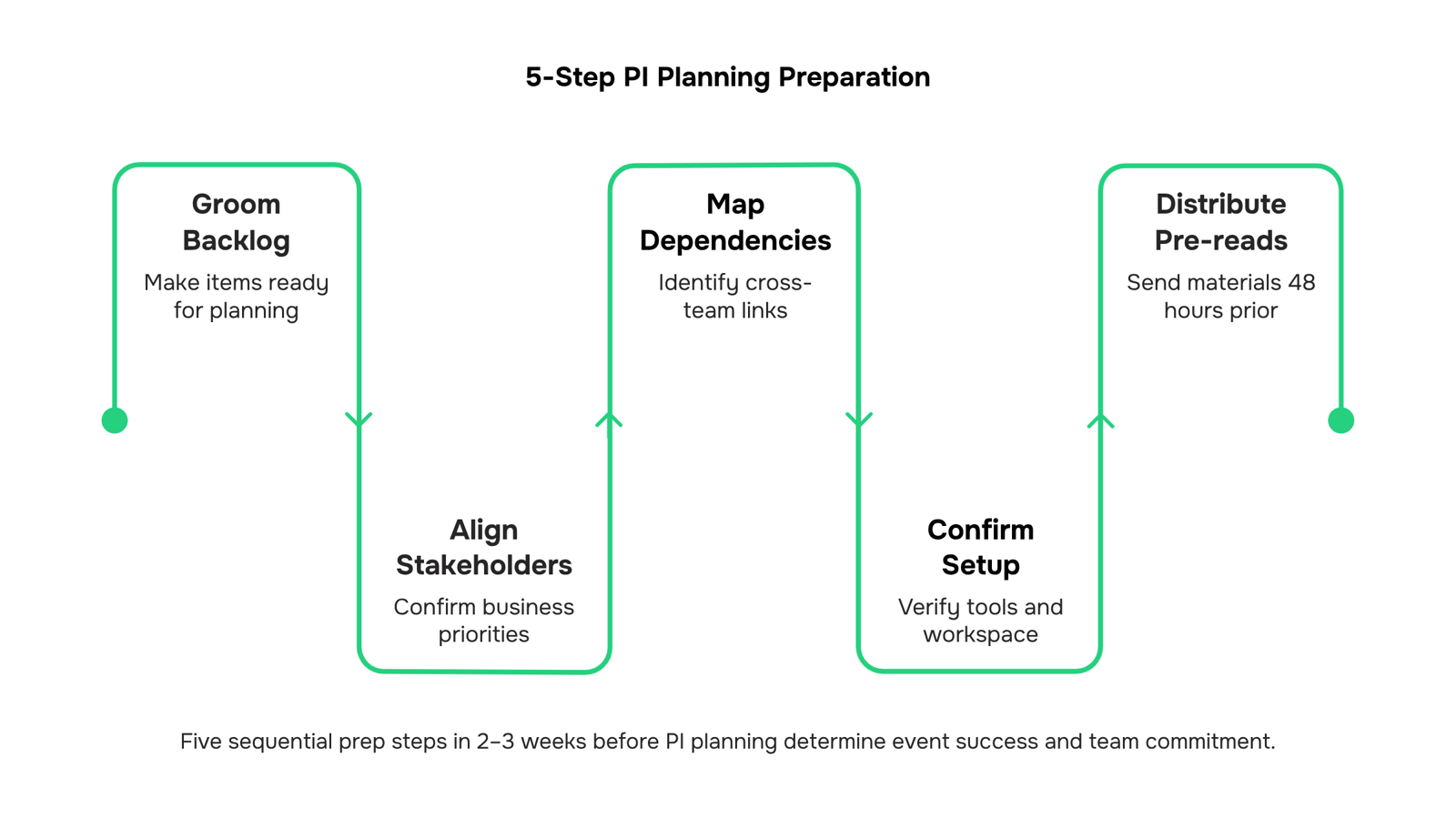
The five steps below cover everything that should happen in the two to three weeks before the event starts, so your teams arrive ready to commit, not just ready to listen.
How to prepare for a PI planning event in 5 steps
Preparation determines whether your PI planning event produces committed plans or two days of productive-sounding confusion. The event itself follows a fixed structure: business context briefings on day one, team breakouts to draft iteration plans, a cross-team dependency review, and final plan commitment by end of day two. What makes or breaks that structure is the work you do in the two to three weeks before anyone enters the room.
Here are five steps to get that preparation right.
1. Groom your backlog to a plannable state
A backlog full of vague epics is the fastest way to stall team breakouts. Before the event, every feature entering the PI should have an acceptance criterion, a rough size estimate, and a clear business outcome attached to it. Aim to have the top 20 to 30 features refined at least one week before the event.
If your backlog has 200 items and no prioritization logic, Taro reads your entire backlog and tells you what to build first, so your teams walk into breakouts with a ranked, ready list rather than a negotiation about what even belongs in scope.
2. Align stakeholders on business context before day one
Product managers and business owners often arrive at PI planning with different assumptions about strategic priorities. Resolve that before the event, not during it. Schedule a 60-minute alignment call one to two weeks out, confirm the top three to five business objectives for the increment, and document them in a shared brief.
A concrete example: an IT services team running a four-team program should have its CTO and delivery leads agree on which client commitments are fixed constraints versus flexible targets. That single conversation removes hours of day-one debate.
3. Map dependencies across teams before breakouts begin
Cross-team dependencies discovered during breakouts add unplanned time and often force teams to re-draft plans they spent hours building. Do a dependency pre-scan instead. Ask each team lead to list their known external dependencies two weeks before the event, then plot them on a shared board.
For agile PI planning across distributed teams, this step is especially critical. A dependency that takes five minutes to flag in advance takes 45 minutes to untangle mid-breakout when three teams are involved.
4. Confirm your tooling and shared workspace setup
Teams that spend the first hour of breakouts figuring out which board to use or who has edit access lose momentum they never fully recover. Set up your planning boards, program board template, and shared iteration planning space at least three days before the event. Test access for every participant, including remote attendees.
For IT company owners running multi-team programs, Taro gives every team a connected workspace where sprint plans, dependencies, and capacity data live in one place, so there is no "which tool are we using" conversation on day one.
5. Distribute pre-reads 48 hours before the event
Pre-reads are not optional material. They are the mechanism that lets teams arrive with informed questions rather than blank stares. Your pre-read package should include the business context brief, architectural runway updates, any capacity constraints, and the prioritized feature list from step one.
Send it no later than 48 hours before kickoff. Teams that receive pre-reads the morning of the event treat them as background noise. Teams that get them two days early show up to breakouts with questions already formed, which compresses alignment time and improves the quality of iteration plans.
For a deeper look at how best project prioritization methods for IT teams apply inside a PI cycle, that breakdown covers the ranking frameworks that work at scale.
Common mistakes that derail PI planning sessions
Most PI planning sessions don't fail during the two-day event. They fail in the three weeks before it.
These are the preparation failures that show up most often:
Ungroomed backlog: Teams arrive with hundreds of loosely defined stories and no clear priorities. Facilitators spend the first morning doing triage instead of planning. If your backlog isn't sized and ranked before the event, you're wasting your most expensive room.
Missing business context: Product managers skip the vision briefing or deliver it too late for teams to internalize. Without that framing, iteration plans drift from business goals before the first sprint starts.
No dependency pre-work: Cross-team dependencies discovered on day two become blockers that nobody owns. Mapping them beforehand, even roughly, cuts that risk significantly. This is one of the most common PI planning challenges in distributed IT organizations.
Wrong attendees in the room: Architects, security leads, and infrastructure owners get left off the invite. Decisions get made, then unmade when the right person finally weighs in.
No pre-read distribution: Teams read the vision deck for the first time during the event. Thirty minutes of async reading beforehand saves hours of live catch-up.
Where to track PI planning outputs after the event
The two-day PI planning event produces a lot: iteration plans, team PI objectives, risks, and a dependency map that spans multiple teams. Without a single place to hold all of that, the outputs scatter across slide decks, spreadsheets, and chat threads within days.
For agile PI planning to translate into actual delivery, each output needs an owner, a due date, and visibility across teams. That means your work management tool needs to handle more than task lists. It needs to surface blocked dependencies, flag risks as they age, and show whether iteration commitments are tracking on schedule.
Taro is built for exactly this handoff. You can map team PI objectives directly to sprints, assign dependency owners, and link risks to the tasks meant to resolve them. When something slips, the AI flags it before it hits a deadline, not after.
If you want to understand why this structure matters beyond logistics, the purpose of PI planning in SAFe explains how the event connects strategy to execution at the program level.
Closing
PI planning only works if your teams arrive prepared. That means a groomed backlog, aligned stakeholders, mapped dependencies, tested tooling, and clear success criteria — all before day one. The event itself follows a fixed structure, but the preparation determines whether your teams leave with real commitments or just a full calendar. Start with step one this week: audit your backlog and identify what needs refinement before your next PI cycle. Then ask yourself: do your teams know what success looks like for the increment, and have you surfaced the dependencies that will actually block them?
FAQ
What is PI planning in SAFe?
PI planning (Program Increment planning) is a structured, two-day event where all teams in an Agile Release Train align on what they'll build over the next 8 to 12 weeks. Teams review business objectives, surface dependencies, and commit to iteration plans with explicit confidence votes.
How do you prepare for a PI planning event?
Prepare in five steps: groom your backlog to a plannable state, align stakeholders on business context, map cross-team dependencies in advance, confirm your tooling and workspace setup, and define clear success criteria. This work should happen two to three weeks before the event.
What are the benefits of PI planning for agile teams?
PI planning delivers cross-team alignment on shared goals, surfaces dependencies before they cause mid-sprint rework, stabilizes scope so teams can start sprints with momentum, and reduces the rework caused by misunderstood requirements or uncoordinated interfaces.
How do you facilitate a successful PI planning session?
Start with clear business context briefings on day one, ensure teams have pre-refined backlogs and mapped dependencies, run structured breakouts where teams draft iteration plans, then conduct a dependency review and risk assessment before final commitment on day two.
What are the most common challenges during PI planning?
Ungroomed backlogs that force teams to refine mid-event, misaligned stakeholders with conflicting priorities, dependencies discovered too late to resolve cleanly, and teams arriving without clear acceptance criteria or sizing estimates for planned work.


 Elena Petrova15 September 2026


