TL;DR: Most content on sales leads stops at definitions and generic follow-up tips. This piece gives IT company owners a conversion framework built around the three places deals actually die: slow response, poor qualification, and no routing system. You'll get specific fixes for each stage, with the metrics to know when each one is working.
What are sales leads?
A sales lead is any individual or organization that has shown some signal of interest in what you sell, but hasn't yet become a paying customer.
For IT company owners, that definition has real operational weight. A lead isn't just a name in a spreadsheet. It's a signal that needs to be read, routed, and acted on at the right speed. Research from Harvard Business Review found that companies contacting leads within an hour are nearly seven times more likely to qualify them than those waiting even 60 minutes longer. Most IT teams lose deals not because the lead was bad, but because the follow-up was slow or misdirected.
Understanding types of sales leads matters because each type demands a different response. A cold outbound contact needs education before a pitch. A warm inbound lead who downloaded your security audit checklist needs a fast, specific reply. Treating both the same way is where conversion breaks down.
Before you can build a strategy around how to develop sales leads into customers, you need a shared definition of what a lead actually is at each stage. That's what identifying a qualified sales lead gives your team: a consistent filter, not a gut call.
Types of sales leads every IT team should know
Not all sales leads deserve the same response. Treating a cold prospect the same way you treat someone who just requested a demo is one of the fastest ways to burn both the lead and your team's time.
Here are the five types IT owners encounter most:
Cold leads have never interacted with your company. They match your target profile but haven't signaled interest. Outbound sequences work here; one-to-one personal outreach rarely scales.
Warm leads have engaged at least once, opened an email, visited a pricing page, or attended a webinar. They need nurturing, not a hard pitch.
Hot leads show clear buying intent: a demo request, a reply asking about pricing, or a free trial sign-up. These need a response within minutes, not hours.
Inbound leads come to you through web forms, content, or referrals. They're self-qualified to some degree and typically convert at higher rates than outbound.
Outbound leads are sourced by your team through LinkedIn, cold email, or events. Qualification work happens upfront before any conversation starts.
The real conversion lever isn't volume, it's routing. A hot lead that sits in a shared inbox for six hours is effectively a cold lead by the time someone responds. Why most leads don't convert comes down to this mismatch more often than any messaging problem.
Match the follow-up action to the lead type, and use a 5-step qualification framework to keep that routing consistent across your team.
How to generate sales leads for an IT business
Four channels consistently produce the highest-quality sales leads for IT businesses. Here's what works and what to do first in each.
Referrals: A satisfied client recommending you to a peer converts at 3 to 5 times the rate of cold outreach. After every successful project delivery, ask directly: "Do you know another IT director facing the same challenge?" One specific ask beats a generic "let us know if you can refer anyone."
LinkedIn outreach: Decision-makers at mid-market companies are reachable without a paid list. Search by job title, company size, and industry, then send a connection request with a one-sentence observation about a problem they likely have. No pitch in the first message. The goal is a reply, not a close.
Web forms tied to intent: A contact form sitting on your homepage captures almost nothing. A form gated behind a resource — a network audit checklist, a security assessment template — attracts sales leads who already have a problem to solve. That intent gap is the difference between a cold name and a warm conversation.
Content that answers real questions: IT buyers search before they call. A 600-word article explaining "how to reduce IT downtime during a migration" puts you in front of buyers at the research stage. If you want to know how to develop sales leads from content specifically, start with the three questions your last five clients asked before signing.
Once you know how to get sales leads flowing from these channels, the next problem is knowing which ones are worth your time — covered in the next section.
How to qualify sales leads using observable signals
Qualification isn't a gut check. It's a read on four observable signals that tell you whether a lead is worth your next hour.
Fit is the baseline. Does the company match your target profile — industry, headcount, tech stack, budget range? An IT managed services firm chasing SMB clients should disqualify a 5,000-person enterprise early, not after three discovery calls. Check company size and vertical before anything else.
Intent is what separates a curious browser from a live opportunity. Signals include repeated visits to your pricing or services page, downloading a technical guide, or replying to a cold email with a specific question. These aren't soft indicators — they're behavioral evidence that the lead is actively evaluating options. If you want a structured way to read these signals, the 5-step qualification framework for IT sales leads breaks down exactly what to look for.
Authority tells you whether the person you're talking to can actually buy. In IT sales, the technical evaluator and the budget holder are often different people. Qualifying authority early means asking directly: "Are you the decision-maker, or will others be involved?" It's a simple question that saves weeks.
Timing is the one most teams skip. A well-fit, high-intent lead with budget authority is still low priority if their renewal isn't for eight months. Ask about their current contract end date or the trigger event driving the search.
When you score sales leads against all four signals, the noise drops fast. Most teams find that 20 to 30 percent of their pipeline fails on fit or authority alone — which is exactly why most leads don't convert despite consistent outreach volume.
How to prioritize and route leads before they go cold
Speed kills deals in both directions. Respond fast and you convert. Wait too long and the lead has already talked to someone else.
Research from Harvard Business Review found that companies contacting a prospect within an hour are nearly seven times more likely to qualify that lead than those who wait even 60 minutes longer. For IT sales teams, where buying decisions often involve multiple stakeholders and narrow evaluation windows, that gap is decisive.
The queue problem is where warm sales leads go cold. A lead comes in, sits in a shared inbox, and waits for someone to claim it. By the time a rep picks it up, the prospect has moved on or is already in a competitor's demo. The fix is routing logic that assigns leads the moment they qualify, not when a manager gets around to reviewing the list.
Effective routing matches leads to reps based on territory, deal size, or technical specialization. A mid-market IT services lead with a stated need for managed security shouldn't land in a generalist's queue. It should go directly to the rep with the right context to respond in minutes.
This is where sales leads software with real-time assignment logic earns its keep. Evox's lead-to-customer conversion workflow handles this automatically, triggering assignment and the first outreach step the moment a lead clears your qualification threshold, so no rep has to decide what to do next.
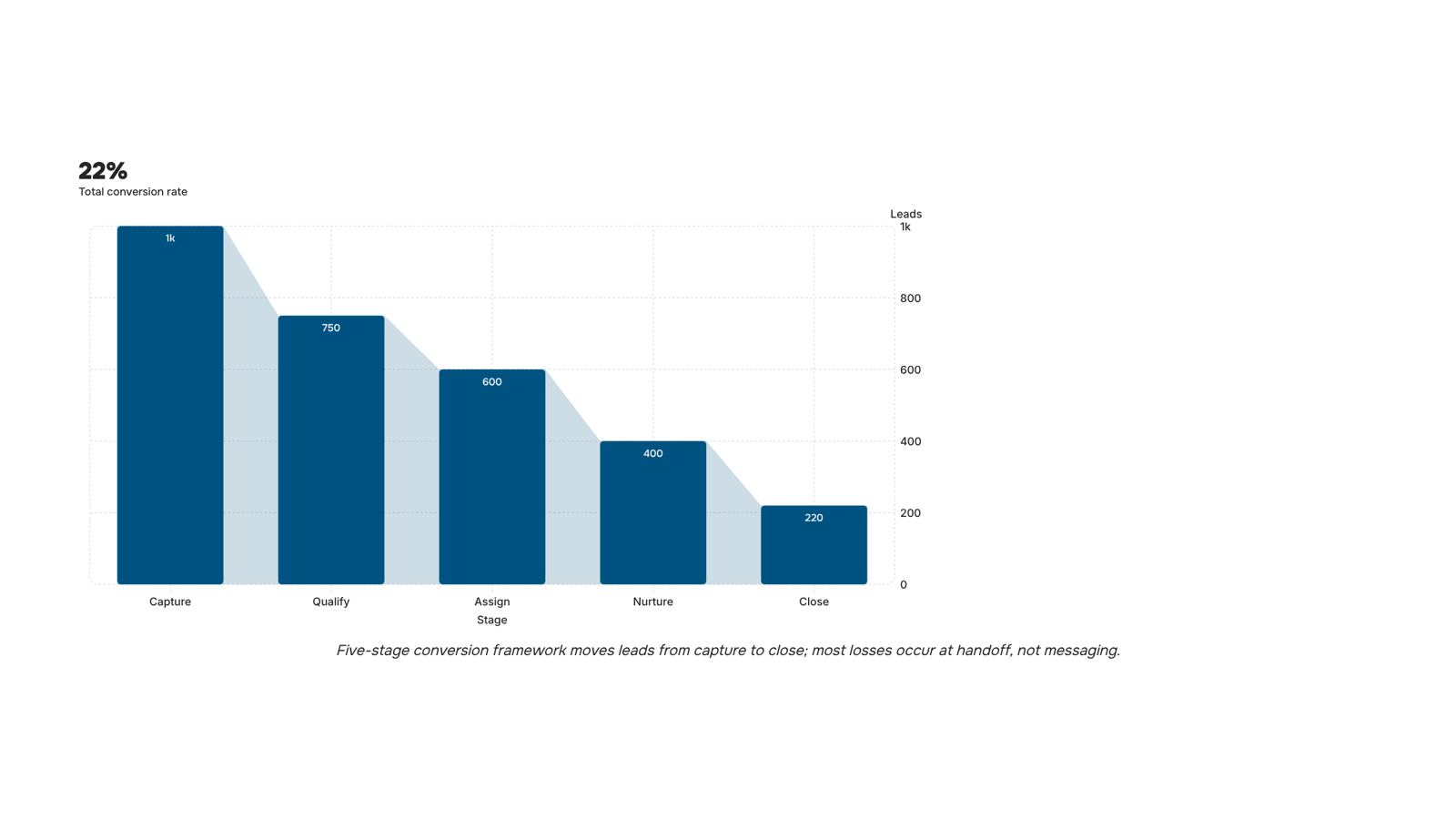
The conversion framework: moving a lead from interested to closed
Five stages separate a new contact from a closed deal. Most IT sales teams lose leads somewhere in the middle, not because the lead went cold, but because the handoff broke down.
Capture: Every inbound lead needs a single destination: your CRM, not a spreadsheet, not someone's inbox. The failure mode here is fragmentation, where leads arrive from three channels and land in three places.
Qualify: This is where most frameworks oversimplify. Qualifying a sales lead isn't a checkbox, it's reading observable signals: budget confirmed, decision-maker identified, timeline stated, and a specific pain tied to your service. Miss any one of those and you're nurturing a contact who was never going to buy. For a deeper look at how to turn qualified leads into revenue, the criteria matter as much as the sequence.
Assign: Route the lead to the right rep immediately. Delayed assignment is where warm leads go quiet. Smart assignment matches lead profile to rep expertise, not just availability.
Nurture: Leads that aren't ready to close today need a structured sequence, not occasional check-ins. Three to five touchpoints over two weeks, each tied to a specific objection or use case, outperform ad hoc follow-up every time.
Close: The failure mode at this stage is usually process, not persuasion. A missing proposal template, a contract waiting on signatures, or no clear next step in the CRM. Fix the friction, and the close rate follows.
Evox runs the nurture and close stages automatically, so your reps spend time on qualified conversations rather than manually scheduling follow-ups.
What changes in 2026: AI and lead conversion for IT companies
Three shifts are reshaping how IT companies convert sales leads in 2026, and they're happening faster than most SMB teams have adapted.
Predictive lead scoring moves qualification off gut feel. Instead of a rep deciding who's ready, the model watches firmographic data, email engagement, and site behavior together, then surfaces the leads most likely to close. HubSpot's 2025 State of Sales report found AI-assisted scoring adoption climbing sharply among SMB sales teams — teams using it report shorter qualification cycles.
Automated enrichment fills the data gaps that stall follow-up. When a lead comes in with just a name and email, sales leads software pulls company size, tech stack, and buying role automatically, so reps start the first call with context, not questions.
Trigger-based nurturing replaces fixed drip sequences. Instead of sending email three on day seven regardless of behavior, the sequence responds to what the lead actually did — opened a pricing page, downloaded a case study, went quiet for ten days.
Understanding why most leads don't convert often comes down to which of these three signals your current process is ignoring.
Closing
The conversion framework in this article only works if your team can execute it without friction. A perfect qualification process means nothing if leads sit unrouted for hours, or if your reps spend half their day hunting down lead status instead of having conversations. The real competitive edge isn't a better pitch—it's a system that captures hot leads, routes them instantly to the right person, and keeps the entire pipeline visible. That's where most IT teams lose deals, not in the conversation itself. The question isn't whether you should implement this framework—it's whether you're ready to see how Lio automates the routing and tracking so your team can focus on closing. Start a free trial and watch how many deals you recover just by eliminating the manual coordination.
FAQ
What are sales leads and why do they matter?
A sales lead is anyone showing interest in your solution but not yet a paying customer. They matter because response speed is decisive—companies contacting leads within an hour are nearly seven times more likely to qualify them than those waiting longer.
What are the most effective ways to qualify sales leads?
Score leads on four observable signals: fit (company profile match), intent (behavioral evidence like pricing page visits), authority (can they actually buy?), and timing (when do they need a solution?). This framework eliminates 20-30% of noise immediately.
How do I prioritize and manage sales leads effectively?
Route leads the moment they qualify, not when a manager reviews them later. Assign hot leads to reps within minutes, not hours. Use a shared qualification framework so every team member reads intent the same way.
What is the best strategy for converting sales leads into customers?
Match your follow-up action to the lead type, respond within an hour, qualify using fit/intent/authority/timing, and route immediately. The conversion lever isn't messaging—it's routing speed and consistency.
Can sales leads be generated through social media?
Yes. LinkedIn outreach to decision-makers by job title and company size is a consistent lead source for IT businesses. Start with a connection request and one-sentence observation about their problem—no pitch in the first message.


 Elena Petrova15 September 2026


