TL;DR: Most guides on the digital signature standard stop at definitions. This one maps DSA, RSA, ECDSA, and EdDSA to real security tradeoffs, explains what each standard actually protects against, and gives IT company owners a concrete framework for choosing the right one before deploying a signing tool or executing a contract.
What the digital signature standard actually is
A digital signature standard is a cryptographic specification that defines exactly how a signature is created, verified, and permanently bound to a document. It is not a legal concept — it is a mathematical protocol. Understanding the difference matters because electronic signatures are a broad legal category, while digital signature standards are the technical layer underneath that makes them trustworthy.
The core mechanism works the same way across all standards: a private key generates a unique signature from the document's hash, and a public key lets any recipient verify that the hash matches and the private key holder actually signed it. If a single byte changes after signing, verification fails.
What most articles miss is that "digital signature standard" refers to a family of specifications, not one algorithm. NIST FIPS 186-5, finalized in 2023, currently approves three core algorithms: DSA (the original DSA digital signature algorithm), RSA, and ECDSA, with EdDSA added as a fourth. Each carries different key length requirements, performance profiles, and use-case fits — which the next section covers in detail.
For regulated workflows, the standard you choose also determines which legal tier your signature reaches. Under eIDAS, an advanced electronic signature requires a standard that uniquely links the signature to the signer and detects subsequent changes — criteria that rule out weaker implementations entirely.
The four main types of digital signature standards
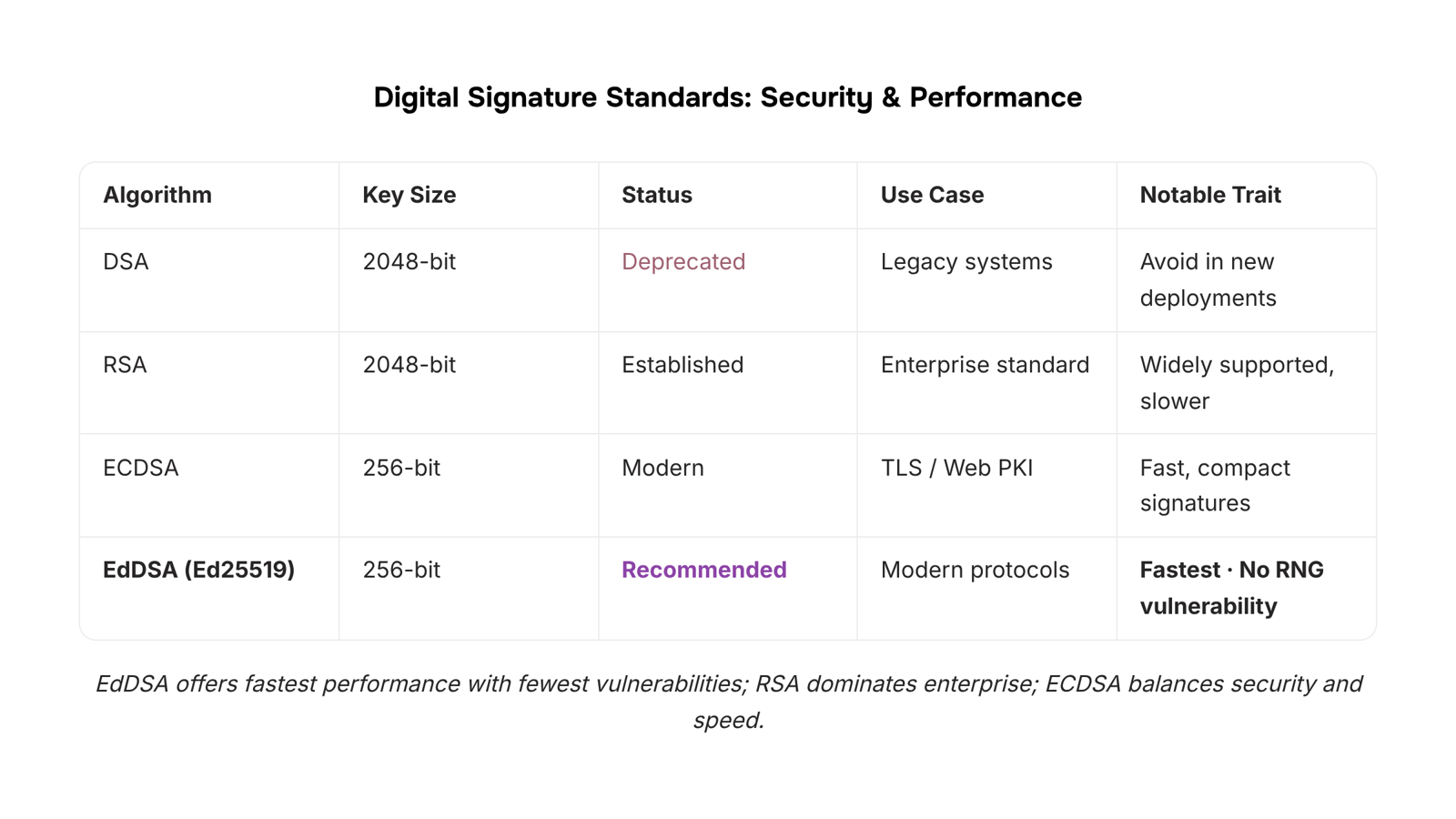
The four main types of digital signature standards are not interchangeable. Each one uses a different mathematical approach, runs at a different speed, and fits a different operational context. Treating them as one thing is how teams end up with the wrong standard for their environment.
DSA (Digital Signature Algorithm) was the original NIST-approved standard, defined in FIPS 186. It uses discrete logarithm math and requires a 2048-bit key minimum under current NIST guidelines to remain secure. DSA is largely a legacy choice today. It works, but it has been superseded for most new implementations because it offers no performance or security advantage over newer options.
RSA is the most widely deployed standard in enterprise environments, particularly for TLS certificates, email signing (S/MIME), and PDF document workflows. The ECDSA RSA digital signature comparison comes up constantly in IT procurement because RSA's familiarity makes it the default. The tradeoff: RSA at 2048 bits is computationally heavier than elliptic curve alternatives, which matters when you're signing at volume or on constrained hardware.
ECDSA (Elliptic Curve Digital Signature Algorithm) delivers equivalent security to RSA at much shorter key lengths. A 256-bit ECDSA key matches the security of a 3072-bit RSA key. That gap translates directly to faster signing, smaller certificate sizes, and lower server load. ECDSA is the standard behind most modern TLS implementations and is the right choice for high-throughput document workflows. NIST FIPS 186-5, published in 2023, approves ECDSA alongside EdDSA and explicitly deprecates older DSA usage.
EdDSA (Edwards-curve Digital Signature Algorithm), specifically the Ed25519 variant, is the fastest of the four and the most resistant to implementation errors. Unlike ECDSA, EdDSA does not require a random number generator during signing, which eliminates an entire class of vulnerabilities that have caused real-world key exposure. For teams building new signing infrastructure in 2026, EdDSA is the technically superior choice where compatibility allows.
Here is how the four map to common IT company scenarios:
Legacy enterprise systems, PDF signing, email: RSA 2048-bit minimum
High-volume contract workflows, modern web infrastructure: ECDSA (P-256 or P-384)
New builds, API-driven signing, security-first environments: EdDSA (Ed25519)
Existing DSA deployments: migrate; do not extend
Understanding how an electronic signature works at the protocol level helps clarify why the standard you choose affects more than just key length. It shapes your compliance posture, your signing speed, and your exposure to future cryptographic risk.
How the digital signature standard keeps documents secure
The security behind a digital signature comes down to three interlocking mechanisms: a public-private key pair, a hash function, and a certificate authority (CA).
When you sign a document, your signing software runs the file through a hash function (SHA-256 is standard today) and produces a fixed-length digest. That digest gets encrypted with your private key. Anyone who receives the document can decrypt that value with your public key and run the same hash on the file. If the two digests match, the document is untouched and the signature is genuine. If even one character changed after signing, the hashes diverge and the tampering is visible. This is the core of how digital signature standards ensure document security — the math makes forgery computationally impractical, not just policy-prohibited.
The CA layer adds identity verification on top. A trusted third party confirms that the public key actually belongs to the person or organization claiming it, then issues a certificate binding the two together. Without that binding, you'd have a valid signature from an unverified identity.
Cryptographic integrity alone, though, doesn't tell you who was at the keyboard or when they acted. That's where audit-layer controls close the gap. IP address logging, device fingerprinting, and timestamped access records create a second verification layer that courts and compliance teams increasingly expect. Advanced electronic signatures (AES) specifically require this kind of linked, traceable evidence under eIDAS.
Platforms that store and reuse verified signer identities — the way Sigi handles signature storage — carry that verified identity forward into every subsequent document, so the CA-backed binding doesn't have to be re-established from scratch each time.
NIST FIPS 186-5, published in 2023, sets the approved algorithms and minimum key lengths that underpin all of this. Digital signature security is only as strong as the standard the platform actually implements.
What the law requires from a digital signature standard
Legal requirements for digital signatures vary by jurisdiction, but three frameworks cover most IT company owners operating internationally: ESIGN in the US, UETA at the state level, and eIDAS in the EU.
ESIGN and UETA set a permissive baseline. Both laws recognize electronic signatures as legally binding for most commercial contracts, but neither mandates a specific cryptographic standard. What they require is intent to sign, consent to do business electronically, and a reliable method to associate the signature with the signer. In practice, that means audit trails, timestamps, and identity verification — not necessarily PKI.
eIDAS is more prescriptive. Under eIDAS, three tiers exist: Simple Electronic Signatures (SES), Advanced Electronic Signatures (AES), and Qualified Electronic Signatures (QES). QES carries the same legal weight as a handwritten signature across all EU member states, but it requires a certificate issued by a Qualified Trust Service Provider and must be based on a qualified certificate stored on a secure signature creation device. That means RSA or ECDSA cryptography with key lengths meeting current NIST minimums — RSA 2048-bit at a floor — backed by a regulated CA.
For most IT service agreements and vendor contracts, AES is sufficient. QES is the requirement for regulated industries: financial services, healthcare, and government procurement in the EU.
The practical compliance baseline for an IT company owner operating across both jurisdictions: ESIGN-compliant audit trails for US clients, AES-level cryptographic binding for EU clients, and QES for any regulated EU counterparty.
Sigi handles all three tiers and generates tamper-proof completion certificates that satisfy the audit trail requirements under both ESIGN and eIDAS without manual configuration.
Digital signature vs. electronic signature: the practical difference
The two terms describe different things, and mixing them up creates real compliance risk.
An electronic signature is any digital indicator of intent — a typed name, a checkbox, a drawn signature. It's broad by design. What an electronic signature actually is and how it works covers the full scope, but the short version: most e-signatures carry no cryptographic proof of who signed or whether the document changed afterward.
A digital signature is a specific cryptographic mechanism. It uses a private key to generate a unique signature hash tied to both the signer's identity and the document content. If a single character changes post-signing, verification fails. That's the core of what the digital signature standard defines.
In practice, every digital signature is an electronic signature, but most electronic signatures are not digital signatures.
For IT company owners, the distinction matters most under eIDAS's Advanced Electronic Signature tier, which explicitly requires the cryptographic binding that basic e-signatures skip. A typed name on a contractor agreement may satisfy ESIGN. A regulated procurement contract in the EU likely won't clear AES or QES without a proper digital signature standard underneath it.
When the stakes are low, a basic e-signature is fine. When they're not, the cryptography is the requirement, not a preference.
How to choose the right digital signature standard for your business
Choosing between types of digital signature standards comes down to four criteria. Work through them in order and you'll eliminate the wrong options before you spend time evaluating tools.
1. Compliance requirement. Start here, because it overrides everything else. If your contracts fall under eIDAS Qualified Electronic Signature (QES) rules, you need a standard that supports qualified certificates issued by a Trust Service Provider. If you're operating under US federal procurement or defense contracts, FIPS 186-5 compliance is non-negotiable, which means ECDSA or RSA at 2048-bit minimum.
2. Key strength. NIST's current guidance sets RSA and DSA minimums at 2048 bits through 2030, with a migration path toward elliptic curve algorithms after that. If you're signing documents with a 10-year retention requirement, plan for that transition now.
3. Performance at scale. RSA verification is fast; RSA signing is slower. ECDSA flips that ratio and uses shorter keys, which matters if you're processing hundreds of contracts daily. For most IT service businesses signing under 50 documents a day, this criterion won't decide the question.
4. Tool support. The standard you choose only works if your signing platform implements it correctly. Check whether your tool generates tamper-proof completion certificates and supports the algorithm your compliance framework requires. For a practical comparison of platforms, the best tools for creating digital signatures for PDFs covers the implementation differences worth knowing.
Closing
The digital signature standard you deploy shapes your signing speed, compliance posture, and long-term cryptographic safety. RSA remains the enterprise default, but ECDSA handles modern high-volume workflows better, and EdDSA is the technically superior choice for new builds. The real differentiator, though, is whether your signing tool actually implements the standard with verifiable audit trails — cryptographic correctness alone doesn't prove who was at the keyboard or when they acted. Before you lock in a standard, ask yourself: does my signing tool embed IP tracking, device fingerprinting, and sequential workflow into a single, auditable flow? If not, you're leaving compliance risk on the table.
FAQ
What are the different types of digital signature standards?
The four main standards are DSA (legacy), RSA (enterprise default), ECDSA (modern, faster), and EdDSA (fastest, most resistant to implementation errors). Each uses different math and key lengths; NIST FIPS 186-5 approves all four but deprecates DSA for new deployments.
How does the digital signature standard ensure document security?
A hash function creates a digest of the document, your private key encrypts it, and recipients decrypt it with your public key to verify the file is unchanged. If one byte changes after signing, verification fails. A certificate authority adds identity verification; audit trails add timestamped proof of who signed and when.
What is the difference between a digital signature and an electronic signature?
Electronic signature is a broad legal category covering any digital intent to sign. Digital signature is the cryptographic standard underneath that makes it mathematically verifiable and tamper-evident. All digital signatures are electronic; not all electronic signatures are cryptographically sound.
How do I choose the right digital signature standard for my business?
Use RSA for legacy systems and PDF workflows; ECDSA for high-volume modern contracts; EdDSA for new infrastructure. Match your choice to your signing volume, compliance tier (ESIGN vs. eIDAS), and whether your signing tool tracks IP, device, and timestamp.
What are the legal requirements for digital signature standards?
ESIGN and UETA (US) require audit trails and identity verification but no specific standard. eIDAS (EU) mandates advanced electronic signatures for regulated workflows, which requires a standard that uniquely links the signature to the signer and detects changes.
Is RSA or ECDSA better for business document signing?
RSA is the enterprise default and works everywhere; ECDSA is faster and uses shorter keys for equivalent security. For high-volume workflows, ECDSA reduces server load and signing latency. For legacy system compatibility, RSA remains the safer choice.
Does a digital signature standard expire or need to be renewed?
The standard itself doesn't expire, but cryptographic key lengths weaken over time as computing power grows. NIST FIPS 186-5 (2023) sets current minimum key lengths; you should plan to migrate older RSA keys to longer lengths or switch to ECDSA within the next 3–5 years.


 Elena Petrova15 September 2026


