TL;DR: Most itemized invoice guides list fields without explaining why each one matters to your books. This one connects line items directly to tax deductibility, audit defense, and cash flow visibility, then shows where manual invoicing creates the blind spots that proper itemization closes.
What an itemized invoice actually is
Professional 3D render of an itemized invoice on a clean desk with organized line items and business accounting details
An itemized invoice breaks every charge into a separate invoice line item: description, quantity, unit price, tax rate, and subtotal. A standard (lump-sum) invoice shows one total, maybe with a vague label like "Development Services — $12,000." That's the structural gap.
For IT billing, this distinction matters immediately. Consider a monthly engagement that includes 40 hours of backend development at $150/hr, two SaaS license pass-throughs at $200 each, and a $1,500 support retainer. A lump-sum invoice collapses all of that into one number. Itemized billing separates each component so both you and your client can trace exactly what was delivered, at what rate, and under which cost category.
The downstream difference: itemized invoices feed your accounting system with category-level data. Each line maps to a GL code, a project, or a tax-deductible expense class. Without that granularity, your bookkeeper reconstructs it manually, or it never gets categorized correctly.
This is why the format matters beyond "looking professional." It determines whether your records survive an audit, whether clients can approve charges without a follow-up call, and whether your invoice management practices actually produce usable financial data.
How itemized invoices differ from regular invoices
A regular invoice might read: "Development services — $12,000." That tells accounting nothing about what was delivered, when, or at what rate. An itemized invoice for business breaks that same amount into discrete invoice line items: 80 hours of backend development at $100/hr, two annual SaaS license renewals at $500 each, and a monthly support retainer at $1,000.
Here's what the lump-sum version omits that matters for IT billing:
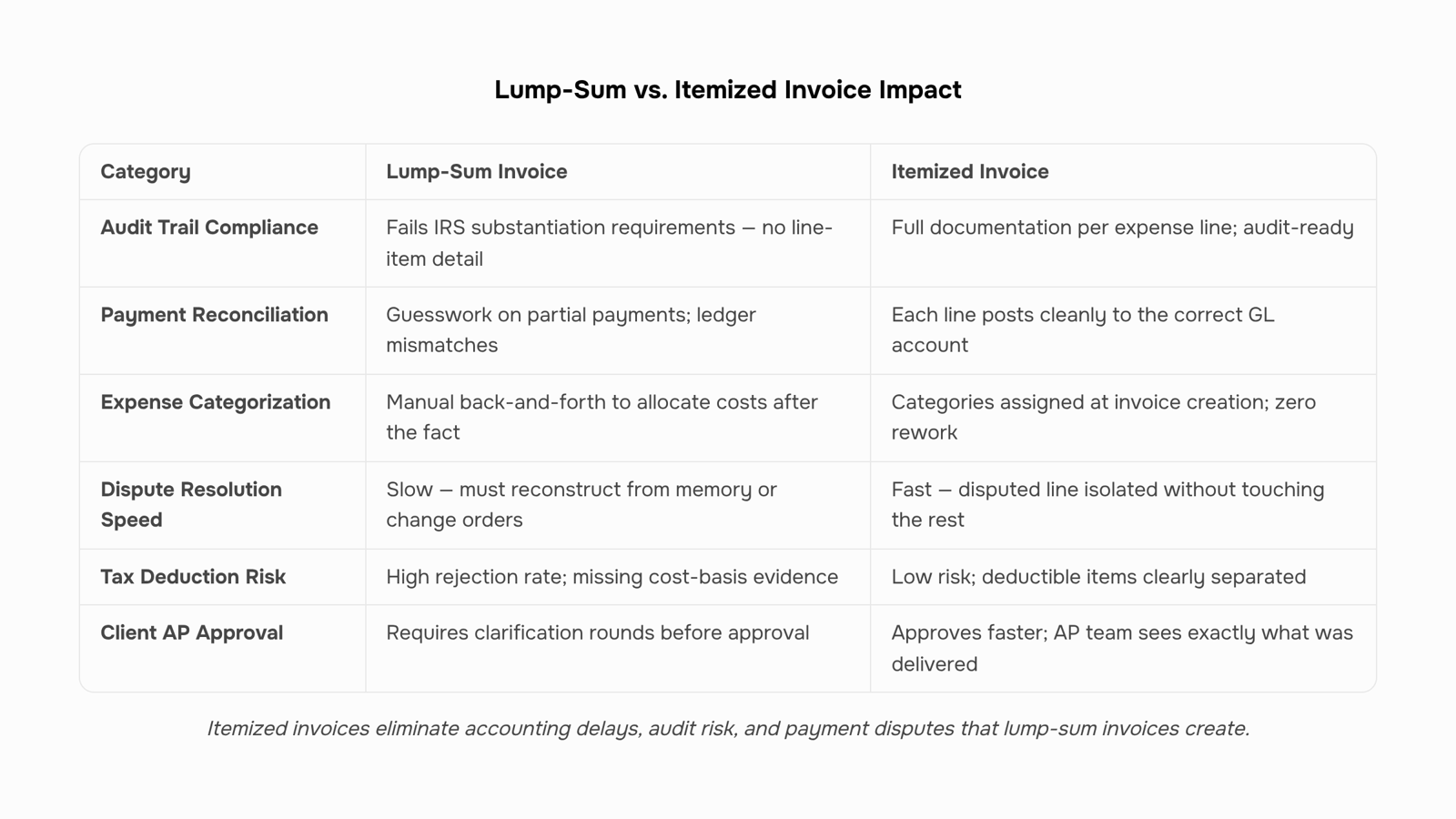
When a client questions a charge six months later, the lump-sum invoice forces you to reconstruct the work from memory or time logs. Itemized invoices make the answer self-contained in the document itself.
For IT companies billing a mix of hourly dev work, fixed-price licenses, and recurring retainers, this distinction also determines whether your expenses get categorized correctly at tax time. The IRS requires sufficient detail to substantiate business expense deductions. A single line reading "consulting" rarely qualifies.
If you're still sending single-line invoices, compare your format against common invoice formats used by small businesses to identify what data you're leaving out.
Why itemized invoices matter for business accounting
Every line item on an invoice functions as a discrete financial record. When you send a lump-sum invoice that reads "Development services — $12,000," your accounting system has nothing to categorize, your accountant has nothing to reconcile, and your client has nothing to verify. An itemized invoice for business accounting splits that same amount into 80 hours of backend development at $100/hr, two annual SaaS licenses at $1,200 each, and a $600 infrastructure provisioning fee. Each entry maps to a specific GL code, cost center, and tax treatment.
This matters for four concrete accounting functions:
Audit trails. Tax authorities require line-item detail to substantiate expense deductions. The IRS can disallow deductions when invoices lack sufficient documentation of what was purchased, the quantity, and the unit cost. A single-line invoice forces you to reconstruct that detail months later, often unsuccessfully.
Payment reconciliation. When a client pays $9,800 against a $12,000 invoice, itemized billing tells you exactly which deliverables are covered and which remain outstanding. Without line items, partial payments become guessing games that delay follow-up by days.
Expense categorization. Your bookkeeper needs to split a vendor invoice across software, labor, and infrastructure accounts. Line items make that a 30-second task instead of a back-and-forth email thread.
Dispute resolution. Most payment disputes resolve faster when both parties can point to a specific line item rather than arguing over a total. Teams that use invoice management practices that protect cash flow report fewer escalations because the documentation already exists.
Business accounting invoices without line-item detail create downstream cost: slower closes, rejected deductions, and unresolved AR balances. The format is not a preference. It is the difference between a financial record and a receipt.
Each field on an itemized invoice exists to answer a specific question your accountant, tax authority, or client will eventually ask. Here's what belongs and why it matters downstream.
Line item description tells your bookkeeper which GL account to hit. "Development services" is useless for categorization. "Backend API integration, Project Falcon, Sprint 12" lets you allocate cost to the correct project and expense category without a follow-up email.
Quantity and unit rate separate volume from price, which matters when a client disputes a total. If your invoice line items show 14 hours at $175/hour, the client can verify against their timesheet records. A lump sum of $2,450 invites questions you'll spend 20 minutes answering.
Tax amount per line satisfies most tax authority requirements for deduction claims. The IRS expects sufficient detail to substantiate each business expense. Bundling tax into a single invoice total makes it harder for your client to claim input tax credits, and harder for you to prove compliance during an audit.
Discount (if applied) needs its own line so both parties can reconcile the original rate against the adjusted total. Without it, your revenue reports overstate gross billing and your client's AP team flags the mismatch.
Subtotal and total close the loop. The subtotal confirms arithmetic before tax; the total confirms what's owed. Together they give your accounting system a clean reconciliation path.
For IT businesses billing hourly dev work alongside software licenses and infrastructure costs, mixing these categories without proper line-item separation makes expense categorization nearly impossible at quarter-end. Tools like Inzo structure business accounting invoices with these fields by default, so nothing gets skipped. For formatting reference, see common invoice examples for small businesses.
Using itemized invoices for tax purposes
Tax authorities care about one thing on an invoice for tax purposes: can they trace the deduction back to a specific, categorized business expense? Generic line items like "consulting services — $12,000" fail that test. An itemized invoice for business expenses needs to separate labor hours from materials, software licenses from infrastructure costs, and taxable items from exempt ones.
For IT companies, this means breaking a project invoice into distinct categories:
Development labor (hours × rate, per team member or role)
Software licenses purchased on behalf of the client
Cloud infrastructure costs passed through at cost or marked up
Hardware or equipment if applicable
Each category maps to a different deduction class. Labor is typically a service expense. Licenses and infrastructure may qualify for different depreciation schedules or immediate write-offs depending on jurisdiction. When these sit on a single line, your accountant has to guess, and guesses get rejected during audits.
The IRS requires "adequate records" for any claimed deduction, which means documentation showing amount, date, business purpose, and the nature of the expense. An itemized invoice satisfies all four when structured correctly. Most small business deduction rejections trace back to records that lack this specificity.
Keep your invoice formats consistent across clients so your year-end tax prep pulls clean data instead of requiring manual reclassification. If you're generating dozens of mixed-service invoices monthly, tools like Inzo let you build multi-line item templates with tax categories baked in, so each invoice ships audit-ready without extra formatting work.
How to create an itemized invoice for your clients
Creating itemized invoices starts before you open any billing tool. It starts during project execution.
Capture line items as work happens. For IT billing, that means logging hours per task, tagging software licenses purchased on behalf of the client, and recording infrastructure costs (cloud hosting, domain renewals, third-party API fees) the moment they're incurred. If you wait until month-end to reconstruct this from memory or Slack threads, you'll bundle things that should be separate invoice line items.
Structure line items by category, not chronology. Group your itemized billing into sections a client can scan:
Labor (role, hours, rate per hour)
Software and licenses (product name, license period, unit cost)
Infrastructure (service, usage period, cost)
Expenses passed through (description, receipt reference)
Each line item needs a description specific enough that your client's AP team won't email you for clarification. "Development work, March" fails. "Backend API integration, Stripe webhook handler, 12 hrs @ $150/hr" passes.
Remove the re-entry step. If your project management tool already tracks hours and deliverables, generating invoices manually from that data is wasted effort. Inzo's integration with Taro converts completed project data directly into multi-line item invoices with tax calculations applied, so nothing gets lost between delivery and billing.
For reference formats that work across service types, see common invoice formats used by small businesses.
Common mistakes that make itemized invoices useless
Four mistakes turn an itemized invoice for business into a document nobody can act on.
Vague line-item descriptions. "Development work — 40 hours" tells your client nothing. When they cannot match a charge to a deliverable, they escalate to their finance team. That adds 2-3 weeks to payment cycles. Write "Backend API integration, user auth module, Sprint 12" instead.
Bundled services into a single line. Combining hosting, dev hours, and license fees into one total makes the invoice useless for your client's expense categorization and your own tax filing. The IRS requires sufficient detail to substantiate business expense deductions. Bundled business accounting invoices fail that test.
Missing tax breakdowns. If sales tax or VAT appears as a lump sum without per-line allocation, clients in multi-jurisdiction setups will reject the invoice outright.
No project or contract reference. Without a PO number or SOW reference, accounts payable has no way to match your invoice to an approved budget. It sits in a queue.
Each error compounds. Adopting invoice management practices that protect cash flow eliminates most of these at the template level.
Closing
Itemized invoices are not a formatting preference—they're the foundation of audit-ready accounting and faster client approvals. When you separate each charge into its own line with description, quantity, rate, and tax treatment, you give your bookkeeper usable data, your clients a clear breakdown to verify, and tax authorities the documentation they need. The gap between lump-sum and itemized billing shows up most painfully at tax season or during a dispute. Start by auditing your last three invoices: can your accountant categorize each line without asking you a follow-up question? If not, your invoicing format is creating work downstream that proper itemization eliminates.
FAQ
What is the importance of itemized invoices for business accounting?
Itemized invoices give your bookkeeper category-level data for GL coding, satisfy tax authority deduction requirements, and enable fast payment reconciliation. Without line-item detail, you lose audit trails, create manual categorization work, and invite client disputes.
How do itemized invoices differ from regular invoices?
Regular invoices collapse all charges into one total (e.g., 'Development services—$12,000'). Itemized invoices break that into discrete lines: 80 hours at $100/hr, two licenses at $500 each, plus a retainer. Each line maps to a specific deliverable, rate, and tax treatment.
What information should be included in an itemized invoice?
Line description (tied to GL account), quantity, unit rate, tax amount per line, any discounts, and subtotal/total. Each field answers a question your accountant or tax authority will ask during reconciliation or audit.
Can I use itemized invoices for tax purposes?
Yes. Tax authorities require sufficient line-item detail to substantiate business expense deductions. Itemized invoices that separate labor, materials, and software licenses by category make deduction claims defensible and audit-ready.
How do I create an itemized invoice for my clients?
List each deliverable, service, or product as a separate line with description, quantity, unit price, and tax. Tools like Inzo build itemized invoices automatically from project and deal data, so the structure is correct from creation and accounting happens in real time.
What happens if an invoice isn't itemized during an audit?
The IRS can disallow deductions when invoices lack sufficient documentation. You'll be forced to reconstruct line-item detail months later, often unsuccessfully, and risk losing tax credits or facing penalties.
Do itemized invoices help with faster client payments?
Yes. Clients can verify charges line-by-line without follow-up calls, and partial payments are easy to reconcile. Teams using itemized invoices report fewer payment disputes and faster approval cycles.


 Elena Petrova15 September 2026


