TL;DR: Most LOI guides hand you a blank template and move on. This one walks IT company owners through every section — what each clause actually does, which terms are binding by default, and where vague language creates real legal exposure. You get a six-step process for building an LOI that the other party reads the same way your team does.
What a letter of intent actually is
A letter of intent (LOI) is a written document that signals two parties are serious about moving forward together before a formal contract exists. It captures the core terms both sides have agreed on in principle: scope, price range, timeline, and next steps.
An LOI is not a contract. It does not obligate either party to complete the deal. Most clauses are explicitly non-binding, which means walking away carries no legal penalty. The exceptions matter, though. Two clauses are typically enforceable even in an otherwise non-binding LOI: confidentiality and exclusivity. If you include either, treat them as real legal commitments.
For IT company owners, this distinction is practical, not academic. You might use a letter of intent loi template to frame a vendor relationship before the full agreement is drafted, or reference one when an LOI leads into a formal investment agreement. Either way, signing your LOI professionally signals good faith without locking you in prematurely.
The next section covers exactly when to use one.
When you need an LOI (and when you do not)
An LOI earns its place in three situations.
Partnership deals between IT firms and complementary vendors (think managed services plus a cybersecurity provider) move faster when both sides document scope, revenue splits, and exclusivity terms before legal drafts the full agreement. The LOI aligns stakeholders early and reduces expensive back-and-forth later.
Vendor onboarding for high-value software or infrastructure contracts benefits from a commercial LOI template when pricing, SLAs, and implementation timelines need written confirmation before procurement signs off. It protects both parties if the deal stalls.
Client project kickoffs for custom development or IT consulting work use an LOI to lock in project scope and estimated fees while the formal statement of work is being drafted. Once that contract is signed, what happens after an LOI converts to a contract becomes the next question worth answering.
Where an LOI creates friction: routine, repeat-business engagements with established clients. If your team already has a signed master services agreement in place, adding an LOI template free of charge sounds helpful but mostly adds a signature step with no legal upside.
What to include in a letter of intent template
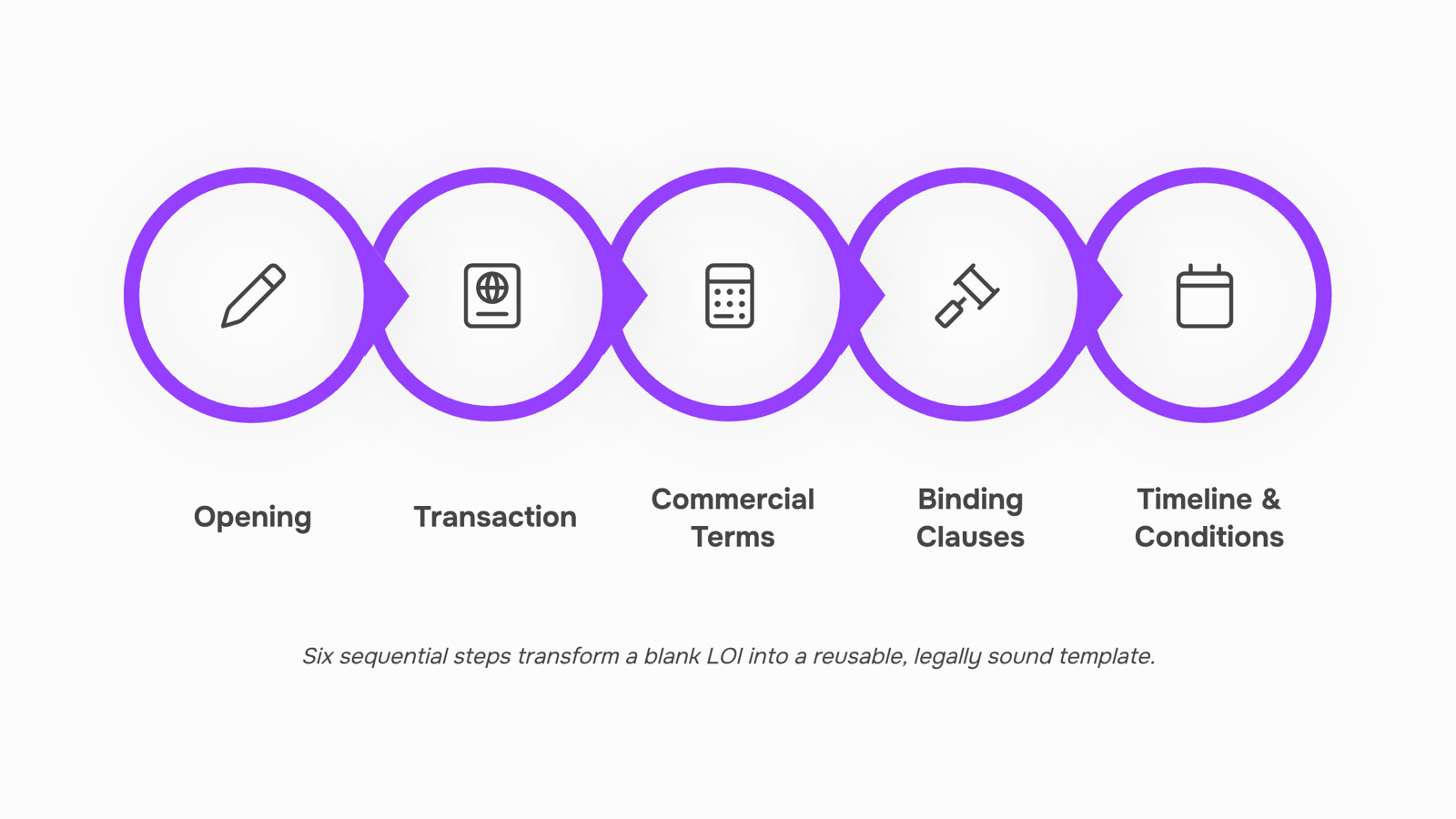
A standard LOI template has six sections. Most are non-binding — they signal intent, not obligation. Two are not, and mixing those up is where deals get complicated.
Opening statement. This identifies the parties, states the purpose of the letter, and sets the date. Keep it one short paragraph. Its only job is to establish who is talking and why.
Transaction or engagement summary. Describe what the deal actually involves: the scope of work, the asset being acquired, or the partnership structure you're proposing. For IT company owners, this is where you'd outline the service engagement or vendor relationship in plain terms. Vague language here creates renegotiation later.
Key commercial terms. Price, payment structure, timeline, and any performance conditions go here. In a letter of intent LOI template for a services deal, this section might list project phases, rate cards, or milestone-based payment triggers. Non-binding, but the more specific you are, the less room there is for a counterparty to reinterpret terms once the formal contract drafting starts.
Due diligence or review period. Both parties agree on how long they have to validate assumptions before committing. Thirty to sixty days is common in commercial deals. Non-binding.
Confidentiality clause. This one is binding by default in most US business LOIs. It prevents either party from disclosing deal terms, financials, or proprietary information shared during negotiations. If you're using a sample loi template you found online, check whether this clause is present and whether it survives termination of the LOI itself — many standard templates omit that survival language.
Exclusivity clause. Also typically binding. It bars the other party from negotiating a similar deal with a competitor for a defined window, usually 30 to 90 days. Sellers and vendors sometimes push back on this; if they do, shorten the window rather than removing it entirely.
Once your LOI converts to a signed agreement, the obligations that carry forward are exactly the ones you made binding here.
How to create a letter of intent template for business in 6 steps
Building your own LOI template takes less time than most people expect. The structure is consistent enough that you can draft a reusable commercial LOI template in a single sitting, then adapt it deal by deal.
Write the opening statement. Identify both parties by legal name, state the purpose of the letter, and confirm the date. One sentence should make clear this is a non-binding expression of intent unless specific clauses say otherwise.
Define the proposed transaction. Describe what is being bought, sold, licensed, or partnered on. For IT service deals, this means naming the scope: managed services, software licensing, implementation work, or a combination. Vague scope here creates disputes later.
State the key commercial terms. Include the proposed price or fee structure, payment schedule, and any equity or revenue-share components. You don't need final numbers, but a range anchors the negotiation and signals good faith.
Add the binding clauses explicitly. Confidentiality and exclusivity are the two clauses most business LOIs make binding by default. Label them clearly. If you want a 30-day exclusivity window, write "30 days from the date of this letter" rather than "a reasonable period."
Set the timeline and conditions. Specify the due diligence period, the target date for a formal agreement, and any conditions that must be met before the deal proceeds. For commercial deals, a 30 to 60-day due diligence window is common. Once the LOI converts, what happens next in the contract stage follows a different set of rules.
Include signature blocks and get countersignature. Both parties sign. If your deal eventually moves toward equity or funding, the LOI often feeds directly into a formal investment agreement. Use consistent signature formatting from the start — best practices for signing documents professionally apply here too.
A free loi template built on this structure handles most standard B2B scenarios. Save it as a base file and edit only the transaction-specific fields each time.
LOI template vs. contract: the key differences
Most people treat these two documents as interchangeable. They are not, and confusing them at the wrong deal stage is expensive.
An LOI (letter of intent) establishes intent and frames the deal. A contract creates binding legal obligations. The practical difference shows up across four dimensions:
Dimension | LOI | Contract |
|---|
Legal enforceability | Mostly non-binding, except confidentiality and exclusivity clauses | Fully binding on all parties |
Detail level | High-level terms, ranges, and conditions | Precise figures, reps, warranties, remedies |
Timing in the deal cycle | Early stage, before due diligence | After due diligence, ready to close |
Revision cost | Low — redlines are expected | High — changes trigger legal review and delay |
The enforceability point trips up most first-time users of a letter of intent LOI template. The whole document looks informal, so people assume nothing in it sticks. In reality, confidentiality and exclusivity provisions are routinely upheld in US courts even when the rest of the LOI is explicitly non-binding.
A sample LOI template is the right tool when you need to lock in shared understanding before spending money on attorneys. Once due diligence closes and terms are agreed, move to a contract. The distinction matters the same way it does when choosing between a payment contract and a payment agreement.
Using an LOI template for real estate transactions
A real estate LOI follows the same core structure as a business LOI — parties, deal summary, exclusivity, confidentiality, and a non-binding disclaimer — but three fields need property-specific detail that a generic loi template won't include by default.
Purchase price and earnest money deposit: State the amount and the escrow deadline.
Due diligence period: Commercial deals typically run 30 to 60 days. Name the start date and what triggers it.
Closing date: Tie it to a specific calendar date, not a vague "within 90 days."
If you're using an loi template free version you found online, check that it has all three. Most don't.
Involve a real estate attorney before you send. Once the LOI leads into a formal purchase agreement, what should be included in an investment agreement becomes the next question to answer. Confidentiality and exclusivity clauses are typically enforceable even in a non-binding LOI, so the language matters from day one.
Common mistakes that weaken an LOI
Four errors show up repeatedly in a commercial LOI template before it ever reaches the other party.
Vague exclusivity terms. "Exclusive negotiations" without a defined end date leaves both sides guessing. Specify the period: 30 or 60 days is standard.
No termination clause. Without one, either party can walk away on unclear terms. State the notice requirement and what happens to shared materials.
Contract-style language. Phrases like "shall be obligated to" signal binding intent. Courts have enforced LOIs written this way. Use "intends to" instead.
No version control. Sending LOI_final_v3_REVISED.docx creates confusion fast. Number versions and date every draft before signing and countersigning your LOI.
Store and reuse your LOI template in one place
Version drift is the quiet killer of LOI accuracy. When your sales team pulls a sample LOI template from a shared drive, they often grab the wrong version, one missing the termination clause you added last quarter or still using the old exclusivity language.
The fix is a single live blueprint. Store your LOI template inside a document management system where every field, clause, and version note lives in one place. Sigi Blueprints lets you lock in your approved structure so anyone generating a new LOI starts from the right foundation, not a stale copy.
Pair that with Lio's Document Attachments to attach the active template directly to the deal record, so the right document reaches the right stage automatically.
Closing
An LOI template only works if every deal starts from the same clean version—vague language in one section cascades into renegotiation across the entire formal contract. The six-step process above gives you a reusable structure, but the real payoff comes when you store that finalized template somewhere your sales team actually uses it. Save your LOI template to Sigi's document Blueprints so every deal begins from a consistent baseline, then attach it to the lead record in Lio before the first call. That single move keeps your team aligned on what was promised and what still needs clarification. Ready to stop rebuilding your LOI from scratch each time?
FAQ
What should be included in a letter of intent template?
Opening statement, transaction summary, key commercial terms, due diligence period, confidentiality clause (binding), and exclusivity clause (binding). Specificity in scope and pricing prevents renegotiation later.
How do I create a letter of intent template for business?
Write the opening, define the transaction, state commercial terms, label binding clauses (confidentiality and exclusivity), set timeline and conditions, then add signature blocks. Save as a reusable base and edit only deal-specific fields.
What is the difference between a letter of intent template and a contract?
An LOI signals intent with mostly non-binding clauses; a contract creates legal obligations. Only confidentiality and exclusivity clauses in an LOI are typically enforceable.
Can I use a letter of intent template for real estate transactions?
Yes, but real estate LOIs have different legal standards by state. Consult a real estate attorney to ensure your template complies with local law before using it.
Is a letter of intent legally binding?
Most clauses are non-binding, but confidentiality and exclusivity are typically enforceable by default. Label them clearly to avoid confusion.
How long should a letter of intent be?
One to two pages. Keep it concise—LOIs signal intent, not legal detail. Formal contracts handle the complexity.


 Elena Petrova15 September 2026


