What contingency plan meaning actually covers

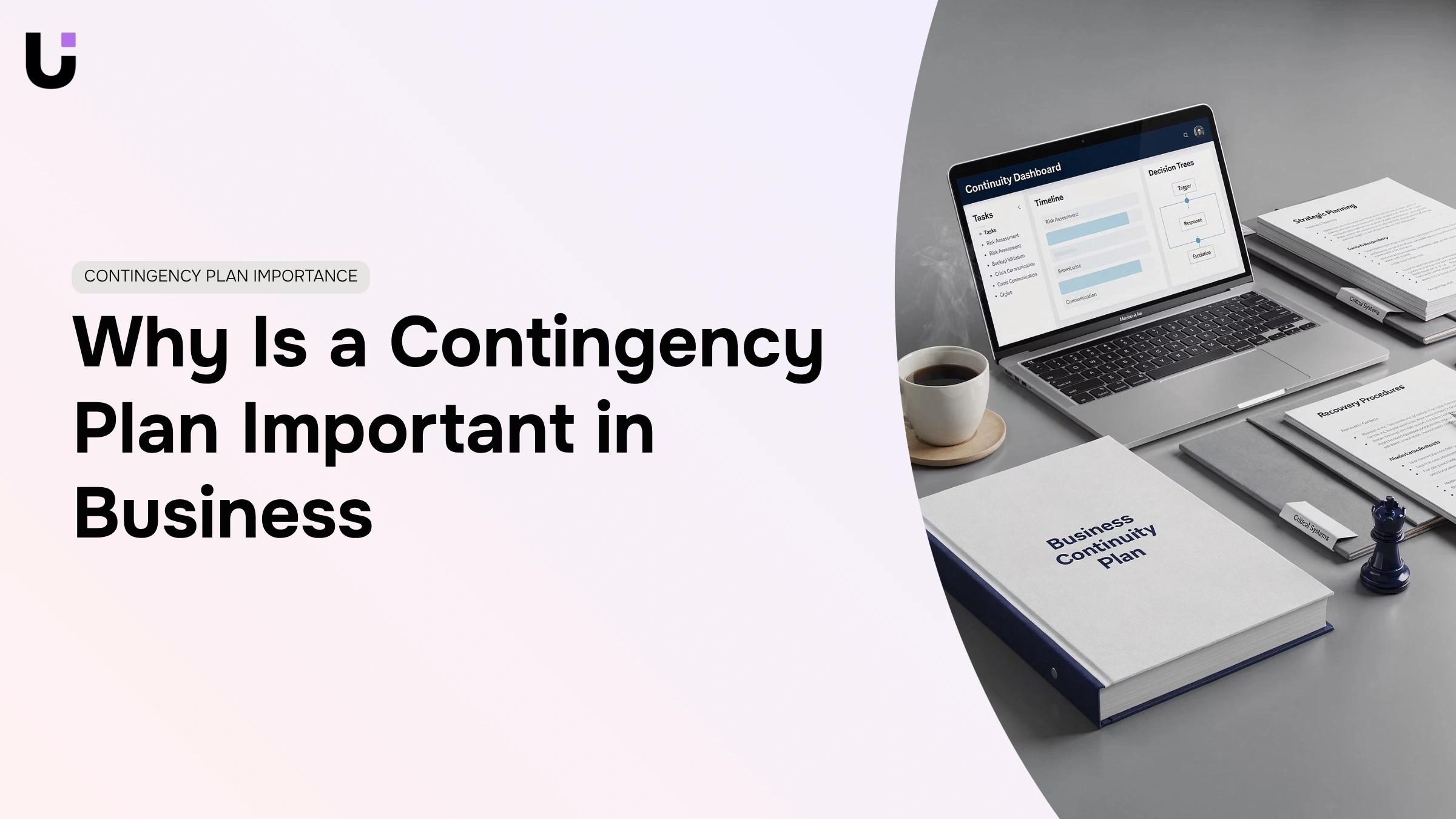
Modern business workspace showing strategic contingency planning documents and flowcharts on a monitor
A contingency plan is a documented, trigger-based response to a specific risk event. That last part matters: it activates when a named condition occurs, not when things feel uncertain. That distinction separates it from a general backup plan, which is vague about when and how it kicks in, and from a risk register, which identifies threats without prescribing action.
In a contingency plan business context, the structure follows a simple logic: if X happens, your team does Y, using Z resources, within a defined timeframe. A vendor goes dark two days before a client delivery. A key engineer resigns mid-sprint. A cloud provider has an outage during a product launch. Each scenario gets its own response path, not a generic "we'll figure it out."
This is also where contingency planning parts ways with risk management broadly. Risk management maps what could go wrong. A contingency plan tells your team exactly what to do once it has.
The plan covers more than technical failures too. Personnel changes, vendor breaches, and banking system failures all qualify as contingency scenarios (ncontracts.com).
The next section covers why having that specificity translates directly into client trust, revenue protection, and team clarity when pressure hits.
Why a contingency plan matters for your business
Most IT projects don't fail because the work was bad. They fail because something unexpected happened and no one had a clear answer for what to do next.
A contingency plan gives your business that answer before the question becomes urgent. The difference between a team that recovers in hours and one that loses a client over a disruption often comes down to whether a documented response existed.
Here's what that looks like in practice across four real business outcomes:
- Client trust: When a key integration breaks mid-project, a contingency plan tells your team exactly who communicates with the client, what they say, and by when. Clients don't expect perfection; they expect competence under pressure.
- Revenue protection: Unplanned disruptions don't just delay delivery, they trigger penalty clauses, emergency contractor costs, and scope renegotiations. A risk mitigation contingency plan caps those losses by shortening the window between problem and response.
- Team clarity: Without a plan, pressure produces guesswork. With one, your team knows their role the moment a trigger condition is met. That's the difference between a two-hour recovery and a two-day scramble.
- Operational continuity: A contingency plan business owners can actually use keeps critical services running while the fix is in progress, rather than pausing everything while leadership decides what to do.
Understanding what the contingency planning process looks like end-to-end helps you see why each of these outcomes depends on having the right structure in place, not just good intentions. For a broader view of where this fits, effective risk management solutions cover the full landscape.
Key elements every contingency plan needs
A contingency plan without defined structure is just a list of good intentions. These five elements are what separate a plan that works under pressure from one that gets ignored when things go wrong.
- Trigger conditions: Every plan needs a clear threshold that activates it. "If the primary vendor misses two consecutive delivery milestones" is a trigger. "If something goes wrong" is not. Specificity here is what prevents the plan from sitting unused while a crisis escalates.
- Response actions: A step-by-step sequence of what happens once the trigger fires. Each action should be concrete enough that someone unfamiliar with the project could execute it. Vague instructions ("coordinate with the team") create delays at exactly the wrong moment.
- Named owners: Every action needs one person responsible for it, not a role or a department. If two people share ownership, no one owns it. This is the element most plans skip, and the one that causes the most confusion when a real disruption hits.
- Communication steps: Who gets notified, in what order, and through which channel. This covers both internal stakeholders and external ones, including clients. The contingency planning process breaks down how communication sequencing differs depending on the type of risk event.
- Review cadence: A plan written once and filed away degrades fast. Triggers become outdated, owners change roles, and response steps stop matching the actual environment. Quarterly reviews are a reasonable baseline for most IT projects; high-stakes engagements may need monthly checks.
For a broader look at how these elements fit into risk management solutions for IT businesses, the linked piece covers complementary tools and frameworks worth pairing with your plan.
How to create a contingency plan for your project in 6 steps
Building a contingency plan from scratch feels harder than it is. The process breaks into six steps, each one feeding the next. Work through them once on a real project and the pattern becomes repeatable.
Step 1: Identify your risks
List every event that could derail the project. For an IT team, that means server failures, key developer departures, vendor API outages, and scope changes from the client. Don't filter yet — volume matters at this stage. The goal is a complete threat inventory, not a tidy one.
Step 2: Assess likelihood and impact
Score each risk on two axes: how likely it is to occur, and how badly it would hurt the project if it did. A simple 3×3 matrix (low/medium/high for each) works for most teams. This step is the foundation of any solid risk mitigation contingency plan — it tells you where to spend your planning energy.
Step 3: Define your trigger conditions
For each high-priority risk, write a specific trigger: the observable event that activates the contingency plan. "If the cloud hosting provider reports an outage exceeding two hours" is a trigger. "If things go wrong with hosting" is not. Precise triggers remove ambiguity when the pressure is on. This is the step most teams skip, and it's why their contingency plans sit unused when a crisis hits.
Step 4: Write the response actions
Document the exact steps your team takes once a trigger fires. Assign a named owner to each action, not a role or department. For the hosting outage example: the infrastructure lead initiates failover to the backup environment within 30 minutes, the project manager notifies the client within one hour, and the team lead updates the incident log. Specificity here is what separates a plan from a checklist. The contingency planning process works best when every action has a single accountable person behind it.
Step 5: Set your communication steps
Decide in advance who gets notified, through which channel, and on what timeline. Clients, internal stakeholders, and affected team members often need different messages. Write templates now so no one is drafting communications under stress.
Step 6: Schedule a review cadence
A contingency plan written in January is outdated by March on most IT projects. Build in a review at each major project milestone or at minimum once per quarter. Update trigger conditions and owners whenever the project scope or team changes.
These six steps cover the key elements of a contingency plan without overcomplicating the process. If you want to go deeper on how to create a contingency plan for a project across multiple workstreams, the best risk management approaches for IT businesses are worth reviewing before you finalize your template.
Contingency plan vs risk management plan: what is the difference
These two tools are often used interchangeably, but they solve different problems at different points in time.
Risk management is proactive: you identify threats before they occur and work to reduce their likelihood or impact. A contingency plan is reactive: it defines the specific steps your team takes once a risk event has already triggered. As CFO Strategies puts it, contingency planning is about preparing specific steps to take after a risk event occurs, while risk management focuses on identifying and mitigating potential risks.
Neither replaces the other. You need both working in sequence.
| Dimension |
Risk management plan |
Contingency plan |
| Timing |
Before an event |
After a trigger fires |
| Goal |
Reduce probability or impact |
Execute a pre-built response |
| Scope |
All identified risks |
Specific high-priority scenarios |
| Ownership |
Risk manager or PMO |
Named incident owner per scenario |
| Trigger |
Ongoing monitoring |
Defined threshold or failure event |
The practical implication: if your team only has a risk register and no response playbook, you have half the system. For a deeper look at how the two connect in practice, see what is the contingency planning process.
Common mistakes that make contingency plans useless
Most contingency plans fail before a disruption ever happens. The failure is usually one of four structural problems.
- No named owner: If the plan doesn't assign a specific person to each response step, everyone assumes someone else is handling it. Under pressure, that assumption costs hours.
- No defined trigger: A plan that says "activate if the project is at risk" is not a plan. The trigger needs to be specific: a missed milestone by more than two days, a vendor going dark for 24 hours, a key resource becoming unavailable. Vague language guarantees hesitation at exactly the wrong moment.
- The plan lives in a document no one reads: This is the most common failure in contingency plan business contexts. If your response steps aren't visible inside the tools your team uses daily, the plan effectively doesn't exist.
- Vendors and contractors are excluded: As PM Alliance notes, leaving external dependencies out of the plan creates blind spots that surface at the worst time.
Before you learn how to create a contingency plan for a project, audit whether your current one has any of these gaps.
How to track your contingency plan inside your project work
- A contingency plan only works if your team can find it when things go sideways. A document sitting in a shared drive fails the contingency planning process the moment a trigger fires and no one remembers where it lives.
- The better approach: attach contingency tasks directly to the sprint or project phase they protect. When a risk trigger fires, the response task is already in the queue, with an owner and a due date.
- Taro handles exactly this, sitting contingency actions alongside active project work so your risk mitigation contingency plan never drifts from the work it covers.
Closing
A contingency plan stops being theoretical the moment a trigger fires—and that's when your team discovers whether the plan actually works or sits buried in a document no one can find. The six-step framework turns vague risk awareness into concrete, assigned actions with clear owners and communication sequences. Your team now knows exactly who does what, when, and why.
But a plan only works if it's visible when you need it. That's why the best contingency plans live inside your active project board—not in a separate folder—so trigger conditions, owners, and response steps are right there alongside the work happening today. Start a free trial of Taro to see how contingency tasks and active project work sit on the same board, keeping your response plan actionable instead of forgotten.
FAQ
Q. Why is a contingency plan important in business?
A. A contingency plan turns crisis response from guesswork into documented action, protecting revenue, maintaining client trust, and keeping teams clear on their roles when pressure hits. The difference between a two-hour recovery and a two-day scramble often comes down to whether a response existed in advance.
Q. What are the key elements of a contingency plan?
A. Every plan needs: specific trigger conditions that activate it, step-by-step response actions, named individual owners (not roles), communication steps with defined sequences, and a review cadence to keep it current as your environment changes.
Q. How do I create a contingency plan for my project?
A. Identify all risks, score them on likelihood and impact, define precise trigger conditions, write specific response actions with named owners, set communication steps, and assign a review schedule. Work through these six steps once on a real project and the pattern becomes repeatable.
Q. Can a contingency plan help mitigate risks?
A. Yes. A contingency plan caps losses by shortening the window between problem and response, preventing penalty clauses and emergency costs. It keeps critical services running while fixes are in progress instead of pausing everything while leadership decides what to do.
Q. What is the difference between a contingency plan and a risk management plan?
A. Risk management identifies what could go wrong; a contingency plan prescribes exactly what your team does once it has. A contingency plan is trigger-based and action-oriented, while risk management is broader and preventive.
Q. How often should you review and update a contingency plan?
A. Quarterly reviews are a reasonable baseline for most IT projects; high-stakes engagements may need monthly checks. Plans degrade fast as triggers become outdated, owners change roles, and response steps stop matching your actual environment.



 Ryan Mitchell07 August 2026


