TL;DR: Most content on the importance of time management stops at personal productivity tips. This piece connects individual habits to team-wide outcomes — showing IT company owners exactly how scheduling decisions compound into missed deadlines, billing gaps, and resource conflicts across multiple projects. You'll get a framework you can apply to your own operation, not just a list of reasons to use a calendar.
What is time management and why does it matter?
Time management is the practice of deciding in advance how your working hours get allocated — and then protecting those decisions against interruption, scope creep, and reactive work.
Most writing on this topic treats it as a personal discipline problem: you need better habits, a tighter morning routine, a new app. That framing misses the business reality. When one person on your team consistently misallocates their hours, the downstream effect hits everyone — missed handoffs, delayed deliverables, and bottlenecks that compound across the sprint.
The importance of time management at the team level is structural, not motivational. Research from McKinsey suggests knowledge workers spend a significant portion of their week on low-value or unplanned tasks — work that crowds out the high-impact output your clients actually pay for.
Time management and productivity are directly linked because focused, intentional hours produce better work in less time. But that connection breaks down the moment a team has no shared system for prioritization. Individual effort without team-level structure is just busy work distributed unevenly.
If your team struggles with how to prioritize daily tasks when everything feels urgent, that is a systems gap, not a character flaw. The sections ahead cover the mechanism behind that gap and the specific fixes that address it at the team level, not just the individual one.
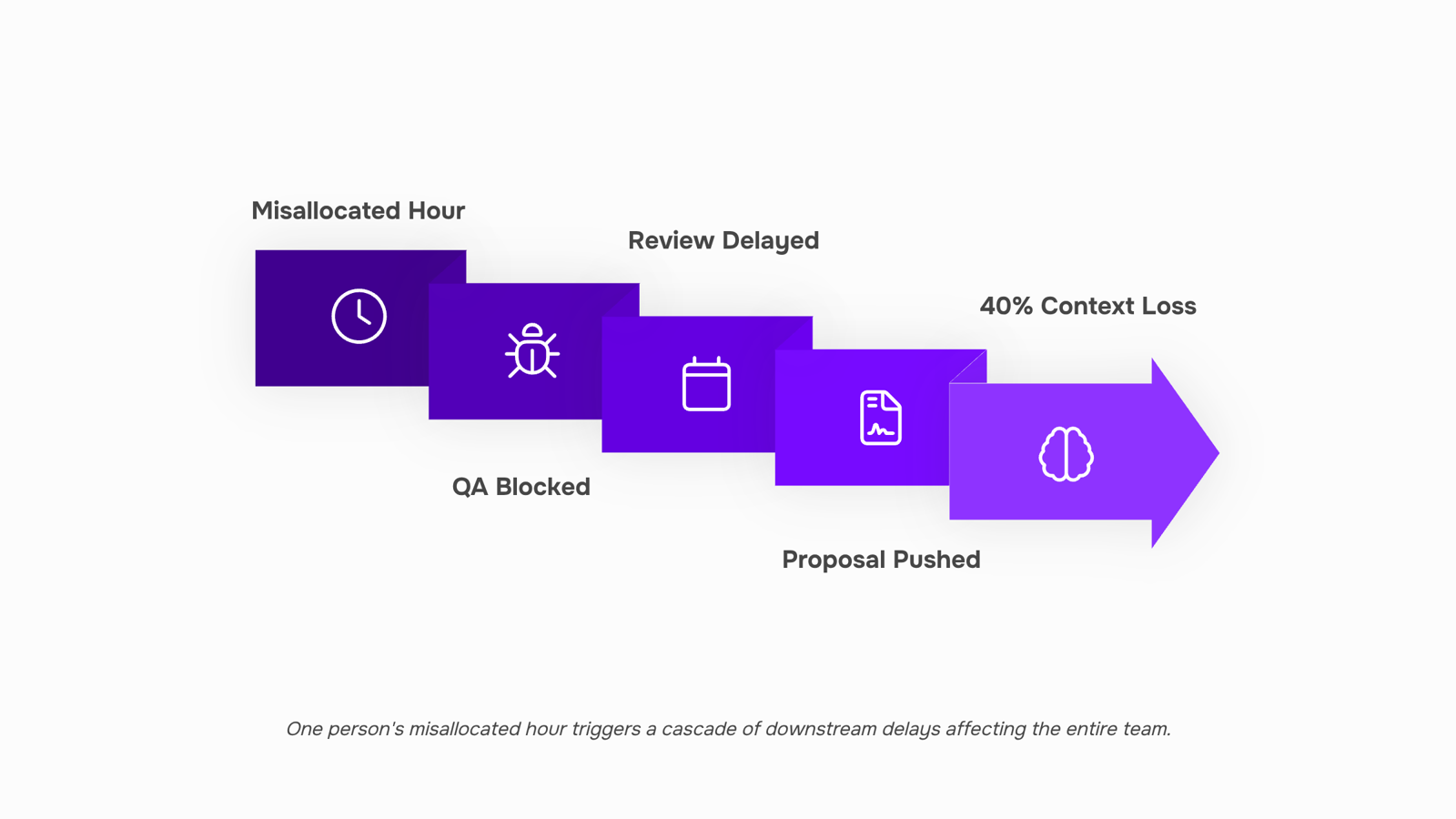
How poor time management compounds into team-wide delays
One missed deadline rarely stays contained. When a developer spends Tuesday morning on low-priority email threads instead of unblocking a QA handoff, the tester's afternoon is gone before they start. The project manager then reschedules a client review. The account lead pushes a proposal. By Friday, four people have lost billable hours because one person's morning was misallocated.
This is the compounding mechanism that makes the importance of time management in the workplace a business problem, not a discipline conversation. Individual misallocation creates sequential dependencies that fail downstream. Most teams treat the symptom — the missed deadline — rather than the cause: hours that were never protected in the first place.
Context switching makes it worse. Research from the American Psychological Association shows that switching between tasks can cost as much as 40% of productive time, not because people are slow, but because reorientation has a real cognitive cost. Multiply that across a five-person team and you're losing the equivalent of two full workdays every week.
The fix isn't telling everyone to "manage their time better." It starts with identifying which roles create the most downstream dependency when they're behind, then protecting those hours structurally. Time management techniques that work in practice tend to focus on exactly this: building buffers around high-dependency work before the bottleneck forms.
If your team is managing time across multiple projects simultaneously, the compounding risk is even higher — and the structural fix becomes non-negotiable.
Key benefits of effective time management in the workplace
The importance of time management shows up most clearly in outcomes you can measure, not in how organized someone's calendar looks.
Higher output on work that matters: Research from McKinsey found that knowledge workers spend roughly 28% of their week on email and another 14% on uncoordinated communication. Structured time allocation pulls hours back toward high-value work, which is where productivity gains actually compound.
Fewer downstream delays for the whole team: When one person consistently misses handoffs, the bottleneck spreads. Effective time management at the individual level keeps dependent tasks moving on schedule, reducing the idle time other team members absorb while waiting.
Lower stress and burnout risk: Predictable workloads and clear daily priorities reduce the cognitive load that accumulates when tasks feel uncontrolled. The next section covers the research on this in detail, but the pattern is consistent: structure reduces anxiety, not just lateness.
Better decision quality: Rushed decisions made at the end of an overloaded day carry higher error rates. When you protect time for thinking, not just doing, the quality of judgment improves across the board.
Stronger accountability across the team: Time management is also a communication tool. When team members plan and share their capacity honestly, ownership gaps surface early instead of at the deadline.
These five benefits of time management stack. Better individual planning reduces team friction, which reduces stress, which improves judgment, which strengthens accountability. If you want to build the habits that drive these outcomes, the best time management techniques for productivity covers the methods worth prioritizing first.
The connection between time management and stress is direct, not incidental. When tasks pile up without a clear order of priority, your brain treats every item as urgent. That sustained pressure activates the same stress response as a genuine emergency, and over time it compounds into burnout. Research from the APA consistently links poor time management to elevated cortisol levels and reduced cognitive recovery between work sessions.
The performance side is equally measurable. Context switching — moving between unplanned tasks without completing them — costs roughly 40% of productive capacity, according to APA research on task interruption. That's not a motivation problem. It's a structural one. When your day lacks a defined sequence, you're not just slower; you're making more errors and recovering from them longer.
The importance of time management shows up most clearly at the team level. One person's unstructured schedule creates downstream pressure: missed handoffs, compressed review windows, and reactive work that crowds out planned output. Individual time management and team-level time management are different problems, and most guidance conflates them.
The fix is structural, not motivational. Time management techniques that work in practice — like timeboxing focused work hours or prioritizing daily tasks when everything feels urgent — reduce stress by removing the ambiguity that causes it. Fewer open loops means lower cognitive load, which directly improves both accuracy and throughput.
Can good time management improve work-life balance?
Yes — and the mechanism is specific, not motivational.
When you define clear end times for work tasks, you create a hard boundary that unplanned work has to push against. Without that boundary, low-priority requests and unfinished tasks expand into evenings and weekends by default. That's not a discipline problem; it's a structural one.
The practical fix is time blocking: assign every category of work (client calls, deep work, admin) a fixed slot in your calendar. When those slots fill, new requests move to tomorrow. This is one of the time management techniques that work in practice that consistently separates teams who protect personal hours from those who don't.
For IT company owners specifically, the overflow usually starts with unplanned interruptions during the day. Each interruption pushes scheduled work later, which pushes it past business hours. Timeboxing as a structured way to protect focused work hours addresses exactly this: cap each task at a fixed duration so the day stays on track.
The benefits of time management here are concrete: fewer late nights, cleaner handoffs, and a work-life balance that doesn't depend on willpower.
How time management works in real IT team workflows
Two scenarios show the difference most clearly.
Sprint planning without structure: A five-engineer team kicks off a two-week sprint with tasks assigned but no time estimates attached. By day eight, two engineers are buried in unplanned bug fixes while a client-facing feature sits idle. Nobody flagged the drift early because there was no baseline to compare against. The sprint ships late, the client escalates, and the team lead spends Friday in damage-control calls instead of planning the next cycle. This is where the importance of time management in the workplace stops being abstract — one team's untracked hours become a client relationship problem.
Client project delivery with structure: The same team, next quarter, runs sprint planning through Taro's task management layer. Each task carries a time estimate, an owner, and a priority tier. When the bug fixes land mid-sprint, the lead can see in real time which tasks are at risk and re-allocate before the deadline slips. The client gets a status update grounded in actual progress, not a guess.
The pattern holds for client project delivery more broadly. Teams that map time to specific deliverables before a project starts catch scope creep in week two, not week six. Teams that don't tend to compress the final phase, which is where quality drops and overtime spikes.
Time management and productivity are connected at the team level through visibility. Individual effort matters, but without shared time allocation, effort doesn't compound — it collides.
How AI is changing time management for teams in 2026
Three shifts are reshaping how IT teams handle time in 2026, and they matter precisely because the importance of time management compounds at the team level, not just the individual one.
Automated time logging removes the manual friction of tracking where hours actually go. Instead of engineers self-reporting at end-of-week (when memory is unreliable), AI tools capture activity patterns in real time and surface where billable work is leaking into unplanned requests.
AI task prioritization changes how backlogs get sequenced. Rather than a team lead manually sorting tickets by gut feel, the system weighs deadline proximity, dependency chains, and current workload before recommending what gets done next. For IT owners managing time across multiple projects simultaneously, this cuts the daily triage meeting from 30 minutes to a quick confirmation.
Workload forecasting is the most underused of the three. It flags capacity gaps before a sprint starts, not after someone is already overloaded. That's where the connection between time management and productivity becomes structural rather than personal.
Taro's built-in AI handles all three inside one workspace, so the data feeding each layer stays consistent rather than scattered across separate tools.
If your team is still deciding which prioritization method fits your workflow, how to prioritize daily tasks when everything feels urgent covers the practical tradeoffs.
Closing
Time management isn't a personal discipline problem — it's a visibility problem. Teams that protect their hours do so because they can see where time actually goes, not because individuals are more motivated. When one person's schedule slips, the bottleneck spreads across the entire team: missed handoffs, compressed review windows, cascading delays. The fix isn't better willpower; it's a system that surfaces which roles create downstream dependency, where context switching is eating your week, and which tasks are genuinely high-value versus just urgent.
The structural approach works because it removes guesswork. Instead of hoping your team will self-manage better, you build visibility into task allocation, time logs, and workload capacity in one place — so decisions are based on data, not intuition. Ready to see where your team's time is actually going? Start by mapping one week of your highest-dependency role's schedule and identify where reactive work is crowding out planned output.
FAQ
Why is time management important for productivity?
Focused, intentional hours produce better work in less time. Without team-level structure, individual effort becomes uneven busy work. McKinsey research shows knowledge workers spend 28% of their week on email and 14% on uncoordinated communication — time that should drive client value.
How does good time management impact stress levels?
Clear priorities and protected time reduce the cognitive load that triggers sustained stress responses. APA research links poor time management to elevated cortisol and reduced recovery. Structure removes ambiguity; fewer open loops mean lower anxiety.
What are the benefits of effective time management in the workplace?
Higher output on work that matters, fewer downstream delays, lower burnout risk, better decision quality, and stronger accountability. These stack: better planning reduces friction, which reduces stress, which improves judgment.
Can good time management skills improve work-life balance?
Yes. Defining clear end times and protecting focused work hours removes the open-loop anxiety that bleeds into personal time. Predictable workloads let you actually disconnect.
How does time management affect overall job performance?
Context switching costs roughly 40% of productive capacity and increases error rates. Structured time allocation keeps dependent tasks moving, reduces idle time, and improves accuracy. Performance gains compound across the team.


 Elena Petrova11 September 2026


