TL;DR: Most rank tracking guides blame inaccurate data on tool limitations and leave you guessing which ones matter. This one names the four specific mechanisms that cause data drift in traditional trackers and shows how AI addresses each one, organized into the RANKO Precision Framework. IT company owners get a measurable evaluation standard, not a feature checklist.
Why rank tracking data is less accurate than you think
Most rank tracking dashboards show you a number. What they rarely show you is how unreliable that number is.
Four structural problems sit underneath almost every traditional rank tracker, and they compound each other quietly.
Stale crawl intervals: Most tools check keyword positions once every 24 to 72 hours. A lot changes in that window: algorithm updates, competitor content pushes, news events that reshuffle results. By the time your dashboard refreshes, you're looking at history, not position. How traditional and AI-powered rank trackers compare on real-world accuracy illustrates exactly how wide that gap gets in practice.
Personalization bleed. Google personalizes results based on location, search history, device, and logged-in account signals. When a tracker queries from a fixed IP or a logged-in account, it captures a personalized SERP, not the neutral one your target audience sees. That's personalization bias in rank tracking, and it can shift reported positions by several places for competitive keywords without anyone noticing.
SERP feature blindness: Google SERPs now include at least one SERP feature on the vast majority of queries: featured snippets, People Also Ask boxes, AI Overviews, local packs. A traditional rank tracker that reports "position 4" without noting that positions 1 through 3 are occupied by a featured snippet and a local pack is giving you an incomplete picture. Organic rank and visible rank are not the same thing.
Google-only scope: This is the traditional rank tracker limitation that almost no tool addresses. Search behavior now spans ChatGPT, Claude, Perplexity, and Gemini. If your tracker ignores those surfaces, you're blind to a growing share of discovery. Daily AI mention tracking across ChatGPT, Claude, Perplexity, Gemini, and Google AI Overviews is what fills that gap.
Each of these failures distorts AI rank tracking accuracy in a different direction. The next section covers the mechanisms that fix them.
How AI-powered rank tracking works differently
Traditional rank trackers run on a fixed crawl schedule, typically checking positions once every 24 hours or less frequently for lower-tier plans. That interval is the first thing AI-powered rank tracking changes.
Instead of scheduled crawls, AI systems sample SERPs continuously, triggering re-checks when ranking signals shift rather than waiting for a calendar event. This keeps rank tracking data freshness tied to actual SERP volatility, not an arbitrary clock.
The second mechanism targets personalization. When a traditional tracker queries Google from a fixed IP, Google's personalization layer adjusts results based on location, search history, and device signals. AI systems rotate queries across anonymized, geographically distributed nodes and strip session-level signals before recording a position. The result is a baseline that reflects what an uninfluenced searcher actually sees, not what your logged-in account sees.
Third is SERP feature detection. As of recent data, the majority of Google SERPs now include at least one feature — a featured snippet, People Also Ask box, local pack, or AI Overview — yet most traditional trackers report only the blue-link position. AI parsers read the full SERP structure, classifying each element and recording whether your content holds a feature slot, not just a numbered rank.
The fourth mechanism is the one traditional tools ignore entirely: answer engine polling. AI rank tracking queries ChatGPT, Claude, Perplexity, Gemini, and Google AI Overviews directly, then checks whether your domain appears as a cited source. You can see daily AI mention tracking across ChatGPT, Claude, Perplexity, Gemini, and Google AI Overviews as a live example of this in practice.
Each mechanism addresses one of the four failure modes the previous section named. The next section puts numbers to that gap.
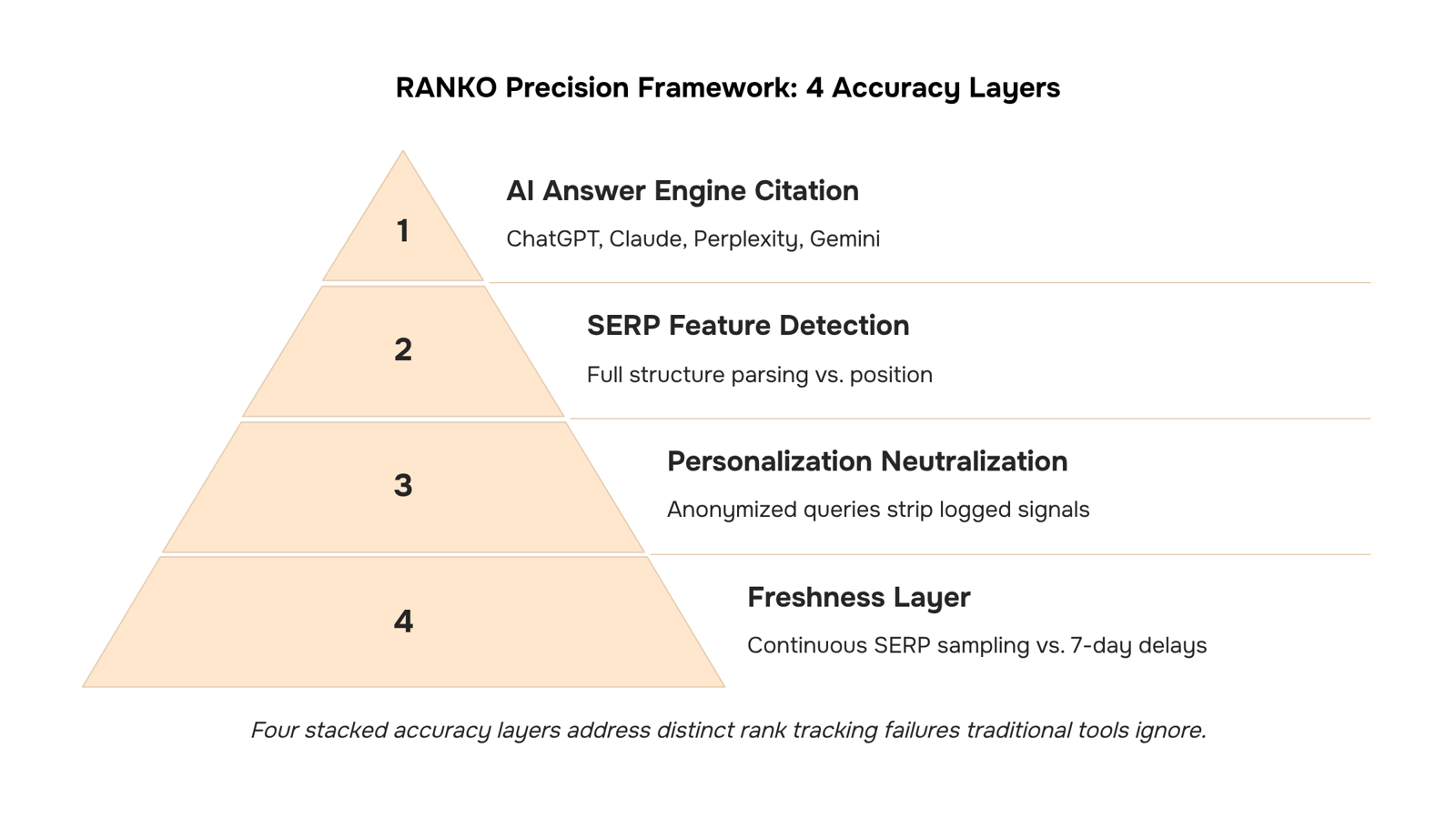
The RANKO Precision Framework: 4 accuracy layers explained
The RANKO Precision Framework organizes AI rank tracking accuracy into four distinct layers, each targeting a specific failure mode that traditional trackers leave unaddressed. Together they close the gap between what a rank tracker reports and what a searcher actually sees.
Layer 1: Freshness Layer
Traditional trackers crawl on fixed schedules, often every 7 days or longer. The Freshness Layer replaces that with continuous SERP sampling, catching ranking shifts within hours rather than days. For volatile queries (news, product launches, algorithm updates), that gap is where bad decisions get made.
Layer 2: Personalization Neutralization Layer
A rank reported from a logged-in, location-specific browser is not the same as the rank a cold searcher sees. Personalization bias in rank tracking is one of the most underreported sources of error in the industry. This layer rotates anonymized queries across clean sessions and geographic proxies to strip that signal out, reporting the position a real first-time visitor would encounter.
Layer 3: SERP Feature Detection Layer
Ranking position 3 means something different when a featured snippet, People Also Ask block, or AI Overview sits above it. Research suggests over 65% of Google SERPs now include at least one SERP feature, which means a raw position number without feature context is incomplete data. The SERP feature detection layer parses the full SERP structure, tagging each result against the features present so you know whether your position 3 is actually visible or buried below the fold.
Layer 4: AI Answer Engine Citation Layer
This is the layer no traditional tracker includes. As AI assistants (ChatGPT, Perplexity, Gemini) answer queries directly, the question isn't just "where do I rank on Google?" It's "am I being cited at all?" The AI Answer Engine Citation Layer polls major answer engines and maps citation presence back to your content, feeding directly into Ranko's Opportunity Score, a 0–100 index that quantifies citation gaps across AI engines so your team knows exactly where to focus.
Benchmark accuracy delta: RANKO vs. traditional trackers
Accuracy dimension | Traditional tracker | RANKO Precision Framework | Delta |
|---|
Ranking freshness | 7-day crawl cycle | Continuous sampling | Up to 6 days faster |
Personalization noise | Uncorrected | Stripped via query rotation | Significant reduction in position variance |
SERP feature context | Position only | Full feature tagging | Complete structural view |
AI citation visibility | Not tracked | Polled across major AI engines | Full gap identified |
Teams using this framework get a materially different picture of their actual search visibility, not just a cleaner spreadsheet. For a concrete look at how teams apply these layers in practice, see how content teams use Ranko to drive results.
What accuracy improvements you can realistically expect
The four-layer framework isn't theoretical. Each layer targets a specific failure mode in traditional rank tracking, and the accuracy gains compound when you run them together.
Here's what that looks like in practice:
Fewer wasted content updates: Personalization bias in traditional trackers causes teams to optimize for rankings that only one logged-in user sees. Neutralizing that signal means you're acting on positions your actual audience experiences, not ghost rankings inflated by your own browsing history.
Faster drop detection: Traditional rank tracker limitations around crawl frequency mean a ranking loss can sit undetected for days. The Freshness Layer surfaces movement within hours, so your team responds before a competitor consolidates the gap.
Visibility into AI citation gaps: Most tools still treat rank tracking as a Google-only problem. The AI Answer Engine Citation Layer gives you an Opportunity Score (0–100) measuring where your content is missing from AI-generated answers across ChatGPT, Claude, Perplexity, and Gemini. You can track daily AI mention tracking across ChatGPT, Claude, Perplexity, Gemini, and Google AI Overviews in one view.
For a direct comparison of how traditional and AI-powered rank trackers compare on real-world accuracy, the benchmark deltas from the previous section give you a ready-made business case. AI rank tracking accuracy improvements aren't incremental — they change which decisions your team makes, and how fast.
How often rank data should refresh to be actionable
Refresh cadence is where most rank tracking setups quietly fail. Traditional crawlers run weekly or every 48–72 hours by default. During a SERP volatility event, that lag means you're reading yesterday's battlefield.
A 48-hour data gap has a concrete cost: if a competitor claims your featured snippet on Monday and your tracker refreshes Wednesday, you've lost two days of recovery time. For high-intent keywords, that's measurable traffic, not a rounding error.
Daily crawling changes the decision window. You can confirm whether a ranking drop is a true signal or a one-day fluctuation before committing to a content rewrite. That distinction alone prevents wasted editorial cycles.
AI-powered rank tracking pushes this further. Rank tracking data freshness matters across more surfaces than Google alone now. AI Overviews, Perplexity, and ChatGPT citations shift independently of organic rankings, sometimes within hours. A tool that only refreshes organic positions daily and ignores AI surfaces is operating with a partial picture.
Daily AI mention tracking across ChatGPT, Claude, Perplexity, Gemini, and Google AI Overviews addresses exactly that gap. For volatile keywords, near-real-time data isn't a premium feature. It's the baseline for acting before the damage compounds.
Evaluating any rank tracking tool against a vendor's feature page is the wrong frame. Evaluate it against the four layers of the RANKO Precision Framework instead.
1. Data freshness: Daily or near-real-time crawling is the baseline. A tool that refreshes weekly can't tell you what changed during a SERP volatility event until the damage is done.
2. Personalization filtering: Rank data pulled from a logged-in, location-specific browser is not your actual SERP position. The tool must strip personalization signals before reporting.
3. SERP feature detection: Over 65% of Google SERPs include at least one feature — featured snippet, People Also Ask, AI Overview, local pack. A tool that only tracks blue-link position misses most of the real estate. Look for explicit SERP feature detection in the reporting layer.
4. AI answer engine citation tracking: This is where most tools stop entirely. If your content is being cited by ChatGPT, Perplexity, or Gemini, that traffic exists outside Google's index. Ranko tracks daily AI mentions across all five major AI engines and surfaces an Opportunity Score showing where citation gaps exist.
A tool that covers all four layers gives you AI rank tracking accuracy. A tool that covers two gives you a partial picture.
Closing
The four layers of the RANKO Precision Framework—freshness, personalization neutralization, SERP feature detection, and AI answer engine citation—each close a specific gap that traditional trackers leave open. Together, they give you a rank tracking dataset that actually reflects what searchers see, not what a scheduled crawler happened to capture. Start by auditing your current tracker against these four dimensions: How often does it refresh? Does it strip personalization? Does it tag SERP features? Does it track AI citations? If you're missing any layer, you're flying blind on a growing slice of your visibility. Ready to see the AI citation layer in action? Check out Ranko's daily AI mention tracking feature—it's the one thing no traditional tracker offers, and it's where the biggest accuracy gap shows up first.
FAQ
How does AI-powered rank tracking work?
AI rank trackers replace fixed crawl schedules with continuous SERP sampling, query rotation to strip personalization, full SERP feature parsing, and direct polling of ChatGPT, Claude, Perplexity, and Gemini. Each mechanism targets a specific failure mode traditional trackers leave unaddressed.
What are the main sources of inaccuracy in traditional rank tracking tools?
Stale crawl intervals (24–72 hours), personalization bleed from fixed IPs, SERP feature blindness (reporting position without context), and Google-only scope that ignores ChatGPT, Claude, Perplexity, and Gemini citations.
How does AI neutralize personalization and location bias in rank data?
AI systems rotate queries across anonymized, geographically distributed nodes and strip session-level signals before recording position. This captures the baseline rank a first-time, uninfluenced searcher actually sees.
How does AI detect SERP features like featured snippets, PAA boxes, and AI Overviews?
AI parsers read the full SERP structure, classifying each element and recording whether your content holds a feature slot. Over 65% of Google SERPs now include at least one feature, so this context is critical to understanding actual visibility.
What is the difference between tracking Google rankings and tracking AI answer engine citations?
Google rankings show position on a SERP; AI answer engine citations show whether your domain is cited as a source in ChatGPT, Claude, Perplexity, or Gemini responses. Both matter—traditional trackers track only Google.
What accuracy improvements can I realistically expect switching from a traditional to an AI rank tracker?
You'll see fresher data (hours vs. days), eliminated personalization noise, complete SERP feature context, and visibility into AI citations. The compounding effect is a materially different picture of actual search visibility.
How often should rank tracking data refresh to be actionable?
Continuous sampling tied to SERP volatility beats fixed schedules. For volatile queries (news, launches, algorithm updates), hourly or sub-daily refresh catches shifts traditional 7-day crawls miss entirely.
What features should I look for in an AI rank tracking tool?
Continuous freshness sampling, personalization stripping via query rotation, full SERP feature tagging, and AI answer engine polling across ChatGPT, Claude, Perplexity, and Gemini. The fourth layer is the differentiator no traditional tracker offers.


 Elena Petrova11 September 2026


