TL;DR: Traditional rank trackers report a position number that tells you nothing about whether your content appears inside an AI-generated answer. This article gives SEO teams a concrete framework, the AEO Visibility Stack, that defines exactly what an AI mode rank tracker must measure across four layers, with benchmark ranges for each so you can set targets and act on gaps.
What AI Mode in search engines actually means
AI Mode is Google's AI-generated answer layer that appears at the top of search results, synthesizing information from multiple sources into a single conversational response. For many queries, it either replaces the traditional blue-link results entirely or pushes them far enough down the page that click-through rates drop significantly.
Traditional rank tracking measures one thing: the position number your domain holds for a given keyword. That model made sense when every search returned a ranked list of ten links. It does not account for what happens when Google generates an answer that cites three sources inline and the user never scrolls to the organic results at all.
The distinction matters because visibility now splits into two separate categories. One is your ranked position. The other is whether your domain is cited inside the AI-generated answer. A site can rank #4 organically and still appear in the AI response, or rank #1 and get ignored by it entirely. How traditional rank tracking software measures position explains why that position number no longer tells the full story.
This is why the category of AI mode rank tracker tools exists. Tracking citation presence inside AI answers requires a different detection method than querying for a position number, which is exactly the gap the next section covers.
Why classic rank trackers miss AI-generated answer visibility
Classic rank trackers do one thing: send a query to Google and record the position of a URL in the blue-link results. That model worked when a #1 ranking meant your page was the first thing a searcher saw. It no longer does.
When Google's AI Mode generates an answer, it pulls citations from across the web and surfaces them inside the generated response, often before any traditional results appear. A domain cited inside that answer gets visibility. A domain sitting at position #3 in the blue links, but absent from the AI-generated response, gets skipped. How traditional rank tracking software measures position shows exactly why that position number tells an incomplete story now.
The blind spot is structural. Legacy tools query for a rank signal that the AI layer does not emit. They return a position number because that is what they were built to capture. They have no mechanism to parse whether a domain appears inside a generated answer, how prominently it is cited, or whether it is cited at all. That gap is growing as AI Mode adoption increases across more query categories.
What you actually need is daily AI mention tracking across ChatGPT, Claude, Perplexity, Gemini, and Google AI Overviews combined with the ability to benchmark your citation rate against competing domains. A best AI mode rank tracker measures both layers. Most tools measure only one.
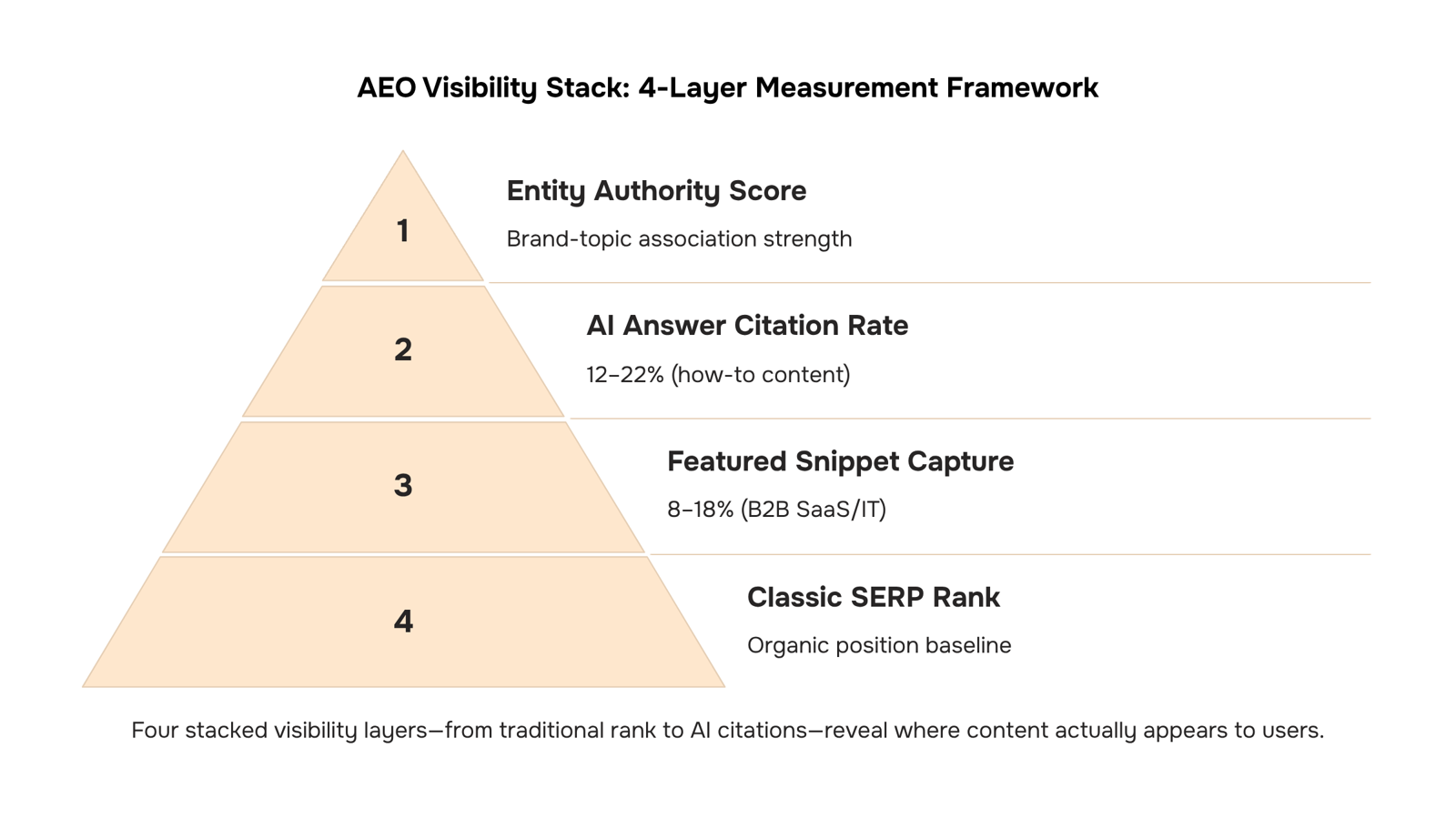
The AEO Visibility Stack: a 4-layer measurement framework
The AEO Visibility Stack organizes your measurement into four distinct layers, each capturing a signal that the others miss. Together they give you a complete picture of where your content appears, whether in a traditional result, a featured position, or an AI-generated answer.
Layer 1: Classic SERP Rank tracks your position for a keyword in standard organic results. It's the baseline every team already measures. The problem is it tells you nothing about what happens above position one.
Layer 2: Featured Snippet Capture Rate measures how often your content wins the boxed answer at the top of a results page. For B2B SaaS and IT services content, a healthy capture rate sits between 8% and 18% of target queries. Below 5% signals that your content structure, specifically headers, definitions, and concise answer paragraphs, needs work.
Layer 3: AI Answer Citation Rate is the layer most trackers ignore entirely. It measures how often your domain is cited inside an AI-generated answer when a user queries a relevant topic. This is the core signal any best ai mode rank tracker tool must surface. Benchmark ranges vary by content type: how-to content typically earns citation rates of 12–22%, listicles 8–15%, product pages 3–8%, and case studies 5–12%. If your how-to content sits below 10%, your content is losing ground to competitors who are being cited in AI Mode results you cannot see with a legacy tool.
Layer 4: Entity Authority Score measures how consistently Google's knowledge graph associates your brand, product names, and key topics with each other. This is not a single metric from one platform; it's a composite read from structured data coverage, Knowledge Panel presence, and co-citation frequency across authoritative domains. A rising Entity Authority Score correlates with improved citation rates at Layer 3, which is why the two layers are tracked together in any serious answer engine optimization service workflow.
Layer | What it measures | Healthy benchmark | Warning sign |
|---|
Classic SERP Rank | Organic position | Top 10 for primary terms | Falling while traffic holds |
Featured Snippet Capture Rate | % of queries winning the box | 8–18% (B2B SaaS/IT) | Below 5% |
AI Answer Citation Rate (how-to) | % cited in AI answers | 12–22% | Below 10% |
AI Answer Citation Rate (product page) | % cited in AI answers | 3–8% | Below 2% |
Entity Authority Score | Brand-topic association strength | Stable or rising | Declining co-citations |
No single layer tells the full story. A domain can rank position two organically while being cited in zero AI answers, which means it is invisible to the growing share of users who never scroll past the AI result. The best online ai mode rank tracker tools surface all four layers in one dashboard so you can see exactly where the gap is.
How to improve your AI Mode visibility in 4 steps
Follow these four steps in order. Each one builds on the last, and skipping ahead will leave you optimizing blind.
1. Audit your current citation rate
Before you change anything, measure where you stand. Pull your last 30 days of AI Overview appearances across your target queries and calculate what percentage of those queries actually cite your content. If you don't have that data yet, daily AI mention tracking across ChatGPT, Claude, Perplexity, Gemini, and Google AI Overviews is the starting point. A citation rate below 15% on how-to content is a signal that Google's AI layer doesn't recognize your pages as authoritative sources, not that your rankings are broken.
2. Identify content gaps against cited competitors
Find out which domains are getting cited on the queries where you aren't. Look at their page structure, entity coverage, and answer format. Are they using structured definitions? Do they cite primary sources? Are they answering the exact question in the first 100 words? This gap analysis is where most teams find the fastest wins. You can benchmark your citation rate against competing domains to see exactly which queries your competitors own in AI answers that you don't.
3. Strengthen entity authority signals
Entity authority is what tells AI systems that your brand, your authors, and your content are credible sources on a topic. Practically, this means consistent structured data (Schema markup for author, organization, and article type), internal linking that reinforces topical clusters, and external citations that connect your content to recognized entities. This is a different optimization target than how traditional rank tracking software measures position — keyword placement matters less than whether the AI can resolve what your content is about.
4. Monitor daily with an AI mode rank tracker tool
AI citation patterns shift faster than traditional rankings. A page that gets cited on Monday can drop out by Thursday after a competitor publishes a stronger answer. The best AI mode rank trackers refresh citation data within 24 hours so you catch those drops before they compound. Tools like Ranko's Page Refresher score existing pages against 18 AI citation criteria and surface side-by-side rewrites, which shortens the gap between spotting a drop and fixing it. For a broader view of how SEO teams are already using AI-native tracking to close the visibility gap, the pattern is consistent: daily monitoring turns reactive fixes into a repeatable system.
What to look for when choosing an AI mode rank tracker
Four capabilities separate a useful AI mode rank tracker from one that just adds a new dashboard to your stack.
Multi-engine citation monitoring is the baseline. If your tracker only watches Google AI Overviews, you're missing citations from ChatGPT, Claude, Perplexity, and Gemini, where a growing share of B2B research actually starts. Daily AI mention tracking across ChatGPT, Claude, Perplexity, Gemini, and Google AI Overviews is what closes the measurement gap, not weekly snapshots.
Entity tracking matters because AI engines cite brands and authors, not just URLs. Your tracker needs to surface whether your company name, product names, and key contributors appear in answers, separate from whether a specific page ranks.
Competitor citation comparison turns raw data into a decision. Knowing your citation rate is 12% means little until you can benchmark your citation rate against competing domains and see which content types they're getting cited for that you aren't.
Daily refresh cadence is non-negotiable. AI answer sets shift faster than traditional SERPs. A tracker refreshing weekly will miss the window where a content update could recover a lost citation. This is where how traditional rank tracking software measures position breaks down for AEO work.
When evaluating the best online AI mode rank tracker options, these four features are the filter. Pricing and UI are secondary.
How Ranko tracks AI citations alongside traditional rankings
Here is what a full Ranko report looks like for a single domain, using a mid-size IT services company as the example.
The dashboard surfaces four data layers simultaneously: traditional keyword positions, Featured Snippet capture, AI Overview inclusion, and direct citations across ChatGPT, Claude, Perplexity, and Gemini. Each layer refreshes daily, so a ranking drop and a citation drop show up in the same morning report rather than separate tools.
For this domain, Ranko's Opportunity Score flagged a gap: the company ranked on page one for three target keywords but appeared in zero AI Overview results for those same queries. The Page Refresher then scored the relevant pages against 18 AI citation criteria and surfaced the specific structural changes needed.
That closed-loop view, keyword rank to AI citation gap to fix, is what separates a true ai mode rank tracker tool from a standard position monitor. See how teams act on this data once the measurement gap closes.
Closing
The shift from position-based visibility to citation-based visibility is not coming—it's here. Your rank tracker must measure all four layers of the AEO Visibility Stack to show you where you actually stand: classic SERP rank, featured snippet capture, AI answer citations, and entity authority. If your current tool reports only position numbers, you're flying blind on the layer that now drives the most qualified traffic.
Start with a citation audit. Run your target queries through daily AI mention tracking across the engines that matter—Google AI Overviews, ChatGPT, Claude, Perplexity, and Gemini—and see where your content is and isn't being cited. That single report will show you whether your gap is a ranking problem or an authority problem, and that distinction changes everything about what you optimize next.
FAQ
What features should I look for in a free AI mode rank tracker?
Look for daily AI mention tracking across multiple engines (Google, ChatGPT, Claude, Perplexity, Gemini), competitor citation benchmarking, and citation rate reporting by content type. Free tools rarely include all four AEO Visibility Stack layers; prioritize AI citation visibility over classic rank position alone.
Can free AI mode rank trackers provide accurate ranking data?
Free tools can track classic SERP rank accurately, but they typically miss AI answer citation data entirely—the layer that now matters most. Accuracy on the citation layer requires real-time parsing of multiple AI engines, which free tools rarely support at scale.
What are the best free AI-powered rank tracking tools?
Most free rank trackers focus on classic SERP position only. Tools claiming AI tracking often lack daily updates across multiple engines or competitor benchmarking. Paid tools with daily AI mention tracking deliver the completeness that free alternatives cannot match.
How do I choose the best free AI mode rank tracker for my website?
Test whether it reports AI answer citations (not just position), covers the engines your audience uses, and benchmarks your citation rate against competitors. If it only reports classic rank, it's not an AI mode tracker—it's a legacy tool with a new label.
Are free AI mode rank trackers suitable for large-scale SEO campaigns?
No. Large campaigns need daily tracking across multiple AI engines, competitor citation analysis, and entity authority signals—all layers of the AEO Visibility Stack. Free tools lack the infrastructure and update frequency to support enterprise-scale measurement.
What signals determine whether a page gets cited in AI Mode answers?
Entity authority (brand-topic association strength), content structure (clear definitions and answer formats), primary source citations, and topical depth. A page can rank #1 organically but get ignored by AI if it lacks these authority signals.
What is a realistic benchmark for AI citation rate by content type?
How-to content: 12–22%. Listicles: 8–15%. Product pages: 3–8%. Case studies: 5–12%. Below 10% on how-to signals that Google's AI layer doesn't recognize your pages as authoritative sources.


 Elena Petrova11 September 2026


