TL;DR: Most rank trackers tell you your position dropped. AI-powered SEO rank tracking tells you why it dropped, what caused it, and what to do before the next shift hits. This article breaks down the mechanics behind intelligent position monitoring and gives IT company owners a concrete framework for turning position data into decisions.
Why Scheduled Polling Misses Most of What Matters
Scheduled polling works like a smoke detector with a dead battery: it tells you the house burned down, not that the stove was left on.
Most traditional rank trackers — including well-known tools in the SEO ranking tracking software category — check positions once every 24 to 72 hours. That cadence made sense when Google's index moved slowly. It doesn't hold up when a core update rolls out across data centers in under six hours and your tracker reports the damage two days later.
The deeper problem isn't frequency. It's that scheduled polling captures position state, not position change. You see where you landed; you don't see the SERP restructuring that moved you, whether a featured snippet appeared, whether a competitor's domain authority spike triggered the shift, or whether the change is permanent or a volatility spike that will self-correct.
SERP change detection requires continuous signal reading, not periodic snapshots. A position drop from rank 4 to rank 9 means something different if it happened alongside a new "People also ask" block than if it happened because a competitor published a stronger page. Intelligent position monitoring separates those two events. Scheduled polling treats them identically.
This is why AI-powered SEO rank tracking requires a different architecture entirely — one that tracks causality, not just coordinates. Competitor movement is one signal layer; algorithm behavior is another. A scheduler reads neither.
The TRACK Framework: Five Stages of AI Rank Tracking
The TRACK Framework breaks AI-powered SEO rank tracking into five sequential stages. Each stage builds on the last, and the point where traditional trackers exit is the point where the real diagnostic work begins.
Stage 1 — Temporal crawling: AI trackers don't poll on a fixed schedule. They adjust crawl frequency based on historical volatility patterns for each keyword. A stable informational term might get checked every 48 hours; a high-competition commercial term gets checked every few hours during a known algorithm flux window.
Stage 2 — Real-time SERP parsing: The crawler captures the full SERP structure: featured snippets, People Also Ask boxes, local packs, AI Overviews, and organic positions. Traditional rank trackers stop here. They record position 4 moved to position 7 and surface that as the finding.
Stage 3 — Anomaly detection: This is where the architecture diverges. Instead of logging the change, the system compares it against cross-domain signals, competitor position deltas, and historical volatility baselines to classify what kind of change occurred. Ranking volatility detection at this stage distinguishes a site-specific drop from a broad SERP reshuffling event. The next section covers this logic in detail.
Stage 4 — Causal attribution: The system maps the detected anomaly to a probable cause: content freshness decay, a competitor's page update, a backlink gain or loss, or an algorithm update signature. Causal attribution SEO means the output isn't "you dropped", it's "you dropped because a competitor added a comparison table and gained three featured snippet triggers in the same cluster."
Stage 5 — Knowledge-loop optimization: Attribution findings feed back into the crawl prioritization model. Keywords that showed high volatility get elevated monitoring. Content clusters that responded well to specific changes get flagged as replication candidates.
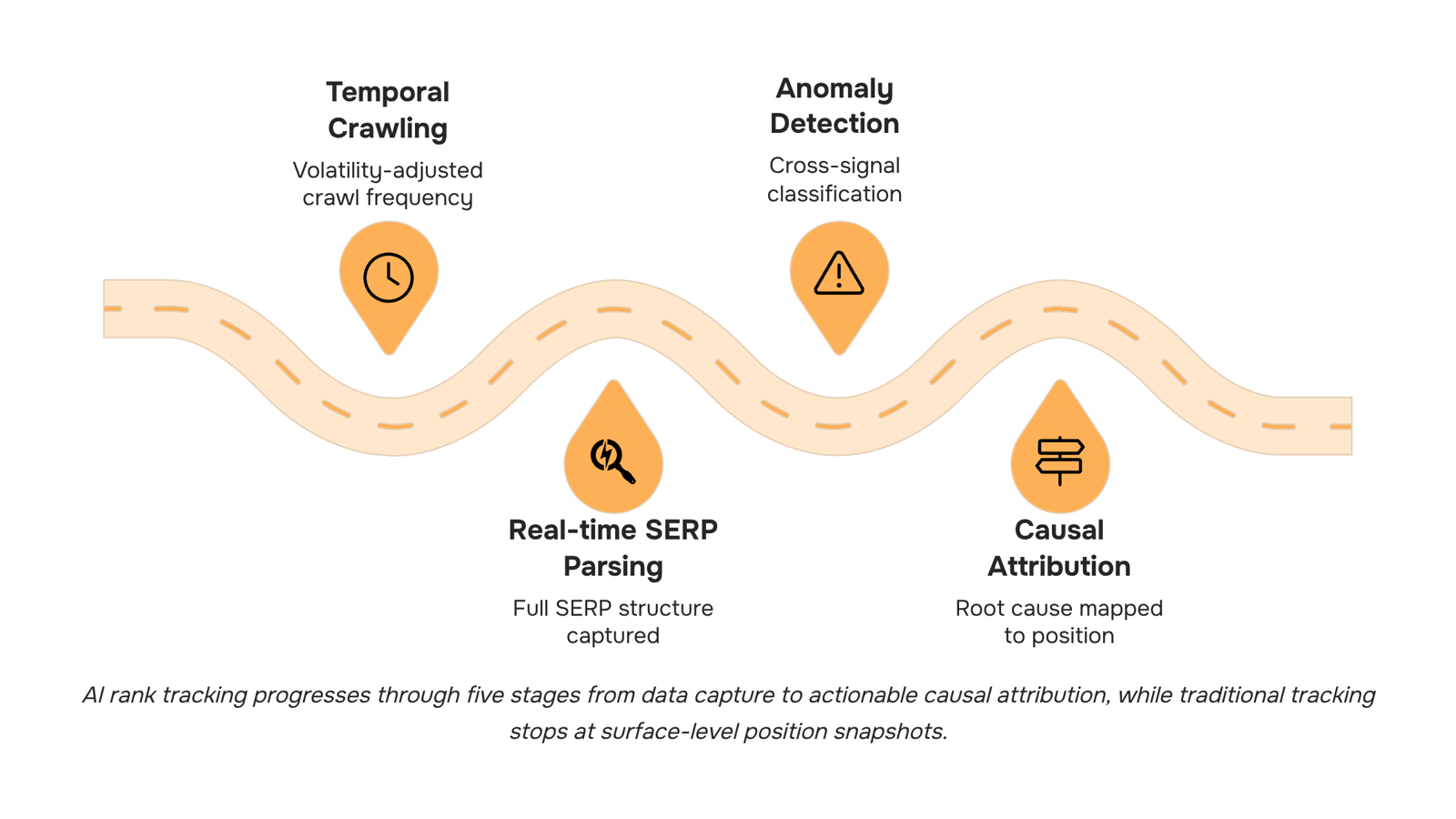
The decision matrix below shows where each approach exits the process:
Stage | Traditional tracker | AI rank tracker |
|---|
Temporal crawling | Fixed schedule | Volatility-adjusted |
SERP parsing | Position only | Full SERP structure |
Anomaly detection | Not performed | Cross-signal classification |
Causal attribution | Not performed | Probable cause mapped |
Knowledge-loop | Not performed | Feeds back into crawl model |
For a hands-on look at tools that reach stage 4 or 5, the best SEO ranking tracking software review for 2025 benchmarks several platforms against exactly these criteria.
How AI Tells an Algorithm Update Apart from a Competitor Move
The distinction matters because the response is completely different. A competitor stealing position 3 from you calls for a content refresh or a backlink campaign. A broad algorithm update hitting position 3 across your entire site calls for a structural audit. Reporting both as "ranking dropped" is useless.
AI rank trackers handle ranking volatility detection by running three checks simultaneously when a position change is logged.
First, cross-domain signal comparison: the system checks whether competing domains in the same SERP moved at similar magnitudes. If five domains all shifted within the same 48-hour window, the volatility pattern points to an algorithm event, not a targeted competitor move.
Second, competitor position deltas: if one specific competitor gained exactly what you lost, with no other SERP-wide movement, the signal pattern looks like a direct displacement. That triggers a different classification than broad volatility.
Third, historical volatility baselines: the AI compares the current change against your keyword's normal fluctuation range. A keyword that typically swings ±2 positions treating a 7-position drop as noise would be a calibration failure. Intelligent position monitoring flags that drop as anomalous even if the broader SERP looks stable.
The output isn't just "change detected." It's a classification: algorithm event, competitor displacement, or isolated anomaly. That classification is what drives the next stage of the TRACK Framework — causal attribution, which we cover in the next section.
For a practical look at how SERP change detection surfaces in a live tool, the best SEO ranking tracking software review covers how current platforms expose this signal layer.
Causal Attribution: Connecting a Position Drop to a Specific Root Cause
Anomaly detection tells you something changed. Causal attribution tells you why — and that distinction is where most rank trackers stop being useful.
The attribution logic in AI-powered SEO rank tracking pulls from at least three signal streams simultaneously: Google Search Console data (impressions, CTR, average position by query), backlink velocity from crawl logs, and on-page change history. When a position drop registers, the system cross-references the timing of each signal against the drop date. A backlink loss that precedes the drop by 48–72 hours points toward authority erosion. A crawl log showing a meta-title rewrite on the same day points toward on-page decay. GSC impressions falling without a CTR change suggests a SERP feature displaced the listing, not a content quality issue.
The key move in causal attribution SEO is separating correlation from probable cause. Two signals changing at once doesn't mean either caused the drop. A well-built attribution model weights recency, signal magnitude, and historical pattern — if this page has dropped after backlink losses twice before, that pattern raises the confidence score for the same diagnosis now.
This is also where competitor tracking data adds precision: if competing pages gained links in the same window, the attribution shifts toward relative authority, not absolute content decay.
Ranko applies this multi-signal attribution logic automatically, so your team sees a probable root cause alongside the position change — not a number that still requires manual diagnosis. For a broader look at how trackers handle this, the hands-on review of SEO ranking tracking software breaks down which tools surface causation versus which only report movement.
A predictive ranking forecast is only as reliable as the data feeding it. Single-source trackers that pull only current SERP positions are missing most of what drives a useful prediction.
The inputs that actually matter:
Historical SERP volatility — how much a keyword's positions have fluctuated over 90-plus days, which sets the baseline for what "normal movement" looks like
GSC click-through trends — declining CTR at a stable position often signals a title or meta description problem before rankings drop
Backlink acquisition rate — velocity matters more than raw count; a sudden slowdown in new referring domains is a leading indicator, not a lagging one
Content freshness signals — last-modified dates, internal link changes, and word-count drift relative to top-ranking competitors
Without all four, the model is pattern-matching on incomplete evidence. That's why rank tracking vs Semrush Ahrefs comparisons often miss the point: both tools track positions well, but neither combines these signals into a causal attribution SEO layer that explains why a position is likely to move.
For teams already exploring which AI marketing tools are best for predictive analytics and forecasting, the data-input question is the same one: garbage in, garbage out applies to forecasts more than anywhere else in SEO.
How AI Rank Tracking Connects to Content Planning and AEO
Most rank trackers stop at the position number. The gap between "you dropped from rank 4 to rank 9" and "here's what to publish next" is where traditional tools leave you.
AI-powered SEO rank tracking closes that gap by feeding position signals directly into content decisions. When intelligent position monitoring detects a cluster of keywords slipping in the 5–15 range, that's a content brief waiting to be written, not just a metric to log. When a competitor gains ground on a question-format query, that's an answer engine optimization opportunity your next article should address.
Ranko's Topic Planner uses this signal flow directly, mining real Google and AI assistant queries to generate 90-day publishing plans grounded in current SERP movement, not guesswork. The result is a closed loop: rank shifts trigger content priorities, content ships, positions respond.
For a broader look at how AI tools fit into this workflow, see what the best AI tools for content creation actually do.
Where Ranko's AI Layer Differs from Semrush and Ahrefs
Semrush and Ahrefs cover the first two stages well: they crawl SERPs on a fixed schedule and surface position changes in a dashboard. That's useful, but it stops short of explaining why a ranking moved or what to do next.
Ranko's AI layer runs all five stages of the TRACK framework. It ingests ranking signals from multiple sources simultaneously, cross-references competitor movement data, and applies causal attribution to distinguish algorithm-driven drops from content decay or backlink loss. That distinction matters because each cause requires a different fix.
The competitor tracking capability feeds directly into this loop: when a competitor gains ground on a target keyword, Ranko flags the gap and surfaces a content action, not just a position change. The multi-source data ingestion means the predictive ranking forecast draws on fresher inputs than a 7-day crawl cycle allows.
For a deeper look at how these tools compare on core features, the hands-on review of SEO ranking tracking software covers the tradeoffs directly. If you're evaluating predictive AI marketing tools more broadly, that context helps too.
Closing
Most teams are still operating with tools that stop at stage 2 — they see the position drop but not the reason behind it. The real diagnostic work happens in stages 3 through 5: anomaly detection, causal attribution, and knowledge-loop optimization. That's where you move from reacting to rank changes to predicting them. See what stages 3 through 5 look like inside Ranko by exploring the features page or starting a free trial — you'll see exactly how AI-powered rank tracking turns position data into decisions.
FAQ
How often should I track my website's rank on Google?
AI-powered trackers adjust frequency dynamically: stable keywords check every 48 hours, high-competition terms check every few hours during algorithm flux windows. Fixed schedules miss volatility spikes that matter.
Can I use rank tracking to improve my website's SEO strategy?
Yes, but only if your tracker does causal attribution. Position data alone doesn't drive strategy. Understanding whether a drop came from a competitor move, algorithm shift, or content decay tells you exactly what to fix next.
What is the importance of rank tracking in SEO?
Rank tracking separates algorithm updates from competitor moves and isolates anomalies from normal volatility. Without it, you're guessing at root causes instead of acting on signal.
How do I set up rank tracking for my website's keywords?
Start with your highest-priority commercial and informational keywords, then layer in competitor keywords. AI trackers auto-adjust monitoring frequency based on volatility, so initial setup focuses on keyword selection, not schedule tuning.
How does AI rank tracking differ from traditional scheduled rank polling?
Traditional trackers poll on fixed schedules and report position only. AI trackers adjust frequency by volatility, parse full SERP structure, detect anomalies, attribute causes, and feed insights back into crawl prioritization.
What data does an AI rank tracker need to generate accurate ranking forecasts?
Google Search Console data (impressions, CTR, average position), backlink velocity, on-page change history, competitor position deltas, and historical volatility baselines. The system cross-references timing across all streams to isolate probable causes.


 Elena Petrova11 September 2026


