TL;DR: Most guides on short term and long term objectives define the terms and stop there. This one shows IT company owners how to build objectives that actually connect, with a step-by-step process for setting both, a review cadence to keep them aligned, and the specific mistakes that cause short term wins to drift away from long term goals.
What short term and long term objectives actually mean
Short term business objectives are the specific, measurable targets your team works toward in the next 30 to 90 days. They answer the question: what needs to happen this quarter for the business to move forward? Think "close 10 new contracts by end of March" or "reduce support ticket backlog by 40% before the next sprint."
Long term business goals operate on a 1 to 3 year horizon. They define where the company is headed, not what it's doing this week. "Expand into two new markets by 2027" is a long term objective. It sets direction; it doesn't assign Monday's tasks.
The common mistake is treating these as separate lists. They're not. Short term objectives are how you make progress on long term goals, one quarter at a time. Without that connection, short term work becomes busywork and long term goals become wishful thinking.
A useful way to think about it: long term goals define the destination, short term objectives are the route. Change the route when conditions shift, but keep the destination visible.
If you're working through where medium-range planning fits between these two horizons, how medium-term plans differ from short and long-term ones is worth a read before you build your full objective stack.
Why both time horizons matter for your business
Running a business without short term objectives is like navigating with only a destination and no turn-by-turn directions. You know where you want to end up, but daily decisions have no anchor. The result is what most IT owners recognize as "busy but not moving": the team ships work, but none of it compounds toward anything.
The opposite failure is just as common. Teams that set bold three-year targets without breaking them into near-term milestones watch those targets age untouched. Ambition without traction is just a slide deck.
This is why the difference between goals and objectives matters in practice, not just in theory. Short term and long term objectives are not two separate planning exercises. They are one connected system, and a gap in either direction creates a specific, predictable problem.
For IT company owners specifically, the cost shows up in resourcing. A long term objective like "expand into enterprise accounts within two years" only moves if short term objectives, such as closing three mid-market clients this quarter, are generating the proof of concept and cash flow to support it.
Write each objective in SMART format and you make that connection explicit. The next section shows exactly how the ladder mechanism works.
How short term objectives connect to long term goals
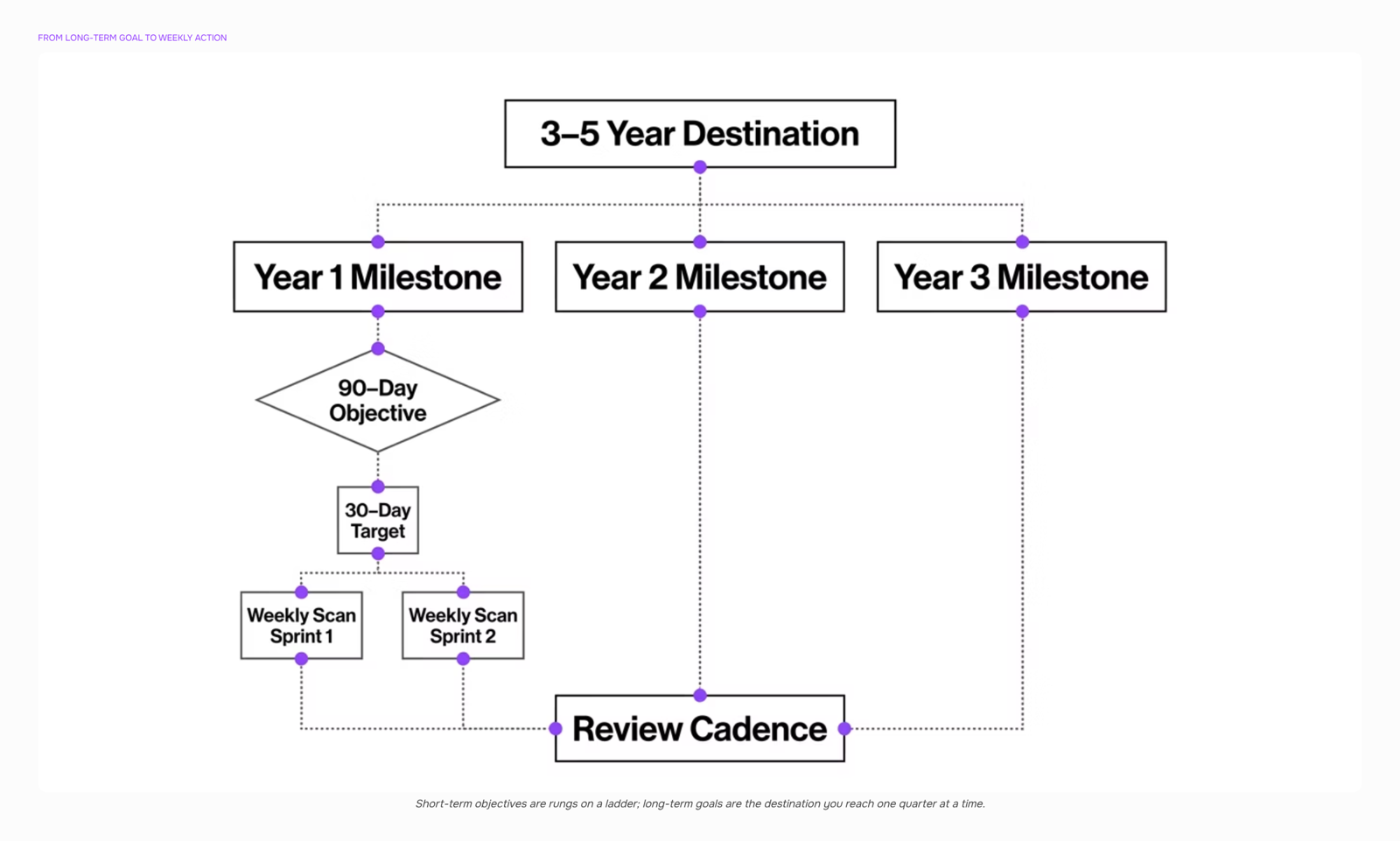
Short term objectives are the rungs; the long term goal is the top of the ladder. You cannot reach the top by staring at it. You get there by completing one rung at a time, in the right sequence.
Here is how the mechanism works in practice. Say your three-year goal is to grow managed services revenue to $2M ARR. That goal sits too far out to act on directly. So you break it into a connected chain: a 12-month target (sign 20 new MSP contracts), a 90-day target (build a repeatable sales process and close five pilots), and a 30-day target (define your service tiers and pricing). Each short term objective creates the condition the next one depends on. Miss a rung and the ladder holds, but you slow down. Skip the ladder entirely and the long term goal stays a wish.
This is the core of any working objective setting framework: long term goals define direction, short term objectives define the next move. If you are unsure the difference between goals and objectives before you start, that distinction matters here.
A medium term plan that bridges the two horizons (typically 6 to 18 months) is where most IT owners find the clearest traction, because it is close enough to act on and long enough to build something real.
6 steps to set short term and long term objectives
Setting short term and long term objectives without a clear process usually produces a list that nobody looks at after January. These six steps give you a repeatable objective setting framework you can run in a single planning session.
1. Start with the long term destination: Write one sentence describing where your IT business should be in three to five years. Keep it specific enough to be testable: "Reach $5M ARR with a 40% gross margin" beats "grow the business." This anchor is what every short term business objective will eventually trace back to.
2. Understand the difference between goals and objectives before you write anything: Goals describe direction; objectives describe measurable outcomes with deadlines. If you're unclear on the difference between goals and objectives, clarify that first. Mixing the two at this stage produces objectives that can't be tracked.
3. Break the long term goal into three to four annual milestones: Each milestone is a meaningful checkpoint on the way to year five. A managed services firm targeting $5M ARR might set year-one at $1.2M, year-two at $2.5M. These milestones become your medium term layer. If you want a medium term plan that bridges the two horizons, this is where you build it.
4. Write each short term objective in SMART format: Short term objectives typically cover 30 to 90 days. For each annual milestone, write two to three supporting objectives that are specific, measurable, achievable, relevant, and time-bound. "Sign three new managed services contracts by end of Q2" is a SMART objective. "Get more clients" is not. Use the guidance on how to write each objective in SMART format if you need a template.
5. Assign a single owner to each objective: Every objective needs one name next to it, not a team name. When ownership is shared, accountability dissolves. The owner is responsible for reporting progress, flagging blockers, and updating the status at each check-in. This step is where most how to set business objectives guides stop short.
6. Set check-in dates before you close the document: A 90-day objective needs at least two formal check-ins: one at day 30 and one at day 60. Without scheduled reviews, objectives drift. Add the dates to your calendar now, not later.
Once you have owners and dates confirmed, move everything into a shared tool so the full picture stays visible across your team. Track both sets of objectives in one place using Taro, where you can assign owners, set due dates, and monitor progress without chasing status updates over email.
The next question most owners hit at this point is how often to revisit these objectives once they're live. That cadence matters more than most planning guides admit.
How often you should review and update your objectives
Review your short term and long term objectives on three distinct cycles, each serving a different purpose.
Weekly: Scan sprint-level tasks and short term targets. You're not rewriting anything here, just checking whether this week's work is still pointed at the right outcome. If a task has no clear owner or is blocked, fix it before it drifts.
Quarterly: This is your real calibration point. Compare what you set 90 days ago against actual results. Short term objectives that consistently miss may signal a resourcing problem, not a motivation one. Adjust scope, not just deadlines.
Annually: Revisit your long term business goals with fresh market context. A goal set in January may be structurally sound but tactically wrong by December. Use this review to retire objectives that no longer serve the strategy and set new ones that do.
The cadence only works if every objective has a named owner and a visible status. A quarterly review with no shared record is just a meeting. For a practical way to measure whether your shorter cycles are feeding the longer ones, how to measure a 30-60-90 day plan covers the specific signals to track.
An objective without an owner and a due date is just a wish. The same applies whether you're setting short term business objectives for the next 90 days or mapping out a three-year growth target.
The practical fix is keeping both time horizons in one shared workspace. When sprint tasks live alongside long term targets, your team can see exactly how today's work connects to where the business is going. That visibility is what turns a planning document into an active system.
Taro handles this by linking sprint-level tasks directly to higher-level objectives. Each task carries an owner, a deadline, and a status your whole team can see. When something slips, it shows up before it becomes a missed quarter.
If you want to track both sets of objectives in one place, start by mapping each short term objective to a long term target, then write each objective in SMART format so progress is measurable from day one.
Closing
Short term and long term objectives only work when they're wired together—your long term destination stays fixed, but your quarterly moves are what actually get you there. The six-step framework above gives you the process; the harder part is keeping both layers visible and connected as conditions shift. Most IT owners build the objectives once, file them away, and wonder why the team drifts. The ones who win treat their objective stack as a living system, reviewed on a cadence, owned by real people, and tracked in one place where daily work connects back to it. Once you've mapped out your objectives using the framework above, the next move is getting them into a tool where your team can see them, own them, and move them forward together. Taro's project management feature is built exactly for this—it's where your short term and long term objectives live side by side, so every sprint connects to the bigger picture. Explore Taro's project management feature and see how to run the system you just built.
FAQ
What is the difference between short term and long term objectives?
Short term objectives are specific targets for the next 30–90 days that answer what needs to happen this quarter. Long term objectives operate on a 1–3 year horizon and define where the company is headed. Short term objectives are the rungs; long term goals are the destination.
How do short term objectives contribute to long term goals?
Short term objectives are how you make progress on long term goals, one quarter at a time. Each near-term win creates the condition the next objective depends on, forming a connected chain from today's actions to your three-year destination.
Can I achieve long term success without setting short term objectives?
No. Long term goals without short term objectives remain wishful thinking. Without quarterly milestones and assigned owners, teams become busy but don't compound progress toward anything meaningful.
How often should I review and update my short term and long term objectives?
A 90-day objective needs at least two formal check-ins: one at day 30 and one at day 60. Without scheduled reviews, objectives drift. Add review dates to your calendar before you close the planning session.
How do I set short term and long term objectives for my business?
Use the six-step framework: start with your long term destination, break it into annual milestones, write each short term objective in SMART format, assign a single owner to each, and set check-in dates before you close the document. Move everything into a shared tool so progress stays visible.


 Elena Petrova15 September 2026


