TL;DR: Most EVA guides hand you the formulas and leave you to figure out the rest. This one walks IT project managers through all five steps, explains what the numbers actually mean for your next decision, and covers what to do when the data looks bad. You'll also see how the right work management tool removes the manual data collection that makes EVA painful in practice.
What earned value analysis actually means
Earned value analysis is a method for measuring project health by combining schedule progress and cost data into a single, comparable signal. Instead of tracking time and budget separately and hoping they tell a consistent story, EVA gives you one integrated view.
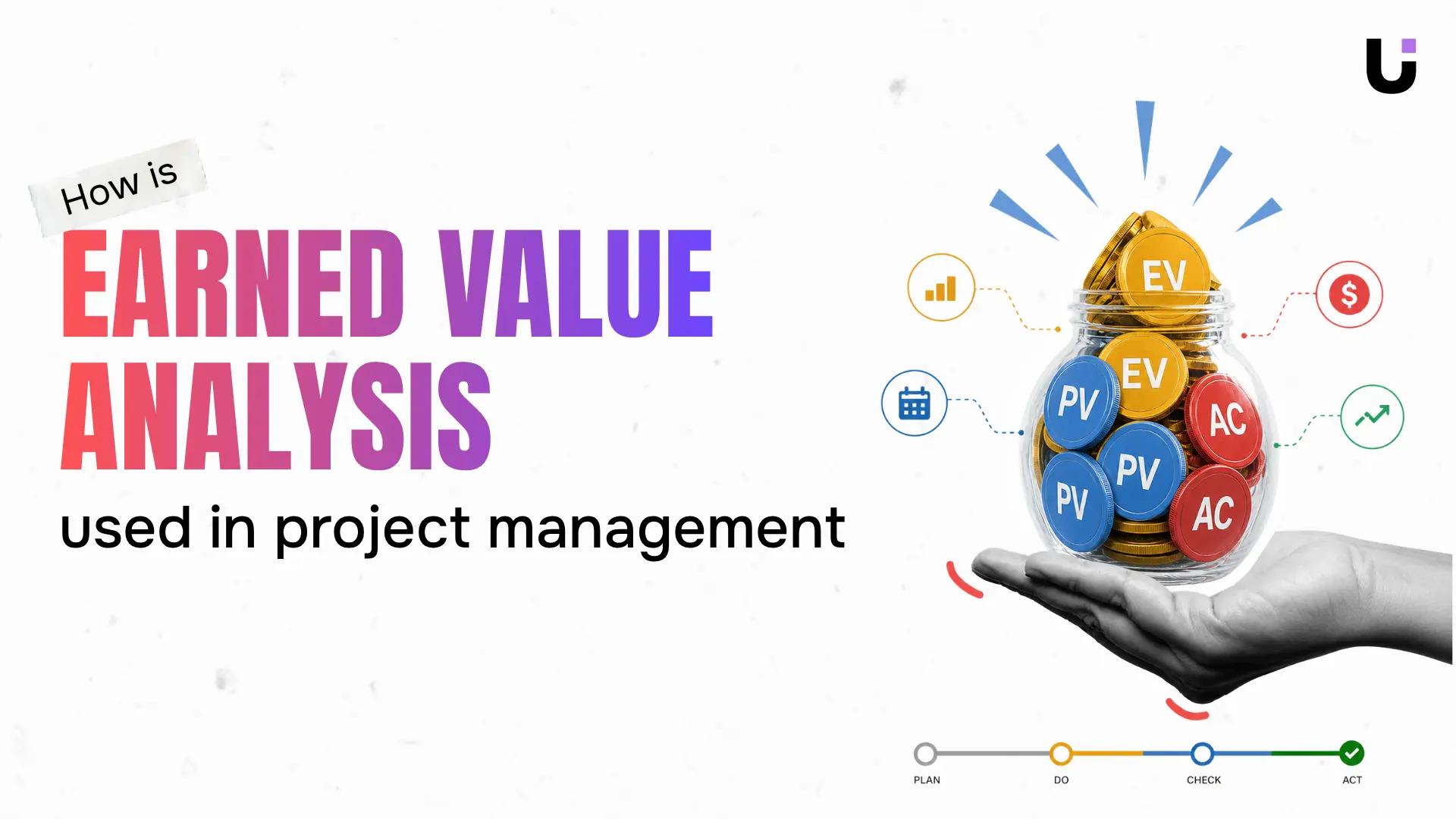
The method runs on three inputs. Planned Value (PV) is the budgeted cost of work you planned to complete by a given date. Earned Value (EV) is the budgeted cost of work you've actually finished. Actual Cost (AC) is what you've spent to do that work. Each number means little alone. Together, they let you calculate whether your project is ahead or behind on both dimensions at once.
That's the core reason earned value analysis in project management exists: it replaces two separate status conversations with one honest number. A Cost Performance Index (CPI) of 0.85, for example, means you're getting $0.85 of completed work for every dollar spent. You don't need to interpret a spreadsheet to know that trajectory needs attention.
The method also predicts your project's actual completion date based on current performance, not original assumptions. That distinction matters when a client asks for a revised forecast and "we're working on it" isn't a credible answer.
If you want to set a budget baseline and track it in one place, that's where the practical value of EVA becomes concrete.
Why EVA matters for IT project teams
Most IT projects don't fail because the team stopped working. They fail because nobody noticed the drift until it was too late to recover.
EVA gives you an early warning system. A CPI below 1.0 in week three means your budget is eroding now, not at final delivery. Catching that early lets you cut scope, add resources, or reset stakeholder expectations while you still have options. Wait until month five, and all three levers are gone.
That early signal also changes how you defend scope decisions. When a stakeholder asks why a feature got cut, "we're tracking at 0.85 CPI" is a different conversation than "we're a bit over budget." Numbers close arguments that opinions keep open.
Forecasting works the same way. EVA predicts your project's actual completion date from real performance data, not from the original plan you built before the first sprint revealed what the work actually costs. Stakeholders get a credible number; you stop defending gut estimates.
For teams running EVA in agile project management, the same logic applies sprint by sprint. Each sprint's planned value becomes a checkpoint. SPI below 1.0 two sprints in a row is a pattern, not a blip.
A tool that lets you set a budget baseline and track it in one place removes the manual data collection that makes EVA feel expensive to maintain.
How to calculate earned value in 5 steps
Use a $100,000 software rollout as the running example throughout these steps. It keeps the math grounded and shows how each formula connects to the next.
Step 1: Set your Budget at Completion (BAC)
BAC is the total approved budget for the project. Every EVA formula you'll use later traces back to this number. For the rollout, BAC = $100,000.
Step 2: Define Planned Value (PV) per period
PV is the portion of the budget you planned to spend by a specific point in time. If the project is 12 months long and spending is linear, PV at month 6 = $50,000. In practice, weight PV to match your actual schedule: front-loaded projects will show higher PV in early periods.
Step 3: Measure work completed as a percentage
This is where most teams stumble. You need an honest percentage of work actually done, not hours logged. Use a completion method your team agrees on before the project starts: 0/100 (task is either done or not), 50/50 (half credit at start, half at finish), or weighted milestones. For the rollout, say the team has finished 45% of planned deliverables by month 6.
Step 4: Calculate Earned Value (EV) and Actual Cost (AC)
EV measures the value of work done by multiplying the completion percentage by BAC.
EV = 0.45 × $100,000 = $45,000
AC is simply what you've spent so far. Pull this from your accounting system or time-tracking tool. For the rollout, AC = $52,000.
Step 5: Compute CPI and SPI
These two ratios are the signal, not just the summary.
Cost Performance Index (CPI) = EV ÷ AC = $45,000 ÷ $52,000 = 0.87
A CPI below 1.0 means you're getting less than a dollar of work for every dollar spent. At 0.87, the project is delivering about 87 cents of value per dollar. If that trend holds, your Estimate at Completion (EAC = BAC ÷ CPI) rises to roughly $115,000, not $100,000.
Schedule Performance Index (SPI) = EV ÷ PV = $45,000 ÷ $50,000 = 0.90
SPI below 1.0 means work is behind schedule. At 0.90, the team has completed 90% of what was planned. A tool that predicts your project's actual completion date can translate that SPI into a revised end date automatically.
Both indexes update every reporting period. That's what makes earned value analysis in project management useful for how to calculate earned value accurately over time: a single snapshot is interesting, but the trend across periods tells you whether the project is recovering or drifting further off course.
Earned value vs. actual cost: what the difference tells you
Earned value (EV) measures the budgeted cost of work you've actually completed. Actual cost (AC) measures the money you've spent completing it. Those two numbers sound like they should match, but they rarely do, and the gap between them is where your project's real financial story lives.
The formula is simple: Cost Variance (CV) = EV minus AC. A positive CV means you completed more work than the money you spent would predict. A negative CV means the opposite, and that's the number that should trigger a budget conversation, not a line item on an invoice.
Here's a concrete example. Say your project has a $100,000 budget. Halfway through, you've spent $55,000 (AC) but only completed work worth $45,000 (EV). Your CV is -$10,000. Your CPI is 0.82, meaning you're getting 82 cents of value for every dollar spent. If that ratio holds, a tool that predicts your project's actual completion date will show a final cost well above your original baseline.
The distinction matters because AC alone tells you nothing about progress. You could be $10,000 over budget because the team worked ahead of schedule, or because a task took twice as long as planned. EV separates those two scenarios. Without it, you're reacting to spend, not managing work.
How to use EVA in agile project management
Agile teams often assume earned value analysis belongs to waterfall projects with fixed schedules and detailed Gantt charts. It doesn't have to. The adaptation is straightforward once you redefine what counts as planned value.
In a sprint-based workflow, treat each sprint's committed story points as your Planned Value (PV). When a sprint closes, the story points from accepted, done-done work become your Earned Value (EV). Actual Cost (AC) is whatever you spent on labor and tooling during that sprint. The same Cost Performance Index formula applies: EV ÷ AC. A CPI below 1.0 after two consecutive sprints is a concrete signal to revisit scope or resourcing before the problem compounds.
The fit isn't perfect everywhere. Story points measure relative effort, not dollar value, so your EV figures are proxies rather than hard financials. That's acceptable for velocity tracking and trend analysis. Where it breaks down is when you need a dollar-accurate Estimate at Completion (EAC) for a board-level budget conversation. In that case, map story points to average hourly cost per point before running the EAC formula.
The bigger practical problem is re-calculation frequency. Sprints close every one to two weeks, which means your PV, EV, and AC figures need updating on the same cadence. Manual spreadsheet updates between sprints introduce lag and calculation errors that distort your CPI trend. A tool that flags stalled workflows and velocity drops before they hit your CPI removes that lag entirely.
PMI's own research acknowledges that a simplified EV approach can help determine an agile project's true status and detect early signs of trouble, which confirms the method is worth the adaptation effort.
Common EVA mistakes that skew your numbers
Three mistakes show up repeatedly when teams try to use earned value analysis in practice.
Setting an unrealistic baseline is the most damaging. If your planned value schedule is optimistic from day one, every CPI and SPI reading that follows is measuring against fiction. Fix it by building your baseline from historical velocity data, not aspirational estimates.
Measuring percent complete by gut feel rather than by finished deliverables is the second. "About 70% done" means something different to every person on the team. Tie completion to binary criteria: a task is done when it meets its acceptance condition, not when someone feels good about it. That discipline is what makes learning how to calculate earned value actually useful.
Ignoring scope changes is the third. Every approved change that adds or removes work invalidates the original BAC. Update it immediately, or your variance numbers will set a budget baseline and track it in one place rather than reflect reality.
EVA is only as good as the data behind it. If task completion is estimated by gut feel and actual costs are pulled from a spreadsheet updated weekly, your CPI is measuring noise.
Taro captures planned vs. actual work automatically as your team logs tasks and time, so the numbers feeding your EVA reflect what's actually happening. It predicts your project's actual completion date using real completion data, and flags stalled workflows and velocity drops before they hit your CPI. You can also set a budget baseline and track it in one place, which removes the manual reconciliation step that makes earned value analysis in project management so time-consuming in practice.
Closing
Earned value analysis only works when the underlying data is clean, current, and actually reflects what's happening on the ground. Most teams skip it not because the math is hard, but because pulling together planned value, actual cost, and earned value from three different spreadsheets every sprint is genuinely tedious. By the time the numbers are ready, the window to act on them has already closed.
The five-step process here gives you the framework. But the framework needs a foundation. If your team is still stitching together progress data manually, you're adding hours of prep work before the analysis even starts.
Lio's project management features handle that data layer for you, tracking completion and cost in one place so you can run EVA in minutes, not an afternoon. If you want to see how it works with your actual projects, the free trial is worth the 10 minutes it takes to set up.
FAQ
Q1. How is earned value analysis used in project management?
A. Earned value analysis compares how much work you planned to complete, how much you actually completed, and what you spent, giving you a single, numbers-based view of whether a project is on track.
Q2. How do I calculate earned value in project management?
A. Multiply your total project budget by the percentage of work actually completed. If a $100,000 project is 40% done, your earned value is $40,000, regardless of how much you've spent.
Q3. What is the difference between earned value and actual cost?
A. Earned value is the budgeted cost of work you've actually completed; actual cost is what you've spent to complete it. When actual cost exceeds earned value, you're over budget.
Q4. What are the benefits of using earned value analysis in project tracking?
A. EVA gives you a single number, the Cost Performance Index, that tells you whether you're over budget before the damage compounds. You catch schedule and cost drift early, not at the post-mortem.
Q5. Can earned value analysis be used in agile project management?
A. Yes, but with adjustments. Traditional EVA assumes fixed scope, so agile teams typically apply it at the epic or sprint-batch level rather than individual sprints, where scope shifts too frequently for the numbers to stay meaningful.
Q6. What does a CPI below 1.0 mean for my project?
A. A CPI below 1.0 means you're spending more than planned for the work completed, a CPI of 0.85, for example, means every $1 of planned work is costing you $1.18.
Q7. How often should you run an earned value analysis?
A. Most teams run it weekly on active projects, monthly is too slow to catch schedule slippage before it compounds. High-stakes projects often warrant twice-weekly checks during critical phases.


 Elena Petrova15 September 2026


