TL;DR: Most sales prospecting tool roundups hand you a feature list and leave the matching to you. This one maps each tool category to the specific pipeline bottleneck behind it — slow lead response, unqualified contacts, stalled follow-up — so IT company owners can pick based on the gap they're actually trying to close, not a checklist someone else built.
Sales prospecting tools handle the work that happens before a lead reaches your CRM: finding contacts, capturing intent signals, and filtering out the ones who will never buy. The tool choice that matters is not the one with the most features — it is the one that fixes where your pipeline actually breaks.
Most IT company owners have the same gap. Leads come in from multiple sources, nothing qualifies them automatically, and the sales team spends time chasing contacts that were never a fit. Lead capture and qualification tools solve a different problem than outreach automation does. Treating them as interchangeable is why most tool evaluations fail.
The functional job of any sales prospecting tool for lead generation is narrow: reduce the time between a lead appearing and a qualified conversation starting. Research consistently shows that response time within the first five minutes of contact dramatically increases conversion — and most small B2B teams miss that window manually.
Before you evaluate any tool, map it to a stage. Does your pipeline break at capture, at enrichment, at follow-up, or at routing? The answer tells you which category to buy first. Prospecting tools mapped to specific pipeline gaps covers that framework in detail — it is the decision logic most roundups skip entirely.
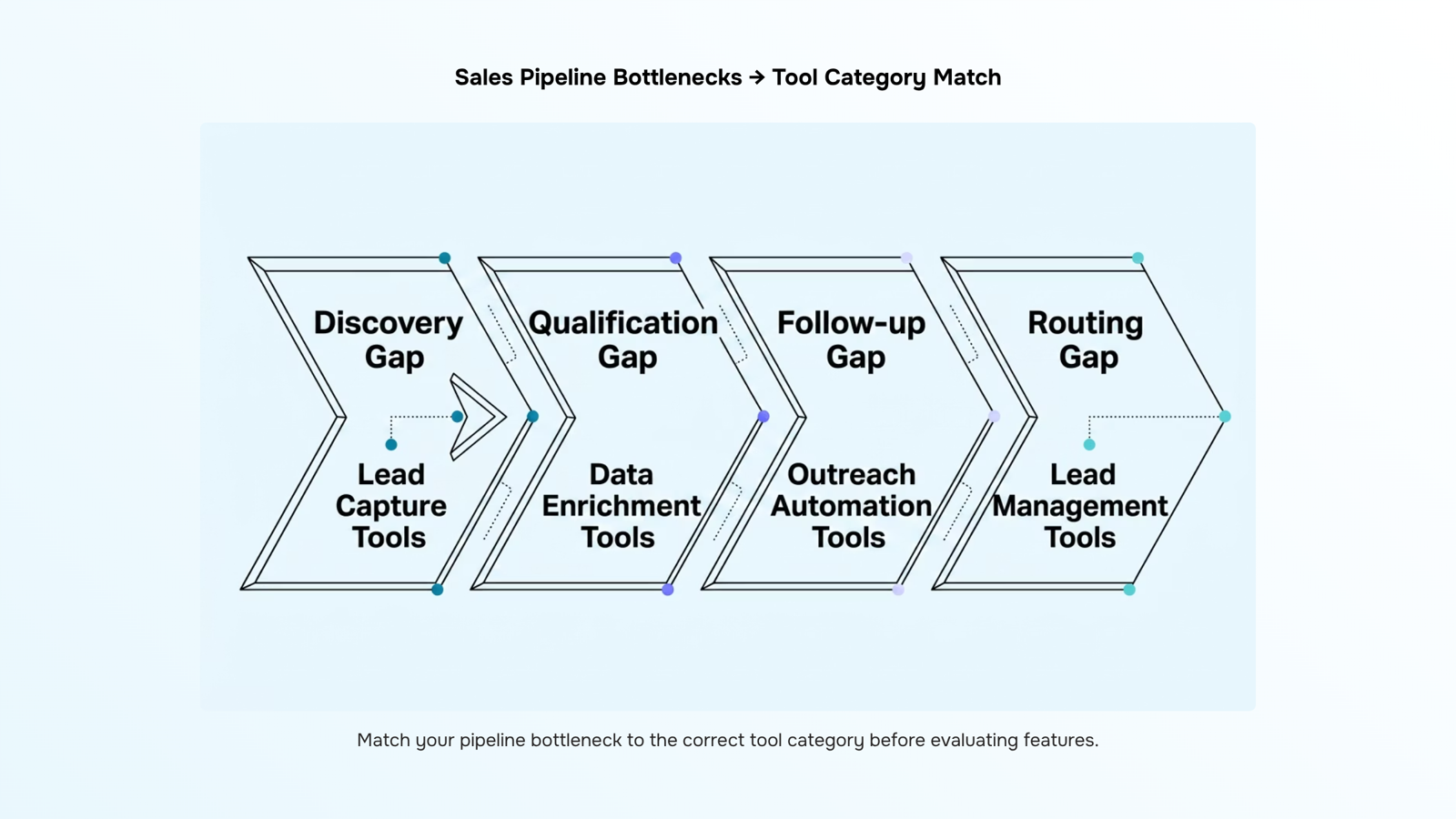
The four categories below map directly to pipeline failure points. Pick the one that matches where your pipeline actually breaks — not the one with the most features.
Lead capture tools solve the "we're losing visitors before they ever reach sales" problem. Forms, chatbots, and intent-tracking scripts collect contact data from web traffic, ad clicks, and content downloads. If your team is manually copying leads from a landing page into a spreadsheet, this is your bottleneck. For prospecting tools mapped to specific pipeline gaps, the capture layer is where most small IT businesses leak the most.
Data enrichment tools solve the "we have a name and email but nothing else" problem. They pull company size, tech stack, job title, and buying signals from sources like LinkedIn, Clearbit, or Apollo — so your reps aren't walking into a call blind. LinkedIn lead enrichment is the most common use case here, especially for IT companies selling to other businesses where the decision-maker's role matters more than their industry.
Outreach automation tools solve the "follow-up falls through the cracks" problem. Sequences, cadences, and triggered emails keep prospects moving without a rep manually tracking every thread. Teams that automate lead generation at this stage typically see faster response rates — research consistently shows that leads contacted within five minutes of showing intent convert at significantly higher rates than those reached hours later.
Lead management tools solve the "we captured it but lost it before it closed" problem. Routing rules, scoring, and pipeline views make sure every qualified lead reaches the right rep at the right time. For a deeper look at how scoring and routing work after capture, lead management tools that handle qualification after capture covers the mechanics in detail.
Most teams need two of these four, not all four. The best sales prospecting tools for small businesses are the ones that fix the stage where deals actually die.
Features That Actually Matter in Prospecting Software
Most prospecting software feature lists read like a spec sheet. They tell you a tool "integrates with your CRM" and "supports custom fields," which tells you nothing about whether it will actually move leads through your pipeline.
Here is what to look for instead.
Multi-source lead capture is the first real filter. A tool that only pulls from one directory or form submission will miss leads coming in through LinkedIn, chatbots, or third-party enrichment APIs. Look for tools that consolidate sources into a single intake queue, so no lead sits unrouted because it came in through an unexpected channel. If you want to see how prospecting tools map to specific pipeline gaps, that framing helps clarify which capture method you actually need.
LinkedIn lead enrichment closes the data gap between a name and a workable contact record. When a lead comes in with only an email address, enrichment pulls job title, company size, industry, and seniority from LinkedIn profile data, so your team can qualify before the first call rather than during it. This is the core value of LinkedIn lead enrichment as a feature, not a nice-to-have.
Routing rules determine whether the right rep gets the lead within minutes or whether it sits in a shared inbox for three days. Effective routing logic should handle territory, deal size, rep availability, and lead score simultaneously. For sales tools built for small business team sizes, routing often matters more than enrichment because small teams cannot afford to chase misassigned leads.
Qualification scoring built into the tool, rather than applied manually downstream, is what separates lead capture and qualification tools from basic form handlers. If scoring requires a separate spreadsheet or a manual review step, the feature is not actually in the tool.
These four capabilities, taken together, cover the majority of what makes sales prospecting software features worth paying for.
Yes, but only when three conditions are met: the tool receives clean input data, routes leads to the right rep immediately, and triggers a follow-up sequence without waiting for a human to remember.
When those conditions exist, the results are measurable. Sales prospecting tools for lead generation that include automated routing cut average response time from hours to under five minutes. That gap matters because B2B leads contacted within five minutes are significantly more likely to convert than those reached after 30 minutes, according to InsideSales research.
The failure modes are just as predictable. A tool pulling from a stale contact list produces fast outreach to the wrong people. A tool with no routing logic dumps every inbound lead into a shared inbox where ownership is unclear and follow-up is inconsistent. A tool that captures leads but has no sequence attached relies entirely on a rep's memory, which is not a system.
The mechanism that actually moves conversion rates is automated lead follow-up. When a prospect fills out a form or clicks a pricing page, a triggered sequence that responds in under two minutes outperforms manual follow-up by a wide margin. Most lead management tools that handle qualification after capture now include this natively.
For sales tools built around small business team sizes, the question is not whether to automate lead generation, but which stage to automate first: capture, qualification, or follow-up.
Picking the right tool comes down to where your pipeline breaks, not which product has the longest feature list. Here are five tools worth evaluating, grouped by the problem they solve.
Tool | Best for | Team size | Key trade-off |
|---|
HubSpot CRM (free tier) | Inbound lead capture + contact tracking | 1–15 reps | Powerful, but form-based capture misses outbound intent signals |
Apollo.io | Outbound prospecting + email sequencing | 5–50 reps | Rich contact database, but deliverability drops without domain warm-up |
LinkedIn Sales Navigator | Account-based targeting + buyer intent | 10+ reps | Strong signal quality, weak native automation — needs a sequencing layer |
Clearbit | Lead enrichment + firmographic scoring | Any | Enriches existing leads well; not a capture tool on its own |
Lio | Automated lead capture, scoring, and routing | 3–30 reps | Built specifically to remove the qualification-to-routing gap that stalls small IT sales teams |
A few things to know before you commit to any of these.
Apollo and Sales Navigator are strong for outbound-heavy teams, but they require someone to manage sequences and monitor reply rates. If your team is under ten people, that overhead adds up fast. HubSpot's free tier handles inbound well and integrates with most stacks, but it won't automate lead qualification or route leads to the right rep without manual setup or a paid upgrade.
Clearbit is best used as a layer on top of your capture tool, not a standalone. It fills in company size, industry, and tech stack data so your scoring model works with real inputs rather than guesses.
Lio sits in a different category. It handles the full capture-to-routing workflow in one place, which matters most when you're trying to automate lead generation without hiring a RevOps specialist to wire everything together. For IT company owners evaluating the best sales prospecting tools for small businesses, that operational simplicity is often the deciding factor.
The sales prospecting software features that matter most aren't the flashiest ones. They're the ones that remove the manual steps between "lead arrives" and "rep follows up."
Before you evaluate any specific tool, identify where your pipeline actually breaks down.
If qualified leads are entering your CRM but going cold, your bottleneck is follow-up speed, not discovery. If you're generating contacts but can't tell which ones are worth calling, the gap is qualification. If your team is manually researching prospects for hours before a single outreach goes out, the problem is data enrichment. Each of these maps to a different tool category, and buying the wrong one just adds a subscription without fixing the leak.
Once you've named the bottleneck, match it:
Discovery gap: lead capture and qualification tools that surface intent signals (form submissions, site visits, ad clicks)
Qualification gap: scoring and enrichment tools that append firmographic data and rank contacts automatically
Follow-up gap: sequence automation that triggers outreach within minutes, not hours
The third step is validation. Pick one metric before the trial starts. For most small IT businesses evaluating the best sales prospecting tools for small businesses, that metric is either contact rate or qualified meetings booked in 30 days. If the tool moves that number, keep it. If it doesn't, the category was probably right but the tool wasn't.
What are the best prospecting tools for sales teams covers this category breakdown in more depth if you want to cross-reference before committing to a trial.
Closing
The prospecting tool that works is the one that fixes where your pipeline actually breaks — not the one with the longest feature list. Map your bottleneck first: are leads getting lost at capture, enrichment, follow-up, or routing? Once you know the stage, the tool choice becomes obvious. Start by asking your team where they spend the most time on manual work that a tool could automate. That is your starting point.
FAQ
What are the best sales prospecting tools for small businesses?
The best tool depends on your specific bottleneck, not your company size. Most small IT teams need either a lead capture tool with routing, or an outreach automation tool with enrichment. Pick based on where deals actually die in your pipeline, not on feature count.
How do I choose the right sales prospecting tool for my team?
Map the stage where your pipeline breaks: capture, enrichment, follow-up, or routing. Then evaluate tools in that category. A tool that fixes the wrong problem will sit unused, no matter how well-designed it is.
What features should I look for in sales prospecting software for lead generation?
Prioritize multi-source lead capture, LinkedIn enrichment, automatic routing rules, and built-in qualification scoring. These four capabilities cover most of what actually moves leads through your pipeline. Everything else is secondary.
Can sales prospecting tools really improve my lead generation results?
Yes, when three conditions are met: clean input data, immediate routing to the right rep, and automated follow-up sequences. Response time within five minutes of lead intent is the mechanism that drives conversion gains.
What are the top sales prospecting tools for automating lead generation?
The top tools vary by category: capture, enrichment, outreach, and lead management. Rather than a ranked list, identify which stage your pipeline breaks at first, then evaluate tools within that category against the four core features that matter.
Do I need a separate prospecting tool if I already have a CRM?
Most CRMs handle pipeline management poorly but capture and qualification even worse. A prospecting tool handles the work before a lead reaches your CRM. You likely need both, unless your CRM has native lead capture and routing built in.


 Elena Petrova11 September 2026


