TL;DR: Most advice on managing time constraints hands you a prioritization tip and calls it a system. This one gives IT company owners a repeatable framework: how to identify constraints early, sequence work under pressure, keep teams aligned without daily standups, and maintain workload visibility across multiple projects. The steps are specific enough to wire up this week.
What Are Time Constraints and Why Do They Stack Up?
A time constraint is a fixed boundary on when work must be delivered. In project management, it's one leg of the triple constraints model, alongside scope and cost. When any one leg shifts, the others absorb the pressure. That's straightforward on a single project. Across multiple projects, the math gets worse fast.
Here's why they stack: each project carries its own deadline, but your team shares the same hours, the same people, and the same attention. A delay on Project A pulls a developer off Project B. That slip pushes Project B's delivery, which then strains the budget on Project C. Scope, time, and cost interact across your active projects in ways that are easy to miss until a client is already waiting.
For IT company owners trying to manage multiple projects simultaneously, the compounding effect is the real problem, not any single deadline. Context-switching between projects also fragments focus in ways that erode delivery quality, not just speed.
The next step is identifying which type of constraint is actually driving the pressure in your specific situation. Client SLAs, sprint cadences, resource bottlenecks, and scope creep each create different kinds of time constraints and each needs a different response. Choosing the right prioritization method starts with knowing which constraint you're actually fighting.
What Are the Most Common Time Constraints in Business?
Four constraint types show up repeatedly across IT project portfolios, and most owners are dealing with more than one at the same time.
Client SLAs set hard external deadlines that don't flex. Miss one and you're in a contract conversation, not a project conversation. These are the constraints that create the most downstream pressure because every internal schedule gets built around them.
Sprint and release deadlines are internal, but they carry real weight. When three active projects share the same two-week sprint cycle, any slip in one project pulls developer attention away from the others. That's where time constraints in business stop being a scheduling problem and start becoming a capacity problem.
Resource bottlenecks are the constraint most owners underestimate. One senior engineer, one QA lead, or one DevOps specialist shared across four projects creates a single point of failure. You can see how workload is distributed across your team in real time to catch this before it collapses a deadline.
Scope creep is the constraint that hides the longest. A client adds two features mid-sprint. The timeline stays the same. The work doesn't. Understanding how scope, time, and cost interact across your active projects makes it easier to name the trade-off clearly when a stakeholder requests a change.
Identifying which constraint is actually driving pressure matters because the fix for an SLA problem looks nothing like the fix for scope creep. The next section covers choosing the right prioritization method for your team once you've named the constraint type.
How Do You Prioritize Tasks When Time Constraints Are Severe?
When everything is urgent at once, "prioritize tasks" becomes meaningless advice without a system behind it. Here is a logic you can apply in under 30 minutes.
Start with dependency sequencing, not urgency: Before scoring tasks by impact or effort, map which tasks block others. A delayed environment setup blocks three developers. A missing client sign-off blocks billing. Unblocking those items first creates forward movement across multiple threads simultaneously, which is what task prioritization under pressure actually requires.
Once blockers are cleared, run a two-axis impact-effort sort:
High impact, low effort: do these today, no debate
High impact, high effort: schedule a dedicated block, assign a single owner
Low impact, low effort: batch these or delegate
Low impact, high effort: cut them or defer to next sprint
This takes about 15 minutes with a shared spreadsheet or a whiteboard photo in Slack. The goal is not a perfect matrix. The goal is a shared view your team can act on without asking you what to do next.
The third filter is constraint type: If you read the previous section, you identified whether you are dealing with a client SLA, a resource bottleneck, or scope creep. Each one changes what "high impact" means. A task that protects an SLA outranks a task that improves internal tooling, even if the internal work scores higher on effort alone. Aligning project prioritization to the actual constraint type stops teams from optimizing the wrong thing.
For day-to-day application, How to Prioritize Daily Tasks for Maximum Productivity walks through a repeatable daily triage that fits inside this same logic.
One rule to hold: no task stays "urgent" for more than 48 hours without a decision. Either it gets scheduled, delegated, or explicitly deferred. Ambiguity under time constraints costs more than a wrong call.
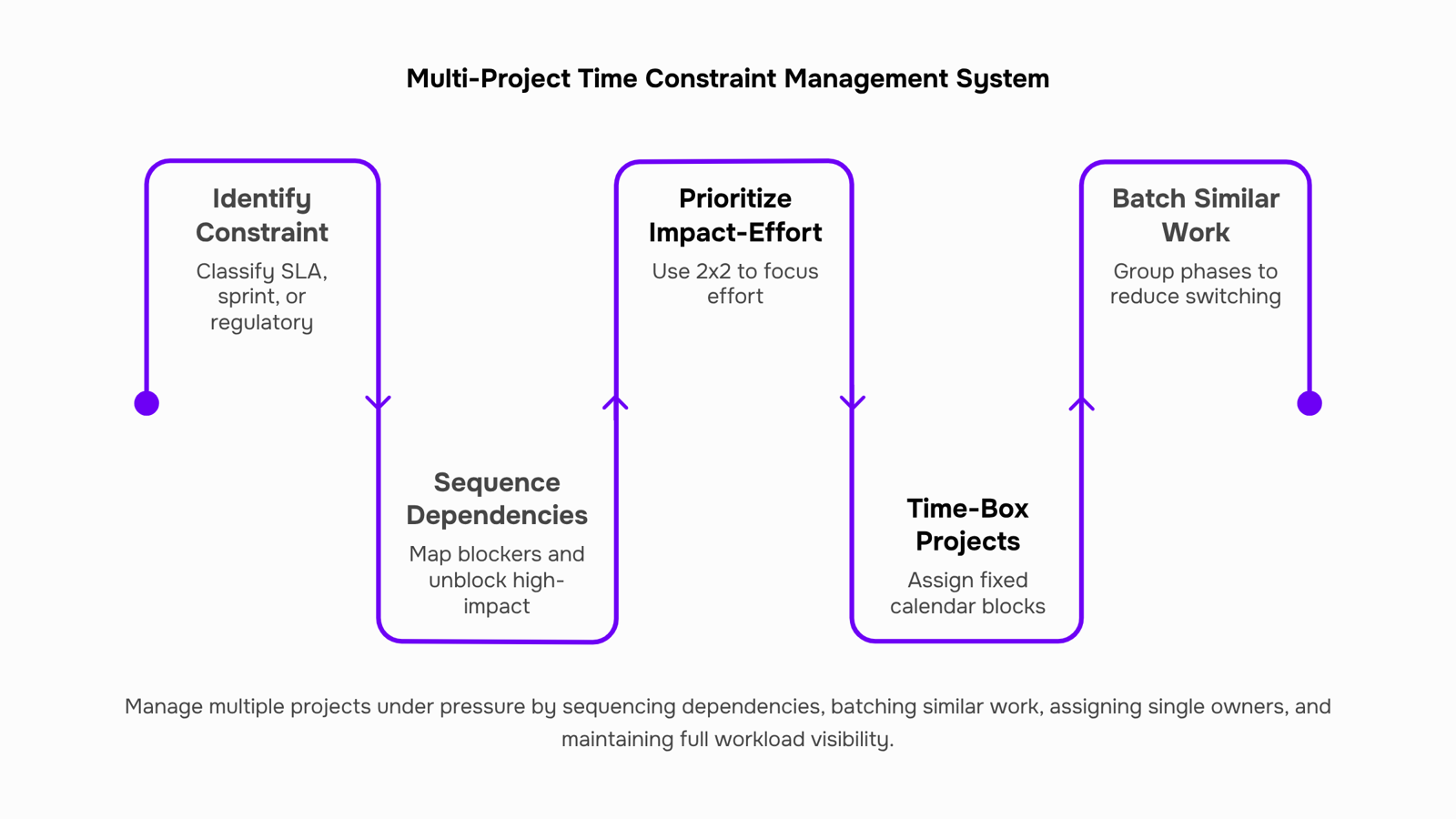
What Strategies Actually Work for Managing Multiple Projects Under Pressure?
Time-boxing, sprint batching, single-owner accountability, and workload visibility are not four separate ideas. They are four layers of the same system, and they only work when you run them in sequence.
Time-boxing is the starting point. Assign each project a fixed block of calendar time — not a task list, a block. A two-hour window for Project A on Tuesday morning means that project gets two hours of focused output, regardless of what else is pulling at your attention. The block is the commitment. Everything outside it waits.
Sprint batching builds on that. Instead of spreading work across all active projects every day, group similar work phases together. If three clients are waiting on technical audits, run all three audits in the same sprint window. Context-switching between projects is one of the biggest drains on output for anyone managing multiple projects at once — batching similar work cuts the ramp-up cost each time you shift focus.
Single-owner accountability removes the most common cause of delays under time constraints: shared ownership. When two people are both "responsible" for a deliverable, neither one is. Assign one person per project milestone. That person coordinates, escalates, and closes. Everyone else contributes, but one name owns the outcome.
Workload visibility is what holds the other three together. You cannot time-box accurately or batch intelligently if you do not know what your team is actually carrying. A simple workload distribution view — even a shared spreadsheet with names, active projects, and weekly hours committed — surfaces overloads before they become missed deadlines. For IT owners running four or more concurrent engagements, this visibility is the difference between catching a capacity problem on Monday and discovering it on the day a deliverable is due.
Run these four in order: block the time, batch the phases, name the owner, and make the load visible. Each step removes a different failure mode. Together, they give you a repeatable system for project time tracking that holds up even when the calendar is full and every client thinks their deadline is the only one that matters.
How Do You Communicate Time Constraints to Your Team and Stakeholders?
Most constraint conflicts don't fail at execution — they fail at the conversation that never happened.
When you're managing multiple projects under real time constraints, the gap between what your team knows and what your clients assume is where deadlines quietly collapse. Closing that gap requires a communication protocol, not a reminder to "keep stakeholders updated."
Internally, flag capacity before it becomes a crisis: When a new request lands, run it against your current workload before committing. If accepting it compresses another deadline, say so in writing — a one-line Slack message counts. "Taking on Project C means Project B ships Friday instead of Wednesday. Confirming this trade-off with you." That sentence prevents a surprise three days later. You can see how workload is distributed across your team in real time before you make the call.
With clients, name the constraint explicitly: Don't soften it into vague availability language. "We have capacity for X by [date], but adding Y to this sprint pushes the delivery to [new date]" is clearer and more trustworthy than "we'll do our best." Clients can work with a concrete date. They can't plan around "soon."
Document every constraint decision: When a deadline shifts, write down why — scope added, resource pulled, dependency delayed. A one-paragraph decision log in your project tool gives everyone a shared record. Understanding how scope, time, and cost interact across your active projects makes those trade-offs easier to explain to stakeholders without relitigating the whole project history.
The goal isn't perfect communication — it's no surprises.
How Do You Track Progress and Adjust When Constraints Change?
Tracking progress across multiple projects isn't just about knowing what's done — it's about catching when your original constraint assumptions no longer match reality.
Start with project time tracking at the task level, not just the project level. When you log hours against specific deliverables, you can see within a few days whether a task is running 20% over estimate. That signal is early enough to act on. Waiting for a status meeting at week three is not.
When constraints shift — a client expands scope, a developer goes on leave, a dependency slips — your response needs data, not instinct. Pull a simple report: planned hours vs. actual, by project and by person. If one project is consuming 40% more time than budgeted, that cost is coming from somewhere else in your portfolio. How scope, time, and cost interact across your active projects explains why that tradeoff is rarely obvious until you measure it.
To manage multiple projects without constant firefighting, build a weekly review into your process:
Compare milestone status against the original schedule
Check workload distribution — flag anyone carrying more than their planned capacity
Identify which projects are at risk of constraint breach and document the reason
Adjust priorities using a consistent method, not whoever shouted loudest that week
See how workload is distributed across your team in real time so reallocation decisions are grounded in actual availability.
Milestone tracking in Prax gives you this view without building it manually — progress against plan, per project, updated as work moves.
The goal is a system where time constraints surface as data points, not surprises.
Closing
The framework works only if you can see it in action. Time-boxing, sprint batching, single-owner accountability, and workload visibility are useless as separate ideas. They collapse the moment you lose sight of who is carrying what, where the real bottlenecks are, and whether a constraint conflict is about to blow a deadline. If your team is scattered across email, spreadsheets, and Slack threads, you're already flying blind. The question to ask yourself this week is simple: can you see, in one place, what your team is actually carrying across all active projects right now?
FAQ
How can I manage multiple projects with tight time constraints?
Use time-boxing, sprint batching, single-owner accountability, and workload visibility in sequence. Block calendar time per project, batch similar work phases, assign one owner per milestone, and track team capacity in one shared view to catch overloads before deadlines slip.
What are the most common time constraints in business and how can I overcome them?
Client SLAs, sprint deadlines, resource bottlenecks, and scope creep are the main four. Identify which constraint is actually driving pressure, then apply the right fix: protect SLAs first, sequence blockers before urgency, flag shared resources early, and name scope changes as trade-offs, not additions.
How do I prioritize tasks when faced with severe time constraints?
Start with dependency sequencing to unblock others, then use impact-effort scoring, then filter by constraint type. High-impact, low-effort work goes first. No task stays urgent longer than 48 hours without a decision to schedule, delegate, or defer.
What strategies can I use to work effectively under time constraints?
Time-box project blocks on your calendar, batch similar work phases to cut context-switching costs, assign single owners per milestone to eliminate shared accountability, and maintain workload visibility across your team to surface capacity problems before they become missed deadlines.
How can I communicate time constraints to my team and stakeholders?
Name the constraint type explicitly—SLA, bottleneck, or scope creep—so the team understands what's actually driving pressure. Use a shared workload view to show capacity limits, and frame trade-offs clearly when scope or timelines shift.
How do the triple constraints of project management affect my deadlines?
Scope, time, and cost are interconnected. When one shifts, the others absorb pressure. Across multiple projects sharing the same team, a slip on one deadline pulls resources from another, compounding delays. Understanding this interaction helps you name trade-offs before stakeholders discover them.


 Elena Petrova15 September 2026


